Laver seaweed and other organisms encode ubiquitin and cytochrome c as a single protein chain
Why it matters
Cytochrome c helps cells get energy from food. Several distantly related organisms, including laver seaweed, carry the instructions for this protein joined to those for ubiquitin, a protein often added later as a tag. The first building block of cytochrome c purified from laver matches the one predicted if the cell cuts off ubiquitin.
Cytochrome c carries electrons between two protein complexes during mitochondrial respiration. To understand how a cell makes this carrier, it helps to know where its sequence begins in the gene. Sequencing the mature protein can identify its first amino acid, but any stretch removed before the carrier takes its final form is lost to that measurement.
Genomes from four classes of red algae and from two single-celled organisms in other groups, the glaucophyte Cyanophora paradoxa and the cryptist Goniomonas avonlea, encode cytochrome c directly after the small protein ubiquitin. In all 24 assemblies of the red alga Galdieria and laver seaweeds where we found this join (16 Galdieria, eight laver), the fused gene was the only detectable nuclear source of the carrier. Individual RNA fragments show that cells transcribe the two parts together in red algae, the glaucophyte and the cryptist. In the laver Porphyra umbilicalis, cutting the encoded chain just after ubiquitin would expose alanine at the position expected from measurements on the purified carrier.
Where ubiquitin and cytochrome c share a gene
Cells commonly attach ubiquitin to proteins after making them. They can also make ubiquitin and another protein as a single chain, called a precursor. In such precursors, cutting the chain just after the two glycines at the end of ubiquitin releases the second protein. Examples include ribosomal proteins and, in diatoms, nickel superoxide dismutase. Our literature search found no prior description of respiratory cytochrome c in such a precursor, including in the Galdieria and Porphyra genome reports or a survey of algal ubiquitin fusions.
We searched 5,158,251 predicted proteins from 196 datasets in EukProt, a collection of protein sequences inferred from eukaryotic genomes and transcripts. In 757 sequences, at least 45 amino acids followed the last recognizable ubiquitin unit ending in two glycines. Ten of these extensions most closely resembled cytochrome c. They came from seven datasets: one based on a genome and six on assembled RNA transcripts (Table 1).
Table 1. The seven EukProt datasets with a predicted ubiquitin–cytochrome c join. Sequences use the one-letter amino acid code. Each join contains the same final six residues of ubiquitin, LRLRGG, followed by the ten residues shown. The last column counts distinct shorter sequences related to the carrier in the same dataset; zero means none met the search threshold. Individual records.
| EukProt | Organism | Group | Sequence after LRLRGG | Other carrier |
|---|---|---|---|---|
| EP00167 | Galdieria sulphuraria | Red alga, Cyanidiophyceae | AIPEGDPTRG | 0 |
| EP00168 | Porphyra purpurea | Red alga, Bangiophyceae | GGNADKGAKI (3 records) | 1 |
| EP00179 | Madagascaria erythrocladioides | Red alga, Compsopogonophyceae | GEDGNVDKGA | 1 |
| EP00189 | Rhodosorus marinus | Red alga, Stylonematophyceae | GDLAKGEKLF, GDGDLAKGEK | 0 |
| EP00276 | Gloeochaete wittrockiana | Glaucophyte | IPAGNVATGE | 1 |
| EP00295 | Goniomonas pacifica | Cryptist | GKPEPDVTVP | 0 |
| EP00297 | Palpitomonas bilix | Cryptist | AGDAGDFADA | 0 |
To look for the join in DNA, we searched ten genomes for the carrier and examined the sequence preceding it (Table 2). Four genomes encoded the join. Five encoded a recognizable carrier with no detectable join; one yielded no recognizable carrier. Both forms can occur in one genome. In Cyanophora paradoxa, a second carrier gene sits on a separate stretch of assembled DNA with no detectable ubiquitin sequence upstream.
Table 2. Search for cytochrome c and an upstream ubiquitin sequence in ten genomes. “No” means the search found a carrier but no join. The last column counts sequenced RNA fragments containing the join, with separate counts for independently sequenced RNA samples (libraries). A dash means no library was tested. Genomic alignments, junction sequences and RNA counts by library.
| Species | Group | Genomic join | RNA fragments with join |
|---|---|---|---|
| Rhodosorus marinus | Red alga, Stylonematophyceae | Yes | — |
| Porphyridium purpureum | Red alga, Porphyridiophyceae | Yes | — |
| Chondrus crispus | Red alga, Florideophyceae | No | — |
| Cyanophora paradoxa | Glaucophyte | Yes | 5 and 82 (two libraries) |
| Goniomonas avonlea | Cryptist | Yes | 52 |
| Guillardia theta | Cryptist | No | — |
| Rhodomonas lacustris | Cryptist | No | — |
| Storeatula major | Cryptist | No | — |
| Cryptomonas baltica | Cryptist | No | — |
| Cryptomonas borealis | Cryptist | Unresolved | — |
In Rhodosorus marinus, DNA encodes GDLAKGEKLF after ubiquitin, matching one of the two transcript sequences in Table 1. Porphyridium purpureum encodes the entire precursor in one uninterrupted reading frame. In C. paradoxa and G. avonlea, ubiquitin leads directly into IPAGDAAKGE and SKPEPDVEVP, respectively. Both carriers contain the characteristic sequence that binds heme, the iron-containing group that carries the electron. In both genomes the DNA sequence is continuous across the join, even where the predicted protein sequence is uncertain elsewhere, as at the beginning of ubiquitin in Cyanophora. These genomes support the arrangement suggested by transcripts from their relatives Gloeochaete wittrockiana and Goniomonas pacifica. For Madagascaria erythrocladioides and Palpitomonas bilix, the evidence comes only from transcripts.
Starting the search with the carrier revealed why the ubiquitin search missed G. avonlea and C. paradoxa. Their EukProt records contain the same joins as their genomes, but only 37 and 70 residues, respectively, precede the carrier. A search allowing partial ubiquitin sequences found four further candidates in transcripts from Cryptomonas curvata, Rhodelphis marinus and two members of the centrohelid group, Acanthocystis and Choanocystis. The centrohelid records have only 28 and 18 residues before the carrier. None of the four records establishes a complete precursor in its source organism.
The carrier gene in Galdieria and laver
We examined 36 genomes from two groups of red algae: laver seaweeds and the cyanidialean algae, which include Galdieria. Each assembly yielded one detectable carrier locus, the stretch of DNA encoding cytochrome c. All eight laver assemblies and 16 of 17 Galdieria assemblies encoded the end of ubiquitin in the same reading frame as the beginning of cytochrome c (Table 3).
Table 3. Carrier loci found by searching for cytochrome c independently of ubiquitin. The last column gives the first four amino acids after ubiquitin. Counts include strains and repeat assemblies. Per-assembly results.
| Genome label | Assemblies searched | With join | Carrier start after ubiquitin |
|---|---|---|---|
| Galdieria | 17 | 16 | AIPE |
| Porphyra | 3 | 3 | AGNK, GGNS |
| Pyropia | 5 | 5 | GGNS |
| Cyanidioschyzon | 5 | 0 | — |
| Cyanidiococcus | 3 | 0 | — |
| Cyanidium, excluding the locus below | 2 | 0 | — |
| Cyanidium label, Galdieria-like locus | 1 | 1 | AIPE |
In 14 Galdieria assemblies, removing the intervening sequences called introns, as occurs during RNA splicing, gives a complete 184-residue precursor: 76 residues of ubiquitin followed by 108 of cytochrome c. These assemblies include G. partita, G. sulphuraria, G. phlegrea, G. mesoamericana and G. yellowstonensis. Two other assemblies establish continuity across the join but give incomplete precursor sequences. In the remaining G. sulphuraria assembly (GCA_019693475.1), the 1,139-base stretch of assembled DNA ends inside the carrier region. Only one base lies upstream of the carrier alignment, leaving the join unobservable.
Close relatives of Galdieria encode the carrier on its own. The reference cytochromes from Cyanidioschyzon merolae, Cyanidiococcus sp. and Cyanidium caldarium are each 110 residues long and lack ubiquitin (protein records BAM80328.1, BHE84622.1 and BHE91533.1, respectively). One assembly labeled C. caldarium contains the fusion, but resembles G. yellowstonensis well beyond the gene. Eight of nine flanking 1,000-base segments match across their full length at ≥99% identity. This locus gives no convincing evidence for the fusion in another lineage.
The predicted structures of both parts of the G. partita and G. yellowstonensis precursors resemble those of the separate proteins. The carrier fits human cytochrome c within 0.5 angstroms (Å) across its 104 residues, and the ubiquitin portion fits ubiquitin within 1.7 Å across 76 residues. The models place residues more reliably within each part than across the two: the median predicted error in relative position is 2 Å within each part and 17–18 Å between them. The orientation of the parts relative to one another is therefore uncertain.
In laver, the first carrier residue varies. Porphyra umbilicalis and Porphyra linearis encode alanine immediately after ubiquitin. In Porphyra dioica, Pyropia haitanensis, Pyropia yezoensis and Pyropia vietnamensis, the carrier begins with two glycines, giving four glycines in a row at the predicted boundary.
One laver RNA dataset, from Porphyra purpurea, contains a second, shorter transcript. Its carrier shares only 68% identity over 102 aligned residues with the fused carrier, so the difference extends beyond the missing ubiquitin. Its closest EukProt matches outside P. purpurea were two records from another organism, Syssomonas multiformis (87% identity over 102 residues). Without DNA from P. purpurea, similarity in this conserved protein leaves both contamination and a second carrier gene plausible.
RNA evidence for a shared transcript
A sequence that crosses the ubiquitin–carrier join can also occur in genomic DNA. If the same fragment crosses a site where an intron has been removed, it identifies a spliced RNA transcript carrying the join. In G. partita and Pyropia haitanensis, introns interrupt ubiquitin after codons 6 and 69. Only seven ubiquitin codons separate the latter splice from cytochrome c, close enough for one sequencing read to cover both sites. Across the 36 laver and cyanidialean assemblies, all 22 detectable introns between the conserved ubiquitin sequences at codon 69 occurred in carrier loci. In G. partita, 193 fragments contained a read crossing both splice and join, with matches in all 12 libraries examined. In Pyropia haitanensis, 5, 8 and 14 fragments did so in three libraries from different projects.
In G. avonlea and C. paradoxa, the informative splice lies within the carrier. Of 52 G. avonlea RNA fragments containing the join, 18 also crossed the first carrier splice. In C. paradoxa, one library had 49-base single reads, too short to span both sites. In a library sequenced from both ends of each fragment, 31 of 82 fragments containing the join also crossed the splice. Of these, 20 contained the entire 112-base spliced interval in one read.
In P. umbilicalis, RNA also supplies the beginning of ubiquitin missing from the deposited protein sequence. That sequence starts at residue 7, only 411 bases from the upstream end of the assembled DNA. All 411 bases align to the final 411 bases of the corresponding 422-base intron in P. linearis, with 396 identical bases. The assembled DNA thus ends where the related gene is still inside its intron. We selected RNA fragments whose paired reads covered both the missing six codons and the distant carrier join, without specifying the sequence of the six codons. Of 16 pairs, 15 supplied the ubiquitin beginning MQIFVK and one supplied MQIFDK (Figure 1).
Where the purified laver carrier begins
In P. umbilicalis, the last six residues of ubiquitin, LRLRGG, lead directly into AGNK. Cutting after ubiquitin would therefore leave alanine as the first residue of cytochrome c. In a 1974 study of purified seaweed cytochrome c, Meatyard measured a free alanine at the beginning (the N-terminus) of the laver protein. A 1975 abstract reporting automated protein sequencing describes a one-residue extension relative to animal cytochrome c. Counting from the alanine after ubiquitin gives that offset: the first heme-binding cysteine is residue 15 rather than 14 (Figure 1).
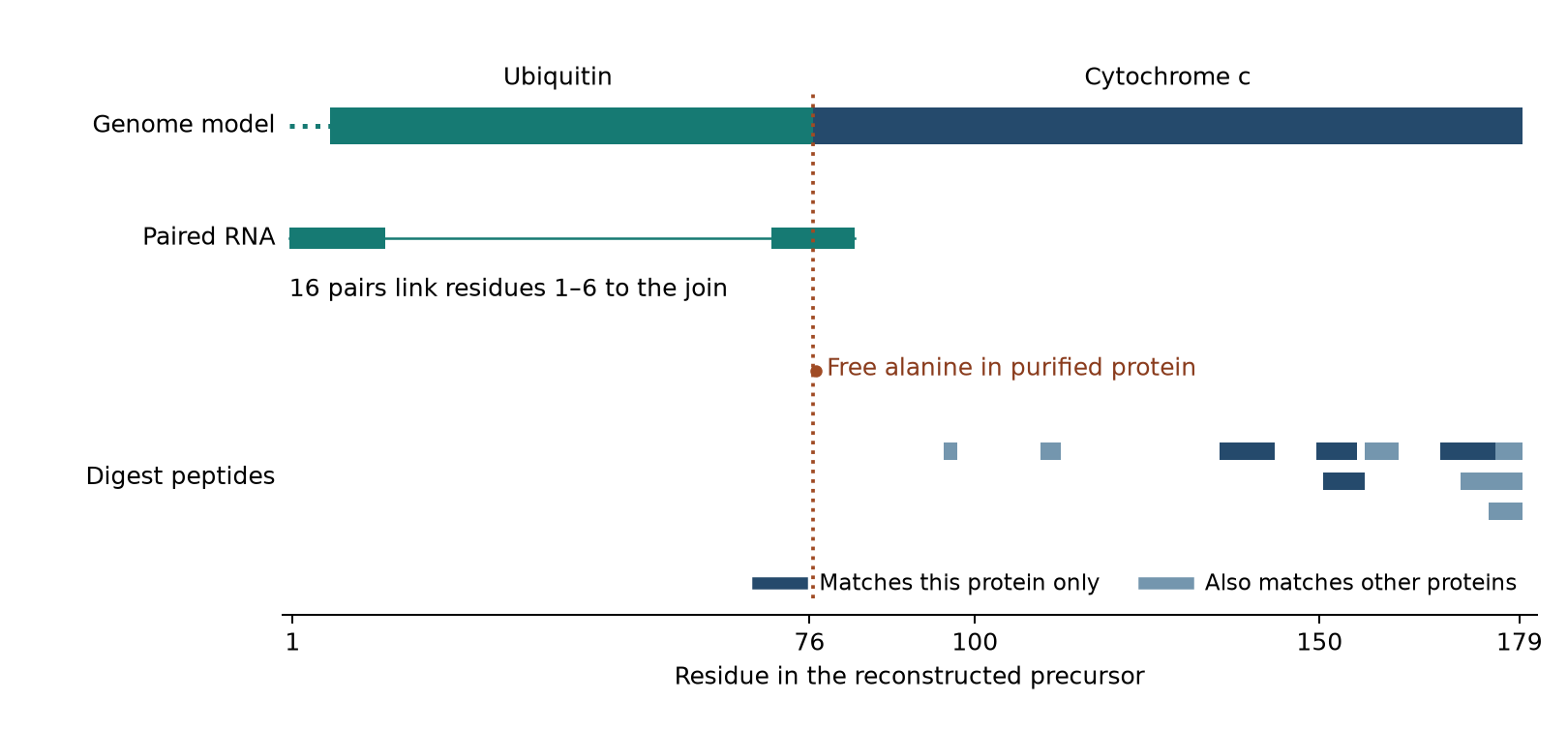
Figure 1. Evidence along the reconstructed 179-residue P. umbilicalis precursor. The dotted portion marks the six residues missing from the genome model. The green blocks show the minimum sequences required on the same RNA fragment; the intervening bases need not appear in either read. The alanine marker shows where the free first residue would fall after removal of ubiquitin. Each bar below it marks a matching peptide obtained by cutting the purified protein into fragments. Four additional peptide sequences had no exact match to the predicted carrier.
Peptides from the purified protein tie it to the carrier gene more specifically than alanine alone. Eleven of 15 published peptide sequences match the carrier, including GATA at its end. Four match only this protein among the 13,567 annotated P. umbilicalis proteins; two of those four overlap. This distinguishes the sequence within the set of proteins from P. umbilicalis, but the P. linearis carrier has the identical sequence.
Of the four peptides without exact matches, the one labeled C6 differs from LINPKKY at one position: leucine in place of isoleucine, counting the ambiguous identification Asx (aspartate or asparagine) as a match for asparagine. Peptide C2 differs from GRRSGTV at two positions. The other two peptides each require at least three substitutions. A separate, low-yield fragment tentatively assigned to the beginning read Ala–Asx–(Pro)–Asx (alanine, Asx, tentative proline, Asx), inconsistent with AGNK. The preparation gave two bands when separated by electrophoresis.
A comparison with dulse (Palmaria palmata) shows how the same free alanine can have a different origin. The first 22 measured residues of purified dulse cytochrome c match one site in the dulse genome. Its initial alanine immediately follows methionine, with a stop codon in the same reading frame only 13 codons upstream of the alanine. In laver, glycine precedes the alanine, so removing an initiating methionine from this reading frame cannot expose it. The free alanine and the reported one-residue extension support cleavage just after ubiquitin in laver.
The genome survey establishes where the fusion occurs among recognizable carriers in assembled DNA. Its distribution cannot distinguish inheritance followed by loss from later acquisition. For laver, the full 1975 sequence was unavailable for a residue-by-residue comparison; a sequence beginning AGNKDKGAKIF in the purified carrier would directly confirm the predicted start. The protein measurements leave the cleavage enzyme and the timing of mitochondrial import unknown.
Methods
Protein sequence searches
We used DIAMOND, a protein sequence search program, to compare human ubiquitin with the EukProt version 3 Comparative Set. We retained matches with an expectation value (E, the number of matches of similar quality expected by chance) ≤ 0.001. We aligned residues 3–72 of ubiquitin locally and retained final ubiquitin units with at least 50 identical core positions and two terminal glycines. We compared their extensions with Swiss-Prot, a curated protein sequence database, at E ≤ 10⁻⁶. To find shorter relatives of the carrier, we retained alignments spanning at least 80 residues of the carrier search sequence at ≥45% identity. To allow for partial ubiquitin sequences, we also looked in these hits for LRLRGG ending within 30 residues upstream of the first aligned carrier position.
Genome searches and structure comparisons
From GenBank, a public sequence archive, we used eight assemblies of Bangiales (the laver group), 28 assemblies from the four cyanidialean genera in Table 3 and ten representatives of the wider groups in Table 2. We selected these genomes to test for presence rather than estimate prevalence. Using TBLASTN, which compares a protein sequence with translations of genomic DNA, we searched with the carrier portions of both the G. partita and P. umbilicalis precursors (E ≤ 10⁻⁵). We then used miniprot, which aligns proteins to DNA across introns, to align the full G. partita precursor in windows extending 10 kilobases to either side. In the wider panel we also translated unspliced DNA across each proposed join, requiring the final six ubiquitin residues and the first ten carrier residues in one frame. For the structural comparison we used predicted precursor models A0A9C7Q4F0 and A0AAV9IHN9 from version 6 of the AlphaFold Protein Structure Database. We fitted each part separately to the corresponding reference structure (chain A of Protein Data Bank entry 1UBQ for ubiquitin and of 3ZOO for cytochrome c), superposing the backbone alpha carbon atoms at all sequence-aligned positions.
Intron searches
To compare splice sites across genomes, we searched both DNA strands for codons encoding the conserved ubiquitin sequences KESTLHL and VLRLRGG. We allowed the sequences to be adjacent or separated by a candidate intron of up to 5 kilobases beginning with GT and ending with AG. The counts apply to ubiquitins with those conserved sequences. To determine where the P. umbilicalis assembly ends, we locally aligned the upstream DNA to the P. linearis intron after codon 6, scoring matches +2, mismatches −3, gap opening −5 and gap extension −1.
RNA searches
We searched for exact sequences on either strand in public RNA reads. We counted each sequencing spot (one fragment sequenced from one or both ends) once per test, even if both reads matched. For C. paradoxa (library accessions SRR7549423 and SRR8306028) and G. avonlea (SRR7601946), we examined the first 500,000 spots per library. We required exact matches to two sequences on the same fragment. One spanned the ubiquitin–carrier join with 18 bases on each side. The other spanned the splice, with 18 bases from each of the two retained RNA segments (exons) flanking the first predicted carrier intron. Neither sequence spanning the splice occurs contiguously on either strand of the corresponding genome assembly. For a continuous single-read match we required both sequences and all intervening bases.
For G. partita, we searched for a 108-base sequence spanning splice and join in the first 200,000 spots per library (DRR337142–153). For Pyropia haitanensis, we searched for a 65-base sequence spanning the two sites in the first 500,000 spots per library (SRR623025, SRR2006653, SRR5558481). For P. umbilicalis, we examined the first 1.5 million spots in each of four libraries (SRR8052634, SRR8052635, SRR8052666 and SRR8052667). We required an exact 36-base sequence centered on the join and, on the same fragment, the first 24 annotated bases with at least 18 readable bases immediately upstream.
Purified protein comparisons
We matched the peptides Meatyard obtained by cutting the purified carrier with the enzymes chymotrypsin and trypsin (1974, Tables 13–14) to every protein in P. umbilicalis assembly GCA_002049455.2. Where the reported residue could be aspartate or asparagine, or glutamate or glutamine, we allowed either member of the pair. At the ambiguous sequencing step in peptide C2 we allowed glycine, aspartate or asparagine. For each nonmatching peptide, we compared every segment of the same length in the carrier and reported the smallest number of substitutions required. We tested the proposed acidic N-terminal fragment separately. For dulse, reported under its former name Rhodymenia palmata, we searched both genomic strands for every codon combination encoding the 22-residue beginning measured in Meatyard's Figure 17, then translated the preceding DNA.