Repeating a 20-vertex pattern raises the share of five-vertex sets that form chains to 9.4501%
Why it matters
How often can five points in a large network form a chain with no extra links between them? Repeating a network built from triples of six symbols raises the attainable share from 9.374% to 9.450%. Adding either of the two missing points to the earlier design makes that share fall; only adding both with the right links makes it rise.
How often can five vertices chosen at random from a large graph form a chain? The five must be connected in order, with no extra edge between them. Adding an edge to a graph can complete one chain while spoiling another, and the highest possible fraction of such sets in the large-graph limit is unknown. We give a construction in which the fraction tends to 720/7619 (9.4501%), up from 1968/20995 (9.3737%). It repeats a pattern of 20 vertices in place of the 18 used in the earlier construction. Adding either of the two new vertices alone lowers the limiting fraction. Adding both, with exactly the connections described below, is the only way to improve it by extending the earlier graph by two vertices under the same repetition rule.
The 20-vertex pattern
The chain is called an induced five-vertex path, or P_5. Its inducibility is the limit, as graph size grows, of the largest possible fraction of five-vertex sets that form such a path. A sequence of growing graphs that achieves a particular limiting fraction gives a lower bound on inducibility. Even-Zohar and Linial (Table 2) obtained the earlier bound by repeating an 18-vertex graph at successively finer scales. The 20-vertex pattern closes 44% of the gap from their bound to their numerical upper estimate of 0.095475179. Bodnár and Pikhurko (§6) list the path among the five-vertex graphs whose inducibility is still unknown.
Take all 20 triples of the symbols 1 through 6. Treat each triple as a vertex and join two vertices when their triples share two symbols. The resulting graph is called the Johnson graph J(6,3). To see the earlier pattern inside it, set aside the vertices A=123 and B=456, writing each triple without braces. These triples are complements: each contains precisely the symbols missing from the other. A neighbor of A replaces one of its symbols with one from B. Its nine neighbors therefore fit on a three-by-three board, with a row for the removed symbol and a column for the added symbol. Call these the plus vertices. Place the complement of each plus triple in the same cell on a second board. These minus vertices are the nine neighbors of B (Figure 1).
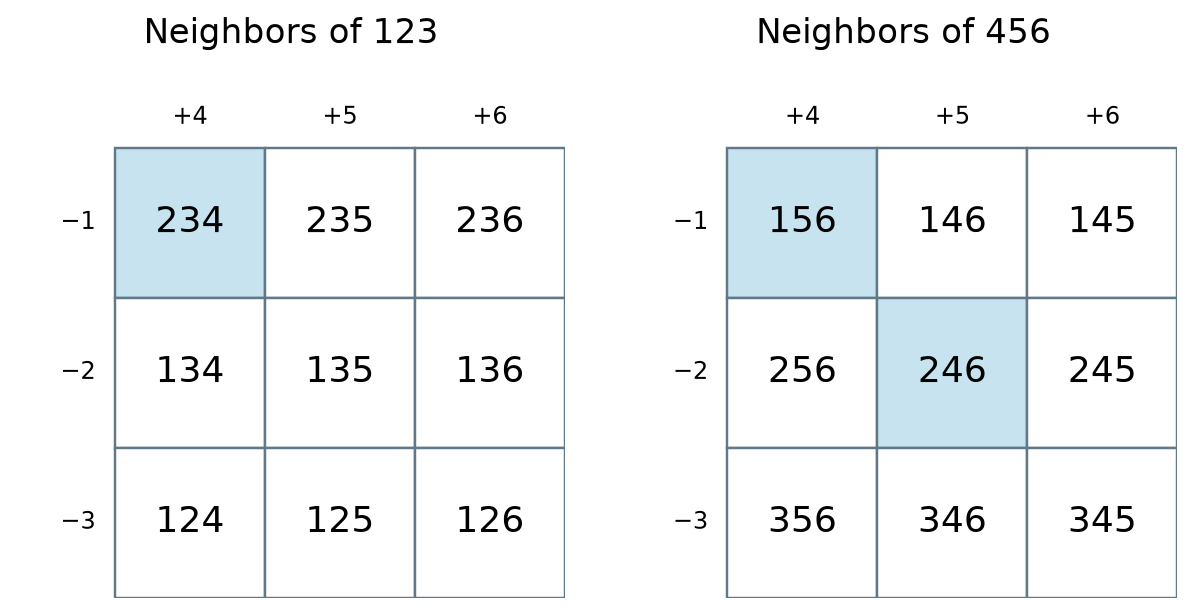
Figure 1. Row and column labels specify which symbol to remove from 123 and which to add. The left board shows the resulting triple; the right shows its complement in the same cell. The shaded entries give a path through both restored vertices: 123,234,246,456,156.
On the same board, distinct vertices are joined when they share a row or column. On opposite boards, they are joined when they differ in both row and column. To compare these rules with the published construction, consider the pattern Even-Zohar and Linial counted. It was the house, the graph obtained from a five-vertex path by exchanging edges and nonedges. Exchanging edges and nonedges throughout their 18-vertex graph thus gives one path for every house they counted.
The two boards together give exactly this graph, called the complement of the published graph. In Even-Zohar and Linial's product construction, each vertex has three coordinates: a row r and column c numbered modulo three (so the numbers wrap around), and a sign. Distinct vertices are joined if they differ in an odd number of coordinates. Place each vertex on the board of its sign in cell (r+c,r-c), computing modulo three. This gives a one-to-one correspondence: cells originally differing in just row or just column now differ in both, and vice versa. The board rules therefore join precisely the distinct vertices differing in an even number of original coordinates, as required.
Counting paths in the pattern
Count each path first in both directions. Its middle vertex can be any of the 20 triples. By relabeling symbols we can treat that vertex as 123, so its predecessor and successor must both lie on the plus board. There are nine choices for the predecessor. The successor must differ from it in both row and column to avoid an extra edge, leaving four choices. Relabeling the symbols puts any such middle segment in the form 234,123,135. A left endpoint must share two symbols with 234 and at most one with each of 123 and 135. Applying the corresponding test at the right end and excluding edges between endpoints leaves seven completions. A left endpoint of 245 allows 156 or 356 on the right; 246 allows 145, 156 or 356; and 346 allows 145 or 156. Dividing by the two directions gives 20\cdot9\cdot4\cdot7/2=2{,}520 path sets.
Of these paths, 216 contain both A and B. The two vertices are nonadjacent and have no common neighbor, so they must be at least three edges apart along the path. If they were four edges apart, the middle vertex would be adjacent to neither, yet every old vertex is adjacent to exactly one of them. At distance three, one of the two must be an endpoint. Start at that endpoint, say A, and write the path as A,x,y,B,z. There are nine plus cells for x and four minus cells for y differing from x in both coordinates. The minus cell for z must differ from y in both coordinates but share at least one coordinate with x to avoid an edge to it. Three cells qualify: the cell of x itself and one more in each of its row and column. Allowing either starting triple gives 2\cdot9\cdot4\cdot3=216. By symmetry each vertex lies on 5\cdot2{,}520/20=630 paths. Thus 2(630-216)=828 paths use exactly one restored vertex, and the remaining 1,476 lie entirely in the old graph.
From a finite count to a limiting fraction
Replace each vertex of the pattern by a copy of the whole pattern. If two original vertices were joined, connect every vertex in one copy to every vertex in the other; otherwise put no edges between the copies. Repeat with equal-sized copies at each step. A path must occupy five distinct top-level copies or lie entirely in one. To see why, suppose a copy contains several vertices of the path and at least one path vertex lies outside. Since the path is connected, some outside vertex has an edge into the copy and hence is joined to every path vertex there. A path vertex has at most two neighbors, so the copy contains exactly two path vertices. But no two vertices in a five-vertex path have identical neighbors outside the pair, as two vertices sharing a copy would have.
Let q be the number of vertices in the pattern and t its number of five-vertex path sets. A vertex in the repeated construction has an address: the sequence of copy labels locating it at successively finer scales. We can sample five addresses independently and uniformly in the limit, since the chance that two entire addresses coincide tends to zero as their length grows. Of the q^5 ordered choices of first labels, 5!t select distinct copies forming a path, in any order. Another q choices put all five vertices in the same copy, where the limiting path probability is again the same number, d. Thus q^5d=5!t+qd, giving d=120t/(q^5-q). For the 20 triples this is 720/7619.
Comparison with other patterns built from pairs
Each triple and its complement form a nonadjacent pair. Between any two pairs, each vertex is joined to exactly one vertex in the other pair. This arrangement of edges is called a perfect matching. We compared 12,293,433 descriptions of graphs built by these rules on three through eleven pairs, counting paths according to which pairs their five vertices occupy.
To describe such a graph, distinguish one pair and label its vertices plus and minus. Give the vertices in every other pair the signs that make its matching to the distinguished pair join opposite signs. A smaller graph, with a vertex for each remaining pair, now records all the other matchings. An edge means match equal signs; a missing edge means match opposite signs. We used the small graph atlas and McKay's graph lists, catalogs of graphs, to take one smaller graph of each shape up to relabeling. Even with this convention, different descriptions can represent the same full graph.
The best limiting fraction occurred at ten pairs. Only one description under this convention attained it: the smaller graph has the nine cells of the board as vertices and joins cells along rows and columns. The maxima at nine, ten and eleven pairs were 9.3737%, 9.4501% and 9.3465%, respectively.
All ways to add two vertices to the earlier graph
Keeping the original 18 vertices and their edges fixed, we allowed the new vertices to have any neighbors. At 20 vertices the limiting-fraction formula requires at least 2,500 paths to beat the earlier fraction. Only the full Johnson graph clears that threshold (Table 1).
Table 1. Exact path counts for extensions with the original 18 vertices unchanged. The fractions refer to repeated equal-sized copies of each listed graph.
| Extension | Vertices | Induced paths | Limiting fraction | Percent |
|---|---|---|---|---|
| Original | 18 | 1,476 | 1968/20995 | 9.3737% |
| Best single addition | 19 | 1,890 | 315/3439 | 9.1596% |
| Best pair | 20 | 2,520 | 720/7619 | 9.4501% |
| Best other pair | 20 | 2,464 | 704/7619 | 9.2401% |
For a single new vertex there are 2^{18} choices of old neighbors. Giving it the same neighbors as an old vertex adds 410 paths, whether or not it is joined to that vertex itself. Only two choices do better: joining the new vertex to all plus vertices and no others, or to all minus vertices and no others. Each adds 414 paths. These are the choices for A and B. A different pair can create as many as 264 paths through both new vertices, compared with 216 for A and B, so the comparison turns on the total count.
For two labelled new vertices, let X and Y be their sets of old neighbors and let e specify whether they are joined to each other. Write s(X) for the number of paths containing the first new vertex and four old ones, and likewise s(Y) for the second. Write j(X,Y,e) for the number containing both new vertices and three old ones. The total path count is then 1{,}476+s(X)+s(Y)+j(X,Y,e).
For each set of four old vertices, we tabulated which of the 16 ways to attach a new vertex give exactly the edges of a path in some ordering. For a set of three old vertices, fixing X and e leaves eight ways to attach the second vertex to the triple. We combined these local tables to count paths for all neighbor sets at once. Each potential edge has an indicator equal to one if present and zero if absent. By inclusion–exclusion, which adds and subtracts contributions from overlapping subsets, we wrote each table as a polynomial in these indicators with no repeated variable in any term. We added the coefficients across tables. To evaluate the resulting polynomial for a given neighbor set, we summed the coefficients for its subsets, using integer arithmetic throughout.
Permuting rows or columns, transposing the board, or reversing all signs preserves adjacency. These symmetries group the choices of X into 2,324 classes. For one representative of each class we evaluated every Y and both values of e, weighting the number of winners by the class size. Among the 2^{37} labelled ways to attach the pair, exactly two improved the earlier fraction: one restores A and B, and the other exchanges their labels. The next highest count was 2,464, attained, for example, by deleting the edge from 123 to 234 in the completed graph. An independent enumeration traced paths on every set of five vertices in the full triple graph and in the graph with this edge removed, recovering both counts.
The unique improvement by two vertices applies when the original graph stays fixed and the construction repeats in equal-sized copies. For unrestricted graphs, the construction gives a lower bound; the maximum limiting fraction remains open.