Moving points off a circle saves at least 48% of same-color crossings as the drawing grows
Why it matters
If you join every pair of dots with a straight line, how many lines of the same color have to cross? For any fixed number of colors, allowing dots inside the drawing saves at least 48% of those crossings in the large-network limit, compared with the best possible coloring on a circle.
Suppose we want to join every pair of points by a straight segment and give each segment a color. The aim is to have as few crossings as possible between segments of the same color. Putting the points on a circle makes crossings easy to identify: two segments cross exactly when their endpoints alternate around the circle. But how much does that restriction cost? Even the best choice of colors on a circle is unknown in general, so beating a particular coloring might tell us little about the cost.
For every fixed number of colors, letting the points move freely saves at least 48.1% of the crossing density compared with the best coloring on a circle, in the limit as the number of points grows. Crossing density is the number of same-color pairs that cross divided by the number of sets of four points. We prove that the minimum density in the plane is at most 14/27 of the circle minimum, a saving of at least 13/27. The proof arranges the points near the corners of a triangle. Each corner can then use the colors from the same part of a circle drawing without introducing crossings between the three copies.
The circle as a benchmark
Call the points vertices and the segments edges. On a circle, the only crossing among four vertices is between the diagonals of their quadrilateral. The rule is the same for vertices in convex position, meaning that they form the corners of a strictly convex polygon. Their order around the boundary determines every crossing. The minimum number of same-color crossings among such drawings with n vertices and k colors is also called the k-page book crossing number. To see the connection, imagine placing the vertices along the spine of a book, in order, and drawing the edges of each color on their own page. Edges with alternating endpoints must cross on that page. Joining vertices in the same order by chords of a circle realizes exactly these forced crossings within each color.
Write B(n) for the convex minimum and G(n) for the minimum when the vertices can lie anywhere in the plane with no three on one line. In both cases all k colors share one placement of the vertices. Dividing each minimum by the number of four-vertex sets, \binom n4, gives the two minimum densities. Denote their limits as n grows by b_k and g_k, respectively. These limits exist because the minimum densities cannot decrease with n: a subset of vertices chosen uniformly from a larger optimal drawing has the larger drawing's density on average. Both densities are bounded above by one. The limiting convex density b_k is positive: on a circle with 2k+2 vertices, the k+1 chords joining opposite vertices all cross one another, and at least two have the same color.
A circle coloring devised by Damiani, D’Antona and Salemi [1] gives the upper bound b_k\le (2k-1)/k^3. Hahn, Klinz and Vogtenhuber found drawings in the plane that improve on this bound for two through ten colors. They asked whether it could be improved for all color counts at once [2, §5]. The comparison with b_k answers that question even if someone finds a better circle coloring.
Which crossings survive a change of position?
Moving vertices can remove a crossing but create another between edges of the same color. To see which pairs of edges still cross after a move, we split a circle into two consecutive arcs and placed each arc on a separate curved chain of points. We tested 443,205 cuts: all 135 starting positions and all arc lengths from 1 to 67 vertices for each of 49 colorings. Forty were the circle coloring of Damiani, D’Antona and Salemi for k=1,\ldots,40. For nine controls we took edge colors from published drawings by Hahn, Klinz and Vogtenhuber [3] and placed the vertices around the circle in the order listed in the data.
At a split of 27 and 108 vertices, we kept the colors of the edges between chains and applied the circle coloring rule separately within each chain. For each of the forty circle colorings we chose the best cut of this size. These cuts retained 52.5% to 66.8% of the original same-color crossings. We checked the coordinates for the selected cuts on all 49 inputs. Whenever three of four vertices fell on one chain and one on the other, the crossing disappeared. Whenever two fell on each chain, the same two diagonals still crossed.
Three copies of one coloring
With three chains we can copy part of any convex coloring, including an optimal one. Start with 2h vertices in convex position. Split them into consecutive halves X and Y around the boundary and call X the active half. Keep all edges within X and all edges joining X to Y. Call this group of edges a bundle. It contains both crossing diagonals of a four-vertex set exactly when at least two vertices belong to X. In particular, when two belong to each half, both diagonals run between the halves because each half is consecutive.
Place h vertices near each of the corners A, B and C of a triangle. At each corner the vertices form a short chain pointing inward and bending slightly toward the next corner in cyclic order. Three groups of vertices near the corners of a triangle have been used to reduce crossings in uncolored drawings [4]. Here the bend makes it possible to reproduce the crossings of one bundle at each corner.
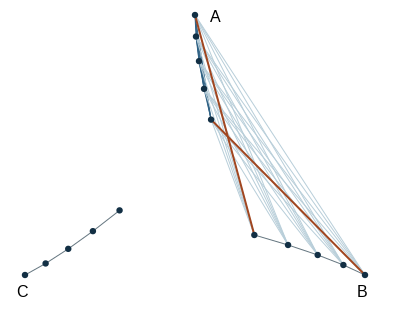
Figure 1. One bundle contains all edges within the chain at A and all edges from A to B. The highlighted segments cross: one joins the outer end at A to the inner end at B, and the other joins the inner end at A to the outer end at B. The next bundle contains the edges within B and from B to C; the last contains the edges within C and from C to A.
To see why edges in different bundles never cross, consider where four vertices can lie. Four at one corner are in convex position in their order along the chain. Three at A make a convex quadrilateral with a vertex at B. With a vertex at C instead, the middle vertex of the triple at A lies inside the triangle of the other three, so there is no crossing. Two vertices at A and two at B make a convex quadrilateral whose boundary follows the two chains in opposite directions (Figure 1). If all three corners are represented, the more inward vertex at the corner that occurs twice lies inside the triangle of the other three. The coordinate construction below proves these properties.
For the bundle at A, match the vertices of A, from outermost to innermost, to X in order. Match those of B, from innermost to outermost, to Y in order. Give each edge in the bundle the color of its matching edge in the convex drawing. Every crossing now has the colors of its two original diagonals. Repeat the coloring by cycling A, B and C. Each edge gets a color exactly once, so the two bundles that meet at B can use different labelings of its vertices.
Let C_j be the number of same-color crossings in the convex drawing with exactly j endpoints in X. Write C for the total over all five values of j. Each bundle copies C_4+C_3+C_2 crossings if X is active and C_0+C_1+C_2 if Y is active. Only the crossings with two endpoints in each half count both ways. Using the half with fewer crossings at all three corners, and bounding the smaller count by the average, gives
Even an arbitrary choice of active half gives a finite-size bound. Starting from an optimal convex drawing gives G(3h)\le3B(2h): the crossing count at most triples, but the number of four-vertex sets grows by a factor of at least (3/2)^4. For any n\ge4, take h=\lceil n/3\rceil, so 2h\le n\le3h. Using the fact that the minimum densities for G and B each increase or stay the same with size gives
How many crossings count in both halves?
In the limit, at most three quarters of the same-color crossings in an optimal convex drawing can have two endpoints in each half. To see why, imagine choosing a subset with slightly more vertices from one half than from the other. This makes crossings that need two vertices from each half less likely to survive. If too many crossings split evenly, the subset would have fewer crossings on average than the minimum for a convex drawing of its size.
Fix k. For each size 2h take an optimal convex drawing and divide it into any two consecutive halves. Choose a subsequence of sizes along which all five fractions C_j/C converge, and call their limits p_j. To vary the balance between halves, choose a number x with -1<x<1. Draw an h-vertex subset by taking \lfloor h(1+x)/2\rfloor vertices uniformly from X and the rest uniformly from Y. Sampling without replacement within each half gives a limiting probability of (1+x)^j(1-x)^{4-j}/16 that all four endpoints of a crossing of type j survive. Every subset has at least B(h) same-color crossings. Since C=B(2h) and both sizes approach the same positive density b_k, the ratio B(h)/B(2h) tends to 1/16. Comparing the expected count in the subset with its minimum therefore gives
Group the limiting fractions by the split: P=p_0+p_4 for all four endpoints in one half, Q=p_1+p_3 for three against one, and R=p_2 for two against two. Averaging the inequality at x and -x removes the odd powers of x. Subtracting the constant term P+Q+R=1 gives
To convert the count in (1) into a density, divide by the number of four-vertex sets in the three-chain drawing. The convex drawing has 2h vertices and the new drawing has 3h, so the ratio of their four-set counts tends to (2/3)^4. Substituting the bound on C_2/C into (1) gives
Coordinates for the two constructions
For the two-chain comparison on n vertices, we placed an arc of m vertices on the upper parabola and its complement on the lower parabola of y=\pm(10n^3+x^2). On each we used consecutive integer horizontal coordinates starting at zero. The order around the original circle ran rightward on the upper chain and leftward on the lower. To apply the coloring rule of Damiani, D’Antona and Salemi on s vertices, number them from zero. Divide the residues modulo s into k consecutive bands as equal in size as possible, putting the longer bands first. Give the edge joining vertices i and j the color of the band containing (i+j)\bmod s.
For the three-chain drawing, label the triangle corners counterclockwise. At a corner A, let B denote the next corner and D the previous one. Define the vectors U=B+D-2A and V=B-A. The first points toward the midpoint of the opposite side; the second points toward the next corner. Place the chain vertices at
For three indices i<j<l, the middle point A_j is below the line through A_i and A_l. Each outer point is above the line through the other two. A segment from A_j to a point near B therefore crosses the outer chord. For a point near D, the same three tests place A_j inside the triangle formed by that point and the outer points.
With two points near A and two near B, the line through either pair leaves the other pair strictly on one side. Both short chords are therefore boundary edges of the quadrilateral. Looking along the A chord in order of increasing index, the B points lie to the right because the chord direction tends to U. Looking along the increasing B chord, the A points lie to the left by the same test. Thus for i<j and u<v the boundary order is A_i,A_j,B_v,B_u, up to reversal.
Finally, take two points near A and one each near B and D. The direction from the outer A point to the inner one tends to U, strictly inside the angle toward B and D. The distance between the A points tends to zero while their distance to the opposite side stays positive. The inner A point therefore lies inside the triangle of the other three. There are only finitely many choices at fixed h, so sufficiently small \varepsilon makes all these side-of-line tests strict at once. A further small displacement can keep the crossing pairs unchanged while ensuring that no more than two edges cross at one point.
Independent counts of the crossings
To check which colored edges crossed without relying on the classification by corner, we used a triangle with corners (0,0),(1,0),(0,1), set \varepsilon=1/(100h^2) and scaled the coordinates to integers. An independent count used only the resulting coordinates and edge colors. It rejected any triple of vertices on one line and tested all three pairings of edges on every four-vertex set using integer orientation signs. Two segments cross when the endpoints of each lie on opposite sides of the line through the other.
On a convex 12-vertex drawing, we marked the crossing diagonals of each of the 495 four-vertex sets in turn by giving the pair a common color. The other edges received distinct colors, except when we needed to mark a second pair entirely in the inactive half to ensure that the designated active half had the lower count or was tied. In all 495 resulting drawings, the marked crossing appeared three times if it belonged to the active bundle and zero times otherwise.
For a larger check we used the first 134 vertices of the published 135-vertex three-color drawing [3]. We kept its edge colors and used the listed vertex order around a circle. This check works for a coloring regardless of its optimality. Comparing the colors of the two diagonals on each four-vertex set gave the counts in Table 1. Making the first half active copied fewer crossings. The independent segment count on the 201 vertices of the new drawing found exactly the predicted 3\times2{,}956{,}189=8{,}868{,}567 same-color crossings.
Table 1. Same-color crossings copied to one bundle in the three-color example, according to where the four endpoints lie.
| Source crossings copied | First half active | Second half active |
|---|---|---|
| Four in the active half | 253,962 | 254,718 |
| Three in the active half | 1,069,538 | 1,070,261 |
| Two in each half | 1,632,689 | 1,632,689 |
| Total per copy | 2,956,189 | 2,957,668 |
The factor 14/27 compares the two optima for every fixed number of colors without requiring the numerical value of either optimum. Whether that factor can be improved remains open.
References
- E. de Klerk, D. V. Pasechnik and G. Salazar. Improved Lower Bounds on Book Crossing Numbers of Complete Graphs, §5.1. Analysis of the Damiani–D’Antona–Salemi construction.
- B. Hahn, B. Klinz and B. Vogtenhuber. On the geometric k-colored crossing number of K_n, Table 1 and §5.
- B. Hahn, B. Klinz and B. Vogtenhuber. Data for the geometric k-colored crossing number of K_n. Graz University of Technology.
- A. Brodsky, S. Durocher and E. Gethner. Toward the rectilinear crossing number of K_n: new drawings, upper bounds, and asymptotics.