Pairs of seven points give the best repeating edge pattern for a triangle with two leaves
Why it matters
How often can five points in a network form a triangle with a leaf hanging from each of two corners? Linking overlapping pairs of seven points and repeating the pattern in equal parts raises the share from 7.32% in a published construction to 7.40%. No other pattern built from overlapping edges does better under that rule, though a different kind of network might.
How often can five points chosen from a large network form a bull? Three of the points must form a triangle. Each of the other two must have just one link, to a different corner of the triangle. All links among the five count: even one extra link spoils the pattern. The maximum possible frequency is unknown. One way to approach it is to find a small pattern that produces many bulls when repeated at successively smaller scales.
A published construction based on the squares of a three-by-three rook board reaches 7.3171%. We find that a pattern based on the 21 pairs of seven points reaches 180/2431, or 7.4044%. Each pair becomes a vertex, and two vertices are linked if their pairs share a point. Among all patterns built from edge intersections and repeated in equal-sized parts, this one is the unique best choice of a single pattern.
Building a large graph from a small one
On a rook board, two squares are linked if they share a row or a column. To see why this is an edge-intersection rule, draw a graph with a vertex for each row and each column. Join every row to every column. This graph is called the root; for the three-by-three board it is the complete bipartite graph K_{3,3}. Each square is now an edge in the root. Two squares share a row or column exactly when their edges meet. The graph linking squares by this rule is the line graph of the root.
The same rule works for any finite simple root graph G, meaning one with no loops or repeated edges. If G has m edges, split the large graph into m equal parts, one for each edge. Between two parts, include every possible link if their edges meet, and none otherwise. Repeat the construction inside each part. Even-Zohar and Linial (Table 2) used the rook board in this construction to obtain 813/11111=3/41 as a lower bound on bull inducibility: the limiting maximum fraction of five-vertex sets that form a bull, with all links among the five retained. Their numerical upper estimate was 0.077634203.
Counting bulls by counting trees
Figure 1 shows what to look for in the root. The triangle of a bull comes from three edges that meet in pairs. They can share a center or form a triangle themselves. In the latter case any edge touching that triangle meets at least two of its edges, so it cannot supply a leaf (a vertex with just one link) for the bull. The three edges must therefore share a center. To supply the two leaves, extend two different arms of this three-armed star by one edge each, keeping the extensions disjoint. Conversely, any five edges arranged as this tree give a bull. Other edges among the same six root vertices do not change how the selected edges intersect.
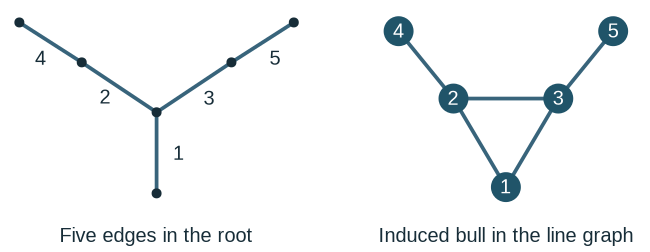
Figure 1. The three edges at the center become the triangle. Edges 4 and 5 each meet just one of those three, giving the leaves.
Let N(G) count the five-edge sets that form this tree in the root. To turn that count into a frequency in the large graph, consider the first split at which the five sampled vertices no longer all share a part. A vertex in another part is linked either to every member of a part or to none. In a bull, by contrast, every group of two, three or four vertices has an outside vertex linked to some but not all of the group. One can check all 25 such groups in Figure 1. Thus a split that separates the vertices of a bull must put them in five distinct parts.
Write p for the limiting fraction of five-vertex sets that form a bull. We can choose parts independently and uniformly in this limit: after k levels, the probability that two sampled vertices still share a part is m^{-k}. At the first level, five independent choices give five distinct parts forming a bull with probability 5!N(G)/m^5, since each qualifying set can be chosen in any order. With probability m^{-4} all five choices agree, and the same calculation starts again inside that part. For m\ge2 this gives
In K_7, the graph joining every pair of seven vertices, every placement of the six tree vertices works. Only exchanging the two long arms gives the same edge set twice. There are therefore 7!/2=2{,}520 bulls in the 21-vertex line graph, giving the limiting density 180/2431.
Why no root gives a higher density
A census of all 12,293,382 simple graphs on six through ten vertices, counting graphs that differ only by vertex names once, singled out K_7. Neither the larger complete graphs nor the irregular graphs in the census improved on it. To cover roots of any size, we prove
Bounding the count with three disjoint edges
In the tree, three disjoint edges must cover all six vertices, so each leaf must be paired with its only neighbor. This determines a unique triple of disjoint edges. Starting with such a triple in the root, there are at most 24 ways to recover the tree. Choose which edge carries the center, which endpoint is the center, and which endpoint of each other edge to join to it. That gives 3\cdot2\cdot2^2 choices. Since there are at most \binom m3 triples, N(G)\le24\binom m3, giving
The triple also rules out roots with nearly all edges at one vertex. If only h edges avoid that vertex, at least two edges of the triple must come from those h. This gives N(G)\le24m\binom h2. For m\ge26 and h\le3, the resulting density is at most 8640/(26^4-1)<a.
Using smaller roots to bound larger ones
We prove the inequality by induction on the number of edges: at each step we may use the bound for all smaller edge counts. At zero and one edge, both sides of the inequality are zero. Removing isolated vertices changes neither side. If edges lie in two or more disconnected components, every copy of the tree lies entirely in one component. Their counts add, whereas F(x+y)>F(x)+F(y) for positive edge counts x,y. The inductive bound is therefore strict for these roots. A connected root with fewer than six vertices or five edges contains no copy. It remains to consider connected roots with 6\le n\le m+1, where n counts vertices.
A vertex's degree d is the number of edges that meet it. Deleting it leaves m-d edges and reduces F by g_m(d)=F(m)-F(m-d). Sum the inductive bounds over all choices of the vertex v to delete, writing d_v for its degree. Each tree contributes once for each of the n-6 vertices outside it. Define S(G) to be the amount by which the total reduction in F exceeds 6F(m). Then
Roots with 26 to 78 edges
For these edge counts, we found S(G)>0 for every connected root whose maximum degree D is at most m-4. A larger degree leaves at most three edges away from one vertex, a case already settled by the disjoint-edge bound.
To check the degrees, we built lists from largest to smallest, starting with each possible D from 1 to m-4. We could often rule out a list before finishing it. The reason is that g_m is concave: moving a unit from a smaller degree to a larger one can only lower their combined contribution. Concentrating the unassigned degrees as much as possible therefore gives a lower bound on the sum.
Suppose the first k entries end with degree b, and R of the total degree sum 2m remains to be assigned. At least l=\max(D+1-k,\lceil R/b\rceil) positive entries must follow: the root needs at least D+1 vertices to accommodate D neighbors, and no entry can exceed b. Discard the partial list if l>R or k+l>m+1. Otherwise start with l ones and distribute the R-l extra units from left to right, filling each entry to b before using the next. The first j\le l entries of this tail sum to \min(jb,R-l+j), at least as much as in any admissible tail, even a longer one. Padding with zeros lets us compare tails of equal length. By concavity and g_m(0)=0, the concentrated tail gives the smallest possible contribution.
If the sum of g_m over the partial list and this tail exceeds 6F(m), every completion has positive S and the search on that branch stops. Otherwise try each next positive entry up to \min(b,R). At the new length t=k+1, require the degree sum so far to be at most m+\binom t2: only edges with both ends among those t vertices can count twice. Across the 53 edge counts this search visited 95,342 partial lists. No complete degree list with nonpositive S survived.
Roots with five to 25 edges
For smaller roots, 3,352 degree lists required us to build graphs and count their trees. To identify these lists, we enumerated the nonincreasing lists of positive degrees with sum 2m, length 6\le n\le m+1, and largest entry below n. For each initial segment of length k we required
A second bound used the degrees around each possible tree center. At a center of degree c\ge3, choose an unordered pair of neighbors i,j to start the long arms. Their two tips and the short arm have at most (d_i-1)(d_j-1)(c-2) choices. Using the c largest other degrees as neighbors gives an upper bound on the sum over pairs. We discarded a list only if this bound, summed over all centers, was strictly below aF(m)/120.
For each remaining list we needed to build only the part of the graph on vertices of degree at least two. In a connected root of this size, two leaves cannot be each other's neighbors. Once the links among nonleaves are fixed, each missing unit of degree at a nonleaf must therefore be filled by a separate leaf. Taking nonleaves in degree order, we tried every subset of later nonleaves as neighbors and kept assignments satisfying the remaining degrees and the edge and leaf totals. This includes every connected graph with the specified degrees. Repeated labellings and extra disconnected graphs do not affect the bound.
In each resulting graph we chose a center and an unordered pair of neighbors. We extended each of their arms by one edge, then counted the center's remaining neighbors available for the short arm, requiring six distinct vertices. We compared fractions exactly by multiplying across their integer numerators and denominators.
| Root edges | Realizations counted | Highest recursive density among those counted |
|---|---|---|
| 5–12 | 132,972 | 3/41 |
| 13–18 | 414,748 | 288/4199 |
| 19–20 | 8,811 | 3840/53333 |
| 21 | 373 | 180/2431 |
| 22–25 | 105 | 12240/171787 |
Table 1. Exact counts after the degree tests. Each realization is a graph built from a surviving degree list. The nonleaves are labelled; permuting leaves attached to the same vertex gives no new realization.
Of the 557,009 realizations counted, exactly one reached 180/2431. Its seven vertices all had degree six, so it was K_7. Induction or a strict counting bound had already ruled out every omitted connected root. This proves uniqueness for every edge count.
Independent counts
We also counted bulls directly in the rook-board and seven-point patterns and in a highest-density realization for each small edge count where the enumeration found a positive tree count. For each set of five edges, we joined the ones that met and tested all vertex labellings against the bull. The direct counts agreed with the tree counts.
The census used Brendan McKay's complete collections of simple graphs and a separate counting method. On six labelled vertices the tree has 6!/2=360 distinct edge sets. For each of the 2^{15} possible graphs on those vertices, we tabulated how many of the 360 it contained. We then summed the table entries over all six-vertex subsets of each census graph. This bypassed both the degree tests and the arm count. Equality occurred once at each size from seven to ten vertices: each time the root was K_7 with zero to three isolated vertices.
Scope of the bound
Changing the line graph between levels still gives density at most a if the parts remain equal. At a split into m parts the probability of a bull in five distinct parts is at most a(1-m^{-4}). The probability of continuing inside one part is m^{-4}. Summing over the first level where the five vertices separate gives at most a, since m\ge2 at every split. To pack bulls more densely, a construction would have to change the equal-part rule or use a pattern outside the line graphs of simple roots. For unrestricted graphs, 180/2431 remains a lower bound.