Edited RNA encodes a potential lipid-attachment signal on a proton-pump protein in four squid and cuttlefish species
Why it matters
The instructions for the tip of a protein in a cellular pump are the same in six squid, cuttlefish and octopus species. Four of them rewrite some of those instructions in nerve tissue, giving the tip the same ending that lets another protein carry a fatty tag. That makes the pump a candidate for the tag, though the RNA alone cannot show whether the pump carries it.
An enzyme can recognize a protein by its last four amino acids and attach a lipid there. In cephalopods, which include squid, cuttlefish and octopuses, RNA editing can change the amino acids a message encodes. Can an edit give a protein a new lipid-attachment signal? A catalog of edits can identify a change at one position. To tell whether the whole signal is present at the very end, we need RNA fragments that also cover the stop codon, the instruction to end the protein.
We found such a signal in messages for ribonuclease K (RNase K). This small protein forms part of a proton pump and already spans the membrane twice. In all six species examined, the reference sequence for RNase K ends in tyrosine, valine, leucine and serine (YVLS in the one-letter amino acid code). In a nerve center called the stellate ganglion, four of the six species, all squid or cuttlefish, also expressed messages with cysteine (C) in place of tyrosine. The resulting ending, CVLS, is the sequence that accepts a lipid on the signaling protein H-Ras. It appeared in 9 of 72 fragments from Hawaiian bobtail squid and 36 of 64 from common cuttlefish, although neither species had a cataloged edit at this site. All 551 fragments from the same tissue in two octopus species encoded YVLS.
How an edit changes the protein ending
In these animals, enzymes convert adenosine in some RNA molecules to inosine, which the cell reads as guanosine. In DNA notation, this changes the three-base code for tyrosine, TAC, to TGC, which specifies cysteine. Position matters because the enzyme that attaches the lipid to H-Ras, farnesyltransferase, recognizes the cysteine exactly three amino acids before the end of the protein. An internal CVLS sequence would not provide the same signal.
We screened a catalog of cephalopod RNA edits for changes to protein endings. Of 1,335 amino acid substitutions in the last four positions of coding sequences with a verified stop, 25 introduced a cysteine at the fourth position from the end. Only longfin squid RNase K gained an ending that also met a narrower filter for sequences that farnesyltransferase might recognize. An expanded catalog of edits reported the same tyrosine-to-cysteine change in striped pyjama squid. We compared RNase K across all six species in that catalog. The six reference proteins shared their final 14 amino acids, IQQRQNARASYVLS.
Two endings in squid and cuttlefish
In stellate-ganglion RNA, we found fragments encoding YVLS and others encoding CVLS in longfin squid (Doryteuthis pealeii), striped pyjama squid (Sepioloidea lineolata), Hawaiian bobtail squid (Euprymna scolopes) and common cuttlefish (Sepia officinalis). The stop codon came immediately after each ending. The same search recovered only YVLS in the two octopuses (Figure 1A). This search required the three codons following the editable site and the stop to match the reference. To check for endings that rule might miss, we selected a separate set of reads by matching only the sequences on either side of the last four codons and stop. We then translated the sequence between the matches. CVLS appeared in the same four species, and no third ending appeared in any species.
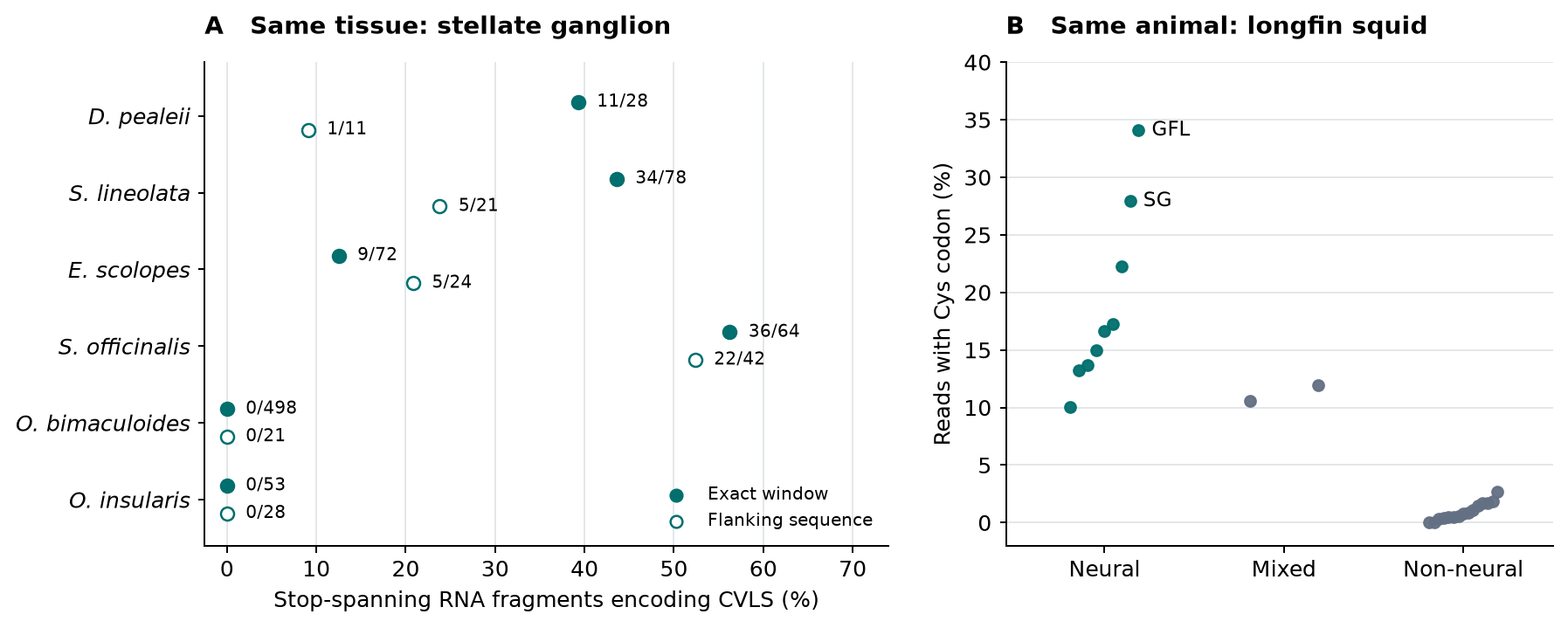
Figure 1. A. Labels show how many informative stellate-ganglion fragments encoded CVLS out of the total examined. Filled points show counts from the exact sequence search, which allowed any base at the edited position. Open points show the check using flanking sequences in a nonoverlapping set of reads from one sequencing library per species. B. Each point represents one dissected tissue sample from the same longfin squid. These counts use all reads covering the edited base, whether or not they reach the stop. The mixed group comprises retina and axial nerve cord. GFL denotes the giant fiber lobe and SG the stellate ganglion. Ganglion counts · Tissue counts.
The two species without a cataloged edit illustrate two ways a survey can miss an ending. The bobtail squid catalog included the YVLS transcript but did not report the edit. We found CVLS in both its stellate ganglion and another brain region, the vertical lobe (11/70 fragments). In common cuttlefish, the catalog's set of predicted proteins lacked RNase K altogether. An independent cuttlefish genome annotation contained one protein matching longfin RNase K, with 84.8% identity over 99 aligned amino acids. Its final coding segment (exon) encoded YVLS. Using that reference, we found CVLS in the original cuttlefish ganglion and optic lobe (28/101 in the optic lobe). A second cuttlefish project yielded CVLS in the optic lobe (4/18) and vertical/subvertical lobes (8/40).
Longfin squid and cuttlefish share the same 29-base sequence used to find the fragments. Bases outside it helped distinguish the species: of 76 cuttlefish CVLS fragments, 73 carried at least two cuttlefish-specific flanking bases and no bases favoring longfin squid. The reciprocal test supported a longfin origin for 35 of 37 longfin fragments.
DNA evidence for RNA editing
DNA from the same animals supports RNA editing as the source of the uncataloged cysteine codons. The two bobtail squid neural samples together yielded 20 cysteine-bearing RNA fragments out of 142. In the animal's entire gill DNA sequencing run, all six high-quality fragments covering the site carried the tyrosine-encoding A. Allowing more mismatches to the reference and dropping the quality threshold added one A and one low-quality T, but no G.
In cuttlefish, we checked whether the G repeatedly seen in RNA also appeared in the same male's assembled germline DNA. We searched for all 31 overlapping 31-base sequences spanning the site, each with either an A or a G at that position. All the A versions occurred on a single 219-base DNA segment that agreed with the independent genome annotation. None of the G versions appeared. In the two species with cataloged edits, the catalog reported 1,451 G and 4,558 A reads in longfin squid RNA, and 8,885 G and 12,372 A reads in pyjama squid RNA. DNA reads supported A in both species (14 and 24 reads, respectively).
Variation across animals and tissues
Each of 12 California two-spot octopuses (Octopus bimaculoides) in a study of temperature and RNA editing contributed 26–52 stellate-ganglion fragments encoding YVLS. None encoded CVLS at either 13 °C (0/227) or 22 °C (0/271). The same sets of reads did capture a tyrosine-to-cysteine edit at the same distance from the stop in a message for a different enzyme, a phosphatase (4/8 fragments). In the western Atlantic octopus (O. insularis, listed in the sequence archive as O. vulgaris), only YVLS appeared in either the stellate ganglion (53 fragments) or the optic lobe (64).
We used ViennaRNA, software that estimates how likely RNA bases are to pair as a molecule folds, to ask whether local folding distinguished an edited squid site from an octopus site. With 60 bases on either side of the site, the editable base had the same preferred partner 54 bases upstream in longfin squid and western Atlantic octopus at both 15 and 25 °C. The preferred partner changed with the length of sequence included. Local folding thus offered no simple explanation for the species difference.
In longfin squid, a tissue atlas that matched RNA reads to the genome had classified this site as more often edited in neural tissue. In one animal, the fraction of reads carrying G in each of nine neural samples (10.1–34.1%) exceeded that in every one of 15 non-neural samples (0–2.7%; Figure 1B). The giant fiber lobe and stellate ganglion ranked first and second in that animal (202/593 and 177/634) and in an earlier set of RNA samples that the atlas authors remapped (242/636 and 191/613). Editing also occurred outside neural tissue: one longfin gill fragment encoded CVLS through the stop.
Where the tail emerges from the pump
The edited cysteine would lie on the tail of RNase K facing the cytoplasm. In the structure of the human proton pump, the last visible RNase K amino acid is an asparagine 7.6 ångströms (Å) beyond the membrane's hydrophobic boundary on the cytoplasmic side. When superimposed on the human protein, the membrane-spanning core of a predicted octopus RNase K structure had a root-mean-square separation of 0.62 Å across 52 backbone positions. All six cephalopod sequences cover those positions and retain the asparagine five residues before the editable tyrosine. This places the base of the tail on the cytoplasmic side; the model's low confidence at the tyrosine (63 on a 100-point scale) leaves its precise position uncertain.
In a crystal structure of farnesyltransferase bound to a short piece of H-Ras, the sulfur atom of the CVLS cysteine lies 2.38 Å from the zinc atom at the enzyme's reaction site. Editing supplies the same terminal sequence to a protein already anchored in the membrane. The longfin squid survey of proteins lists the substitution but does not report detecting the edited site. The giant fiber lobe and stellate ganglion are the clearest longfin tissues in which to look for the modified protein.
These reads establish which endings the RNA encodes. Whether farnesyltransferase can reach and modify RNase K in the pump remains open. Six bobtail DNA fragments give limited power to exclude an inherited variant, and the overlapping cuttlefish sequences describe one assembled locus that could omit a rare variant. The octopus counts leave room for rare editing or editing in another tissue, and the dissected samples cannot identify which cells expressed the edited messages.
Methods and data sources
Protein sequences
We oriented the catalog's coding sequences and edit calls on the strand that specifies the protein and considered each substitution separately. The initial screen covered longfin squid, common cuttlefish and both octopuses. We required a stop codon at or immediately after the annotated coding end. Our narrow filter for finding candidates required cysteine, then two amino acids each drawn from A/V/I/L/M/F, then one from A/C/F/I/L/M/Q/S. It was not an exhaustive definition of farnesyltransferase substrates. We used DIAMOND, a protein sequence comparison tool, to search translated sequences from all six species for matches to longfin RNase K. We required an expectation value (the number of matches this good expected by chance) of E ≤ 10⁻⁷, coverage of ≥65% of the query protein and ≥45% amino acid identity. For cuttlefish we used the predicted gene transcript g11818.t1 and its terminal exon on genome sequence CM114529.1. A nucleotide search with that exon found no match in the original cuttlefish panel at E ≤ 10⁻⁷. The bobtail panel contained a second RNase K-like transcript with a different end; only the YVLS transcript matched the search window.
RNA sequences
The exact search covered 106.3 million sequencing spots (read pairs or single reads) in 73 runs from six public projects. We searched both strands using a 29-base window centered on the variable base. We required a Phred score, a measure of confidence in a base call, of ≥30 there and ≥20 throughout the window. We allowed all four bases at the center, counted overlapping reads from a pair once and observed only A and G. The run-level table gives the archives, tissues and intervals searched, including the complete runs for the newer cuttlefish samples.
For the search using only flanking sequences, we took spots 8,000,001–9,000,000 from one stellate-ganglion run per species. After trimming sequencing adapters, we required a 13-base flanking match and ≥92% identity over ≥40 flanking bases of quality ≥20, with ≥8 on each side. For the sequence encoding the end, we used the same quality cutoffs as in the exact search. For the full-depth comparison of longfin tissues, we used the atlas authors' counts and tissue labels at genome position Dpe36:20578597 (transcript Dopeav2115114m, coding change c.287A>G). We calculated the edited fraction as G/(A + G) per sample.
The six RNA sources were the longfin genome atlas, the bobtail and pyjama squid survey, the original comparative survey, the common cuttlefish genome project, the California two-spot octopus tissue atlas and the octopus temperature study.
DNA sequences
For bobtail squid DNA (run SRR13005722), we searched all 290,218,425 spots using eight 16-base flanking sequences independent of the variable base. We retained reads with ≤5% mismatches outside that base and quality ≥30 at the base. We then realigned the candidates allowing 15% mismatches without a quality cutoff. For cuttlefish DNA (run SRR2859359), we took every 31-base window spanning G that occurred in at least two cysteine-bearing RNA fragments from the donor. We searched the A and G versions on both strands of the Logan assembly graph, a representation of recurrent sequences from the complete DNA run.
Structural comparison
To place the cephalopod tail on the pump, we matched the octopus model to human RNase K (chain T of structure 6WLW) by local protein sequence alignment. We used the Orientations of Proteins in Membranes database to locate the human structure relative to the membrane. We then fitted the aligned backbone alpha-carbon atoms within 16.9 Å of the membrane midplane in that structure. Separately, we measured the distance from the substrate cysteine's sulfur to the zinc in the H-Ras peptide complex (structure 1TN8).