A variant in the cystic fibrosis gene shows little link to pneumonia in two European populations
Why it matters
A CFTR gene variant that alters bicarbonate transport in laboratory cells showed little association with pneumonia across two European biobanks with 98,418 pneumonia cases. The analysis rules out an increase of 10% or more in odds per copy under its statistical model, but does not establish whether treatments that change airway acidity would prevent pneumonia.
Understanding how the lungs resist infection could help identify ways to prevent pneumonia. One unresolved question is whether reducing bicarbonate transport, which helps control airway acidity, increases pneumonia risk independently of changes in salt and fluid movement. The cystic fibrosis transmembrane conductance regulator (CFTR) is an ion channel that transports both bicarbonate and chloride. Some variants of the gene encoding it impair bicarbonate transport in cells while largely preserving chloride transport, offering a way to examine this question.
We examined these variants in two biobanks that link genetic data to health records. The clearest result was for R75Q, a variant that replaces arginine with glutamine at position 75 of the CFTR protein. Across 98,418 pneumonia cases, its combined odds ratio was 1.012 per copy of the variant (95% confidence interval 0.965–1.060). An odds ratio of one means no association. After adjustment for selecting this variant from 11 candidate alleles, or gene versions, the interval's upper limit was 1.083. R75Q therefore showed little average association with pneumonia, although this result leaves the effect of selectively changing airway bicarbonate transport unresolved.
Background
LaRusch and colleagues studied nine CFTR variants using cell-based transport measurements and clinical associations. They reported impaired regulated bicarbonate transport and an association between the variant group and pancreatitis, or inflammation of the pancreas. Subsequent experiments showed that R75Q weakens interaction with WNK1, a regulatory protein that helps determine which ions CFTR transports. These observations make R75Q a useful candidate for a population test. [1,2]
Disease associations also differ within the proposed functional group. A meta-analysis of chronic pancreatitis found a pooled association for the nine variants, but an R75Q-specific odds ratio of 1.12 (95% confidence interval 0.89–1.40). Thus an experimentally measured defect need not imply the same clinical consequence for every allele. [3]
We asked whether the candidate bicarbonate-defective alleles increase pneumonia risk, using FinnGen, a Finnish genetic study linked to health records, and Pan-UK Biobank (Pan-UKB), a public analysis of genetic associations in the United Kingdom’s UK Biobank. We examined chronic pancreatitis as a check for a detectable CFTR-related disease association and bronchiectasis, a chronic condition involving damaged and widened airways, as a secondary lung outcome. The available data resolve R75Q more clearly than they resolve the proposed functional class.
Results
R75Q shows little pneumonia association in either population
R75Q showed little average association with pneumonia in either population (Figure 1). FinnGen included 84,364 cases and 415,822 controls; the European-ancestry Pan-UKB analysis included 14,054 cases and 405,999 controls. Among controls, R75Q accounted for 0.49% and 4.37% of CFTR gene copies, respectively. Despite this frequency difference, the odds ratios were similar: 1.027 in FinnGen and 1.003 in Pan-UKB.
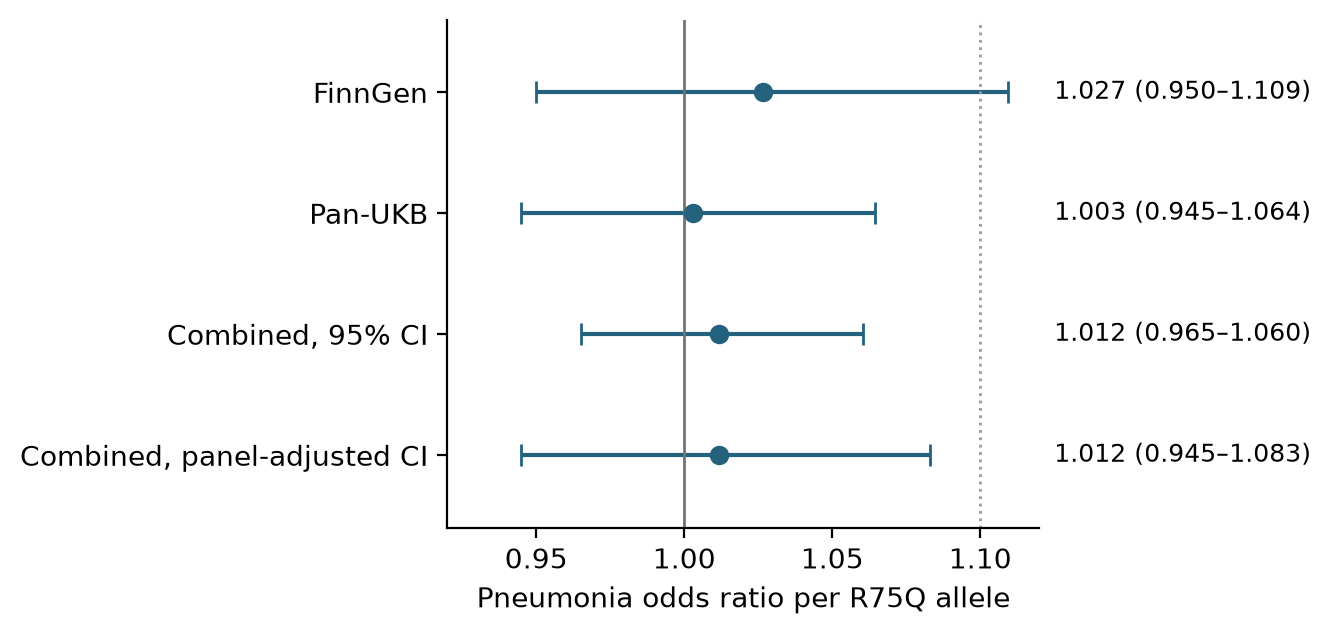
Figure 1. Pneumonia associations per additional R75Q allele. Bars show ordinary 95% confidence intervals except for the bottom row, which uses a Bonferroni-adjusted interval to account for selecting an allele from the 11 examined. The solid line marks no association; the dotted line marks a 10% increase in odds, an interpretive benchmark chosen after inspecting the results.
The combined odds ratio was 1.012 (95% confidence interval 0.965–1.060; P=0.632), with no detected difference between the cohort estimates (Cochran’s Q-test P=0.638). Precision, rather than the nonsignificant P value, makes this result informative. The ordinary upper confidence limit allows a 6.0% increase in odds. A conservative interval accounting for selection of R75Q from all 11 candidate alleles was 0.945–1.083. It still excluded a 10% increase under the additive model, which estimates the change in log odds for each additional copy of the variant. The 10% benchmark was chosen after inspecting the results, rather than set in advance as a clinically acceptable difference.
Pancreatic associations differ despite similar pneumonia estimates
R75Q and the strongly disruptive F508del allele both had near-null pneumonia estimates, but their pancreatic associations differed (Table 1). F508del, a deletion of phenylalanine at position 508, had a combined chronic-pancreatitis odds ratio of 1.799 (95% confidence interval 1.418–2.282). R117H, a replacement of arginine by histidine at position 117 that also affects chloride transport, had an odds ratio of 2.168 (1.415–3.321). These results show that CFTR-related disease associations can be detected in these biobanks even when pneumonia estimates are near one.
Table 1. Alleles with estimates in both cohorts. Substitution names give the original amino acid, its position and its replacement in single-letter notation; for example, S1235R replaces serine with arginine at position 1235. Values are odds ratios per allele with ordinary 95% confidence intervals. Chronic pancreatitis combines 5,157 FinnGen cases and 607 Pan-UKB cases. V470M is a variant historically called M470V, renamed here to describe the change from the current reference sequence; it is not assumed to be functionally neutral.
| Allele | FinnGen pneumonia | Pan-UKB pneumonia | Combined pneumonia | Combined chronic pancreatitis |
|---|---|---|---|---|
| R75Q | 1.027 (0.950–1.109) | 1.003 (0.945–1.064) | 1.012 (0.965–1.060) | 0.979 (0.804–1.192) |
| S1235R | 0.923 (0.853–0.999) | 0.993 (0.872–1.130) | 0.941 (0.880–1.007) | 1.072 (0.825–1.392) |
| F508del | 0.971 (0.883–1.067) | 1.036 (0.942–1.140) | 1.003 (0.937–1.073) | 1.799 (1.418–2.282) |
| R117H | 0.995 (0.853–1.160) | 1.250 (0.980–1.595) | 1.062 (0.932–1.209) | 2.168 (1.415–3.321) |
| V470M | 1.013 (1.002–1.024) | 1.013 (0.988–1.039) | 1.013 (1.003–1.023) | 1.046 (1.008–1.085) |
R75Q's combined chronic-pancreatitis odds ratio was 0.979 (0.804–1.192), consistent with the earlier R75Q-specific meta-analysis. Its pancreatic estimates were nearly identical in FinnGen and Pan-UKB, 0.978 and 0.980. The pancreatic check therefore provides no positive disease association to support using R75Q as a measure of impaired bicarbonate transport in people. S1235R likewise lacked a clear pancreatic association. Its pneumonia association in Finland met the unadjusted statistical threshold but did not replicate in Pan-UKB. V470M’s small pneumonia association also met only the unadjusted threshold and did not survive correction across 11 alleles.
Few bicarbonate-selective candidates have estimates in both populations
Of the nine variants studied by LaRusch and colleagues, eight were candidates for impaired bicarbonate transport with preserved chloride transport; R117H was considered separately because it also impairs chloride transport. Only R75Q and S1235R among these eight candidates had Finnish estimates. Six candidates were absent from the Finnish files, and independent functional measurements also question whether L967S fully preserves chloride transport. [4] Pooling the available variants would therefore provide a poor test of a uniform bicarbonate-specific effect.
Among candidates available only in Pan-UKB, R74Q had a pneumonia association at the unadjusted threshold, with an odds ratio of 1.622 (1.071–2.456; P=0.0225), which did not meet the threshold adjusted for 11 alleles. L967S, L997F and D1152H had wide intervals spanning one. R170H was absent from both cohorts, and D1270N's Pan-UKB estimate was flagged as low confidence. The complete supplementary table includes rows identifying missing and low-confidence estimates.
The secondary lung outcome was less precise. R75Q's FinnGen bronchiectasis odds ratio was 1.259 (0.874–1.814), leaving appreciable increases in chronic structural airway disease compatible with the data.
Interpretation
R75Q has little average association per additional allele with broadly defined, recorded pneumonia in these two European populations. The result separates a reproducible laboratory transport phenotype from a substantial population pneumonia association for this particular allele. F508del's pancreatic association alongside its near-null pneumonia estimate further shows that detectable CFTR-related pancreatic risk need not accompany detectable pneumonia risk in these data.
The mechanistic interpretation remains limited by the absence of airway transport measurements in carriers, incomplete rare-allele coverage and a lack of data showing which variants occur together on the same gene copy. Later airway-cell experiments also show that R75Q's behavior depends on inflammatory challenge, making baseline chloride preservation an incomplete description of its function. [5] The per-allele estimates average across genetic backgrounds; they do not isolate people carrying one allele without cystic fibrosis, and may miss effects that require two copies or combinations with other variants. Who enters a biobank, broad diagnostic codes and restriction to European ancestry constrain generalization. The allele-level bound therefore cannot be translated into the effect of a drug that changes airway acidity or into advice about treating established cystic fibrosis.
Methods
Variant selection and matching
The analysis used the nine variants studied by LaRusch and colleagues, selected before inspecting outcome estimates: R74Q, R75Q, R117H, R170H, L967S, L997F, D1152H, S1235R and D1270N. We treated R117H separately because it also impairs chloride transport and added F508del and the variant historically called M470V as comparators. This gave 11 candidate alleles. R75Q was selected for emphasis after examining variant coverage and association estimates. We analyzed each allele separately, without combining variants into a score or estimating a contrast between functional groups.
We used Ensembl’s variant recoding tool to map protein-coding changes to genomic positions in the human reference genome assemblies GRCh38 for FinnGen and GRCh37 for Pan-UKB. Matching required the genomic position and both alleles. We reversed the effect direction when the datasets expressed the association relative to opposite alleles. The current reference residue at position 470 is valine, so that comparator is reported as V470M. For F508del, we verified that the differently aligned deletion representations produced identical local DNA sequences. All matches used the variants themselves, without substitutes from nearby correlated variants.
Public association data
We extracted published association estimates from indexed files for the genomic region around CFTR from FinnGen release 13 and European-ancestry Pan-UKB. FinnGen's pneumonia endpoint combines viral, bacterial, other and unspecified pneumonia categories, using noncases as controls. Pan-UKB uses phecodes, groups of related diagnostic codes, to define outcomes. Its pneumonia phecode 480 groups hospital and death-record diagnoses, including influenza-associated pneumonia and lung abscess codes, and excludes specified related diagnoses from the controls. These are related broad outcomes rather than identical or pathogen-confirmed infections. [6–8]
Chronic pancreatitis comprised 5,157 cases and 433,953 controls in FinnGen, and 607 cases and 417,106 controls for Pan-UKB phecode 577.2. FinnGen bronchiectasis included 3,096 cases and 405,986 controls. Outcome screening was limited to these diseases.
We used the released additive log-odds coefficients and standard errors. Pan-UKB uses logistic mixed models, which account for genetic relatedness when estimating associations with disease presence or absence. Its variant inclusion rules require an imputation INFO score greater than 0.8; this score measures the quality of genotypes inferred from measured genetic markers. We retained its European estimates and variant-level confidence flags. The pneumonia outcome is flagged because its estimated genetic contribution to variation in disease status did not reach statistical significance. None of the five alleles pooled across cohorts is marked low confidence. Sparse, low-confidence pancreatic estimates were excluded from pooling. [7]
Statistical analysis
For each allele available in both cohorts, we pooled log odds ratios using inverse-variance fixed-effect weighting. This gives more weight to more precise estimates and assumes a common underlying effect in the two independent cohorts. The pooled standard error was the inverse square root of the sum of inverse variances. We exponentiated coefficients and confidence limits to obtain odds ratios and used Cochran’s Q-test to assess whether cohort estimates differed beyond chance. Ordinary intervals used 1.96 standard errors. Selection-adjusted pneumonia intervals used the standard-normal critical value for a two-sided error rate of 0.05 divided by 11; this correction applies to the candidate allele panel rather than all outcome comparisons. Analyses used the Python programming language with pandas for data handling and NumPy and SciPy for numerical and statistical calculations. Disease effects were expressed per allele, without scaling them by transport percentages measured in cell assays.
References
- LaRusch J et al. (2014). Mechanisms of CFTR functional variants that impair regulated bicarbonate permeation and increase risk for pancreatitis but not for cystic fibrosis. PLoS Genetics 10:e1004376.
- Regulation of CFTR bicarbonate channel activity by WNK1: implications for pancreatitis and CFTR-related disorders (2019). Gastroenterology.
- Berke G et al. (2022). Bicarbonate defective CFTR variants increase risk for chronic pancreatitis: a meta-analysis. PLoS ONE.
- Raraigh KS et al. (2018). Functional assays are essential for interpretation of missense variants associated with variable expressivity. American Journal of Human Genetics.
- The COPD-associated polymorphism impairs the CFTR function to suppress excessive IL-8 production upon environmental pathogen exposure (2023). International Journal of Molecular Sciences.
- FinnGen. Release 13 pneumonia endpoint definition.
- Pan-UK Biobank. Quality control and association-analysis methods.
- Pan-UK Biobank. ICD-to-phecode mapping.