Mutant growth points to a bacterial protein that helps one oxygen-using pathway
Why it matters
Bacteria can use different molecular machines to get energy from oxygen. Mutant-growth data suggest that a previously unexplained protein helps one particular machine work, giving researchers a more precise way to interpret bacterial genes. Its exact job still needs a direct laboratory test.
Bacteria often have several enzymes that use oxygen to support energy production. This makes it difficult to determine which pathway an uncharacterized protein helps. Public mutant-growth data identify one such protein in Sphingomonas koreensis as a candidate helper for a particular oxygen-using enzyme. Disrupting the protein gives a relative-abundance measure called normalized fitness of about −1.0 on the sugars maltose and raffinose. This means roughly twofold relative depletion of the mutants in conditions where cytochrome-c oxidase, the oxygen-using enzyme implicated here, is also needed. Fitness is only −0.27 and −0.24 in two assays that require an alternative enzyme. Eleven insertion positions support this contrast, which predicts a branch-selective respiratory function and narrows the target for biochemical characterization.
Background
Terminal oxidases are enzymes that complete respiratory electron transfer by reducing oxygen. Different oxidases receive electrons from different carriers: cytochrome-c oxidases use the protein cytochrome c, whereas quinol oxidases, including the types called bo3 and bd, use small molecules called quinols. These branches can contribute differently under different growth conditions. A protein that helps one branch should therefore resemble that branch's core enzymes across conditions, while remaining dispensable in at least some conditions that require alternative oxidases. Heme A is an iron-containing cofactor used by the class of cytochrome-c oxidases examined here. Proteins that synthesize it or help assemble the oxidase provide additional markers of this branch.
The uncharacterized protein, identified in the database as Ga0059261_0692, contains DUF1467, a conserved protein domain whose name denotes a domain of unknown function. A domain is a recognizable region of a protein that can occur in other proteins. An analysis of genetic material sampled from marine communities already associated DUF1467 abundance with respiratory domains. The unresolved question is whether a particular DUF1467 protein supports a specific respiratory branch. Buttigieg et al., 2013.
We used the Fitness Browser, a public database of growth measurements for pools of bacteria carrying individually barcoded transposon insertions. A transposon is an inserted piece of DNA that disrupts a gene; its barcode allows sequencing to track the mutant's relative abundance during growth. Normalized fitness is on a log2 scale: a value near −1 indicates roughly twofold relative depletion, rather than a twofold change in growth rate. Genes with similar fitness profiles across assays are described as cofit. This similarity can identify a shared pathway even when their protein sequences provide little functional information. Price et al., 2018.
Results
DUF1467 defects occur in formate and other growth conditions
In Rhodopseudomonas palustris, a comparison of 4,322 genes across 52 repeated experimental contexts yielded 224,744 gene–context comparisons. Its DUF1467 gene, TX73_015200, also known as RPA2933, had mean fitness −2.92 in assays with oxygen and formate, a simple carbon compound, versus −0.66 in the non-formate comparison. Ten of 11 and 11 of 11 insertion positions had fitness below −1 in the two aerobic-formate assays. Associations with heme-synthesis genes suggested that respiratory demand could explain this formate-associated defect.
All nine genes annotated with the DUF1467 domain in the database were included. Seven had fitness measurements; six had at least eight experiments suitable for profile comparisons. The clearest evidence came from the 162 assays for S. koreensis strain DSMZ 15582. Comparisons across carbon sources, nutrient supplements and alternative-oxidase mutants tested branch-selective support against a dedicated formate role, a nutritional defect involving synthesis of the amino acid methionine, and a general requirement for oxygen-based respiration.
DUF1467 follows demand for cytochrome-c oxidase
In S. koreensis, DUF1467 shares its strongest respiratory associations with heme-A synthesis, oxidase assembly and cytochrome-c oxidase subunits. Across all 162 assays, its Pearson correlation, a measure of how closely two fitness profiles vary together, is 0.765 with the CtaA-family heme-A synthesis protein, 0.756 with the CtaG/Cox11-family assembly protein, 0.747 with the oxidase-assembly protein Surf1, and 0.673–0.749 with cytochrome-c oxidase subunits I–III. These genes lie away from the DUF1467 locus. Domain annotations distinguish the cytochrome-c oxidase I/II pair, Ga0059261_2008/2009, from the bo3 quinol oxidase pair, Ga0059261_1565/1566. Below, gene identifiers are shortened by omitting the Ga0059261_ prefix.
A single carbon-source panel separates the two branches (Figure 1). On maltose and raffinose, DUF1467 and cytochrome-c oxidase I/II mutants lose fitness, while bo3 mutants are spared. In two assays using casamino acids, an amino-acid mixture, bo3 mutants lose fitness and DUF1467 has only a small defect. All four assays share a date, starting mutant pool and base medium, reducing the possibility that this contrast simply reflects different experimental batches.
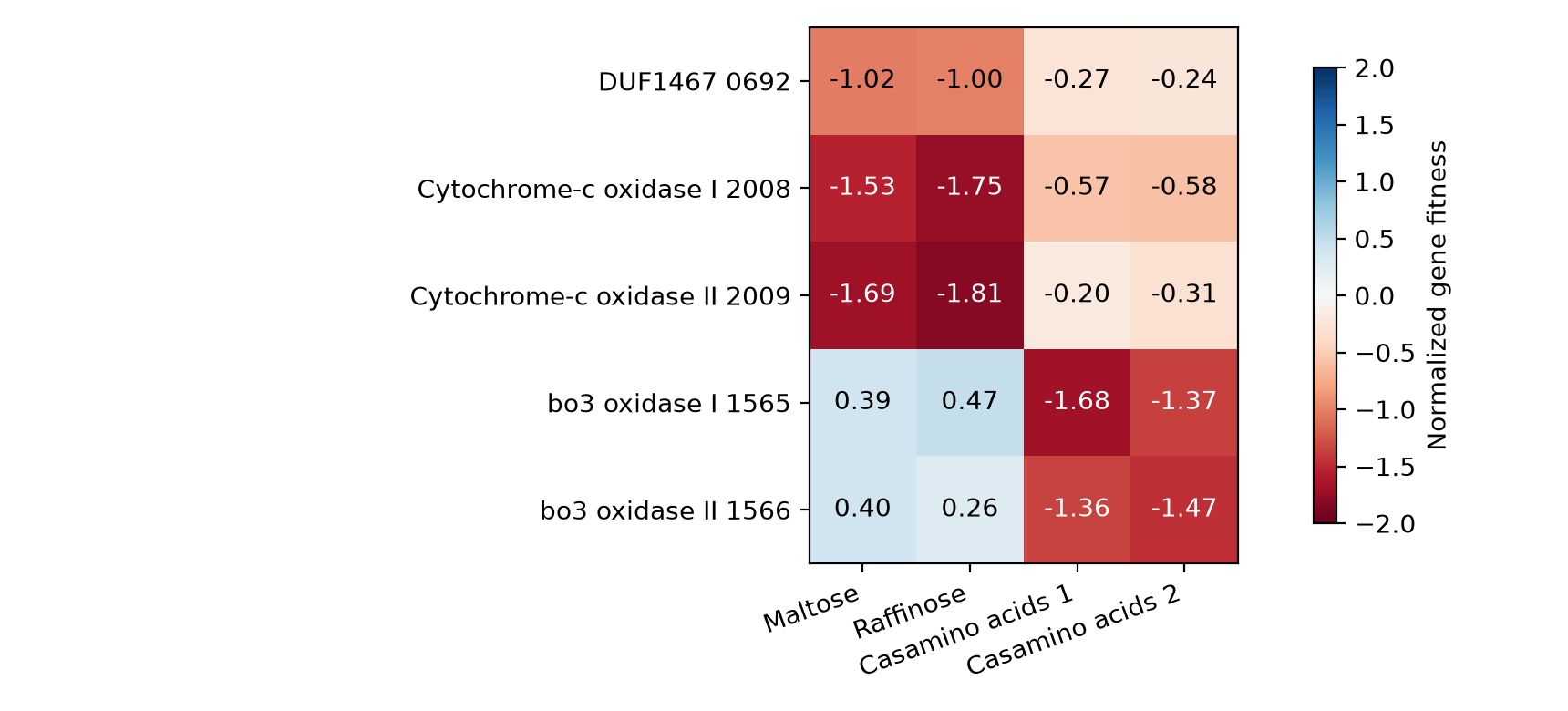
Figure 1. Reciprocal respiratory-branch demand in S. koreensis. Cells show normalized gene fitness; negative values indicate mutant depletion. Maltose and raffinose were each supplied at 20 millimolar (mM) and casamino acids at 2 mg/ml. All assays began on 21 October 2014 and used the same starting mutant pool (the time-zero pool), defined carbon-free base medium, aerobic liquid growth at 30°C and shaking at 200 revolutions per minute. The sugars are distinct conditions, not replicates. The two casamino-acid columns are separate assays.
The database also supplies t-like precision scores, which express fitness relative to its estimated uncertainty. These scores support the sugar phenotypes: DUF1467 has t below −5.3 in both assays, and both cytochrome-c oxidase subunits have fitness below −1 and t below −4. Both bo3 subunits meet the latter thresholds in the casamino-acid assays instead. CtaA and CtaG also follow the sugar defect, with fitness ranges of −2.60 to −2.25 and −1.56 to −1.47, respectively; on casamino acids their ranges are −0.33 to −0.26 and −0.45 to −0.29.
The distinction extends beyond these four assays. Across the full set of assays, 30 assays have both bo3 subunits below fitness −1 and t −4 while DUF1467 remains within ±0.5. Three assays meet the same criteria for the bd oxidase pair 3865/3866. These descriptive thresholds were chosen after inspecting the profiles. These assays show measurable requirements for alternative oxidases while DUF1467 is largely dispensable.
Examining all genes in the oxidase regions also reveals exceptions. Heme-o synthase 2005, which makes a precursor of heme A, has fitness −1.75 in one casamino-acid assay and is therefore not an exclusive branch marker. Protein 1970 is related to subunit IV of an aa3-type cytochrome-c oxidase. Protein 2006 contains the uncharacterized domain DUF1275 and lies between heme-o synthase and the oxidase genes. Their correlations with DUF1467 are −0.079 and −0.050, respectively; three other genes in the cytochrome-c oxidase interval lack measured fitness. The association concerns the core I–III subunits and several accessory proteins, rather than every gene near the oxidase cluster.
Multiple insertions support attribution to the DUF1467 locus
The phenotype appears across 11 insertion positions, rather than depending on a single mutant (Figure 2). Mutants with insertions in the central part of DUF1467 have 25 usable barcodes at these positions, with insertions in both orientations. Median position-level fitness is −1.3 on each sugar, compared with −0.1 and −0.3 in the two casamino-acid assays. Eight of 11 positions are below −1 on maltose and six of 11 on raffinose.
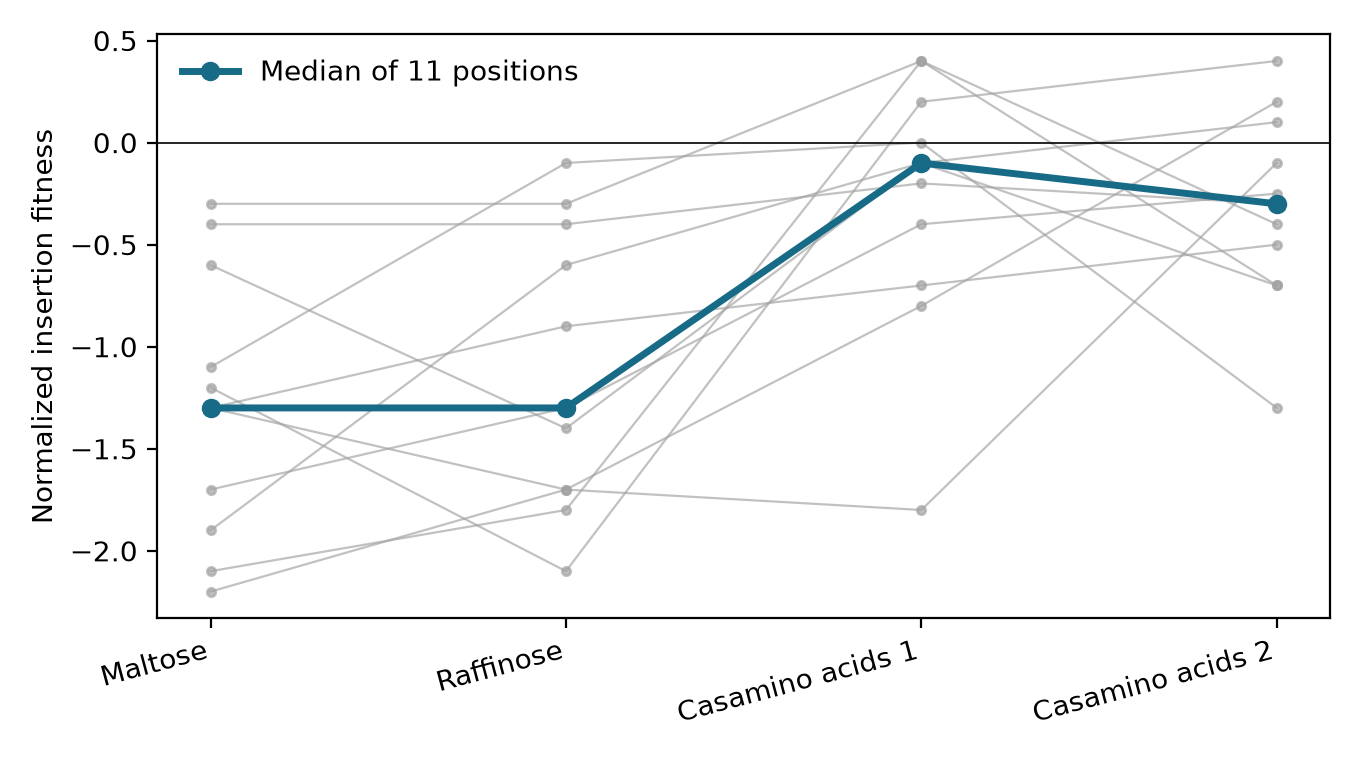
Figure 2. Each gray line follows one insertion position across the assays in Figure 1; multiple barcodes at the same position were collapsed by their median. The blue line is the median across the 11 positions. These are different insertion sites in a pooled library, not 11 independent cultures. Position summaries differ from the database's weighted gene-level estimates.
DUF1467 lies on the minus strand of the reference DNA sequence. Its downstream end, in the direction of transcription, faces an oppositely oriented neighboring gene, 0691, whose mutants are spared. Genes transcribed together form an operon, and an insertion in one can disrupt expression of the next. The opposing orientation and the multiple-insertion evidence make that explanation unlikely here.
Methionine synthesis does not explain the respiratory association
Methionine supplementation separates DUF1467 from a nutritional pathway that is active in the same assays. The assays with growth on glutamate, an amino acid, were published in a study of methionine synthesis without the vitamin-derived cofactor folate. The methionine-synthesizing enzyme MesD and its partner MesX provide positive controls because added methionine bypasses their requirement. Price, Deutschbauer and Arkin, 2021.
Table 1. Median normalized gene fitness across two assays per treatment. All six assays share the 15 March 2020 date and time-zero pool. Methionine was added at 0.25 mM to the no-added-vitamin medium; the standard-vitamin treatment contains a vitamin mixture.
| Gene | No added vitamins | Plus methionine | Standard vitamins |
|---|---|---|---|
| DUF1467 0692 | -1.712 | -1.546 | -0.704 |
| CtaA 1547 | -3.053 | -2.344 | -0.740 |
| CtaG 2003 | -2.265 | -2.395 | -0.864 |
| MesX 2928 | -6.812 | -0.061 | -0.220 |
| MesD 2929 | -5.506 | -0.002 | 0.154 |
Methionine restores MesD/MesX fitness almost to zero but improves DUF1467 by only 0.166. Standard vitamins improve DUF1467 by 1.008, alongside improvements in CtaA, CtaG and the oxidase subunits. Thus the DUF1467 defect does not resemble failure of the measured methionine-synthesis system. The shared response of the respiratory module also makes vitamin rescue alone insufficient evidence for a vitamin-biosynthesis function.
Respiratory cofitness persists outside this nutritional panel. Removing all 14 glutamate assays leaves CtaA and CtaG at ranks 2 and 5 among all measured genes ordered by their correlation with DUF1467, with correlations of 0.676 and 0.604. Removing the entire vitamin-test date leaves them at ranks 2 and 6, with correlations of 0.667 and 0.594. Across all five analyses that each omit one assay date, CtaA remains within the top six partners and CtaG within the top seven. The branch association therefore draws on more than the vitamin-sensitive phenotype.
Cross-species evidence supports a restricted assignment
The strongest locus-level inference remains in S. koreensis. For the DUF1467 gene in R. palustris, removing all formate assays preserves CtaA cofitness at 0.499, but excluding all assays from the date of the two aerobic-formate assays reduces it to 0.192. That association is not independently reproduced across dates. In Caulobacter, the DUF1467 gene CCNA_02010 has Surf1, heme-o synthase and CtaG as its three strongest partners, but its profile rests on only one usable central insertion, and none of its 198 t scores is below −4. Sinorhizobium also shows oxidase cofitness, whereas Azospirillum and Dinoroseobacter do not show the same leading group of respiratory partners. These results support testing related proteins for respiratory functions, with the strongest evidence for a branch-selective role in S. koreensis.
Interpretation and limits
Ga0059261_0692 is a candidate accessory for the heme-A cytochrome-c oxidase branch. The reciprocal branch-demand contrast is the decisive evidence: DUF1467 is impaired alongside this oxidase on two sugars and largely spared when bo3 mutants are impaired on casamino acids. The association with distant assembly proteins, its persistence after condition and date exclusions, and the multiple-insertion phenotype reinforce that assignment.
The strongest individual cofitness partner is protein 2048, which contains a redoxin/AhpC-TSA domain (the latter name refers to alkyl hydroperoxide reductase C and thiol-specific antioxidant proteins) associated with protection against oxidative damage (Pearson correlation r = 0.807). This keeps oxidative protection a credible explanation for the respiratory phenotype. A direct test would compare cytochrome-c oxidase abundance and activity with bo3 activity after loss of 0692.
Pooled growth data identify pathway dependence but leave assembly, maintenance, regulation and branch-specific protection as possible mechanisms. They establish neither a physical interaction nor a particular assembly step. The mixed-vitamin comparison leaves indirect cofactor effects possible, and insertion geometry leaves local regulatory effects possible. Carbon dose and growth rate were not matched across substrates; repeated conditions and shared starting pools are dependent observations. The evidence supports a locus-specific prediction rather than a demonstrated universal phenotype for DUF1467.
Methods
We analyzed a downloaded copy of the public Fitness Browser database in SQLite format and its associated insertion-fitness tables. The database snapshot was 10,433,708,032 bytes, with SHA-256 checksum (a digital fingerprint) e033a1b13c37f816d88441bc9a569b0800ad4bb7e4aee1e808d771b643131ddb. The public database download is mutable, so this fingerprint identifies the analyzed version. Organism names were taken from database taxonomy; the key “Korea” denotes Sphingomonas koreensis DSMZ 15582.
All catalog entries annotated DUF1467, also identified by the protein-family accession PF07330, were retained. Their assay counts were 91 for Azospirillum, 4 for the entry labeled Brev2, 198 for Caulobacter, 186 for Dinoroseobacter, 162 for Sphingomonas, 208 for Rhodopseudomonas and 90 for Sinorhizobium. Two additional entries, labeled Bosea_OAE506 and Phaeo, lacked measured profiles. Profile correlations required at least eight assays. Gene fitness and t-like scores were taken as supplied, using the database’s read-count normalization.
Within each organism, we calculated pairwise Pearson correlations between the focal gene and all measured genes, excluding the focal gene from ranks. Sensitivity analyses omitted each recorded date and experiment group, omitted formate or glutamate descriptions as appropriate, collapsed exact experiment descriptions to medians, or subtracted date/group means. The comparisons were exploratory; no confirmatory p values or adjustments for multiple comparisons were calculated.
Oxidase assignments combined catalog descriptions, domain annotations and genomic context. In Sphingomonas, the protein-family domain identifiers TIGR02891/TIGR02866 identify the cytochrome-c oxidase I/II pair, while TIGR02843/TIGR01433 distinguish the bo3 module. We inspected every gene in intervals 1998–2011, 1563–1566, 3823–3824 and 3865–3866, retaining missing measurements and discordant profiles. These are sequence-based assignments of the exact proteins. Carbon and supplementation comparisons used full condition metadata, including medium, concentration, date and time-zero pool. Threshold-based counts used both comparator subunits rather than selecting whichever subunit fit the hypothesis.
Insertion audits used the public strain-fitness tables for Sphingomonas, Rhodopseudomonas and Caulobacter. We retained database-marked usable insertions within the central 10–90% of each gene, collapsed barcodes at identical genomic positions by their median, and inspected orientation-specific summaries and neighboring genes. Source URLs, retrieved byte ranges and checksums were preserved with the analysis. Computation used the Python programming language, its pandas and NumPy data-analysis libraries, and SQLite database software; figures were generated directly from the saved assay and insertion results.
References
Buttigieg PL et al. (2013). Ecogenomic perspectives on domains of unknown function: correlation-based exploration of marine metagenomes. PLOS ONE 8: e50869.
Price MN et al. (2018). Mutant phenotypes for thousands of bacterial genes of unknown function. Nature 557: 503–509.
Price MN, Deutschbauer AM, Arkin AP (2021). Four families of folate-independent methionine synthases. PLOS Genetics 17: e1009342.