An unassigned bacterial protein supports the use of proline as a carbon source
Why it matters
To understand what bacteria can live on, we need to know the jobs of proteins that their genome sequences leave unexplained. Public mutant data indicate that a previously unassigned protein helps a marine bacterium use the amino acid proline as food, with supporting evidence in two other bacteria. This improves predictions of bacterial nutrient use, but related proteins do not all show the same requirement.
Predicting which nutrients a bacterium can use requires more than a list of its metabolic enzymes. Proteins with unknown functions can determine whether a pathway supports growth. Public measurements of gene-disrupted bacteria identify one such protein in Phaeobacter inhibens DSM 17395. Disrupting its gene, PGA1_c10080, reduces competitive growth on the amino acid proline and on nutrients converted to proline, while sparing growth on glutamate, the product of proline breakdown. Median fitness, a normalized base-2 logarithmic measure of the change in mutant abundance, is −3.83 on proline versus +0.02 on glutamate; negative values indicate depletion and values near zero indicate little effect. The pattern predicts that this protein supports the proline-to-glutamate part of the pathway. Related proteins in two other bacteria also support the use of proline as a carbon source, while other family members are dispensable under the tested conditions.
Background
A nutrient-use defect can arise at several points. A bacterium may fail to import the nutrient, convert it to a usable intermediate, or process the products. Comparing growth on a precursor, an intermediate and a downstream product helps distinguish these possibilities.
For P. inhibens, the published pathway reconstruction connects citrulline and ornithine to proline. Ornithine cyclodeaminase, encoded by PGA1_c16390, converts ornithine to proline; PutA, an enzyme that performs two reactions and is encoded by PGA1_c11750, converts proline to glutamate. In their reconstruction of bacterial nutrient-breakdown pathways, Price, Deutschbauer and Arkin proposed the citrulline-to-ornithine step and described complicating arginine side routes. The precursor route is therefore a pathway model supported by genetics, with some upstream chemistry still unresolved (Price et al., 2022, supplementary figure S3).
PGA1_c10080 has no specific role in that reconstruction. It belongs to DUF3422, a protein family named for a “domain of unknown function.” The family is also listed as COG4949 in the National Center for Biotechnology Information (NCBI) Clusters of Orthologous Genes catalogue and described as an uncharacterized membrane-anchored protein family (NCBI COG). We asked whether its nutrient-use pattern could locate its function within the proline pathway, and whether related proteins share that function.
The measurements come from the Fitness Browser, which reports competitions among mutant bacteria grown together. Each mutant carries an insertion of a mobile DNA element, a transposon, that disrupts an individual gene. Gene fitness measures the normalized change in mutant abundance relative to this pool during growth. It measures competitive performance, rather than an absolute growth rate (Price et al., 2018).
Results
Substrate comparisons place PGA1_c10080 at the proline-to-glutamate segment
PGA1_c10080 mutants lose fitness when proline supplies carbon for growth, including when the cells make proline from precursor nutrients. Median fitness is −3.83 on proline, −2.66 on citrulline and −2.35 on ornithine, compared with +0.02 on glutamate. These summaries include four, six, four and three assays, respectively. Proline produces the strongest median defect among 32 tested carbon sources.
The pathway enzymes provide an internal check on the precursor interpretation (Figure 1A). Ornithine cyclodeaminase mutants are impaired on ornithine and citrulline but spared on proline. PutA mutants are impaired on all three substrates and spared on glutamate. PGA1_c10080 follows the PutA pattern. If its sole job were importing extracellular proline, making proline inside the cell from ornithine should bypass the defect. Instead, the requirement persists. The shared defect and preserved glutamate use favor a contribution at the proline-to-glutamate segment. Here, “accessory” means a protein that supports use of this part of the pathway; the term leaves its specific biochemical activity open.
The same pattern appears in five comparisons matched for experimental context (Table 1). Across all 3,099 measured genes, PGA1_c10080 ranks second after PutA when genes are ordered by their weakest substrate-versus-control defect. Even its weakest contrast is −1.63. This descriptive rank measures how consistently a gene shows the selected pattern across the comparisons.
Table 1. Matched carbon-source comparisons. Differences are median substrate fitness minus median control fitness. Each comparison matches the recorded medium, nutrient dose, oxygen status, other compounds, mutant library (the collection of insertion mutants), date label and time-zero reference pools (the starting mutant mixtures used to calculate fitness). Doses are in millimoles per liter (mM). Controls are shared between some contrasts.
| Date label | Substrate / control | Dose (mM) | Assays per side | PGA1_c10080 difference | PutA difference |
|---|---|---|---|---|---|
| 8/5/2013 | Proline / Glutamate | 20 | 1 / 1 | -4.27 | -4.29 |
| 8/5/2013 | Citrulline / Glutamate | 20 | 1 / 1 | -2.86 | -4.03 |
| marchapr14 | Proline / Glutamate | 20 | 2 / 2 | -3.43 | -1.73 |
| 4-Aug-21 | Ornithine / Glucose | 10 | 2 / 2 | -2.95 | -3.14 |
| 4-Aug-21 | Citrulline / Glucose | 10 | 2 / 2 | -1.63 | -2.51 |
The 2013 proline/glutamate comparison contains only one assay per side after matching time-zero pools. The label “marchapr14” does not identify an exact day. Repeated assays use the same mutant library.
Multiple insertions support assignment to PGA1_c10080
The proline growth defect occurs at insertion sites across PGA1_c10080, and its immediate neighbors are largely spared. PGA1_c10080 contains 24 usable insertion positions in its central 80%, grouped into 16 spatial clusters when nearby positions within 10 base pairs (bp) are combined. In each proline assay, 22–24 positions have strain fitness below −1. Defects occur with the transposon inserted in either direction along the gene. Precursor evidence is less uniform: one citrulline assay has only 11 of 24 positions below −1 and remains included in the summaries.
Transposon insertions can alter expression of adjacent genes, producing a defect that is wrongly assigned to the disrupted gene. Here, both neighboring genes have much weaker effects (Figure 1A). The neighboring gene PGA1_c10090 points toward PGA1_c10080 on the opposite DNA strand and overlaps its last 65 bp, outside the central insertion interval. This arrangement, together with the distributed insertion phenotype, argues against a simple effect on a downstream gene in the same transcriptional unit. The distributed insertion effects strengthen the assignment of the defect to PGA1_c10080 within these libraries.
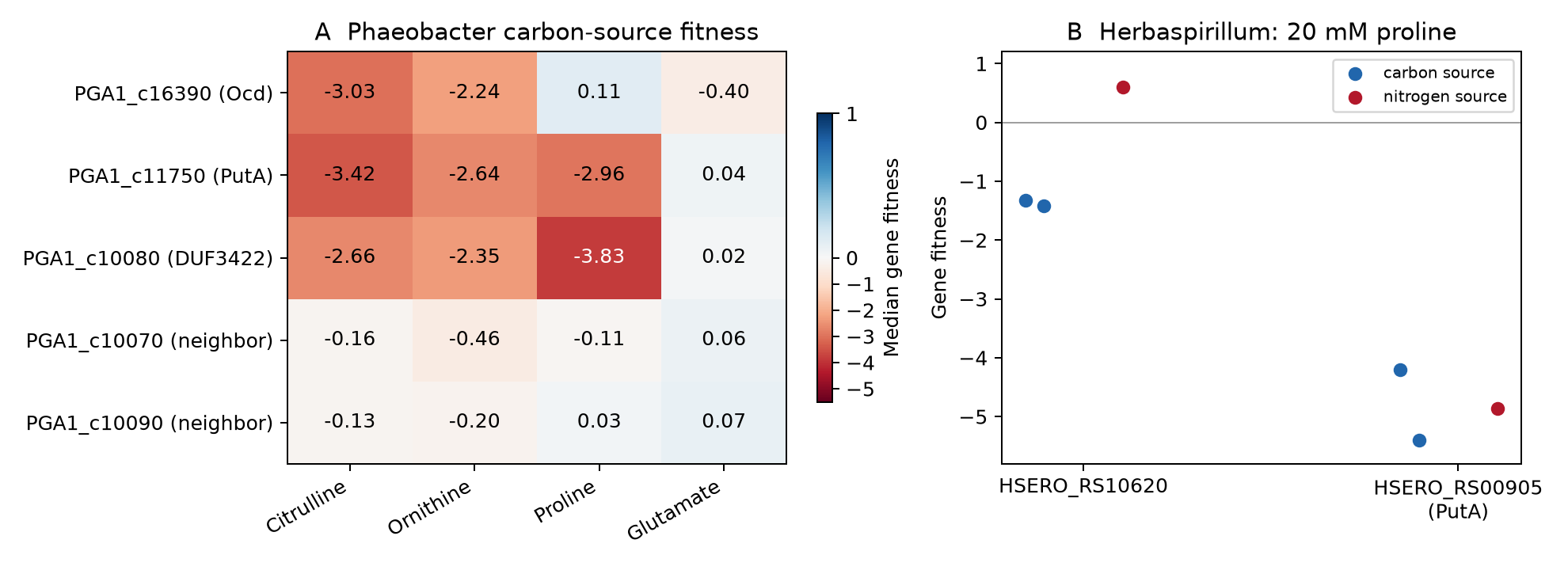
Figure 1. Genes with known pathway roles locate the growth defect, and a homolog (a protein related by shared ancestry) separates carbon from nitrogen use. A: Median gene fitness in P. inhibens over all assays for the four carbon sources, including assays outside the matched comparisons. Ocd is ornithine cyclodeaminase; the bottom two genes flank PGA1_c10080. B: Every available assay using proline as a carbon source or a nitrogen source for the indicated genes in the bacterium Herbaspirillum seropedicae. Proline is 20 mM in both contexts; the nitrogen-source medium supplies glucose as carbon. Each point is one assay. One carbon assay shares a time-zero pool with the nitrogen assay. Colors in A are centered on zero.
Related proteins share the proline-carbon growth defect
A distantly related protein encoded by AO356_01705 in the bacterium Pseudomonas FW300-N2C3 provides cross-organism support for proline-carbon involvement. It has 32.8% amino-acid identity to PGA1_c10080 over 427 alignment columns, including gaps, for proteins of 405 and 426 amino-acid residues. AO356_01705 mutants have fitness −1.66 and −1.49 in two proline-carbon assays. Seven of nine central insertion positions are below −1 in both assays, with both orientations represented. Immediate neighbors, including a downstream gene on the same DNA strand encoding a hydrolase, an enzyme that breaks chemical bonds using water, are spared.
Proline is AO356_01705's worst median carbon source among 45 tested sources. All ten alternative carbon sources with strictly matching experimental metadata produce substantially weaker defects; the smallest median difference is −1.39, against histidine. This specificity disfavors a general carbon-growth defect. A sequence search identifies AO356_09015 as a near-full-length PutA homolog despite its database description as a transcriptional regulator. Mutants of AO356_09015 have fitness −5.35 and −5.48 in the same assays, confirming that these conditions require the proline pathway. The Pseudomonas evidence supports proline-carbon involvement; precursor-based placement within the pathway is established only in Phaeobacter.
The requirement for a DUF3422 protein varies across the family (Table 2). Of 21 catalogued DUF3422 proteins, 12 genes across ten organism-and-mutant-library combinations have proline-carbon measurements. Several are nearly neutral even when PutA is strongly required. For example, AZOBR_RS10595 and ABID97_RS27910 have median fitness +0.02 and +0.16, while their PutA controls have fitness −4.41 and −5.16. These are informative conditions in which a DUF3422 requirement could have appeared.
Table 2. All DUF3422 genes with proline-carbon measurements. Organism/library identifiers are those used by the Fitness Browser. PutA-control medians use the same assays as the corresponding DUF3422 gene; values summarize tested conditions rather than intrinsic differences between species.
| Browser identifier | DUF3422 gene | Assays | Median fitness | PutA-control median |
|---|---|---|---|---|
| Phaeo | PGA1_c10080 | 4 | -3.83 | -2.96 |
| pseudo5_N2C3_1 | AO356_01705 | 2 | -1.57 | -5.41 |
| HerbieS | HSERO_RS10620 | 2 | -1.37 | -4.81 |
| Smeli | SMc00830 | 1 | -0.42 | -5.66 |
| Caulo | CCNA_02669 | 3 | -0.42 | -2.38 |
| psRCH2 | Psest_0888 (GFF869) | 3 | -0.14 | -2.68 |
| BFirm | BPHYT_RS00555 | 1 | -0.06 | -5.52 |
| azobra | AZOBR_RS10595 | 2 | +0.02 | -4.41 |
| BFirm | BPHYT_RS00500 | 1 | +0.05 | -5.52 |
| Marino | GFF3507 | 2 | +0.12 | -2.21 |
| Variovorax_OAS795 | ABID97_RS27910 | 2 | +0.16 | -5.16 |
| Marino | GFF1735 | 2 | +0.35 | -2.21 |
Sequence similarity alone does not resolve these differences. Pf6N2E2_2210, a 96.2%-identical homolog of AO356_01705, has only proline-nitrogen measurements and cannot serve as a counterexample to the carbon phenotype. Conversely, Caulobacter CCNA_02669 has a modest proline-carbon effect (−0.42) and a much stronger xylose-carbon effect (−3.03). The functional prediction should therefore remain attached to the supported genes rather than transferred to every DUF3422 member.
Carbon demand constrains the accessory role
Mutants of HSERO_RS10620, the gene encoding the H. seropedicae homolog, are impaired when proline supplies carbon but spared when it supplies nitrogen (Figure 1B). Fitness is −1.33 and −1.41 in the two carbon assays and +0.60 in the nitrogen assay, all at 20 mM proline and the same date label. The PutA gene in this bacterium, HSERO_RS00905, remains strongly required in both contexts: its carbon median is −4.81 and its nitrogen fitness is −4.86. Thus this DUF3422 homolog can be dispensable during PutA-dependent proline use when glucose supplies carbon.
This supporting result has less insertion depth than the focal result. Only three central HSERO_RS10620 insertion positions are available: two are below −1 in the first carbon assay, all three in the second, and none in the nitrogen assay. The neighboring gene downstream, which points toward HSERO_RS10620, is spared. Insertions upstream and between genes did not resolve whether altered gene expression explains the defect. The carbon-versus-nitrogen difference argues against a requirement for this protein in every instance of PutA activity.
In Phaeobacter, citrulline-nitrogen use also largely spares PGA1_c10080 (median fitness −0.07). This is a weaker localization test because nitrogen can be released before the pathway reaches proline.
Interpretation
The evidence supports the annotation “predicted proline-catabolic accessory supporting carbon utilization” for PGA1_c10080. Its requirement persists across proline and proline-producing precursors, while glutamate use remains intact. AO356_01705 merits a proline-carbon-utilization assignment, and HSERO_RS10620 supplies weaker evidence that this contribution depends on the nutritional context.
The similarity between PGA1_c10080 and PutA fitness profiles is driven by their shared nutrient requirements. Their Pearson correlation, a measure of how closely fitness values vary together across conditions, is 0.884 across 274 assays. It falls to 0.046 across 258 assays after removing proline, ornithine and citrulline conditions. Their common substrate dependence accounts for the correlation.
These pooled-mutant measurements leave the mechanism open, including regulation, support for electron-transfer reactions, metabolite handling and broader transport effects. They do not measure pathway reaction rates, protein interactions or growth of isolated mutants, and provide no evidence of direct PutA binding. A neutral single mutant may reflect another protein compensating for its loss. Repeated assays and insertion sites in the same library are not independent mutant constructions or additional biological replicates. The genome-wide rank and homolog comparisons are exploratory because the candidate was selected from the same resource; the rank is neither a significance test nor independent confirmation.
The prediction is testable: a clean PGA1_c10080 deletion should impair carbon utilization when proline is supplied or generated intracellularly, while retaining glutamate utilization, and complementation (reintroducing a functional copy of the gene) should restore the defect. Resolving that prediction would connect an unassigned protein to a defined segment of bacterial nutrient metabolism.
Methods
We analyzed a fixed public Fitness Browser database snapshot, its protein sequences, experiment metadata and local strain-fitness tables. An exploratory scan covered four uncharacterized protein families, DUF3422, DUF5943, DUF924 and DUF2790, comprising 133 genes, 18,706 fitness values and 548,203 correlations with other genes. Searches using domain profiles, statistical models of the sequence patterns characteristic of a protein family, covered all 334,098 catalogued proteins. Using the models' curated inclusion thresholds confirmed the catalogued family memberships, including 21 DUF3422 proteins. DUF3422 was validated with model PF11902.15 from the Pfam protein-family database. The phenotype analysis used all available measurements for the catalogued DUF3422 genes, rather than restricting the family to close sequence matches to PGA1_c10080.
We used the Browser's published gene-fitness estimates without recalculating them from counts of the DNA barcodes that identify individual mutants. Medians summarize assays grouped by organism, gene, nutrient role and nutrient identity. Carbon-source and nitrogen-source experiments were kept separate. For the five focal contrasts, we selected experiments sharing the metadata listed in Table 1, retained shared time-zero reference pools, and subtracted the control median from the substrate median for every measured gene. We ranked genes by the largest, or least negative, of their five differences. This produced 15,495 gene–contrast values. For alternative-carbon specificity, we enumerated every metadata-matched proline/control assay pair and summarized differences by control nutrient. Shared controls and repeated assays were not treated as independent evidence. We report no post-selection p-values.
Pathway controls were identified from gene annotations and protein-sequence searches. Where annotation searches missed PutA, we searched the complete sets of proteins in the comparison organisms with the Phaeobacter PutA sequence using the protein-sequence search software DIAMOND 2.1.8. Matches exceeding 40% identity and an alignment length greater than 80% of both protein lengths recovered AO356_09015, AZOBR_RS23695 and ABID97_RS00240. Alignment lengths include gaps and are not exact sequence-coverage estimates. Each recovered control was evaluated in the same assays as its DUF3422 homolog. The separate sequence comparison between PGA1_c10080 and AO356_01705 used no cutoff for transferring a functional annotation.
For insertion support, we retrieved complete local strain-fitness intervals around the three candidate genes and inspected their neighbors. Quantitative central-site summaries retain Browser-flagged usable insertions between 10% and 90% of gene length. Multiple barcode observations at the same genomic position were collapsed by their median fitness. Positions separated by at most 10 bp were grouped when counting spatial clusters. We examined both transposon orientations and retained observations excluded from the central-site summaries, including insertions between genes, to inspect the surrounding region. These site medians differ from the Browser's weighted gene estimates and are not expected to reproduce them exactly.
Computations used Python 3.12.16, pandas 3.1.0 and NumPy 2.5.4; the figure used Matplotlib 3.11.2. Source URLs and input hashes identify the analyzed snapshot. All figures and table values were generated from the public inputs.
References
Price MN, Wetmore KM, Waters RJ, et al. (2018). Mutant phenotypes for thousands of bacterial genes of unknown function. Nature 557, 503–509.
Price MN, Deutschbauer AM, Arkin AP (2022). Filling gaps in bacterial catabolic pathways with computation and high-throughput genetics. PLoS Genetics 18, e1010156.
Fitness Browser. Public mutant-fitness measurements, experiment metadata and protein sequences.
NCBI Clusters of Orthologous Genes, category S. COG4949 family description.