An uncharacterized bacterial protein supports growth in external nitrite even when other nitrogen is available
Why it matters
Bacteria can use nitrite as a nutrient, but nitrite can also harm them. Mutant data point to a small protein that helps one bacterium grow in nitrite even when other nutrients supply its nitrogen. This suggests a protective role and gives researchers a specific gene to test.
Bacteria can use nitrite as a nitrogen source, but nitrite can also harm them. To understand how bacteria grow in its presence, we need to distinguish proteins that help acquire nitrogen from those that help tolerate nitrite. Public measurements of mutant growth identify the uncharacterized protein Psest_1622 as a candidate nitrite-tolerance accessory in the bacterium Pseudomonas stutzeri RCH2. Disrupting its gene reduced mutant fitness on nitrite relative to nitrate by −3.75 and −4.45 on two assay dates. Fitness here measures the change in a mutant's abundance relative to a pool of mutants on a normalized log₂ scale. A smaller defect persisted in nutrient-rich medium, where other nitrogen sources were available and mutants in the nitrogen-assimilation pathway were spared. This separates Psest_1622's contribution from the shared machinery for obtaining nitrogen from nitrate and nitrite.
Background
Nitrogen assimilation converts nitrate through nitrite to reduced nitrogen for building cellular material. Supplying nitrite directly bypasses nitrate reduction but still requires nitrite reduction. Comparing the two nitrogen sources can therefore distinguish proteins needed for their common pathway from proteins particularly important when nitrite arrives from outside the cell. Rich medium supplies alternative nutrients, so a nitrite-associated defect there need not reflect failure to obtain nitrogen.
RCH2 has been studied using pooled libraries of mutants, each carrying a transposon, an inserted piece of DNA that disrupts a gene and carries a sequence tag. Sequencing these tags, also called barcodes, before and after growth measures changes in mutant abundance. The Fitness Browser, a public database of these measurements, reports normalized log₂ fitness values. Negative values indicate that mutants lose abundance relative to the pool; they are not direct measurements of growth rate. This approach underlies large public surveys of bacterial gene function [1,2]. Earlier RCH2 work examined accessory genes in denitrification, the use of nitrogen oxides for respiration without oxygen [3]. Here the question concerns aerobic growth, with oxygen present, under external-nitrite exposure.
Psest_1622 belongs to DUF6306, a protein family named as a domain of unknown function. A domain is a recognizable region of a protein that can occur alone or alongside other domains. Nitrite acquisition, support of the assimilation machinery and tolerance of external nitrite predict different mutant behavior when nitrate supplies nitrogen or when rich medium supplies other nutrients.
Results
Mutants grow poorly on nitrite but retain fitness on nitrate
Psest_1622 has one of the strongest reproducible fitness differences favoring nitrate over nitrite in the RCH2 dataset. We screened all 3,349 measured genes in two comparisons matched by assay date, giving 6,698 gene-by-date contrasts. Both nitrogen sources were supplied at 5 mM in the same defined medium under aerobic conditions. Ranking genes by their weaker nitrite-minus-nitrate contrast placed Psest_1622 second, behind Psest_4083, a predicted permease, or membrane transport protein.
The annotated assimilatory nitrite reductase Psest_1928, an enzyme that reduces nitrite for nitrogen assimilation, provides the pathway control. Its mutants lose fitness on both nitrogen sources, as expected for an enzyme acting after nitrate reduction. Psest_1622 mutants instead show severe defects on nitrite and little change on nitrate (Table 1). The pattern argues against an obligatory role in the common nitrite-reduction machinery.
Table 1. Median gene fitness in the matched nitrogen-source assays. Values are normalized log₂ changes in mutant abundance relative to the pool.
| Gene | June 2013 nitrite | June 2013 nitrate | February 2014 nitrite | February 2014 nitrate |
|---|---|---|---|---|
| Psest_1622 | −3.982 | −0.229 | −4.339 | +0.110 |
| Psest_1928 | −2.650 | −2.407 | −1.736 | −2.250 |
| Psest_4083 | −4.201 | −0.131 | −5.064 | −0.824 |
June 20, 2013 comprised two nitrite assays and one nitrate assay; February 27, 2014 comprised two of each. Both dates used the same RCH2 mutant-library resource, rather than independently constructed knockout collections.
The defect persists when nitrite need not supply nitrogen
Psest_1622 mutants also lose fitness during nitrite exposure in Luria–Bertani (LB) medium, a nutrient-rich growth medium. Across all three assays with 2.5 mM nitrite in LB, their fitness values were −1.397, −1.413 and −1.848. The median was −1.413, compared with −0.081 across 14 other LB assays on the same date. The resulting contrast, −1.331, ranked 36th among 3,349 genes. The Fitness Browser's moderated t statistics, which summarize fitness relative to its estimated uncertainty, ranged from −2.73 to −3.23 in these three nitrite assays.
The assimilation-associated controls were largely spared in LB nitrite (Figure 1A). Median fitness was +0.145 for the nitrite reductase Psest_1928, −0.258 for the nearby annotated dehydrogenase Psest_1926, an enzyme involved in electron-transfer reactions, −0.087 for Psest_1925, an annotated uroporphyrin methyltransferase that adds methyl groups to uroporphyrin, and +0.151 for Psest_3835, the small electron-transfer protein rubredoxin. All four had substantial defects when nitrite supplied nitrogen. Their recovery in LB supports the interpretation that alternative nutrients bypass the assimilation requirement, whereas Psest_1622 still contributes to growth under nitrite exposure. This favors a tolerance function over an uptake requirement confined to assimilation.
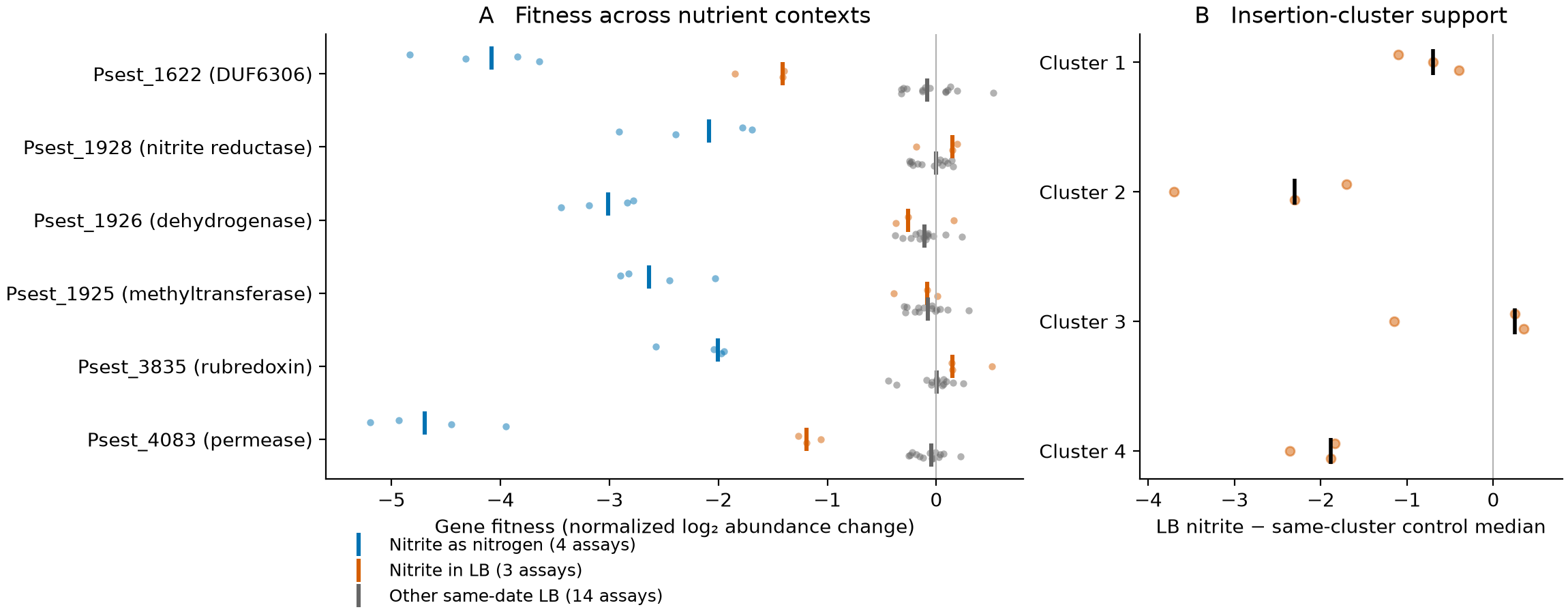
Figure 1. Psest_1622 retains a rich-medium nitrite defect where assimilation-associated mutants recover. A, Points show every assay in each group; vertical marks show medians. Nitrite supplied nitrogen at 5 mM in four assays across two dates. The three 2.5 mM LB-nitrite assays and 14 other LB assays share February 24, 2014. B, Insertion clusters group transposon insertion coordinates within 10 base pairs. Each point is one LB-nitrite assay's insertion-cluster fitness minus that cluster's median across the 14 controls; black marks show the three-assay median. Three of four clusters support the rich-medium defect. Points are descriptive observations, not independent biological replicates.
The predicted permease Psest_4083 shares the LB-nitrite defect, with median fitness −1.194. This identifies a second gene associated with growth under external nitrite. Similarities between the genes' fitness patterns are concentrated in the nitrogen-source assays. After removing the four assays in which nitrite supplied nitrogen, correlations of Psest_1622 with the reductase, rubredoxin and permease fall to 0.059, 0.023 and 0.033, respectively.
Multiple insertion sites support the gene assignment
The severe nitrogen-source phenotype is supported across the gene. Eight usable barcode records resolve to five insertion coordinates and four spatial clusters. All five positions have fitness below −1 in two assays in which nitrite supplied nitrogen; four of five do in each of the remaining two. Rich-medium support is less uniform. Cluster-level nitrite-minus-control contrasts are −0.700, −2.300, +0.250 and −1.888 (Figure 1B). The third cluster is a counterexample to a uniform insertion phenotype.
Gene arrangement also argues against an ordinary downstream polar effect. This occurs when an insertion impairs expression of another gene in the same operon, a group of genes transcribed together. Psest_1621, the adjacent gene beyond the end of Psest_1622, faces toward it on the opposite DNA strand and has median fitness −0.055 when nitrite supplies nitrogen. The upstream gene Psest_1623 encodes a cyclophilin, a protein in a family that assists protein folding. It has a weaker defect when nitrite supplies nitrogen (−1.324) and is spared in LB nitrite (+0.234). These observations favor an effect at Psest_1622 itself.
The phenotype is strongest in the tested aerobic conditions. Across all twelve anaerobic nitrite assays, performed without oxygen, Psest_1622 median fitness is −0.278. Those assays use 20 mM nitrite and also change medium, supplements and respiratory context, so the difference cannot be attributed to oxygen alone.
Related proteins are fused to enzyme domains with different known activities
Sequence comparisons uncovered an enzyme association. Of 158 DUF6306 proteins downloaded from UniProt, a public protein-sequence database, 37 from 17 named genera also contain a separate PF03060 domain before the DUF6306 domain in the same protein. Such fusions can offer clues to a protein's function. PF03060 is a domain family named for nitronate monooxygenase, an enzyme that can generate nitrite, but its characterized members also include quinone reductases, enzymes that transfer electrons to quinones [4–6].
Comparing the 37 enzyme regions with five characterized proteins gave best matches to a bacterial nitronate monooxygenase in 19 cases, a quinone reductase in 17, and a fungal nitronate monooxygenase in one. Sequence identities to the best reference matches were only 29–43%. We also searched for four published sequence signatures, characteristic amino-acid patterns associated with class-I nitronate monooxygenases. None of the 37 complete regions preceding DUF6306 matched any of these signatures; both class-I positive controls matched all four. This fails to support the simple explanation that DUF6306 is fused to a nitrite-producing partner, while leaving divergent enzyme activities possible.
Interpretation and limits
The supported functional prediction is that Psest_1622 helps RCH2 cope with external nitrite in the tested aerobic conditions. The matched nitrate comparison separates it from the shared assimilation requirement; the rich-medium comparison supplies the additional evidence favoring tolerance. A clean loss of Psest_1622 is predicted to impair growth during external-nitrite exposure even with alternative nitrogen available, while largely preserving nitrate-supported growth.
The rich-medium evidence is modest and comes from one date used in exploratory screening. Its 14 comparators are other stress exposures, including nitrate, chloride, perchlorate, paraquat and cisplatin, rather than untreated LB or equally toxic doses. One insertion cluster fails to reproduce the median effect, and pooled insertion mutants provide less precise causal evidence than deleting the gene and restoring it to test whether growth recovers. The data therefore support a tolerance-accessory prediction; transport, regulation and damage protection remain possible mechanisms. The permease annotation does not establish nitrite transport, fitness correlations do not establish a shared protein complex, and the fusion evidence does not determine the chemical role of Psest_1622. A search of all 334,098 Fitness Browser protein sequences found no second measured DUF6306 member, limiting the phenotype assignment to this gene and strain.
Methods
We used the public Fitness Browser database, experiment metadata and individual-mutant fitness records for RCH2 [7], retaining all 350 available experiments. Gene-level fitness and moderated t statistics were taken from the database rather than re-estimated from sequencing reads. For the nitrogen-source comparison, assays were selected by nitrogen-source labels and date. Within each date, medium, concentration, secondary conditions, temperature and oxygen labels matched. We subtracted median nitrate fitness from median nitrite fitness and ranked genes by the less negative of their two contrasts. This exploratory ranking screens for effect size; it is not a significance test adjusted for multiple testing.
The other comparisons included every aerobic assay in which nitrite supplied nitrogen, every LB-nitrite assay and every anaerobic nitrite assay. The LB contrast subtracted each gene's median across the 14 non-nitrite LB assays started on February 24, 2014 from its median across that date's three nitrite assays. We applied no t-statistic filter. For insertion analysis, we retained records marked usable by the source, took medians across barcodes at each coordinate, then grouped successive coordinates separated by at most 10 base pairs and took their medians within each assay. Each cluster was compared with its own median control fitness. Correlations were Pearson correlations, which measure linear association, across available gene-fitness profiles, with the specified nitrite groups removed.
The November 2026 UniProt family sample contained 158 entries. We validated DUF6306 and PF03060 domains using profile hidden Markov models from Pfam, a database of protein families. These statistical models recognize family-specific sequence patterns; we used their curated gathering thresholds, the score cutoffs for assigning a sequence to each family. Split PF03060 matches were combined into one enclosing span per protein. These spans were compared by local alignment, which finds similar sequence regions, using the BLOSUM62 amino-acid substitution scoring matrix, with gap-open penalty 10 and gap-extension penalty 0.5. The five characterized reference proteins were PA4202 (UniProt identifier Q9HWH9), PA1024 (Q9I4V0), PA0660 (Q9I5R1), and the fungal enzymes Q12723 and Q01284. Exact class-I signature matching used the four patterns in Table 3 of Salvi et al. [4], the study defining the nitronate-monooxygenase classes. We searched the entire region before DUF6306 to avoid losing terminal sequence signatures through domain-boundary truncation. Fusion counts describe the downloaded sample, not independent evolutionary events. The search of all Fitness Browser protein sequences for DUF6306 used the same gathering-threshold criterion.
References
- Wetmore KM et al. (2015). Rapid quantification of mutant fitness in diverse bacteria by sequencing randomly bar-coded transposons. mBio 6, e00306-15.
- Price MN et al. (2018). Mutant phenotypes for thousands of bacterial genes of unknown function. Nature 557, 503–509.
- Vaccaro BJ et al. (2016). Determining roles of accessory genes in denitrification by mutant fitness analyses. Applied and Environmental Microbiology 82, 51–61.
- Salvi F et al. (2014). The combined structural and kinetic characterization of a bacterial nitronate monooxygenase from Pseudomonas aeruginosa PAO1 establishes NMO class I and II. Journal of Biological Chemistry.
- Salvi F et al. (2016). Functional annotation of a presumed nitronate monoxygenase reveals a new class of NADH:quinone reductases. Journal of Biological Chemistry.
- Reis RAG et al. (2019). Kinetic investigation of a presumed nitronate monooxygenase from Pseudomonas aeruginosa PAO1 establishes a new class of NAD(P)H:quinone reductases. Biochemistry.
- Fitness Browser public database. RCH2 gene fitness, experiment metadata and linked strain-fitness data; downloaded November 2026.