On cube faces, marking exactly three eighths of the corners is easier than marking one eighth
Why it matters
Imagine marking settings on a panel of switches. Fix most switches at random and try every setting of the ones left free: you can arrange for exactly three in eight settings to be marked on nearly every test. Asking for exactly one in eight instead makes misses more common even with the best arrangement, and the gap grows exponentially with the number of free switches.
Suppose we want to mark the corners of a high-dimensional cube so that as many faces as possible have a chosen fraction of their corners marked. Think of each corner as a setting of a bank of switches. Fix some switches and try every setting of the rest: the corners visited form a face. Getting the right fraction across the whole cube leaves open how to distribute the marks, because each corner belongs to many faces. Known marking rules take advantage of powers of two in the desired count. That suggests one eighth and three eighths should be equally easy targets, since their counts on a given face are odd multiples of the same power of two.
The two targets differ even in the best possible markings. In the large-cube limit, with 32 switches left free, every marking misses the one-eighth target at least 29 times as often as a particular marking misses three eighths. The ratio of the two optimal failure fractions (three eighths divided by one eighth) falls to zero exponentially as the face dimension d grows. The smallest possible fraction of faces that miss one eighth lies between constant multiples of (3/7)^d. For three eighths, we give a marking that misses on just 15(1/3)^d-24(1/6)^d of the faces.
How to sample a face
A vertex (corner) of an n-dimensional binary cube is a string of n bits. To sample a coordinate face of dimension d, choose d bit positions uniformly to leave free and choose a uniform setting for the remaining n-d bits. The face consists of all 2^d strings that agree on the fixed bits. It succeeds at target a if exactly 2^d a of its vertices are marked. For the two eighths, take d\ge3 so these counts are integers.
At each cube dimension n, minimize the probability of failure over all markings, whatever their overall density. Write B_d(a) for the limit of these minima as n grows with d fixed. To see why the limit exists, fix just one randomly chosen coordinate to a random value. Sampling a face inside this smaller cube gives the same average failure fraction as sampling in the whole cube. Thus the minimum cannot decrease as n grows, and it is bounded above by one. We take this large-cube limit before increasing the face dimension.
In On hypercube statistics, Alon, Axenovich and Goldwasser denote the limiting maximum success fraction by \lambda(d,2^d a), so B_d(a)=1-\lambda(d,2^d a). Their Theorem 2 uses free bits to repeat a smaller count a power-of-two number of times. For one eighth, Bodnár and Pikhurko computed the failure fraction of a marking based on a Hamming code for every d and proved it optimal at d=4. The choice of directions matters here. If a face varies along random independent binary directions (a random affine subspace) instead of along coordinate axes, Xu proved that both targets have failure of order 2^{-(d-3)}.
Two constructions
The Hamming code gives a marking that treats both targets alike. Give each coordinate one of the seven nonzero three-bit labels, using the labels as equally often as possible. To each vertex assign the sum, bit by bit modulo two, of the labels at its 1-bits. Mark the vertex if its sum is 000. On a face, toggling a free bit adds its label. If sums of subsets of the free labels give all three-bit words, all eight sums occur equally often and exactly one eighth of the face is marked. Otherwise only one, two or four distinct sums occur, with equal multiplicities. The face must fail. In fact, marking three of the eight sums instead gives exactly the same failed faces: three eighths, too, is impossible with only one, two or four equally frequent sums.
For fixed d the free labels approach d independent uniform draws as n grows. Failure means that all labels fall in one of the seven planes through zero. Each plane consists of the solutions to a single nonzero linear equation modulo two and contains three nonzero labels. Adding the seven plane probabilities gives failure at most 7(3/7)^d. The exact value is 7(3/7)^d-14(1/7)^d: when all labels coincide, three planes count the same outcome instead of one Bodnár and Pikhurko, equation (4).
Three eighths admits a different marking in which any three distinct labels suffice. Divide the coordinates into six blocks of equal limiting size. For each block record a parity bit: zero if the number of 1-bits is even, one if it is odd. Mark a vertex if the resulting six-bit word belongs to the 24-word pattern that Goldwasser and Hansen used in their Figure 4 to count a particular three-point shape. Regardless of shape, every one of the pattern's 160 coordinate three-faces has exactly three marks.
Figure 1 shows how to build the pattern. Label five positions by the vertices of a pentagon and the sixth by a star. Identify a word with its set of 1-bits. Mark the empty set, the star alone, the five edges, and the five diagonals each with the star added. Also mark the complements of those twelve sets.
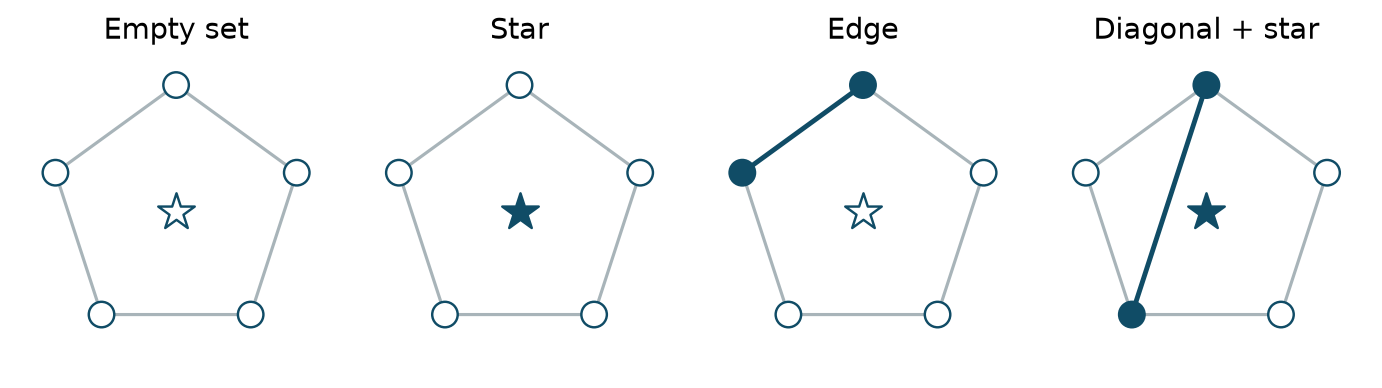
Figure 1. Filled positions are 1-bits. Rotating the four words gives respectively one, one, five and five distinct words; reversing filled and empty positions gives the other twelve marks.
To check the count, choose a marked word uniformly. Each bit is equally often zero and one because each word comes with its complement. For any pair of positions, six of the twelve original sets contain both positions or neither. This holds for a star and a vertex, an edge, and a diagonal. After adding complements, exactly six marks therefore have both bits set to one. Since each bit is balanced, all four settings of the pair occur equally often.
For three specified positions, complementation interchanges even and odd numbers of 1-bits, so these two cases are equally frequent as well. To see why these balances suffice, write the indicator of a specified triple as a product of three factors (1\pm(-1)^{x_i})/2, where x_i is the bit in position i. Each factor selects zero with the plus sign or one with the minus sign. On expansion, every nonconstant term has mean zero by the single-bit, pair or triple balance just shown. Each triple setting therefore occurs on three of the 24 marks. Fixing that triple leaves the other three bits free: the resulting face has exactly three marks.
When the free bits meet j blocks, the parity words on the face fill a coordinate j-face, each word equally often. For j\ge3, partition that face into three-faces; every part has the right count. For j<3, the denominator 2^j precludes three eighths. Thus the failure probability is just the chance of seeing at most two block labels. Among 6^d equally likely label sequences in the limit, six use one label and \binom62(2^d-2) use two. Calling this last probability T_d gives an upper bound on the minimum failure probability:
A lower bound for every marking
To bound failures from below, consider how much the marked fraction varies from face to face. Write f(x)=1 if vertex x is marked and f(x)=0 otherwise. Let p be the fraction of the cube marked and Z the fraction of a random face marked. The average of Z over faces is E Z=p, since every vertex is equally likely to be sampled. If the failure probability at target a\le1/2 is b, the difference Z-a vanishes except on a fraction b of the faces. Hence
Averaging over a face cancels some patterns of variation exactly. To see which ones survive, expand f in parity functions \chi_S(x)=(-1)^{\sum_{i\in S}x_i}, one for every subset S of the coordinates. These functions form an orthonormal basis under uniform averaging, with coefficients \widehat f(S)=E[f\chi_S]. The constant term is p and the remaining squared coefficients sum to \operatorname{Var} f=p(1-p). Choose the face by choosing its free coordinates and a uniform vertex through which it passes. A parity term averages to zero if a free coordinate lies in S; otherwise it keeps its value at the vertex. At the uniform vertex, distinct parity terms have mean product zero. Each surviving term therefore contributes its own squared coefficient to the variance. The binomial ratio below is the chance that all free positions miss S:
Large sets S are the easiest to hit. If too much variation came from these sets, however, flipping a single bit would change the marking more often than its density permits. Flip one uniformly chosen bit of a uniform vertex. The chance that its marking changes is at most 2p, since one of the two endpoints must be marked. This chance also equals the mean squared change in f. A parity term changes sign with probability |S|/n, so orthogonality gives the mean squared change as 4\sum_S (|S|/n)\widehat f(S)^2. This edge count also bounds how many bits one can fix while keeping every face density unchanged (Potapov). Weighting each nonempty S by \widehat f(S)^2/[p(1-p)], the mean of |S|/n is at most 1/[2(1-p)].
At fixed d, the fraction in (3) differs from (1-|S|/n)^d by at most \binom d2/n, uniformly in S: draws with replacement and without replacement can agree until a coordinate repeats. The function (1-t)^d is convex and decreasing on [0,1]. Its weighted mean is at least its value at the weighted mean of t (Jensen's inequality). For 0<p\le1/2, this yields
At a=1/8 the Hamming upper bound forces |p_d-a|\le7(3/7)^d. In particular 0<p_d<1/2 for sufficiently large d, and q(p_d) is exponentially close to q(a)=3/7. Even after taking the dth power their ratio tends to one, since d\,|\log(q(p_d)/q(a))|\to0. Equation (4) places B_d(1/8) between (1/7-o(1))(3/7)^d and 7(3/7)^d. Here o(1) tends to zero as d grows. Thus the Hamming marking has the best possible exponential rate: a different marking could improve the constant factor, but cannot lower the base 3/7.
The same proof gives the rate at every fixed a=2^{-r}, r\ge2. Use all 2^r-1 nonzero r-bit labels in equal proportions and mark sum zero. Failure requires the free labels to lie in a hyperplane (the solutions to one nonzero linear equation). There are 2^r-1 such hyperplanes, each containing a fraction q(a)=(2^{r-1}-1)/(2^r-1) of the labels. The resulting upper bound (2^r-1)q(a)^d again forces p_d exponentially close to a in (4). Thus B_d(a) lies between constant multiples of q(a)^d as d grows with r fixed.
Size of the separation
Even the lower bound for one eighth exceeds the failure fraction of the six-block marking for three eighths at every d\ge19. Table 1 shows what this comparison guarantees. At 32 free bits every one-eighth marking fails at least 29 times as often as the six-block rule does at three eighths. By (1) and (4), the ratio B_d(3/8)/B_d(1/8) is at most a constant times (7/9)^d for large d.
Table 1. Failure fractions in the large-cube limit. The third column is attained by a specific marking; the second applies to every marking. The last column gives a guaranteed factor of separation when it exceeds one. Values are rounded.
| Free bits d | One eighth: lower bound for any marking | Three eighths: six-block failure | One-eighth bound / six-block failure |
|---|---|---|---|
| 18 | 3.40\times 10^{-8} | 3.87\times 10^{-8} | 0.878 |
| 19 | 1.46\times 10^{-8} | 1.29\times 10^{-8} | 1.13 |
| 24 | 2.11\times 10^{-10} | 5.31\times 10^{-11} | 3.97 |
| 32 | 2.40\times 10^{-13} | 8.09\times 10^{-15} | 29.6 |
| 48 | 3.10\times 10^{-19} | 1.88\times 10^{-22} | 1.65e+03 |
To obtain the second column, set a=1/8 and u=7(3/7)^d. Since a-u\le p_d\le a+u and q decreases, (4) gives the lower bound L_d=(a-u)(1-a-u)q(a+u)^d/(1-a)^2 in the displayed range. At d=19, direct rational substitution gives L_d/(15/3^d)>1.12. This ratio keeps increasing: the positive prefactor increases as u decreases, and the exponential factor [3q(a+u)]^d already has base greater than one. Nineteen is a sufficient dimension, not the first instance of separation. At d=4, for example, Bodnár and Pikhurko's exact one-eighth failure is 79/343, already larger than T_4=1/6.
Testing other markings
We tested rules that mark a vertex when the sum (bit by bit modulo two) of the labels at its 1-bits belongs to a prescribed set. The National Institute of Standards and Technology catalogue of Boolean functions supplied representative functions with binary inputs and a single binary output. The inputs with output one form the prescribed set. For each representative on two through five bits, we added each possible linear function of the inputs to the output modulo two. We treated complementary outputs as equivalent and skipped constant outputs and sets of density one half.
In the 1,272 remaining tests we varied the frequencies of the nonzero labels. For each nonconstant parity term with nonzero coefficient, we computed the chance that adding one random label leaves the term unchanged. The term survives face averaging if all d free labels leave it unchanged. We therefore minimized the largest of the single-label probabilities. Each is linear in the label frequencies, so we could certify the minimum exactly: a feasible choice of rational frequencies and a feasible solution of the dual problem (which bounds the minimum from below) gave matching values. At three eighths, 16 of 200 tests reached 1/3; at one eighth none improved on 3/7.
On six bits we tested 63,033,634 candidate label pools across 150,357 representatives. To form a pool, we set a threshold and included each label whose addition changed the output on at least that many inputs. We assigned equal frequency to every label in the pool. We tested every nonempty pool formed this way for every linear addition to the output that left the function nonconstant and its density different from one half. This restricted search again reached 1/3 at three eighths. Evaluating the five-bit rule that attained this value on all settings of its six selected labels gave the Goldwasser–Hansen pattern up to permuting and flipping bits. Counting all 160 three-faces directly confirmed that any three distinct blocks suffice. Separately, summing marks directly on faces verified (3) and the edge bound for every one of the 65,536 markings of the four-cube and all four positive face dimensions.
The limit for fixed block patterns
No marking based on a fixed number of block parities can improve the base 1/3 at density three eighths. Consider any fixed pattern on m block parities of density a=3/8, even with unequal positive block proportions. Subtract the target from the marking indicator to give a function g=f-a with mean zero. The mean of its cube is nonzero: E[g^3]=a(1-a)(1-2a). In the expansion of this third moment, products of three parity functions average to zero unless their product is constant. Some three parity functions with nonzero coefficients must therefore have constant product. Every bit occurs an even number of times among their three index sets, so at least one set omits it. Summing the omitted block proportions over the three sets therefore gives at least one. At least one set omits blocks of total proportion 1/3 or more. With probability at least (1/3)^d all free coordinates land in those omitted blocks, preserving that nonconstant parity term. For any such choice of free coordinates, the surviving term has nonzero coefficient. Thus at least one starting parity word must give a nonzero face average of g, which means the face misses three eighths. Since the m block parities of a uniform vertex are uniform, failure has probability at least 2^{-m}(1/3)^d in the large-cube limit. This third-moment argument is related to the bounds on how many bits can be fixed while keeping the marked fraction unchanged, studied by Krotov and Vorob’ev.
The factor 2^{-m} in the lower bound depends on the number of blocks. Whether increasingly complex markings can beat the three-eighths base remains open; the separation from one eighth holds either way.