In early mouse embryos, daughters of the much larger sister extended their head start by nearly an hour on average
Why it matters
In movies of early mouse embryos, the daughters of a larger cell could divide before their cousins simply because they were born first. In the ten families where the mothers differed most in size early on, the daughters of the larger cell gained nearly another hour after birth, on average. Families with smaller early size differences showed no such average gain.
When cells in one branch of an embryo’s family tree repeatedly divide first, do they inherit a faster pace of division? Division order alone cannot tell us. If one cell divides before its sister, its daughters are born before their cousins. They can divide first even if they take just as long to go from birth to division.
We timed both generations in 60 families from 16 mouse embryos. In ten families, one sister had over 20% more volume than the other early in the eight-cell stage. On average, the larger sister’s daughters were born 67.5 minutes before their cousins and gained another 55.5 minutes because their own cycles were shorter. In the other 50 families, the larger sister’s daughters were born 17.1 minutes earlier but lost 11.6 minutes on average before dividing.
Division times within families
Earlier movies of mouse embryos showed the order in which related cells divided. Fabrèges and colleagues made a public dataset that lets us relate division times to cell size: it records the paths of individual cell nuclei through successive movie frames as well as the volumes enclosed by cell membranes.
We paired the cells at the eight-cell stage that came from the same mother at the four-cell stage. To identify the larger sister, we used each cell’s median volume during the first 30% of the time when all eight cells were present and matched to their nuclei. We expressed the difference as a percentage of the smaller sister’s volume. The larger sister divided first in 43 of 64 pairs, later in 16 and in the same frame in five. Among 26 pairs differing by at least 10% in volume, the larger sister divided first in 22.
In 60 families, we could follow all four daughters to division. We averaged the times for the two daughters on each side of the family before comparing the cousins. Their mothers’ difference in division time gave the daughters’ head start at birth. The difference in the daughters’ own cycle lengths gave the time they gained or lost after birth. For example, one sister had 24% more volume than the other and divided 90 minutes earlier. Her daughters took an average of 37.5 fewer minutes than their cousins to go from birth to division. By the time they divided, their lead averaged 127.5 minutes.
Table 1. Mean time differences in minutes, grouped by how much larger one sister was early in the eight-cell stage. Each complete family counts equally. A positive head start means the larger sister’s daughters were born earlier; a positive gain means their cycles were shorter. The sum gives their lead at division. Parentheses beside the means give approximate 95% intervals calculated by leaving out whole embryos.
| Excess volume | Pairs (embryos) | Head start at birth | Gain during daughter cycles | Lead at daughter division |
|---|---|---|---|---|
| <5% | 16 (10) | 2.8 (−18.1 to 23.8) | −21.1 (−42.3 to 0.1) | −18.3 (−49.1 to 12.5) |
| 5–10% | 20 (12) | 22.5 (−24.1 to 69.1) | −11.2 (−31.9 to 9.4) | 11.2 (−45.3 to 67.8) |
| 10–20% | 14 (9) | 25.7 (−0.8 to 52.3) | −1.1 (−40.2 to 38.1) | 24.6 (−24.0 to 73.3) |
| >20% | 10 (8) | 67.5 (28.3 to 106.7) | 55.5 (23.7 to 87.3) | 123.0 (86.8 to 159.2) |
The mean head start rose from 2.8 minutes among nearly equal sisters to more than an hour among the most unequal. In all ten of the most unequal families, the larger sister’s daughters divided earlier on average than their cousins. In seven they gained time after birth, in two they lost time and in one they kept their birth lead exactly. Leaving out any one of the eight contributing embryos gave a mean gain of 48 to 64 minutes. Among pairs differing by at most 20%, the mean gain was −11.6 minutes (95% interval, −26.9 to 3.8), consistent with anything from a loss of nearly half an hour to a gain of a few minutes.
Across all sizes, we also estimated how each timing difference varied with the logarithm of the sisters’ volume ratio. We fitted straight lines through zero, so that sisters of equal volume had no predicted timing difference. This summary attributed 75% of the size-associated lead at daughter division to earlier birth. In the most unequal families, the contributions from earlier birth and shorter cycles were much closer in size.
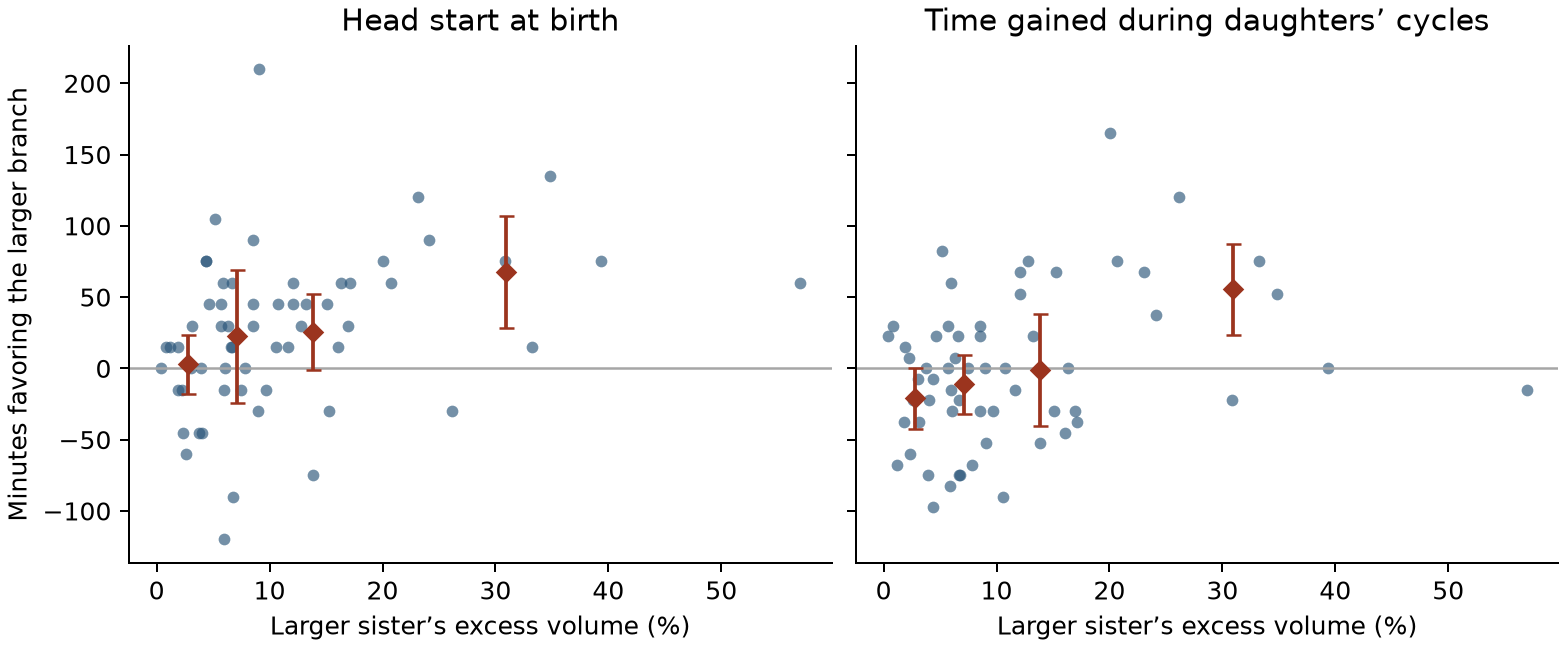
Figure 1. Each blue point represents one family. Diamonds mark the means from Table 1 at each group’s mean volume difference; the intervals are the same as in the table. The largest gain after birth (165 minutes) occurred just above the 20% boundary. In the most unequal pair, the larger sister’s daughters lost 15 minutes.
How the timing of the size measurement mattered
When we used median volumes from the middle or final 30% of the eight-cell interval, the group above 20% changed. Each later group retained six of the original ten pairs. The mean gain after birth fell to 22.5 minutes using the middle window (eight pairs; 95% interval, −18.5 to 63.5) and 15.8 minutes using the final window (ten pairs; −11.5 to 43.0). With either later measurement, the data were compatible with an average loss as well as a gain.
Among the 16 families whose sisters were initially within 5% of each other in volume, the initially larger sister’s daughters had cycles averaging 21.1 minutes longer. The interval in Table 1 includes no average difference. In the middle window the other sister ranked as larger in four of those families; using the new rankings, the larger sister’s daughters averaged 6.1 minutes longer. In the final window five rankings reversed relative to the early window, and the difference averaged 20.2 minutes. For nearly equal sisters, a change in rank could reflect measurement error or a real change in relative volume.
Measuring cells and estimating uncertainty
In the 16 control embryos, we matched 3,936 cell centers identified from membranes to tracked nuclei across 492 eight-cell frames. Within each frame we centered the two sets of positions, aligned their spread along each axis and paired centers with nuclei one to one to minimize the total distance between them. Every cell center was closest to its assigned nucleus, and vice versa. The early volume window ended at least 4.25 hours before either sister divided. Frames were 15 minutes apart; we dated each division to the first frame showing both daughter nuclei as separate tracks. To estimate the standard error of each group mean, we recalculated it leaving out one contributing embryo at a time. We used the t distribution with one fewer degree of freedom than the number of contributing embryos to calculate the interval.
All four families with incomplete follow-up fell below the 20% cutoff. Of the five daughters without a recorded division, four were still being followed when the movie ended and one track stopped earlier. To include these families, we counted time to division up to a limit of 22 hours after birth; the longest completed cycle was 21.75 hours. For each unfinished cycle we allowed any duration between the age at last observation and 22 hours, capping both bounds at 22 hours. Across all 54 families in the lower group, the mean gain could then range from −4.4 to +2.8 minutes. This range bounds the possible averages for the observed families under the time limit; it is not a confidence interval for eventual division times.
In 48 families from 12 additional control embryos, we compared two ways to predict the daughters’ lead at division from their head start at birth. Carrying the head start forward unchanged gave a mean absolute error of 41 minutes, compared with 61 minutes for doubling it. These embryos lacked matched cell volumes for a comparison by size.
The size comparison comes from one set of 16 embryos. We chose the groups after inspecting the families, so the intervals describe uncertainty within those groups and omit uncertainty from choosing them. The 20% boundary is therefore descriptive, not an established threshold. Cell position and developmental state could also vary with volume. What the movies show is that, among the sisters most unequal in size early on, shorter daughter cycles added about as much to the average lead as earlier birth did. Measuring size at the same stage in independent movies would test whether that pattern recurs.