If sudden gas loss stretched the inner orbit of UCAC4 093-013644, its distant star must follow an elongated orbit
Why it matters
If a dying star made its close companion’s orbit oval by suddenly shedding gas, the pair would also have recoiled. In this system a distant third star could have stayed with the pair only by passing much closer than it is today. Many distant stars already follow such stretched orbits, so finding a fairly round orbit here would tell us more: the sudden gas loss alone could not explain the inner pair’s orbit.
When a giant star transfers gas to a nearby star, tides should make their orbit nearly circular. Yet some pairs follow elliptical orbits even after the giant has shed its outer layers and left behind a compact remnant, a white dwarf. Astronomers would like to know whether the last gas to escape stretched the orbit or whether the orbit was already elliptical. The pair’s orbit today cannot distinguish those histories on its own.
A distant third star offers a test in the system UCAC4 093-013644. The inner pair consists of a visible dwarf star and a likely white dwarf. If a single, sudden, symmetric ejection of gas produced their orbit from a circle, the pair recoiled at 6.25 ± 0.73 km/s. For the third star to have stayed gravitationally bound, it must have been much closer to the pair then than it is today. Its orbit must therefore have an eccentricity of at least 0.84 for a plausible red-dwarf mass, or 0.76 for a conservatively heavy companion. Eccentricity measures how far an orbit departs from a circle: zero is circular, and values approaching one describe increasingly elongated ellipses. For comparison, the inner eccentricity is 0.234. The outer limits are central estimates and allow any orientation of the outer orbit. Roughly half of ordinary wide star pairs would meet the weaker requirement. Finding a fairly round outer orbit would therefore count more strongly against sudden ejection than finding an elongated orbit would count in its favour.
How a distant star can test mass loss
Using stellar motions measured by the Gaia space observatory, Shahaf et al. identified several thousand binaries in which a visible star orbits a likely white dwarf at a separation comparable to the Earth–Sun distance (one astronomical unit, AU). Yamaguchi et al. checked a subset of the orbits with velocities measured from stellar spectra. The orbits are less eccentric than those of ordinary pairs with similar periods, but more eccentric than expected if tides efficiently circularized them. A population analysis by Yamaguchi, El-Badry & Shariat finds eccentricities near 0.1 even among systems attributed to stable mass transfer.
A giant ordinarily sheds its outer gas envelope over many orbits. A slow, symmetric wind widens the orbit but leaves its eccentricity unchanged on average (Veras et al.). Gas ejected in much less than an orbital period, by contrast, can leave a formerly circular pair on an ellipse. Even gas ejected equally in all directions carries away momentum because the giant itself is moving. The remaining pair recoils. Other mechanisms proposed for binaries enriched in barium by mass transfer include gas exchange concentrated near closest approach, gravitational torques from a disc around both stars, and an asymmetric kick of a few km/s when the white dwarf forms (Izzard et al.).
During a sudden ejection the distant star continues at its old velocity. If it is too far from the recoiling pair, gravity cannot hold it. A star thousands of AU away today could have survived if it was passing much closer at ejection. Those two distances constrain the shape of its orbit regardless of where it formed.
Identifying a companion to a pair that exchanged gas
We matched all 3,145 candidate binaries without significant excess red light in the corrected Shahaf catalogue to the Nagarajan & El-Badry catalogue of widely separated star pairs. The latter uses Gaia’s motion for the centre of the inner binary rather than treating the binary as a single star. We kept 213 systems with a chance-alignment statistic below 0.01; smaller values make an unrelated neighbour on the sky less likely. We assumed the unseen inner star contributed no light, assigned the third star a mass of 1.2 solar masses and lowered each inner eccentricity by twice its quoted error. Even then, seven companions had to be within one fifth of their present projected separation at ejection, and two within one tenth. Projected separation is the distance measured across the sky; the true separation can be larger.
Lack of excess red light alone cannot confirm a white dwarf. We looked in all 213 systems for a chemical trace of a former giant. Giants can produce barium and yttrium, and a companion that captures their gas can retain both elements (Rekhi et al.). Ten inner pairs appeared in the nearby-star sample of Galactic Archaeology with HERMES (GALAH), a survey that uses the HERMES spectrograph to measure stellar composition. Seven had unflagged measurements of the star and its element abundances. In four, both barium and yttrium exceeded +0.5 on a base-ten logarithmic scale that compares each element’s abundance relative to iron with the same ratio in the Sun.
Of those four, only UCAC4 093-013644 required a passage closer than today’s projected separation when we lowered the inner eccentricity. Its maximum separation at ejection was 0.22 times today’s projected separation, just outside the group of seven. The visible star is a dwarf. Its barium-to-iron and yttrium-to-iron ratios on the logarithmic scale are [Ba/Fe] = +0.51 ± 0.04 and [Y/Fe] = +0.69 ± 0.07. Only ten of 13,740 comparable GALAH stars exceeded both abundances. This supports past transfer from a giant.
The Two Micron All Sky Survey resolved the distant star 16 years before Gaia. Running Gaia’s motions back in time gives an earlier position relative to the pair that differs from the observed one by 0.22 arcseconds (arcsec), comparable to the positional error scale of 0.25 arcsec. A stationary background star would miss by 1.19 arcsec. Its catalogue chance-alignment statistic is 0.000042.
How close the third star had to be
Gaia measured the visible star’s motion both across the sky and along our line of sight. Its orbit has a period of 170.61 ± 0.22 days and an eccentricity of 0.234 ± 0.024. At the time of the GALAH spectrum, the Gaia orbit predicts a line-of-sight velocity of −5.7 ± 1.4 km/s, consistent with the measured −7.3 ± 0.24 km/s. For a visible star of 0.88 solar masses, the amplitude of its velocity variation and the inclination of its orbit give a remnant mass of 0.59 ± 0.05 solar masses.
To produce the measured eccentricity from a circle, the giant had to eject 0.34 solar masses in much less than an inner orbital period. Just before ejection the stars moved at the circular speed for their original, larger mass. Just afterwards their relative speed was unchanged, but with less gravity holding them together that speed was now the speed at closest approach on an ellipse. The required mass loss is eM, where e is the final inner eccentricity and M the remaining mass of the pair. The gas carried the giant’s orbital velocity. Using that inferred velocity gives a recoil of 6.25 km/s; using the orbit of the centre of light (the brightness-weighted position of the pair) gives 6.24 km/s from the same Gaia fit.
For the third star to stay bound, its speed relative to the pair must be below the local escape speed both before and after ejection. The change in relative velocity is the pair’s recoil. Even if the two relative velocities point in opposite directions, that change cannot exceed the sum of their magnitudes. Since escape speed falls with distance, this sets an upper limit on the separation at ejection. With recoil speed V, total three-star masses M_i and M_f before and after ejection, and gravitational constant G, the limit is
This distance limit also applies to an asymmetric kick if its recoil speed is known. For a symmetric ejection from a circular orbit, the inner orbit alone fixes that speed.
The third star is faint and red: its absolute Gaia magnitude is 12.56 and its blue minus red magnitude is 2.77. These measures of brightness and colour are consistent with a low-mass red dwarf. For an illustrative mass of 0.2 solar masses the maximum separation at ejection is 333 AU (central 95% range 222–539 AU). At a conservative upper mass of 1.2 solar masses, stronger gravity allows survival out to 515 AU (342–837 AU). Today the third star appears 15.09 arcsec from the pair, or 3,769 AU in projection. Its orbit must reach at least that far at its farthest point and come within the ejection limit at its nearest. For a present separation r, the outer eccentricity must therefore satisfy e_{\rm out}\geq\max[0,(r-R_{\max})/(r+R_{\max})].
Allowing any relative orientation of the two orbital planes, the median lower limit on eccentricity is 0.837 for 0.2 solar masses and 0.759 for 1.2 solar masses. For comparison, Hwang, Ting & Zakamska found that ordinary wide binaries at several thousand AU favour eccentric orbits. Under a commonly used distribution called thermal, with probability density 2e for eccentricity e, 42% exceed the conservative limit of 0.759. Under a distribution weighted more toward high eccentricity (density proportional to e^{1.3}), 47% do. At the 2.5th percentile of the calculated lower limit, 0.637, the fractions rise to 59% and 65%. Even the red-dwarf limit of 0.837 is exceeded by 29.9% and 33.5%, respectively. These fractions describe comparison orbits rather than the probability that this star survived.
If the two orbits lie in nearly the same plane, the position of the third star tightens the limit. We see the inner orbit almost edge-on, yet the direction to the third star is 63.7° from the line where the inner orbital plane cuts the sky. At that sky position the star can lie near the inner plane only if it is far in front of or behind the pair. Requiring the planes to lie within 10° raises its minimum present separation to 17,242 AU (Table 1). Only 1.5% of randomly oriented outer planes would be this closely aligned, counting both senses of revolution.
Table 1. Minimum present separation and outer eccentricity for a sudden ejection from a circular inner orbit. Tilt is the angle between the orbital planes. Entries are median lower limits; parentheses give the 2.5th percentile of each eccentricity limit after propagating measurement errors.
| Maximum tilt | Minimum present separation (AU) | Minimum eccentricity, 0.2 solar masses | Minimum eccentricity, 1.2 solar masses |
|---|---|---|---|
| Unrestricted | 3,769 | 0.837 (0.750) | 0.759 (0.637) |
| 30° | 6,513 | 0.903 (0.847) | 0.853 (0.772) |
| 10° | 17,242 | 0.962 (0.939) | 0.942 (0.906) |
| 0° | 148,161 | 0.996 (0.989) | 0.993 (0.983) |
Gaia reports a goodness-of-fit statistic of 2.9 for the inner orbit, a measure of how closely the orbit fits the observations. As a sensitivity check, doubling the quoted orbital errors lowers the 2.5th-percentile eccentricity limit for the higher mass from 0.637 to 0.407 for unrestricted planes and from 0.906 to 0.826 within 10°. The bounds allow any initial outer eccentricity and either sense of revolution.
What the companion’s motion can tell us
One possible trajectory illustrates how the distant star could have survived. A 0.3-solar-mass star starts on a nearly circular outer orbit with a semimajor axis (half the long axis of the ellipse) of 248 AU and an eccentricity of 0.028. A recoil of 6.24 km/s at a separation of 241 AU leaves the star on an orbit with semimajor axis 2,293 AU, eccentricity 0.909 and closest approach 209 AU. Its final plane is tilted by 77° to the inner orbit. At the observed sky position its velocity relative to the pair is (+0.231, −0.294, +0.100) km/s east, north and away from us. The two sky components fall inside the ellipse describing their joint 68% measurement uncertainty.
The most useful velocity to measure is the component perpendicular to the line joining the two stars on the sky. Multiplied by the projected separation, this crosswise speed gives the magnitude of the line-of-sight component of angular momentum per unit mass. A companion that passed close to the pair could carry only limited angular momentum then, and conserves it afterwards. For any orientation, the maximum physical crosswise speed today is 0.26 km/s at 0.2 solar masses, 0.28 km/s at 0.3 solar masses and 0.42 km/s at 1.2 solar masses. For the 0.2- and 1.2-solar-mass cases the 97.5th percentiles of the limits are 0.34 and 0.53 km/s. Assuming a common distance, Gaia gives +0.61 ± 0.35 km/s. The central measurement exceeds both limits, but by only about one measurement error for the red dwarf. A physical crosswise speed securely above 0.53 km/s would challenge even the conservative case under the quoted errors. Distance matters for this comparison: stars at different distances can move through different angles on the sky at the same physical speed.
A secure upper limit below 0.6 on the outer eccentricity would likewise conflict with sudden ejection from a circular orbit under the quoted orbital errors, even at the higher mass. Measuring the outer orbit is difficult. Orbits spanning several thousand AU take of order 100,000 years. The angle on the sky between the separation and the relative motion constrains eccentricity statistically, but unknown depth and line-of-sight speed leave a wide range for an individual star.
A modest outer eccentricity would tell us how elongated the inner orbit already had to be before the giant lost its envelope (Figure 1). Suppose the outer eccentricity proves to be 0.3 or less. Even choosing the most favourable time in the inner orbit for symmetric ejection, allowing unrestricted planes and assigning the third star 1.2 solar masses, the inner eccentricity before ejection had to be at least 0.12 at the central values (central 95% range of the lower limit 0.07–0.17). For planes within 10° the corresponding limit is 0.18 (0.13–0.23), compared with the observed inner eccentricity of 0.234.
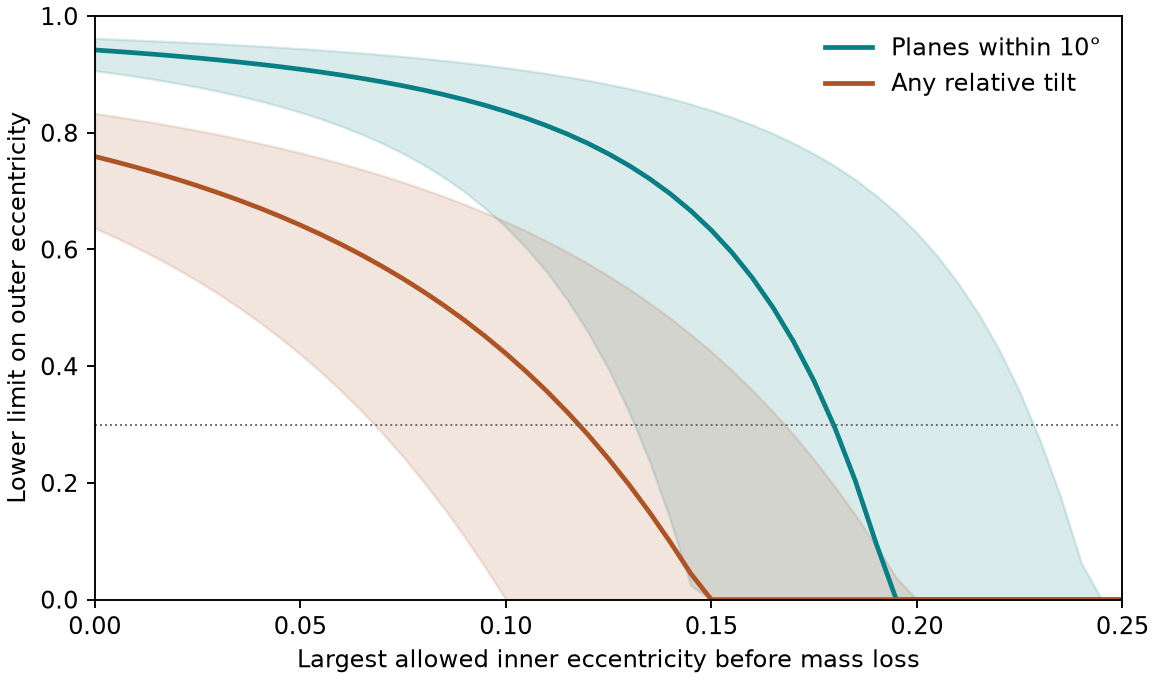
Figure 1. An already eccentric inner orbit requires the ejection to remove less mass and momentum. The curves use a 1.2-solar-mass third star; shading gives the central 95% of the calculated limits. The dotted line marks an example outer eccentricity of 0.3. Each curve excludes orbits below it on the basis of the required passage alone; it assigns no probability to orbits above it.
Counting distant companions gives a less direct test. Of 272 candidates with inferred recoil above 5 km/s and inner eccentricity above five times its error, seven have companions projected beyond 3,000 AU. In simulations the expected count changes from about two to about eight as the sizes and shapes of the original outer orbits change. Interpreting the count therefore requires assumptions about the birth orbits and the frequency of companions.
The individual test avoids those population assumptions. The stars’ common motion supports, but does not establish, the premise that the third star is bound; neither its orbital tilt nor its eccentricity has been measured. The test assumes a single symmetric ejection without simultaneous accretion or thrust, and that the inner orbital properties used to infer recoil have remained unchanged. It also assumes that the outer star has followed a gravitational two-body orbit since ejection. Encounters, further mass loss or the Galaxy’s tidal pull can change that orbit, especially at the large distances implied by exact alignment. Under these conditions, a low outer eccentricity would rule out a final ejection as the sole source of the inner eccentricity, while allowing an ejection from an already eccentric orbit.
Methods
Sample and inner orbit
We matched stars by their Gaia Data Release 3 (DR3) identifiers across the corrected Shahaf catalogue (red-excess probability below 0.64), Gaia’s two-body orbit solutions and the wide-pair catalogue. For the catalogue scan we used the listed visible-star mass. We converted the apparent orbit of the centre of light to a physical semimajor axis using the parallax, the annual shift in sky position that gives the distance to a star. Treating this as the visible star’s semimajor axis, we used Kepler’s law to infer the unseen mass.
For UCAC4 093-013644 (inner Gaia DR3 5263498162306171264, outer 5263498127946433536), we instead used the constants C,H from the spectroscopic orbit. They give the projected semimajor axis of the visible star in AU as a_1\sin i=\sqrt{C^2+H^2}, where i is the inclination measured from stellar motion across the sky. We solved the single-lined mass function, the relation between stellar masses and the measured orbit when only one star’s spectrum is visible, to obtain the remnant mass m_2. For a circular start the recoil is V=eK_1 m_1/(m_2\sin i), where m_1 is the visible-star mass and K_1=18.1\pm1.0 km/s is half the full range of its orbital line-of-sight velocity. The mass ratio converts the visible star’s velocity to the giant’s.
Independent checks on the stars
We matched the 213 pairs by inner source identifier to stars in GALAH Data Release 4 with parallax above 1 milliarcsecond. We required zero quality flags for the stellar measurements, barium and yttrium. We compared the visible star with other unflagged stars within 150 K in temperature, 0.2 dex in surface gravity, 0.15 dex in metallicity (abundance of elements heavier than helium) and 0.3 dex in signal-to-noise ratio in the red channel of the spectrograph. A dex is a difference of one on a base-ten logarithmic scale. To check the velocity we used the Gaia orbit to predict the value at the time of the spectrum, modified Julian date 57760.63. To check the earlier sky positions we compared the two resolved Two Micron All Sky Survey sources with the positions predicted from Gaia’s relative proper motion (angular velocity across the sky) over 16.04 years.
Geometry and measurement errors
Let \Delta be the angle on the sky between the direction to the third star and the inner line of nodes, where the inner orbital plane intersects the sky plane. Let \beta be the elevation of the separation vector out of the sky plane. If the orbital planes differ by at most \theta, the component of the unit separation vector perpendicular to the inner plane cannot exceed \sin\theta in magnitude. Choosing the more favourable sign of the unknown depth, we took the smallest |\beta| satisfying |\sin i\sin\Delta|\cos\beta-|\cos i|\sin|\beta|\leq\sin\theta. Dividing the projected separation by \cos\beta gives the minimum physical separation.
We drew 131,072 Gaussian realizations of the Gaia orbit, preserving the covariances between its fitted parameters. We varied the visible-star mass independently, using its catalogue upper error above the central value and its lower error below. For each draw we recomputed the total masses before and after ejection that set the two escape speeds, the recoil, the line of nodes, the inclination and the physical separation.
For a bound orbit the specific angular momentum h (angular momentum per unit mass) satisfies h^2<2GM_fR_{\max}. Its line-of-sight component determines the crosswise speed through |v_{\rm cross}|=|h\cos i_{\rm out}|/s, where i_{\rm out} is the outer inclination and s the projected separation. For the observed motion we projected each star’s proper motion and its two-component covariance onto the direction perpendicular to the great circle joining the stars. We treated the stellar errors as independent.
Allowing eccentricity before ejection
For Figure 1 we found the greatest permitted separation at ejection over all orbital phases and all initial inner eccentricities e_0 up to a chosen value u. Let d be the ejected mass divided by the remaining inner mass M, and B=V/e the circular-start recoil speed per unit of final inner eccentricity. An eccentricity vector points towards closest approach and has length equal to the eccentricity. Because the stars’ relative velocity is unchanged at ejection, their initial and final eccentricity vectors satisfy \boldsymbol e=(1+d)\boldsymbol e_0+d\hat{\boldsymbol r}, where \hat{\boldsymbol r} is the unit separation vector at ejection.
The squared recoil for this history, divided by B^2 d, is (d+e^2)/(1+d)-e_0^2. For u<e this expression is smallest at fixed d when e_0=u, and its lower bound increases with d. Meanwhile (\sqrt{M_f+dM}+\sqrt{M_f})^2/d decreases. The greatest R_{\max} therefore occurs at the smallest permitted d=(e-u)/(1+u), attained by ejection at closest approach with e_0=u. The recoil there is B(e-u); if u\geq e, no recoil is required. For each measurement draw, we inverted the resulting monotone bound to find the minimum initial inner eccentricity for the example e_{\rm out}=0.3.
Calculating which outer orbits survive
To find an example trajectory we placed the third star at the same present depth as the pair, sampled velocities within the outer star’s proper-motion error ellipse and tried line-of-sight speeds between −0.7 and +0.7 km/s. At successive points around each bound ellipse we reversed a recoil directed along the visible star’s inner orbital velocity at closest approach. We then tested whether the pre-ejection orbit was also a bound ellipse.
For the count comparison we gave every binary a 1.2-solar-mass companion, sampled random times on the orbits before and after the impulse, and counted all survivors projected beyond 3,000 AU. The lower count uses orbits oriented randomly in space with eccentricity density 2e, at the shared semimajor axis that yielded the most survivors (78 AU). The higher count uses initially circular orbits in the inner orbital plane with semimajor axis tuned to each recoil (6GM_f/V^2).