A weight cutoff that identified half the female mice as light in one fasting trial identified 93% in another
- Numbers reproduced
- Yes
- Original conclusion
- Weakened, error in the original
The lighter-group benefit holds, but a statistically uncertain benefit in heavier mice does not support the original inference that fasting failed to extend their lives.
In plain English
Female mice in the lighter half of one study lived longer when they went without food two days a week. We recovered that result, but heavier mice may have benefited too. The same cutoff counted nearly every female in a second study as light. Comparing mice of similar weight could not tell us whether lighter mice in the other strains gained the same number of days.
Could weighing mice before a diet starts help researchers predict which mice will live longer on it? In one trial, female mice in the lighter half lived longer when they fasted for two consecutive days each week than when they could eat at any time. To use starting weight as a guide in another population, researchers need to know whether females of comparable weight gain a similar number of days.
We reproduced the survival benefit in the original trial of genetically diverse, outbred mice. The same research consortium tested the same fasting schedule in a second trial of ten inbred strains, randomly assigning diets in each trial. The original cutoff classified 93% of the second trial's females as light. When we compared the trials at weights well represented in both, fasting added an estimated 39 days to mean survival through age 30 months in the outbred mice and reduced it by an estimated 18 days in the inbred mice. The difference of 57 days favored the outbred mice, but its 95% confidence interval (−13 to 127 days) also allows equal gains or a small advantage for the inbred mice.
Survival above and below the original weight cutoff
Di Francesco and colleagues assigned female Diversity Outbred mice to five diets at six months of age [1]. Each mouse in this population carries a different mix of genes from the same eight founder strains. The authors split 937 mice at their median six-month weight, then compared the diets within each half. They found that lighter mice benefited from two-day fasting and concluded that intermittent fasting did not extend lifespan in heavier mice.
We recovered the published median of 32.206 g and all ten counts of mice by diet and weight group. Among lighter mice, 100 fasted and 89 ate without restriction; among heavier mice, the counts were 90 and 99. We used a log-rank test, which compares survival over the full follow-up, to compare the two diets in each group. The results matched the original study's Supplementary Table 8: after adjustment for multiple comparisons, p = 0.0249 in lighter mice and 0.211 in heavier mice.
How much benefit was compatible with the data for heavier mice? In heavier mice, the fasting-to-control hazard ratio (the death rate among surviving mice on fasting divided by that on unrestricted food) was 0.80. Its 95% confidence interval, 0.60 to 1.07, allows a benefit in heavier mice too. We therefore compared the diet effects directly. The hazard ratio in lighter mice was 0.75 times that in heavier mice (95% interval, 0.47 to 1.20). The interval includes 1, the value for equal relative effects. The evidence for a benefit among lighter mice is stronger than the evidence for a weight threshold.
Comparing mice of similar starting weight
Luciano and colleagues compared the weekly 48-hour fast with unrestricted feeding in ten Collaborative Cross strains [2]. These inbred strains descend from the same founders as the outbred mice. Luciano and colleagues found shorter survival and little average benefit of fasting in the inbred females. Starting weight offered one possible explanation for the difference between trials.
The original cutoff placed 352 of 378 inbred females in the lighter group. Their fasting-to-control hazard ratio was 0.94 (95% interval, 0.76 to 1.16), compared with 0.62 (0.47 to 0.82) in the original lighter group. Using mean weight over the same two weeks before diets began in both trials changed the outbred estimate only slightly, to 0.66 (0.51 to 0.85). Yet the cutoff had a different meaning in the two populations. Across the fasting and control groups combined, the median starting weight was 24.2 g in the inbred trial and 31.4 g in the outbred trial.
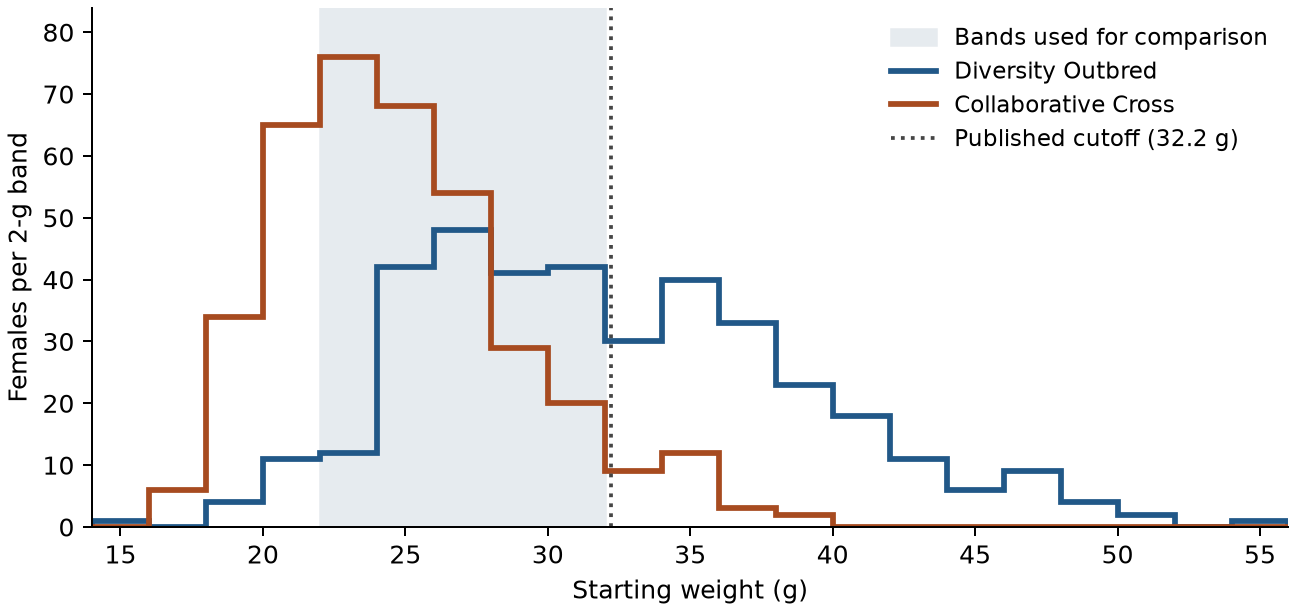
Figure 1. Starting weights measured on days 162–175 in the fasting and control arms (378 females per trial). The five shaded bands, from 22 to less than 32 g, each contained at least five females from each diet in each trial. Both tails of the weight distribution lacked comparable groups of that size.
To compare like weights, we gave the fasting and control groups in both trials the same distribution across the five shared weight bands. Within bands, we compared diets among mice from the same breeding generation in the outbred trial or the same strain in the inbred trial. The four groups then had mean starting weights ranging from 26.75 to 27.02 g. We measured survival as mean days alive from birth through age 30 months. Any mouse still alive at that age contributed 912 days, however long it lived afterward.
| Population | Unrestricted feeding (days) | Weekly fast (days) | Fasting gain (days, 95% confidence interval) |
|---|---|---|---|
| Diversity Outbred | 764 | 802 | +39 (−16 to +93) |
| Collaborative Cross | 625 | 606 | −18 (−63 to +27) |
| Difference in gain (outbred minus inbred) | +57 (−13 to +127) |
Table 1. Mean days alive through age 30 months among females alive when the diets began. The gain subtracts the concurrent unrestricted-fed control mean from the fasting mean before rounding. Intervals account for mice sharing cages.
Over the full follow-up, the fasting-to-control hazard ratio was 1.20 times as large in inbred as in outbred mice (95% interval, 0.81 to 1.79) when we compared diets within weight band and strain or generation. Simply comparing mice below the cutoff gave a ratio of 1.51 (1.07 to 2.12) using the original outbred weights, or 1.42 (1.02 to 1.97) using the same two-week mean in both trials. Comparing mice within shared bands brought the estimate closer to 1, and the interval included equal relative effects.
The clearest survival difference was among mice eating unrestricted food. At comparable weights, outbred females lived 139 more days through age 30 months than inbred females (95% interval, 84 to 194). Suppose fasting added the same fraction of the control group's remaining days after six months in both trials. The outbred result would then predict a 29-day gain in the inbred trial, still 48 days more than observed (−14 to 110). Extending follow-up to four years left the estimated fasting gain near −18 days in inbred mice, compared with +60 in outbred mice (difference 78 days, −5 to 162). The inbred average spans ten strains. Within the shared weight range, unadjusted 30-month gains for individual strains ranged from −60 to +88 days.
Effects of weighing and incomplete follow-up
Using each mouse's last weight on days 154–181 instead of its two-week average placed 178 outbred and 258 inbred females in the shared bands. The estimated difference in fasting gains rose from 57 to 105 days (95% interval, 22 to 187). Changing how we handled small groups had less effect. Including strains or generations represented by only one diet in a band, using regression, gave a difference of 69 days (−3 to 142). Every analysis of days alive favored the outbred trial. Whether the interval excluded zero depended on the weighing rule, the age at which we stopped counting days and the adjustment method (Supplementary Table 1).
Both studies counted missing mice as deaths. Among mice that contributed to the comparison, 29 had uncertain outcomes before day 912. These included mice whose follow-up ended before a death was counted (censored mice) and those recorded as missing, euthanized by request or failing to recover. We allowed each of these mice any survival time from its recorded exit to day 912. Assigning times to minimize the outbred advantage left a difference of +15 days; maximizing it gave +113 days. Uncertain exits alone could not reverse the comparison for these mice, although sampling variation could.
Starting weight identified a group that benefited in the original trial. At comparable weights, survival on unrestricted food differed more clearly between trials than the benefit of fasting did. The alternative analyses draw on the same two trials, and their intervals do not account for the choice of comparisons after exploring the data. A different set of strains could give a different average. Diet was randomized within each trial, but ancestry varied with trial, so the data cannot separate the effects of inbreeding or particular strains from other differences between trials.
Methods
Reproducing the original comparison
We identified the mice in the original analysis from its public release of animal measurements [3] and used archived six-month weights [4] to reconstruct the original Figure 2e. We compared all ten pairs of diets by log-rank test, using Holm's adjustment for multiple tests within each weight half. To estimate hazard ratios, we used Cox regression, a model that compares death rates while allowing them to change with age. We allowed a separate baseline death rate over time for each generation or strain and calculated standard errors that account for mice sharing a cage. For the ratio of the independent estimates in the two trials' lighter groups, we added the variances of their log hazard ratios. To test whether the diet effect differed across the original cutoff, we included diet, weight group and their interaction in the model.
Comparing the trials
For the cross-trial comparison we used individual animal records from the public archive [4]. Its outbred records are a copy of the original trial data. We averaged raw weekly weights over days 162–175. Measurements were available for all 378 outbred females in the two eligible diet groups and for 378 of the 388 inbred females alive at day 182.4. An exploratory analysis tested whether diet effects varied with weight in 60 model fits across ten pre-diet weighing windows, treatments and sexes, plus four outbred fits using the published six-month weight. The comparisons examined included the shared weight range and the 30-month endpoint used here.
The five shared bands contained 185 outbred mice from 48 cages and 247 inbred mice from 93 cages. To give both trials the same weight distribution, we set each band's share in proportion to the harmonic mean of its two trial counts. This average gives less influence to bands scarce in either trial. From lightest to heaviest, the shares were 11.2%, 28.1%, 27.5%, 18.4% and 14.7%. Within each trial and band, we weighted each generation or strain by the harmonic mean of its two diet counts. A group represented by only one diet received zero weight, leaving 181 outbred and 230 inbred mice that contributed directly. As an alternative, we used regression to fit additive effects of weight band and generation or strain separately for each diet in each trial. We then averaged the predictions over the observed mix of generations or strains within each band.
Estimating days alive
For each diet in each trial, we used the released event codes to estimate a Kaplan–Meier survival curve, the fraction of mice surviving to each age with allowance for censoring. The area under the curve through the chosen age estimates mean days alive. To average that estimate over the chosen weight bands and genetic groups, we calculated a survival value for each mouse, called a jackknife pseudo-observation. We multiplied the diet group's size by its estimated mean days alive, then subtracted the same product recalculated without that mouse. Without censoring, this value is simply the mouse's observed days alive, capped at the chosen age.
In the main weight range, the outbred trial censored three accidental deaths and the inbred trial had no censoring. The survival estimates assume that censoring is independent of survival within each diet group. For the bounds on uncertain exits, we instead applied the same comparison weights to the extreme individual outcomes. To calculate confidence intervals for mean days alive and differences between means, we omitted one cage at a time and recalculated survival values and weights. We summed the resulting jackknife variances calculated within groups defined by trial, generation or strain, and diet. We used the estimate plus or minus 1.96 standard errors, treating the represented generations and strains as fixed.
Supplementary Table 1. Difference in fasting gains under different analysis choices
| Starting weight | Age (days) | Adjustment | Missing exits | Outbred gain | Inbred gain | Difference (95% confidence interval) |
|---|---|---|---|---|---|---|
| Two-week mean | 730 | Regression | Deaths | +29.6 | −27.9 | +57.5 (+1.9 to +113.1) |
| Two-week mean | 912 | Exact | Deaths | +38.6 | −18.3 | +56.9 (−12.8 to +126.5) |
| Two-week mean | 912 | Regression | Deaths | +46.7 | −22.7 | +69.4 (−3.0 to +141.8) |
| Two-week mean | 912 | Regression | Censored | +50.9 | −11.9 | +62.8 (−11.2 to +136.8) |
| Two-week mean | 1095 | Regression | Deaths | +63.9 | −22.1 | +86.0 (+1.5 to +170.6) |
| Two-week mean | 1460 | Exact | Deaths | +60.3 | −18.0 | +78.3 (−5.3 to +162.0) |
| Two-week mean | 1460 | Regression | Deaths | +70.7 | −22.1 | +92.8 (+5.3 to +180.2) |
| Two-week mean | 1460 | Regression | Censored | +83.2 | −10.3 | +93.5 (+2.5 to +184.6) |
| Last reading | 912 | Exact | Deaths | +77.3 | −27.4 | +104.7 (+22.2 to +187.2) |
Gains are mean days alive on fasting minus unrestricted food through the stated age. The difference subtracts the Collaborative Inbred gain from the outbred gain. Exact comparisons use only groups with both diets represented within weight band and strain or generation; regression also uses groups with one diet. The missing-exit column shows how mice recorded as missing were treated. Intervals account for cages but not for selection among analyses.
References
- Di Francesco A et al. Dietary restriction impacts health and lifespan of genetically diverse mice. Nature (2024).
- Luciano A et al. Genetic regulation of fasting-induced longevity effects. Genetics (2026).
- Calico. Dietary Restriction in Diversity Outbred mice: published phenotype release.
- Luciano A et al. Collaborative Cross and Diversity Outbred study data, version 1. Figshare.