An infinite line of shrinking branches makes a five-leaf tree shape as common as possible
Why it matters
How often can five tips chosen from a branching tree fall into two pairs with a fifth tip set apart? Four balanced pieces had seemed to give the best tree, but every fixed number of pieces can be beaten. In one arrangement that reaches the limit, the pieces get smaller toward the root, each eventually about 37% as large as the one before it.
In a tree that branches in two at every fork, pick five leaves at random. How often can one leaf branch off first, leaving four that divide into two pairs? Of the three possible shapes for five leaves, this is the only one whose highest limiting frequency as the tree grows is unknown. A tree made by joining four balanced branches, each dividing its leaves as evenly as possible at every fork, came close to the known upper bound. The question was whether a few such branches could suffice.
We show that even the best arrangement of any fixed number of balanced branches improves with one more branch. A tree that attains the maximum in the limit has a balanced core, with infinitely many balanced side branches along the path from the core toward the root. Far along that path, each side branch carries about 36.6% of the leaves carried by the preceding one: the ratio tends to (\sqrt{3}-1)/2. Fourteen balanced branches already give a frequency above 0.247155027601, within 0.0000016 of the published upper bound.
The shape and its frequency
The root is the starting point of the tree; the leaves are its tips. To see the shape of five selected leaves, start at their most recent common ancestor and trace the paths to them. Keep only the forks where the paths separate. In the shape called A_5, one side of the first fork leads to a single leaf (the outgroup). The other leads to a fork with a pair of leaves on each side (a balanced quartet; Figure 1, left). The fraction of five-leaf subsets with shape A_5 is its density. For each leaf count n, take the largest density among trees of that size. The limit of these densities as n grows is called the inducibility of A_5, denoted by I.
A balanced subtree can serve as a building block. Joining large balanced blocks of different sizes gives a tree whose branches may be far from equal. Dossou-Olory and Wagner chose sizes for four blocks that give a limiting density near 0.24707150. They expected this to be the maximum after trying more blocks without seeing a gain. Brosch and Puges (Table 3) later proved that the maximum is at most 0.2471566.
Counting at the quartet fork
Each occurrence of A_5 can be counted at a single fork, regardless of how far above it the outgroup attaches. Call the fraction of leaves in a subtree its mass, so the whole tree has mass one. In the limiting model we sample each leaf by following branches down from the root, independently of the other draws. A leaf enters a subtree of mass s with probability s. Suppose the children of a fork have masses a and b, with s=a+b. For this to be the quartet fork, two sampled leaves must enter each child and one must land anywhere outside the subtree. There are five choices of the outside leaf and six choices of the pair in the first child. Thus the fork contributes 30(1-s)a^2b^2. Summing this over forks counts every successful sample exactly once.
In a limiting balanced block of mass s, each descent chooses between equal halves. At depth j there are 2^j forks of mass s/2^j. Summing their contributions gives
We can find I by considering arrangements of finitely many balanced blocks, even though each block represents a limit of ever larger trees. To approximate an arrangement with a finite tree, round the block populations to whole numbers of leaves and divide each population as evenly as possible at every fork. Conversely, replace every leaf of an n-leaf tree by a balanced block of mass 1/n. Conditional on the five draws hitting distinct blocks, the induced shape has exactly the original distribution. The chance of a repeated block is at most \binom52/n. This probability tends to zero. The least upper bound (supremum) of the densities of finite arrangements therefore equals I.
We first searched for good arrangements without prescribing their shape or number of splits. On a grid of masses in units of 1/N, we worked up from the smallest mass. At each mass s we compared B(s) with every split into two positive grid masses, adding the two previously computed best scores to the fork contribution. Six grids (N=64,256,1024,4096,16384,32768) gave 340,018,176 split comparisons, using integer multiples of 1/(7N^5) for the scores. Even the coarsest grid beat the four-block candidate, scoring 0.24708501. The finest gave 0.24715502722 with eleven blocks: one large core and ten side branches on the path from it to the root. The two smallest branches each had mass just 1/N. The grid cannot resolve any smaller branch. The next comparison applies at any mass.
Why one more branch always helps
The key to locating the unequal splits is to ask when an entire subtree can be balanced without losing density. Compare a balanced block of mass s with a fork of that mass above two balanced blocks. Subtraction gives the exact difference
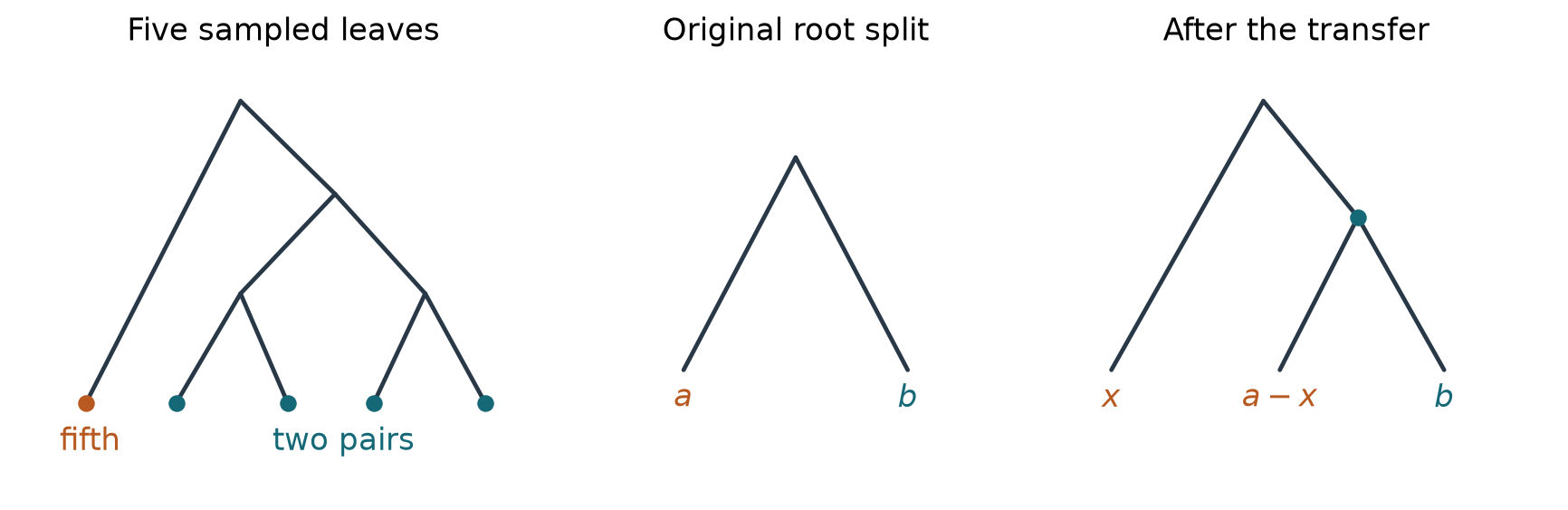
Figure 1. The target (left) is counted at the fork separating the two pairs. Before the transfer (middle), the root can never serve as that fork: there is no place outside it for the fifth leaf. After the transfer (right), the old root, marked by a dot, has a new branch of mass x outside it.
Moving a little of the smaller root arm into a new branch makes a strict gain (Figure 1). Let a\le 1/2 be the mass of that arm, now balanced, and b=1-a the mass of the other arm. Keep the latter intact. Replace a by a balanced block of mass a-x and attach a new balanced block of mass x above the old root. Every fork inside b keeps its contribution, since its two child masses are unchanged. The gain is
Write M_k for the best density achievable with at most k blocks. A best arrangement exists because there are finitely many ways to join the blocks, the density varies continuously with their masses, and any block of zero mass can simply be removed. For one block, any unequal positive split improves the score by the comparison at s=1. For every larger budget, take a maximizing spine and apply the transfer. It follows that M_{k+1}>M_k for every k, even though M_k tends to I. The gain also constrains ordinary finite trees: expand their leaves into blocks as above, balance the smaller root arm and apply the transfer. An n-leaf tree whose smaller root arm contains a fraction a of the leaves has density at most I-a^3/6+10/n. In any sequence approaching I as n grows, that fraction must tend to zero.
Constructing a maximizing limit
To describe the whole path with a single set of numbers, walk from the root toward the core and tally the mass in the side branches passed. If the tally rises from t to u at a branch, represent that branch by the interval (t,u). Its own mass is u-t, the mass farther toward the root is t, and the arm continuing toward the core has mass 1-u. The branch and its attachment fork together contribute
For an infinite spine to attain this maximum, there must be a genuine branch next to the core, then another next to that one, and so on. It suffices to show that the interval next to the core retains a fixed fraction of the total side-branch mass, however many intervals we allow. Fix 0<T\le4/7. In an optimal partition for H_m(T), m\ge3, write (t,T) for the last positive interval and a=T-t for its length. A best partition exists because its score is continuous in the interval lengths, which are nonnegative and sum to T (a zero length simply omits an interval). The earlier intervals score H_{m-1}(t), since we could replace them at fixed t. If t\ge T/2, that score is at least t^3/2: two equal intervals are feasible, and the second fork alone gives (30/8)t^3(1-t)^2.
Delete the last interval and stretch the earlier intervals by a common factor to fill [0,T]. To bound the gain, differentiate the logarithm of each positive contribution with respect to the logarithm of that factor. For a fork this derivative is 3-2u/(1-u)\ge1/3, where u is its current endpoint. For a block of current length d the corresponding derivative is 4-2d/(15/7-2d)\ge1/3. Both bounds use u,d\le4/7. Thus as the total length increases from t to T, the earlier score increases at rate at least H_{m-1}(t)/(3T) per unit length. Optimality requires the deleted contribution R(t,T) to cover that increase. Since R(t,T)\le33Ta^2, we have
It follows that, for each T>0 in this range, there is a last interval even when we remove the limit on the number of cuts: some cut t_*\le(1-1/1584)T satisfies H(T)=H(t_*)+R(t_*,T). Indeed, take a convergent subsequence of the last cuts as m tends to infinity. The earlier scores are bounded by H(t), so continuity gives the inequality H(T)\le H(t_*)+R(t_*,T); appending the interval to finite partitions gives the reverse inequality.
Start at a maximizing T_0 and successively take such cuts T_1,T_2,\ldots toward the root. Each cut leaves at most the fraction 1-1/1584 of the preceding outer mass, so these masses tend to zero. They cannot reach zero in finitely many steps because that would attain I with finitely many blocks. Adding the score identities cancels all intermediate values of H. The residual H(T_j) tends to H(0)=0, giving a core of mass 1-T_0 and side branches of masses T_j-T_{j+1} that together attain I. This describes a limit in terms of what a sample of leaves sees: one can replace the whole portion of mass T_j nearest the root by one balanced branch. For any fixed number of draws, the chance of sampling that altered portion tends to zero. In the limit there is no first positive branch at the root end.
The sizes of the outer branches
Near the root, the main contribution comes from samples with one leaf farther toward the root, two in the current branch and two in the much larger arm toward the core. For a partition of [0,T], as T tends to zero this gives
The cubic sum also occurs in packing the permutation pattern 132: the aim there is to make triples with relative ranks 1, 3, 2 as frequent as possible. In a sequence of decreasing runs, each wholly below the next in value, such a triple takes one entry from earlier runs and two from the current run. Here the same count governs the small outer branches. Write r=t/u for the fraction of the mass up to an interval’s endpoint that lies before the interval. The cubic score, including the tree sampling factor of 30, has supremum CT^3, where
The cubic approximation gives the limiting ratio for the full score as well. Substitute H(T)=CT^3+O(T^4) into H(T_j)=H(T_{j+1})+R(T_{j+1},T_j) and put r_j=T_{j+1}/T_j. Division by T_j^3 gives
Table 1 checks the predicted ratio using only the outer mass, independently of the fit to the whole tree. For each prescribed outer mass T, we divided [0,T] into 1,000 equal steps. At every endpoint u we compared all earlier grid cuts t, maximizing the best earlier sum plus R(t,u) in exact arithmetic. The optimal last cut is at step 366 on all three grids, while the normalized score approaches the predicted C\approx4.64102.
| Outer mass T | Best cut t/T | Best score on [0,T] divided by T^3 |
|---|---|---|
| 0.10000 | 0.366 | 3.81981 |
| 0.00100 | 0.366 | 4.63238 |
| 0.00001 | 0.366 | 4.64093 |
A finite construction and an independent count
Using the limiting ratio only in the outer branches gives a fourteen-block construction of density 0.247155027601110 (rounded). We let the three cut positions farthest from zero, U,V,W in descending order, vary to maximize the partition score. We placed the next ten cuts at Wr_*^i, 1\le i\le10, and rounded all cuts to the nearest multiple of 10^{-10}. The resulting masses, in units of 10^{-10} from the root end to the core, are
These integers specify the whole construction. For an independent count of its density, we combined the probabilities for two child subtrees at each fork, working up to the root. For a child of mass a, let q be the probability that four draws from the whole tree all land there and form a balanced quartet; let d be the analogous probability for five draws forming A_5. In a balanced block these probabilities are (3/7)a^4 and (1/7)a^5: consider the first fork at which the draws go to different children. For four draws, six of the fourteen ways to occupy both children put two draws on each side. For five draws, ten of the thirty ways put one draw on one side and four on the other, after which the four must form a quartet. Let (b,r,e) denote the corresponding mass and probabilities for the second child. The quartet probability after joining the children is q+r+6a^2b^2: the quartet lies in either child or splits two and two. The probability of A_5 is d+e+5(ar+bq): the five leaves lie in either child or split into an outgroup in one child and a quartet in the other. Applying these two sums from the core outward with rational arithmetic gives I>0.247155027601.
The exact value of I, including whether it is irrational, remains open. Finding that value now reduces to choosing cuts along one path. The limiting ratio describes the small branches near the root; the large branches near the core may have different proportions. Whether the maximizing core is unique is not needed for the result.
References
A. A. V. Dossou-Olory and S. Wagner. On the inducibility of small trees. Discrete Mathematics & Theoretical Computer Science 21(4), 2019.
D. Brosch and D. Puges. Getting to the root of the problem: sums of squares for limits of trees. Mathematical Programming, Table 3.