On prime-sized rings, colorings with the fewest same-color four-point progressions must correlate with a wave
Why it matters
Color a ring of dots red and blue and try to avoid four equally spaced dots of the same color. As the rings grow through prime sizes, colorings that approach the lowest possible rate must keep a rhythm in where the colors fall. At least one wave around each ring picks it up, and that signal cannot fade to zero.
Color a ring of positions red or blue. Pick a starting position and a step at random, then move by that step three times, wrapping around the ring. How should the colors be arranged to make it as rare as possible for all four positions to have the same color? For a large ring the random-coloring benchmark is 1/8. Even an arrangement with no appreciable correlation with any single sinusoidal wave can beat that rate. A test for a single wave can miss a pattern shared by four positions. The question is whether such an arrangement can do as well as the best coloring.
For rings with a prime number of positions, the answer is no. As the rings grow, colorings whose strongest wave correlation tends to zero have a limiting lower bound of 0.11157654 on the fraction of four-position progressions that are all one color. An explicit arrangement of red and blue arcs achieves 799/7260=0.11005509\ldots in the limit. The gap means that any coloring sequence approaching the minimum must retain a wave correlation bounded away from zero.
Measuring the gap
On a cycle of prime size p, choose a start x and a step d independently and uniformly. Let M_p be the probability that x,x+d,x+2d,x+3d, read modulo p, are monochromatic. This counts ordered starts and steps; the zero step has probability 1/p and does not affect the limit. Give the colors signs f(x)=\pm1. The Fourier coefficient \widehat f(r)=\mathbb E_x f(x)e^{-2\pi i rx/p} measures how well a wave making r turns around the circle tracks the colors. A sequence of colorings is Fourier-uniform if its largest coefficient in absolute value, apart from the mean \widehat f(0), tends to zero.
Gowers showed that even a Fourier-uniform set of density one half can contain fewer four-term progressions than expected. Wolf studied the two-color count, and Lu and Peng gave an unrestricted upper bound of 17/150 on large prime cycles. To decide whether the best colorings need a wave pattern, we compare one construction with a lower bound that holds for every Fourier-uniform sequence.
To state the lower bound precisely, let p tend to infinity along any sequence of primes. Write \mathbb Z_p for the positions on this ring and f_p:\mathbb Z_p\to\{-1,1\} for the coloring. The magnitude of its strongest wave correlation is \delta_p(f_p)=\max_{r\ne0}|\widehat f_p(r)|. Then
The consequence for the best colorings follows directly. Let m_p be the minimum of M_p over all two-colorings of \mathbb Z_p. Then
A coloring below the uniform bound
A coloring with just 22 changes of color on the circle gives the unrestricted side of the comparison. In units of 1/220 of a turn, change color at
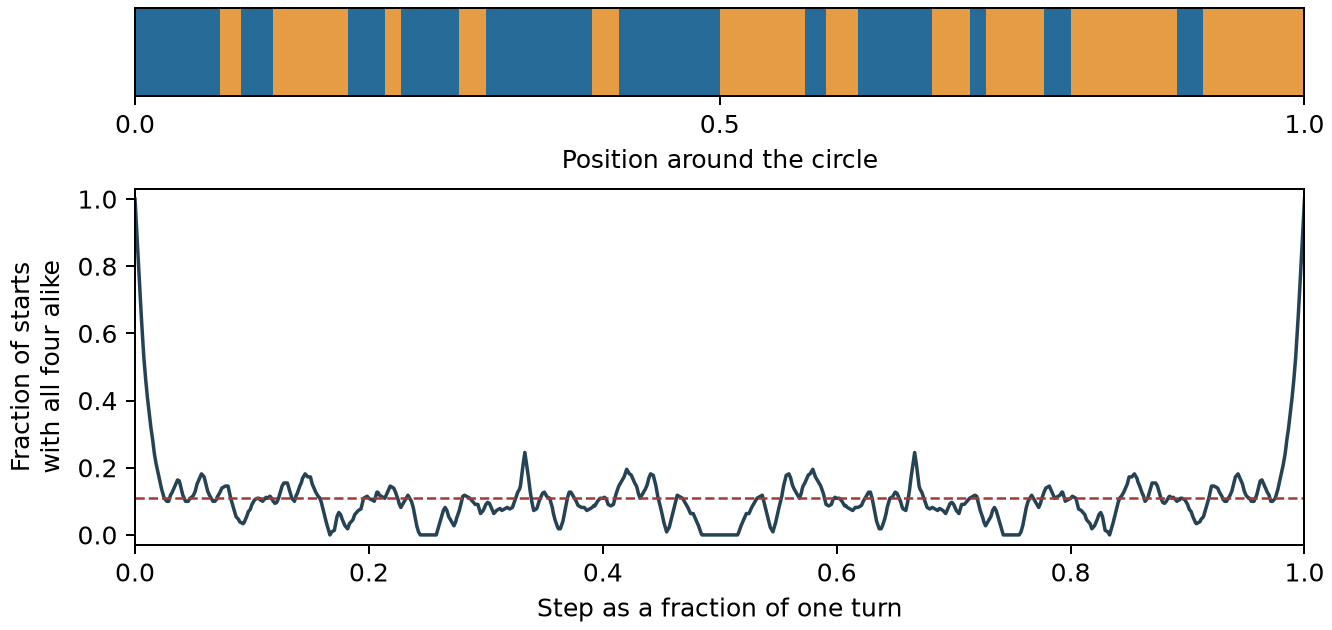
Figure 1. The two ends of the strip meet. For steps close to zero, all four positions often fit in one arc. Around half a turn, no start works. The area under the curve is the monochromatic rate; the dashed line marks its mean height, 799/7260.
To search for the arcs, we represented a coloring by a binary word: each digit specifies the color of one equal arc. We tested Lu and Peng's three published words and all words on 2 through 22 equal arcs, counting a word and its color reversal only once. The lowest rate among the unrestricted short words was 17/150. Requiring opposite colors on opposite arcs made it possible to search all even grid sizes from 4 to 52: 67,108,862 words up to color exchange for four terms. The search scored each word by integrating over fractional starts and steps within grid cells. The best grid, with 44 equal cells, gave 27/242. For the best word at each of the five best grid sizes, we moved the color boundaries in directions that lowered the rate, then rounded their positions to multiples of 1/220. The 44-cell word gave the arcs in Figure 1.
The area can be checked exactly without repeating the search. For a fixed step d, divide the possible starts wherever one of the four points meets a color boundary. These cuts occur at u-jd modulo one for each color boundary u and j=0,1,2,3. Their order can change only at a multiple of 1/1320: the relative slopes are 1, 2 or 3 in absolute value. Between consecutive such steps, the total monochromatic length varies linearly with the step, so its midpoint value equals its average. At each of the 1,320 step midpoints all cuts lie on the grid of 2,640 start cells. Exactly 383,520 of the 1320\times2640 cell midpoints give four equal colors. The prime-cycle counts converge to this area by Riemann sums, since the boundaries in the start-step square lie on finitely many lines.
How waves at different frequencies affect the count
Only the four-way correlation can push the rate below 1/8. Let b=\mathbb E f be the average color sign, and let \Lambda_4 be the average product of the four signs. Expanding the indicators that all signs are positive or all are negative gives
The key restriction on \Lambda_4 comes from quadratic patterns. For an example, consider a coloring determined by two coordinates on circles, one varying linearly with position and the other quadratically, as in the construction of Deng, Tidor and Zhao. A Fourier series expresses the dependence on the quadratic coordinate as a sum of waves of different frequencies. Along four equally spaced positions, a quadratic takes values whose third difference vanishes: the coefficients of that difference are (1,-3,3,-1). Averaging over quadratic shifts therefore pairs a frequency only with its triple. The same rule holds in the more general spaces needed for arbitrary colorings.
To bound the count for every coloring, we use a model that gives the four-way correlation to arbitrarily small error (the last section justifies this step). In the model a real function F with |F|\le1 takes the place of the color sign on a space X. The base H of this space is a torus (a product of circles) carrying the linear coordinates. Above each base point is a copy of a torus V carrying the quadratic coordinates, called the vertical fiber. These copies need not fit together as a product. In the progression average, the base points have the law of a+jd for independent uniform a,d\in H. The four points in X have the same joint distribution if point j is shifted within its fiber by v_0+jv_1+\binom j2 v_2, for any v_0,v_1,v_2\in V. Finally, for Fourier-uniform inputs the mean h of F on each fiber differs from b by arbitrarily little in mean square over H.
For a vertical frequency r (an integer vector), let P_r be its energy: take the squared magnitude of its Fourier coefficient on each fiber, then average over the base. Choosing another origin on a fiber changes only the phase. Parseval's identity gives \sum_r P_r=\int_X |F|^2\le1, and P_{-r}=P_r since F is real.
In the four-way product a tuple of frequencies survives averaging only if the phases from all three vertical shifts cancel. Writing k_j for the frequency at position j, solving \sum_j k_j=\sum_j jk_j=\sum_j\binom j2 k_j=0 gives (k_0,k_1,k_2,k_3)=(r,-3r,3r,-r). For r=0 the product average is b^4 up to an error of at most 4\|h-b\|_2. For r\ne0 the contribution has absolute value at most P_rP_{3r}. To see why, apply Cauchy–Schwarz to the product of the first two factors against the last two. Within either pair the squared magnitudes depend only on the base points. For j=0,2, the map (a,d)\mapsto(a+jd,a+(j+1)d) is an automorphism of H^2: subtract the outputs to recover d, then recover a. It preserves uniform measure, so the two base points are independent. Each pair therefore has mean squared product P_rP_{3r}. This argument allows any phase from the choice of fiber origins. For convergence one can first take finite Fejér averages (smoothed partial sums) of the vertical Fourier series; these converge uniformly for continuous F and their weights are at most one.
Group the nonzero frequencies into chains \{\pm r,\pm3r,\pm9r,\ldots\}, starting from vectors r not divisible by 3. Let s_C be the energy on both signs of chain C. On one sign its energy is s_C/2. Call the exponent of 3 the depth of a frequency in the chain. Each neighboring product links an even depth to an odd depth, so their sum is at most the product of the energies at even and odd depths, at most (s_C/2)^2/4. Counting both signs gives
The energy on a tripling chain
Five equally spaced samples already prove a strict gap. On one fiber, take the vector r at the start of a chain. It defines a character, a map r:V\to\mathbb R/\mathbb Z that takes addition on the fiber to addition around a circle. Use this map as a coordinate: average F over the points with the same coordinate (translates of the kernel of r). Every nonzero torus character is onto, so this gives a real circle function w with |w|\le1 retaining all coefficients at multiples of r, even if the entries of r have a common factor. Measured in this circle coordinate, the chain frequencies are \pm1,\pm3,\pm9,\ldots.
Sample w at t+j/5, 0\le j<5. The total energy in the four nonconstant discrete Fourier modes is the sample variance. It is a convex quadratic function of the five values in [-1,1], so it attains its maximum at signs. Five signs have sum of absolute value at least one, hence variance at most 1-1/25. Integrating in t turns this into a bound on the sum of circle energies at frequencies not divisible by 5: sampling at fifths groups together frequencies with the same remainder modulo 5, and integration cancels cross terms between different frequencies. All chain frequencies are in those classes. Thus s_C\le24/25, even after averaging over fibers.
A search over 14 sample sizes gave a tighter bound with 13 equally spaced samples. Modulo 13, \pm3^i visits just the six nonzero square remainders R=\{1,3,4,9,10,12\}. It suffices to bound the discrete energy projected onto these six modes. This projection energy is again convex in the samples. It therefore suffices to test signs. At signs w_0,\ldots,w_{12} it equals
Table 1. Exact maxima of T on 13 signs, by number of negative sites. Flipping every sign preserves the energy, so seven columns cover all possibilities.
| Negative sites | 0 | 1 | 2 | 3 | 4 | 5 | 6 |
|---|---|---|---|---|---|---|---|
| Largest character sum | 0 | 0 | 8 | 24 | 32 | 32 | 40 |
To obtain the table, take every subset D of at most six of the 13 sites (4,096 subsets). The matrix with entries \chi(j-k) has zero row sums, so T is eight times the sum of \chi(j-k) over unordered pairs in D. Since S^2\ge1, the projection energy is at most c=(168+40\sqrt{13})/338<0.924; the six-negative column attains this projection bound. Integration over the starting point of the samples and then over fibers gives s_C\le c.
With each chain capped at c>1/2, the largest possible sum of squared masses is c^2+(1-c)^2: fill one chain to the cap and put the remainder on another. Moving mass from a smaller entry to a larger one until a cap is reached can only increase the sum of squares. The correlation bound therefore gives
Why the bound applies to every Fourier-uniform sequence
Two steps justify using the model for rings of growing size. First we replace the coloring by a function on a space with circle coordinates while controlling the error in the progression count. Then we show that a coloring with vanishing wave correlations gives a function whose average over a fiber is nearly constant across the base. The space itself can change with the prime.
Approximating the coloring
Fix an error tolerance 0<\epsilon<1 and a growth function \mathcal F, to be chosen below. A periodic quadratic regularity theorem decomposes a function into a structured part, a small error and an error with little effect on progression counts. We use Candela and Sisask, Theorem 5.1 at degree two with the primes as the characteristic-zero set of moduli (their least prime factors tend to infinity). For every sufficiently large prime p and every q:\mathbb Z_p\to[0,1], it gives q=q_{\rm nil}+q_{\rm sml}+q_{\rm unf} and a complexity parameter m=O_{\epsilon,\mathcal F}(1). The small error has root mean square (L^2 norm) at most \epsilon. The remaining error has uniformity norm U^3 at most 1/\mathcal F(m); the product formula below explains how this controls its contribution. Both q_{\rm nil} and q_{\rm nil}+q_{\rm sml} lie in [0,1].
The structured term evaluates a function F_0 along a path, q_{\rm nil}(n)=F_0(g(n)\Gamma). The path lies on a filtered nilmanifold X=G/\Gamma of degree at most two: points of a group G are identified modulo a lattice \Gamma, and the group has layers describing the linear and quadratic coordinates. The space's complexity and the Lipschitz norm of F_0 (which controls how rapidly its values vary) are at most m. The polynomial sequence g is p-periodic modulo the lattice \Gamma and A-irrational for A=\mathcal F(m): no nontrivial level character of complexity at most A takes an integer value on the corresponding Taylor coefficient (Definition 4.7). Periodicity makes the model a function on the cycle; irrationality lets us count progressions by integration.
Take q=(1+f)/2. Set F equal to 2\operatorname{Re}F_0-1 clipped to [-1,1] on X. This keeps every orbit value 2q_{\rm nil}(n)-1 and gives
Counting progressions in the model
A counting theorem replaces an average along the path by an integral. Let \Phi=(\phi_1,\ldots,\phi_t) be either the four progression forms in two variables or the single form n in one variable. For a degree-two filtered space and an A-irrational polynomial orbit of period p modulo \Gamma, Candela and Sisask, Theorem 4.1 gives
By Definitions 2.3–2.4, G is connected and simply connected, and each filtration group G_i is closed and connected with G_i\cap\Gamma cocompact in it. Since G=G_1 and G_3=\{1\}, the commutator inclusions [G_i,G_j]\subseteq G_{i+j} make G_2 central and G/G_2 abelian. Hence both the fiber V=G_2/(G_2\cap\Gamma) and the base H=G/(G_2\Gamma) are tori. Write \pi:X\to H for the quotient map.
For the progression forms x+jd, the first-layer exponent vectors in the counting lemma span 1,j as functions of j, and their second-layer products span 1,j,j^2. The presence of 1 makes the successive spans nested, as required by the Green–Tao flag condition. Modulo G_2 the progression group therefore has exactly the affine tuples, with independent uniform start and step under its invariant measure. In G_2 the second-layer generators realize every translation v_0+jv_1+\binom j2v_2 by taking real powers before quotienting by the lattice. The diagonal translate by g(0) allowed in the counting lemma preserves both properties, since the translations upstairs are central.
Controlling the average color on each fiber
To relate the fiber mean h to the original color mean b, consider their mean squared difference. It is exactly \int_X(F-b)(h\circ\pi-b), by averaging first on each fiber. For the single form n the progression space is X itself, so one-position counting gives the corresponding orbit average to error \epsilon. This test has Lipschitz norm bounded in terms of m: central translations act isometrically for the nilmanifold quotient metric, and averaging over them preserves a Lipschitz bound.
The link to the original Fourier test is that every wave on the base becomes a single wave on the ring. On H, approximate h-b uniformly to error \epsilon by a trigonometric polynomial whose sum of absolute coefficients is at most B(m,\epsilon). Smoothing in each circle coordinate with a Fejér kernel gives this bound uniformly at each complexity. The coordinates adapted to the group and lattice (Mal'cev coordinates) give standard torus coordinates on H; both their number and the distortion of distances are bounded in terms of m. Each character pulls back under \pi g to a constant times one cyclic character: the base orbit is affine and periodic. Correlating the polynomial with f-b thus costs at most B\max_{r\ne0}|\widehat f(r)|, because f-b has zero mean.
In this correlation, replacing f-b by F(g\Gamma)-b costs O(\epsilon) for s tested against the original bounded function h-b. For u use the polynomial: \|\widehat u\|_\infty\le\|u\|_{U^3}, and u is bounded, so the cost is O(B/\mathcal F(m)+\epsilon). Choose \mathcal F(m) at each complexity to cover B(m,\epsilon)/\epsilon and the two counting thresholds before applying regularity. For this fixed \epsilon, B is then bounded independently of p. Fourier uniformity now gives \int_H |h-b|^2=O(\epsilon)+o_{p\to\infty}(1). Taking first the liminf in p and then \epsilon\downarrow0 removes the errors in the correlation bound.
What the gap tells us
The gap identifies a wave pattern that every nearly optimal coloring must have. The exact minimum, the shape of the best colorings and a numerical lower bound for their strongest wave correlation remain undetermined by these bounds.