A new way to place points lowers the upper bound on the fewest convex polygons they can form
Why it matters
Imagine placing dots on a page so that as few groups as possible form the corners of a convex polygon. Even when no polygon has many corners, there can be many ways to choose them. We found a placement rule that lowers the known ceiling on how fast this count must grow as more dots are added.
How few convex polygons can a drawing of a given number of points contain? To count one polygon, choose at least three points, each a corner of the shape enclosed by a taut band around the chosen points (their convex hull). Other points in the drawing may lie inside. Erdős and Hammer asked for the smallest possible count over all drawings of n points in the plane with no three on a line. Keeping the largest polygon small is only part of the problem: many different groups of points may form small polygons.
For every sufficiently large n, we construct a drawing in which the base-two logarithm of the polygon count is at most \tfrac12(\log_2 n)^2+O(\log n\,\log\log n). This lowers the leading coefficient in the reported upper bound from about 0.72135 to 0.5. The term in O(\cdot) grows more slowly than the squared logarithm. The construction labels each point by a sequence of left and right turns in a tree. Keeping points with the same weighted sum of right turns lets us bound the choices for the lower and upper sides of a polygon together.
What determines the bounds?
Write f(n) for the smallest possible count. Erdős (1978), pp. 52–53 showed that \log f(n) grows on the scale of (\log n)^2 and asked whether their ratio converges as n increases. All logarithms here are base two, except for the natural logarithm, written \ln.
A lower bound counts polygons that every drawing must contain. Suk’s bound on the Erdős–Szekeres threshold relates the number of points to the size of a convex polygon they must contain. In particular, every group of about \sqrt n points contains a convex polygon with (1/2-o(1))\log n vertices, where o(1) tends to zero as n grows. Counting how many such groups can share one polygon gives a lower coefficient of 1/4. For an upper bound, it suffices to give one drawing at each size. A 2026 working report on Problem 838, §§1–3 gives the lower-bound calculation and obtains an upper coefficient of 1/(2\ln 2) by counting polygons in classical drawings of Erdős and Szekeres. We select points from a related drawing.
Counting the two sides of a polygon
A binary tree describes the drawing: starting at the root, take m turns to reach a leaf, which represents a point. Label its turns b_m\cdots b_1, with zero for left and one for right. The point with that label has integer coordinates
This is the recursive point set of Duque, Fabila-Monroy and Hidalgo-Toscano, §2.2. At each fork, the points reached by taking the left branch lie to the left of all points reached by taking the right branch. They also separate by slope: every right point lies strictly above each line through two left points, and every left point lies strictly below each line through two right points. No three points can lie on a line, since at the first fork that separates them, two must be on one side and one on the other.
A polygon has two chains of edges joining its leftmost and rightmost vertices. Read from left to right, the slopes of successive edges increase along the lower chain (a cup) and decrease along the upper chain (a cap). We also count a singleton or pair as both a cup and a cap. A cup crossing a fork can contain only one right point: a left point followed by two right points makes a decreasing turn. Conversely, any cup on the left extends to any single point on the right. If the cup already has an edge, the new point lies above the line through its last edge. For a cap the roles reverse.
Fix the leftmost point of a cup and call it the anchor. Every point to its right first departs from the anchor’s path at a zero bit, taking the right branch where the anchor went left. Each such branch offers a choice: take any one of its points or take none. The choices are independent because the cup can be extended one fork at a time, working from the anchor back toward the root. For example, Figure 1 shows the paths that remain when only eight points are kept.
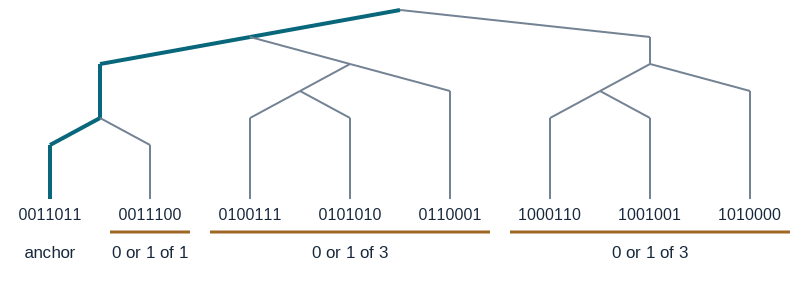
Figure 1. The leftmost point, labelled 0011011, anchors (1+1)(1+3)(1+3)=32 cups, including the anchor alone. The eight points come from the rule below for keeping points of equal score, with tree height m=7 and score 12.
One way to select points is to balance the number of left and right turns within each block of a label. We formed labels by joining blocks of 2h bits, each with exactly h ones. We counted polygons for all 192 combinations of h=1,\ldots,12 and one to 16 blocks. At 16 blocks, the logarithm of the polygon count divided by the squared logarithm of the point count fell from 0.85030 at width two to 0.56670 at width 24. The position of a turn also matters: a right branch at the first bit can contain up to 2^{m-1} points, whereas one at the last bit contains only one.
Selecting points with the same score
Give each turn a weight equal to the number of turns remaining, including that turn. The first turn has weight m, the last weight one. Let T be the sum of all weights and let the score s(b) of a point be the sum for its right turns:
Keep only points with a common score s. For a cup, each zero bit b_r of its anchor offers at most 1+2^{r-1}\le 2^r choices, including taking no point. The weights of the zero bits sum to T-s, so multiplying the choices gives at most 2^{T-s} cups at that anchor. For a cap, fix its rightmost point as anchor. The branches offering choices now occur at its one bits, giving at most 2^s caps.
In a drawing with n retained points, each chain has at most n possible anchors. The lower and upper chains of a polygon have different anchors, but those anchors have the same score. The exponents therefore add to T, regardless of the score. Since the two chains determine the polygon, the number F of polygons satisfies
The product includes pairs of chains that cannot form a polygon, so it gives an upper bound.
Enough points share a score to make this bound useful. The 2^m leaves have only T+1 possible scores. A largest group with a single score (a layer) therefore has at least 2^m/(T+1) points. For a given n, take the smallest height with a layer large enough. Choose a largest layer, breaking ties in favor of the smaller score, and retain its first n points from the left. Write L=\log n. For large n, height \lceil L+3\log(L+2)\rceil already suffices because T+1 grows only quadratically in the height. Thus m=L+O(\log L). Substitution in the polygon bound gives \log f(n)\le 2L+m(m+1)/2=L^2/2+O(L\log L).
Exact polygon counts
Table 1 gives exact counts for whole layers, counting each polygon once. At height 96, the logarithm of the count divided by the squared logarithm of the number of points is 0.51672.
| Tree height | Score | Points n | \log F | \log F/(\log n)^2 |
|---|---|---|---|---|
| 16 | 68 | 1,314 | 64.390 | 0.59995 |
| 32 | 264 | 31,592,878 | 341.727 | 0.55058 |
| 64 | 1,040 | 48,870,013,251,334,676 | 1,614.126 | 0.52516 |
| 96 | 2,328 | 114,963,593,898,159,699,687,805,154 | 3,872.576 | 0.51672 |
Table 1. Counts for a largest equal-score layer at each height. All counts are integers before taking logarithms.
To count each polygon once, consider the first fork that separates its vertices. The selected points on the left must form a cup, and those on the right a cap. To see why, suppose three left points in horizontal order make a decreasing turn. The middle point lies above the line through the outer two. By the separation at the fork, it lies inside the triangle they form with any selected right point, so it cannot be a vertex. The same argument excludes an increasing turn among three right points. Conversely, a left cup and a right cap always give a subset in convex position. Each edge of the cup lies on a line supporting the combined set from below, and each edge of the cap supports it from above. If either side has just one point, that point is the leftmost or rightmost vertex.
We used this rule to count from the leaves up to the root, temporarily including singletons and pairs in the count of nonempty convex subsets. At each fork, add the counts within the two branches. To include subsets spanning both branches, add the number of left cups times the number of right caps. The same calculation counts cups if the product is left cups times right points, and caps if it is left points times right caps. A retained leaf contributes one to each count.
For a layer, only the remaining height and the score still required determine these counts. At remaining height r and required score s, a left turn leaves score s to be supplied; a right turn leaves s-r. Both branches have remaining height r-1. Impossible scores contribute zero. At the root, subtract the n singletons and \binom n2 pairs to obtain the polygon count. For the fixed-width blocks we used the same counting rules, tracking the zeros and ones still required in the current block instead of the score.
As an independent check, we enumerated every nonempty subset of every score layer through height eight. Using the integer coordinates, we built the lower and upper hulls in horizontal order. The sign of the determinant of two successive edge vectors gives the direction of the turn; whenever it was wrong for that chain, we removed the middle point. This check agreed with the counts from the tree for polygon totals and for cups and caps at each anchor, including all 81,895 subsets checked at height eight.
Why the coefficient is sharp for large selections from this tree
Suppose the height is m and the number of retained leaves is N=2^{m-o(m)}. This means that the gap between m and \log N is a vanishing fraction of m. Any such selection contains at least 2^{m^2/2-o(m^2)} polygons. The reason is that a branch with many leaves contains many chains of each kind, and there must be a fork near the root with many leaves on both sides.
To count chains, consider a subtree of height r with M=2^{r-o(r)} selected leaves. Choose an anchor uniformly from these leaves and follow its path. At a node containing K selected leaves, let p be the fraction on the left. The next node contains either pK or (1-p)K leaves, with probabilities p and 1-p. The expected drop in \log K is therefore
where a term with zero probability counts as zero. A fair split has H(1/2)=1; every other split gives less. Along each path the drops sum to \log M, since the anchor is the only leaf left at the end. Over all levels, the expected shortfalls from a one-bit drop thus sum to r-\log M=o(r). Fix any tolerance 0<\delta<1/2. Whenever |p-1/2|>\delta, the shortfall is bounded away from zero. The expected number of levels with such an uneven split is therefore only o(r).
At a nearly fair split there are many choices for a cup. Only a left turn offers a choice, and the right branch then has (1-p)K leaves. Conditional on reaching the node, its expected contribution to the log count of cups at the anchor is p\log(1+(1-p)K). For |p-1/2|\le\delta this is at least (1/2-\delta)\log K-O_\delta(1), where the subtracted constant depends only on the tolerance.
At depth j, the expected value of \log K is at least \log M-j, since each step costs at most one bit on average. Summing these expected values over 0\le j<r gives at least r^2/2-o(r^2). Omitting uneven splits costs only o(r^2) in this sum: there are o(r) of them on average and each has \log K\le r. Multiplying the remaining sum by 1/2-\delta and subtracting the per-level constants gives a lower bound on the expected log cup count. Some anchor attains at least that expectation. Dividing by r^2 and letting \delta decrease to zero gives at least 2^{r^2/4-o(r^2)} cups. Counting choices at right turns gives the same lower bound for caps.
To find two large branches at the same fork, follow the branch with more selected leaves from the root for k=\lceil m-\log N\rceil+1=o(m) steps, choosing either branch in a tie. The subtree reached has room for at most 2^{m-k}\le N/2 leaves. At least half the selected leaves have branched off along the way. At some fork, then, the smaller branch contains at least N/(2k) leaves, and the larger contains at least as many. Both have height r=m-o(m) and 2^{r-o(r)} selected leaves, so the chain bound applies to each. Pairing each left cup with each right cap gives a different convex subset. Removing the at most N^2 two-point unions leaves at least 2^{m^2/2-o(m^2)} polygons.
The equal-score construction has m=\log n+O(\log\log n), so its upper and lower leading coefficients match. Improving on one half would require a different geometry or a selection sparse enough to escape the height condition. For unrestricted drawings the lower coefficient remains 1/4, and whether \log f(n)/(\log n)^2 converges is still open.