Listeners repeated the wrong speaker less often with speech enhancement than with amplification alone
Why it matters
When listeners got none of the intended speaker’s words right, 24 of 216 answers with a basic hearing aid contained words we could trace to another speaker. None of 715 such answers did with systems designed to turn down background sound. A score that counts only correct words misses the difference between giving no answer and repeating another conversation.
When two people speak at once, a hearing-aid wearer wants to follow the person they are listening to. Tests of hearing-aid systems usually count how many words a listener repeats from that person, the target speaker. A listener who repeats a whole phrase from the other person can get the same score as someone who gives no answer. To distinguish these outcomes, we compared listeners’ answers with the background recordings played in a test of simulated hearing aids. Among answers with no correct target words, 24 of 216 with amplification alone contained at least two identifiable words from the competing speaker. None of 715 with the nine speech-enhancement systems did, and the difference persisted among answers long enough to contain a match.
The listening test
In the second Clarity Enhancement Challenge, Akeroyd and colleagues compared systems designed to help people with hearing loss follow a speaker in noise. The baseline system amplified the whole sound mixture, adjusting the gain by frequency and compressing the range between loud and soft sounds. The nine systems submitted to the challenge and tested with listeners aimed to make the target stand out from the background. Participants first heard examples of the target voice alone. They then heard simulated scenes through headphones, with the sound processed for their hearing loss, and repeated the target speaker’s words. The organizers aligned each transcribed answer with the target sentence and scored the percentage of target words recognized. All nine submissions scored higher than the baseline. In a subsequent competition, the Clarity Prediction Challenge, researchers trained and tested models to predict these listener scores.
The public data cover 6,843 responses from 15 listeners out of the reported 10,062 responses from 18. Scores calculated from the public responses reproduce the published ranking of all ten systems. The best system averaged 94.7% correct and the baseline 29.1%, compared with 91.5% and 26.5%, respectively, in the published listening results.
Identifying the competing speaker’s words
Matching an answer to a background speaker’s scripts can identify a plausible phrase, but the speaker may have said it in a different recording. We searched 5,924 responses across 400 scenes and ten systems for sequences of four consecutive words from a background speaker’s scripts. In scenes with competing speech, 13 of 419 baseline responses and 2 of 3,862 responses to the submissions passed this screen.
To find out which words the listener could actually have heard, we used the scene descriptions and background audio to identify the recorded excerpts before consulting the responses. We counted a word as eligible for a match if it was absent from the target sentence and was not on a fixed list of common grammatical words such as “the” and “was.” A response contained a competing pair if it included two distinct eligible words from the same excerpt in the order in which the background speaker said them. For example, both listeners in Figure 1 repeated a temperature from a background weather forecast.
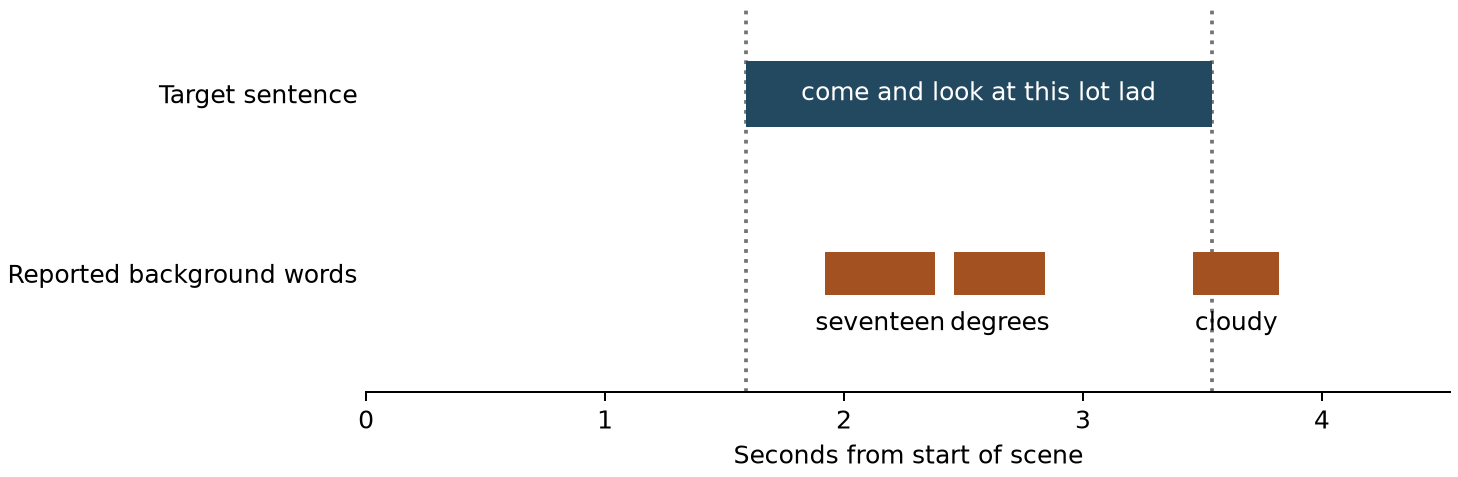
Figure 1. Two listeners using the baseline were asked to repeat “come and look at this lot lad.” One answered “seventeen degrees” and the other “seventeen degrees cloudy.” Both scored zero. The bars show when the background speaker said those words, as determined from the recording independently of the answers. The speaker gave the temperature entirely within the time span of the target sentence.
Reports of the competing talker
We compared all 4,298 responses on the 289 scenes with background speech in the data released for training prediction models. Table 1 pools the trials from the nine submitted systems. On the baseline, 24 responses contained a competing pair and no correct target words. They came from 12 listeners on 21 scenes. Seven further baseline responses contained a competing pair alongside some correct target words. Neither of the two submission responses flagged by the four-word script search contained a qualifying pair from the excerpt played.
Table 1. Target recognition and reports of competing words in scenes with background speech. Each fraction counts responses meeting the criterion among the trials specified in that row. Zero credit means no target words correct; a nonempty transcript contains at least one word. The expected counts in the last row show how often a word would match if we substituted nonoverlapping excerpts from the same background speakers for the excerpts played.
| Outcome | Baseline | Nine submissions |
|---|---|---|
| Mean target-word score | 27.3% | 59.9% |
| No target words correct | 216 / 420 | 715 / 3,878 |
| No words in transcript | 140 / 420 | 525 / 3,878 |
| Competing pair, all trials | 31 / 420 | 0 / 3,878 |
| Competing pair, zero-credit trials | 24 / 216 | 0 / 715 |
| Competing pair, nonempty zero-credit trials | 24 / 76 | 0 / 190 |
| Competing pair, zero-credit trials with two or more eligible words | 24 / 42 | 0 / 59 |
| At least one competing word, nonempty zero-credit trials | 49 / 76 (1.4 expected) | 0 / 190 (1.0 expected) |
Among zero-credit trials, the baseline exceeded the submissions in reports of competing pairs by 11.1 percentage points (95% interval from resampling listeners and scenes, 4.3 to 19.4). The difference was similar when we gave equal weight to each of the 127 scenes with failures in both groups (9.4 points) or to each of the 15 listeners (11.5 points).
Many zero-credit transcripts were too short to contain a pair, but even among answers with exactly two distinct eligible words, 7 of 19 matched on the baseline and 0 of 41 on the submissions. Lowering the threshold to a single eligible word still gave no matches among the 190 nonempty submission failures. Some answers sounded like the target: one listener reported “after pleasure” for “afterwards we could look round at leisure.” Chance agreement on a pair was uncommon. Substituting other, nonoverlapping excerpts from the same background speaker gave an expected 0.34 matching responses across the 216 baseline failures, compared with 24 using the excerpts played.
Removing all 17 training scenes flagged by the four-word script search left competing pairs in 13 of 195 baseline failures and 0 of 654 submission failures. We also used automatic speech recognition to identify the words in each background excerpt without supplying its script. Under that rule, 20 baseline failures matched, including 18 of the original 24, versus none on the submissions. Excluding the one listener whose transcripts differed between public data releases gave 21 of 199 versus 0 of 660 with the script-based rule.
A listener could hear the background speaker alone before or after the target sentence. Eight of the 24 baseline failures contained a pair spoken wholly during the target sentence, as in Figure 1. Five contained a pair spoken wholly before the target began and three a pair wholly after it ended. A response can contain pairs in more than one interval. The full count includes reports from anywhere in the scene; the count of eight requires both words to occur during the target sentence.
Results on separate test scenes
The data released for testing prediction models provided a separate set of scenes. In 52 test scenes where we could identify background speech directly from a baseline sound mixture, 4 of 40 zero-credit baseline responses contained a competing pair, compared with 0 of 49 on the submissions. Two of the four baseline cases confirmed previously identified matches. In the two remaining cases, listeners heard the same scene but repeated different parts of the background speech. One answered “the classic comedy film starring” and another “monty python the holy grey arthurian.” The background speaker was describing Monty Python and the Holy Grail. These examples corroborate the identification of the competing speech. Only one listener in this subset heard both baseline and submitted systems, so the test scenes offer little independent evidence about the size of the difference.
Methods
Listening data
The second prediction challenge release provided target scores and responses. Automatic speech recognition produced the transcripts, and human transcribers checked them. After removing duplicate signal identifiers across the three partitions of the training data, we had 5,946 trials on 400 scenes. We included a further 897 trials on 200 test scenes when checking the overall scores and kept those scenes separate when identifying the competing speech. For the four-word search across scripts, which ignored when the words were spoken, we used the overlapping responses in the third prediction challenge release. A four-word sequence had to contain at least two distinct words absent from the target. In the earlier release the same screen flagged 15 baseline responses and two submission responses. All changes in transcript wording across shared trials concerned one listener.
Matching recordings in training scenes
For each background voice, we cut the Clarity evaluation speaker track at the start time and duration specified for that scene. To identify the source recording, we searched a collection of 3,283 OpenSLR British and Irish English recordings from the 22 background speakers, searching only recordings by the specified speaker. At a sampling rate of 4 kilohertz, we took the difference between successive samples in each waveform. We shifted the two resulting signals relative to each other and measured their correlation to find the best time alignment. We required an absolute normalized correlation above 0.45 over more than 0.25 seconds of overlap. Because a click at the start of a recording could pass that test, we also required correlations above 0.60 in at least three nonoverlapping 100-millisecond blocks at the same alignment. This removed 55 of 767 candidate excerpts and retained at least one recording for each of the 401 background voice segments.
We checked those identifications against the sound mixtures played to listeners, using the first 30 distinct speech scenes with baseline audio in archive order. A separate search in the mixtures recovered 56 scene/recording pairs. All 56 agreed to within 26 milliseconds with the timing derived from the isolated background tracks. No comparison using the wrong speaker passed.
Matching words
To locate individual words in each source recording, we aligned the script’s characters to the output of an English wav2vec 2.0 speech recognition model at 16 kilohertz. Each word had to fall within the scene. Over the span of that word, the source waveform had to have an absolute correlation of at least 0.45 with the isolated background track. This gave us the same reference words and times for every system on that scene. We converted transcripts to lowercase, removed accent marks, retained internal apostrophes and excluded target words and the fixed list of frequent grammatical words. Words had to match exactly, but a pair could have intervening words. Both words had to come from the same recording.
Chance matches and uncertainty
To estimate chance agreement, we compared each response with other available, nonoverlapping segments from each background speaker. For each speaker we averaged the match indicator (whether or not the words matched) across those segments, then summed the per-response probabilities of any match to get the expected count. To estimate uncertainty in the difference between match rates, we resampled scenes and listeners independently with replacement 5,000 times. In each sample, a trial’s weight was the number of times its scene was drawn multiplied by the number of times its listener was drawn. We took the middle 95% of the resulting differences.
Matching recordings in test scenes
The test scenes lacked start times for the background excerpts. For each of the 80 scenes with baseline audio, we selected the first baseline listener in identifier order and searched the first audio channel of that mixture against all 3,283 recordings. We used spectral whitening to balance the contributions of different frequencies before matching waveforms. We required a normalized correlation peak of at least 0.09 and agreement at the inferred time alignment in at least three separate quarter-second windows. This identified 103 excerpts in 52 scenes. Shifting the candidate alignments by 0.53 seconds gave no qualifying matches. We compared responses with the script words that fell inside those scenes.
Interpretation
The baseline amplified and compressed both voices together; the submissions aimed to make the target easier to distinguish. Fewer reports of competing words with the submissions are therefore expected. Matching responses to the speech actually played shows how often another message came through clearly enough for listeners to repeat it. A target-word score alone misses that distinction.
A pair count misses single words, paraphrases and voices heard but not reported. Zero observed matches on the submissions need not mean a zero underlying rate. Target recognition itself improved, and no listener heard the same scene on two systems, so the match rates describe the failures observed with each system rather than the same people failing on the same sentences. The comparison of complete simulated hearing aids cannot isolate which processing feature mattered or estimate how often wearers follow the wrong person in conversation.
References
Akeroyd MA et al. (2023). The 2nd Clarity Enhancement Challenge for Hearing Aid Speech Intelligibility Enhancement: Overview and Outcomes. IEEE International Conference on Acoustics, Speech and Signal Processing. Official listener scores and baseline hearing-aid description.
Barker J et al. (2024). The 2nd Clarity Prediction Challenge: A Machine Learning Challenge for Hearing Aid Intelligibility Prediction. IEEE International Conference on Acoustics, Speech and Signal Processing. Clarity Project data: second prediction challenge listening material, third prediction challenge listening material and first enhancement challenge evaluation sources.
Demirsahin I, Kjartansson O, Gutkin A, Rivera C (2020). Open-Source Multi-speaker Corpora of the English Accents in the British Isles. Language Resources and Evaluation Conference. Figure 1 uses word times derived from the OpenSLR 83 recordings and Clarity scene annotations.