Among any ten points in a square, four enclose at most 8/45 of its area
Why it matters
No matter how you place ten dots in a square, a rubber band stretched around some four of them will enclose less than 18% of the square. Applied to a square with many dots, that guarantee cuts the leading area estimate by one fifth, even for the hardest arrangement.
Place n distinct points in a unit square and choose the four that enclose the least area. Measure their area by their convex hull, the region a taut rubber band would enclose around them. How small an area can we guarantee, even if someone places the points to make that choice as difficult as possible? For large n, Gajjala and Ravi proved an upper bound with leading term 2/n. A square grid shows why one natural way to improve that bound, by studying groups of nine points, runs up against the same factor of 2.
We prove that among any ten points in the square, four have a hull of area at most 8/45. By dividing the square into strips, we obtain a bound for large n with leading term (8/5)/n, one fifth smaller than 2/n. In the usual notation the new bound is (8/5+o(1))/n, where o(1) denotes a term that tends to zero as n grows.
From a single strip to the whole square
The hull of four points can be a quadrilateral, a triangle if the fourth point lies in or on the triangle, or a segment of area zero. For each placement, take the smallest area among all such groups of four, or quartets. Write \Delta_4(n) for the least upper bound of these minima over all placements. Schmidt asked how fast \Delta_4(n) decreases as n grows. The classical upper bound had leading coefficient 3 at order 1/n; Gajjala and Ravi reduced it to 2.
The key to using a strip is that stretching it into a square preserves the fraction of its area that a quartet occupies. Suppose that among m points in a unit square there is always a quartet with hull area at most t. For n\ge m, divide the square into r=\lfloor(n-1)/(m-1)\rfloor vertical strips of equal width, rounding the ratio down to an integer. Assign each point on a dividing line to just one strip. If every strip held at most m-1 points, the square would hold at most r(m-1)\le n-1. So one strip holds at least m points. Stretch it horizontally to fill the square and choose a quartet of area at most t there. The stretch multiplied all areas by r, so the same quartet in the strip had area at most t/r. This is Gajjala and Ravi’s subdivision argument (Observation 3.1).
For ten points, substituting t=8/45 gives
What the number of points changes
For a group of size m, the strip argument gives leading coefficient (m-1)t. Consider the nine points of a 3\times3 grid with spacing 1/2. Their smallest four-point hull has area 1/4. Gajjala and Ravi conjectured that this area suffices for every placement of nine points. Even that matching upper bound would give only 8\times(1/4)=2 by subdivision.
For eight points, an independently checkable proof gives an upper bound of 33/128, hence coefficient 231/128. But deleting the centre of the nine-point grid leaves eight points whose quartets still all have area at least 1/4. Thus the best possible eight-point bound could give no coefficient below 7/4 by subdivision.
To see what individual placements achieve, we examined 166 drawings from a public archive for the related triangle problem, which asks about the smallest area enclosed by three points. The 98 drawings in a square contained 79,208,745 quartets. We evaluated each quartet using the supplied decimal coordinates. The smallest quartet in the ten-point square drawing had area near 0.0931. A local search that adjusted point positions to enlarge the smallest four-point hull found 0.1589 (rounded) in 32 starts. Proving an upper bound requires accounting for every placement, including ones outside this search.
Reducing all placements to ten boundary cases
It suffices to consider placements with two points on the bottom edge and two on the left. The reason is that we can move any noncollinear set into such a placement without shrinking any hull. Then a small hull in the new placement identifies one at least as small in the original. Fixing points on edges reduces the number of coordinates we need to vary, an approach also used for the triangle problem. If all points lie on a line, every hull already has area zero.
First slide the points vertically by an amount proportional to their horizontal position. This motion, called a shear, preserves area. For a point with coordinates (x_i,y_i) the new height is y_i+s x_i, where s sets the slope of the shear. Choose s to minimize the span from the lowest point to the highest,
Take the leftmost value of s that minimizes the span. If the highest and lowest points were both unique there, they would remain the extremes for all nearby values of s. Their height difference would follow a straight line on that interval. A sloping line cannot have a minimum in the interior, and a level line would attain the minimum farther left. Thus at least two points share the highest or lowest position. Translate and scale the vertical range to [0,1], reflecting if needed to put the shared extreme on the bottom edge. Since w(s)\le w(0)\le1, scaling to unit height cannot shrink any area.
Repeat horizontally: shear to minimize the horizontal span, scale it to [0,1] after translation, and put the shared extreme on the left. The heights stay fixed. We can now designate two distinct points on the bottom, one on the top, two distinct points on the left and one on the right.
A point designated for two edges must lie at their common corner. To list the cases, choose which corners serve twice and subtract the edge positions they fill from the required counts. Discard choices that give a negative count. For each remaining position allow a point anywhere on its closed edge, endpoints included. For example, when only the bottom-left corner serves twice, one further point can lie anywhere on each of the left, bottom, right and top edges. All undesignated points can lie anywhere in the square, including on edges or corners. As a separate check, we assigned the six edge positions to point labels in every possible way, discarded incompatible assignments and grouped those differing only by relabeling. Both enumerations gave the same ten cases.
Checking a continuous range of positions
Within each boundary case, each point has an allowed box: a rectangle, an edge segment or a single corner. The computer proof repeatedly splits these boxes until it can name a quartet whose area stays at or below the bound for every choice of positions in its boxes. The record of those decisions, called a certificate, forms a tree. Each branch records a split and each endpoint, or leaf, names a quartet.
One split can handle several points at once. Suppose g points share the same allowed box. Bisect it along one coordinate. Only the number of points in the lower half matters, since exchanging labels within the group changes neither the allowed placements nor the existence of a small quartet. Make one branch for each count k from zero to g, assigning the first k labels to the lower half and the rest to the upper half. A point on the cut may go in either half. Four points sharing a box thus give five cases rather than sixteen assignments. Different branches can use different quartets.
To check a quartet at a leaf, it suffices to put each point at a corner of its box and test every such combination. The reason comes from a triangle area formula. For points a,b,c, write T(a,b,c)=|\det(b-a,c-a)| for twice their triangle area. Here the determinant measures the signed area of the parallelogram formed by the two displacement vectors. For four points the hull area satisfies
Hold three points fixed. Each determinant is then an affine function of the remaining point’s coordinates (a linear expression plus a constant). The sum of their absolute values is convex: along a segment it cannot exceed the larger endpoint value. Applying this first across a rectangle and then along its edges shows that moving the point to a suitable corner cannot decrease the hull area. Repeating for each of the four points proves the corner test.
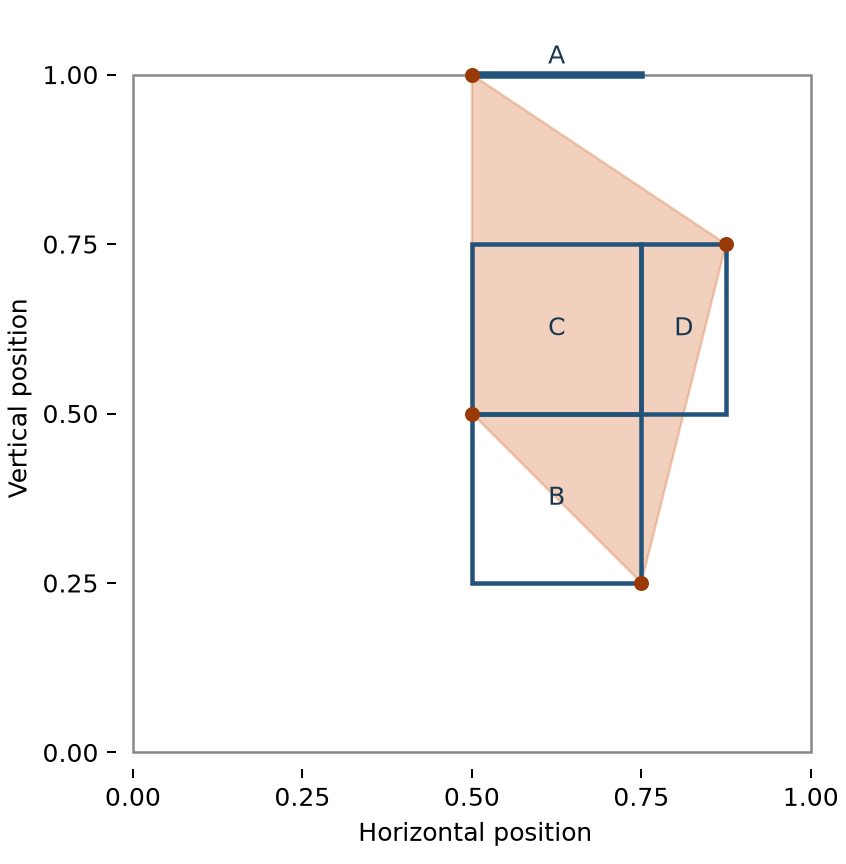
Figure 1. A leaf from the ten-point proof. One point lies on the blue segment A, and one lies in each of the blue rectangles B, C and D. The orange dots give corner positions with the largest hull area, 11/64, below 8/45. The other six points need not be examined at this leaf.
An independent checker verified all 9,103,411 leaves (Table 1). The search used numerical scores to select promising splits. The checker needed only the proposed splits and quartet labels: it started from the ten boundary cases, reconstructed every branch and required the tree record to end exactly after the last case.
For the corner test the checker multiplied all coordinates by D=2^{16}, making every box endpoint and every accepted midpoint an integer. This scales areas by D^2. At every corner combination the checker required 45 times the sum of the four absolute determinants to be at most 4D^2\cdot8. By the hull area formula this is an exact comparison with 8/45 in the unit square. Every leaf passed. Since each split covers its entire parent up to relabeling, every ten-point placement contains a qualifying quartet.
Table 1. Coverage of the ten-point proof, grouped by the number of designated corners serving two edge positions. Tree nodes count all regions in the tree; each verified leaf covers a whole region of allowed placements.
| Corners serving twice | Boundary cases | Tree nodes | Verified leaves |
|---|---|---|---|
| 0 | 1 | 7,305,388 | 3,679,417 |
| 1 | 4 | 8,408,229 | 4,262,839 |
| 2 | 4 | 2,170,630 | 1,109,964 |
| 3 | 1 | 99,291 | 51,191 |
| Total | 10 | 17,983,538 | 9,103,411 |
The complete certificate, its decoding instructions and the counts for each boundary case accompany the proof.
The certificate gives a universal ten-point upper bound; the exact ten-point optimum remains undetermined. For large sets the improvement is in the coefficient of the area guarantee. Its dependence on 1/n is unchanged.
References
W. M. Schmidt, On a problem of Heilbronn, Journal of the London Mathematical Society 4 (1972), 545–550.
R. Gajjala and J. Ravi, Improved upper bounds for the Heilbronn’s Problem for k-gons (2024). Observation 3.1, Corollary 3.8 and Conjecture 3.9 in the arXiv version.
T. Stead and contributors, Canonical Heilbronn point configurations, pinned coordinate archive.