Among nine points in a square, some four always enclose at most a quarter of its area
Why it matters
Place nine dots anywhere on a square sheet. You can always pick four whose tight rubber band encloses at most a quarter of the sheet. Spacing the dots in three even rows and columns reaches that limit: every band around four dots encloses at least a quarter.
Place nine points in a square. For each choice of four, imagine stretching a rubber band around them. The region inside the band is their convex hull. How should we place the nine points to make the smallest of these areas as large as possible? On an evenly spaced three-by-three grid the smallest area is one quarter of the square. The grid gives a target, but checking it leaves open whether some less regular arrangement could do better.
We prove that one quarter is the best possible. However the nine points are placed, some four have a hull that covers at most one quarter of the square. The key is a result about five points: in any rectangle containing five points, four of them have a hull that covers at most half the rectangle.
From nine points to five
Gajjala and Ravi proposed the grid in their study of the four-point version of the Heilbronn problem. Every choice of four counts, even if one point lies inside the triangle formed by the other three. For nine points in a rectangle of area one, they conjectured that the largest possible minimum hull area, which they denoted by \Delta'_4(9), satisfies \Delta'_4(9)=1/4 (Conjecture 1). Stretching a square into a rectangle multiplies all areas by the same factor, so the fraction covered by each hull stays the same.
Cut the square into two equal rectangles and count each point on the cut in just one of them. One half must contain at least five of the nine points. Choose five there. Half the area of their rectangle is one quarter of the original square, so the five-point result gives the conjectured bound.
Gajjala and Ravi had proved a half-area bound for six points. Draw a line through the centre of the rectangle and one of the points. The line halves the area, and at least three of the five remaining points lie in one closed half. Those three and the point on the line give the desired four. With five points in total, the other four might fall two on each side. The proof below handles this case by moving points to the boundary.
Moving five points to the boundary
Work in a unit square, which we can later stretch to any rectangle. The aim is to move each interior point to the boundary without shrinking any four-point hull. Then, if we find four points with a small hull on the boundary, the same four had a hull at least as small before the move.
Fix four points and consider their four possible triples. All four triple hulls share a point, which we call r. If one of the four points lies in the closed triangle of the other three, use that point: every triple either includes it or encloses it. This also covers collinear or coincident points. Otherwise the four points form a convex quadrilateral. Use the intersection of its diagonals as r. Removing any vertex leaves one whole diagonal in the remaining triangle, so that triangle contains r.
Let the fifth point, P, be in the interior. Follow the ray from r through P to the boundary and call its endpoint P'; if P=r, choose any direction. Pick any three of the fixed points. Their hull contains r, so their hull with P' contains the whole segment from r to P', including P. Moving P to P' therefore preserves or enlarges every hull that used P. The hull of the four fixed points stays the same. Repeat for each interior point, finding a new r each time and keeping track of the point labels even when points coincide.
Finding four points on the boundary
Ordering the five points around the perimeter and comparing coordinates on opposite sides gives 192 patterns. Enumeration showed that in each pattern the same four labels work for every placement in that pattern. The following area comparisons explain the bound.
Start with a point T=(d,1) on the top side, so d is its horizontal distance from the left edge. Put a bottom point at (d,0) directly below it and choose any points L and R on the left and right sides. These four enclose exactly half the square. The vertical segment from top to bottom is a common base of length one for two triangles, one reaching left to L and the other right to R. Their perpendicular heights are d and 1-d, so their areas sum to 1/2.
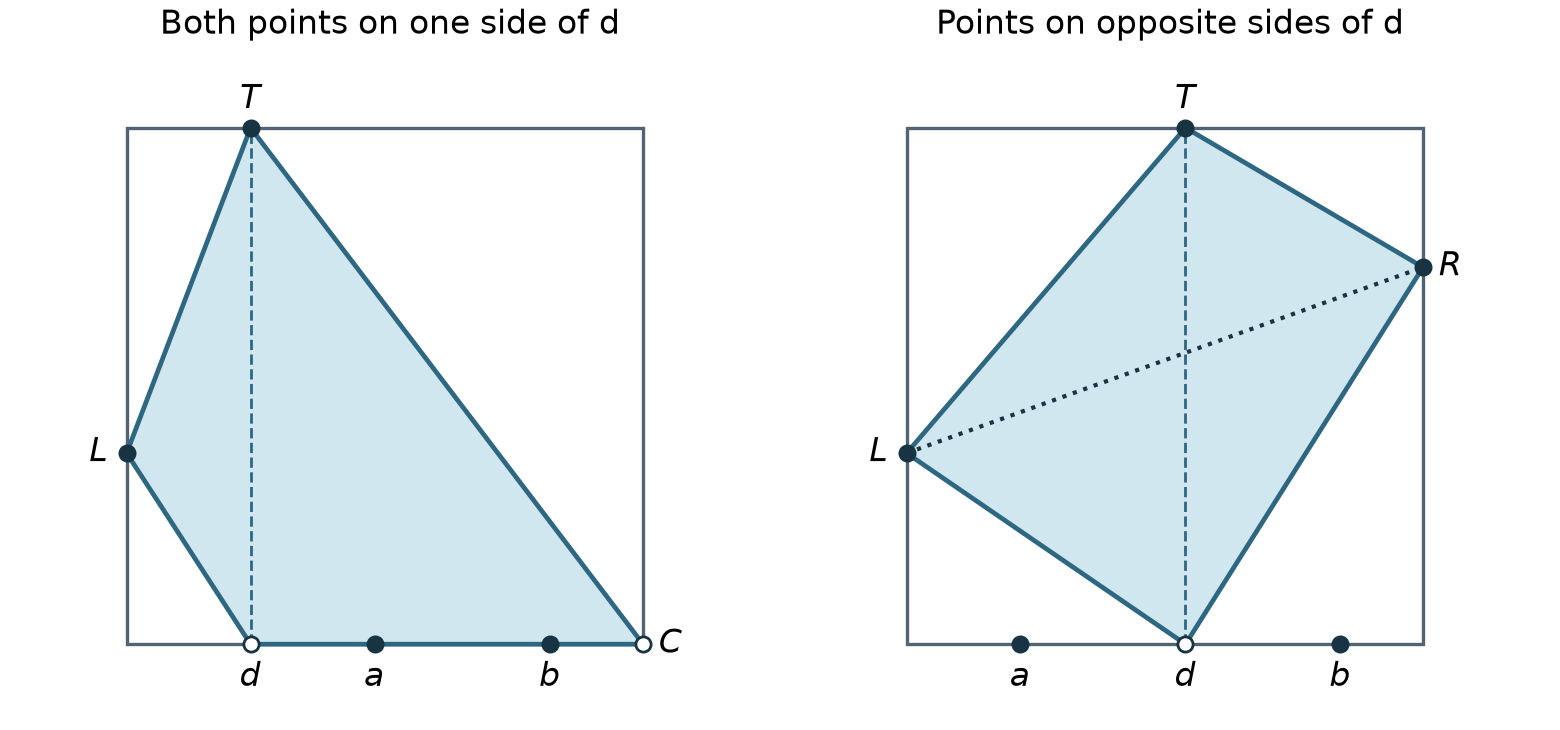
Figure 1. Each shaded hull covers half the square. Filled dots mark points of the placement; open dots complete the shape used for comparison. On the left, the bottom-right corner C serves as the right vertex, so the bottom edge includes both marked bottom points. On the right, moving the bottom tip to one of the two marked points leaves the area at or below 1/2.
Now suppose the bottom side holds two points with horizontal coordinates a\le b. If d\le a, choose the bottom-right corner as R (Figure 1, left). The bottom edge of the half-area shape extends from d to the corner. It contains both bottom points, so those points together with T and L enclose at most half the square. If b\le d, reflect the picture: use the bottom-left corner and a point on the right side.
If a\le d\le b and both side points L and R are present, keep T,L,R fixed and slide the bottom tip to (x,0) (Figure 1, right). The segment LR divides the hull into a fixed triangle with tip T and a triangle with moving tip (x,0). The moving triangle has fixed base LR. Its height, the perpendicular distance to the line through L and R, varies linearly with x because the bottom side never crosses that line. The total area therefore varies linearly too. At x=d it equals 1/2. Since d lies between a and b, at least one of those two endpoints gives an area no greater than 1/2.
To see that these comparisons suffice, count the points on each side, assigning a corner point to either incident side. If three points share a side, they and any fourth point span a triangle with base and height at most one, hence area at most 1/2. If two adjacent sides each hold two points, those four fit in the half-square triangle bounded by the sides and a diagonal. Only two arrangements remain.
If two opposite sides have two points each, orient the square so these sides are the top and bottom and the fifth point is on the left. Interchange top and bottom if necessary so that a leftmost point among the four is on top. Use it as T. Both bottom points are at or to its right, so the comparison in the left panel of Figure 1 applies.
If one side has two points and each other side has one, take the doubled side as the bottom. When the top point lies to either side of the bottom interval, use the corresponding bottom corner. When it lies over the interval, use the sliding tip. The comparisons allow equal coordinates throughout, and a triangle of zero height contributes zero area.
This proves the half-area bound for five points, and cutting the square in half gives the quarter-area bound for nine. The five-point bound is itself exact. Place points at the four corners and the centre: deleting any corner leaves a half-square triangle, while deleting the centre leaves the whole square.
Why the grid attains one quarter
On the three-by-three grid in the unit square, the four corners of one grid cell enclose area 1/4. To see why no four grid points enclose less, double both coordinates. The enlarged grid is \{0,1,2\}^2: each coordinate is zero, one or two. No four sites lie on a line. A nonvertical line meets each of the three columns at most once, and a vertical line contains at most one column of three sites.
If four sites form a quadrilateral, a diagonal splits it into two triangles. If their hull is a triangle, join the fourth site to the vertices. Whether that site is inside or on an edge, the split gives at least two positive-area triangles with disjoint interiors. For each, twice its area is the absolute value of the determinant formed by two edge vectors from a common vertex. The edge coordinates are integers, so the determinant is an integer with absolute value at least one. Scaling back divides areas by four. Each triangle thus covers at least 1/8 of the original unit square, and the four chosen points enclose at least 1/4.
As an exact check, we enumerated all 126 choices of four grid sites. For each hull we ordered its vertices around the boundary and calculated its area by summing triangle determinants with integer coordinates. Exactly 44 choices attained 1/4, and none had smaller area. We also tested the five-point bound on a five-by-five grid. We enumerated all 118,755 unordered choices of five sites, allowing repetitions. For each choice we deleted each point in turn and took the smallest of the five remaining hull areas. The largest such minimum was 1/2. The proof for boundary placements extends that finite check to arbitrary positions in the square.
Reference
Rishikesh Gajjala and Jayanth Ravi (2024). “Improved upper bounds for the Heilbronn’s Problem for k-gons.” 36th Canadian Conference on Computational Geometry, Figure 2 and Conjecture 1. Preprint, Figure 3.2 and Conjecture 3.9.