Five point patterns beat the three-row grid for every choice of six or more points
Why it matters
How can you place fifteen dots on a square sheet so that a rubber band around any six encloses as much paper as possible, even in the worst case? Three even rows seemed best, but their smallest band encloses a quarter of the sheet; in another placement even the smallest encloses just over 25.5%. Combining five patterns beats the rows at every larger size covered by the same rule.
Place points in a square, let someone else choose a fixed number of them, and stretch a rubber band around the chosen points. How should you place the points to make the area inside the band as large as possible, even for the worst choice? When the other person can choose k points out of 3(k-1), a regular grid with three rows of k-1 points each guarantees at least a quarter of the square. The open question was whether any placement could guarantee more.
With fifteen points, we found a placement where even the smallest area enclosed by six points is 25.5184% of the square. Five placements, used alone or in combination, beat the quarter-area guarantee for every k\ge6.
The quarter-area prediction
The classical Heilbronn problem asks how large the smallest triangle among n points in a unit square can be. For a selection of k points, the region inside the rubber band is called the convex hull. It is the smallest convex set containing the selection. Selected points count toward k even if they lie inside the hull or along a straight edge. Write \Delta_k(n) for the best possible minimum hull area: take the smallest area among all choices of k points from one placement, then take the supremum of those minima over all placements of n distinct points.
Gajjala and Ravi's Conjecture 2 predicts that a grid with \alpha rows of k-1 points each is optimal. Their proposed value is \Delta_k(\alpha(k-1))=1/[2(\alpha-1)] for integers 2\le\alpha\le k-1. They considered rectangles of area one. Stretching such a rectangle into a square without changing its area also preserves the area of every hull. If the conjectured value were optimal, every placement would contain a selection with area that small or smaller. One could then use the same guarantee within the cells of a subdivided square to bound hull areas in larger point sets.
For three rows, the grid itself gives exactly 1/4. To see why, put m=k-1 and use integer coordinates on the board [0,m-1]\times[0,2]. No line contains more than m grid sites when m\ge3, so any m+1 sites span a polygon. Dividing the polygon into triangles with all selected sites as vertices gives at least m-1 triangles. Each has area at least 1/2 because twice its area is a nonzero integer. A full outside row and one middle-row point attain this minimum total area: their hull is a triangle with base m-1 and height one. Dividing its area by the board area 2(m-1) gives one quarter.
Five placements with larger minimum areas
On a six-by-six grid, every selection of thirteen points encloses at least 7/25 of the square. Among the full grids we compared with the three-row arrangement, k=13 was the smallest selection size at which a grid beat one quarter. The comparison covered rectangular grids with w sites across and h sites high, for 2\le w\le10 and w\le h\le12. Of 168 combinations of grid dimensions and selection size meeting the conjecture's conditions, 35 had the required total of wh=3(k-1) points. Keeping just the twenty boundary sites of the six-by-six grid and the four corners of its central cell gives the same minimum area with nine points chosen out of twenty-four (Figure 1).
Allowing points to move off the grid gave improvements down to six points out of fifteen (Table 1). Among the twenty-one-point layouts tested, a pattern with both reflection and rotation symmetry fell short, but one with quarter-turn symmetry alone gave an eight-point minimum of 41/160. At fifteen and eighteen sites, searches with half-turn symmetry also fell short. For those sizes we moved sites individually to enlarge the smallest hulls and then rounded the coordinates to rational numbers.
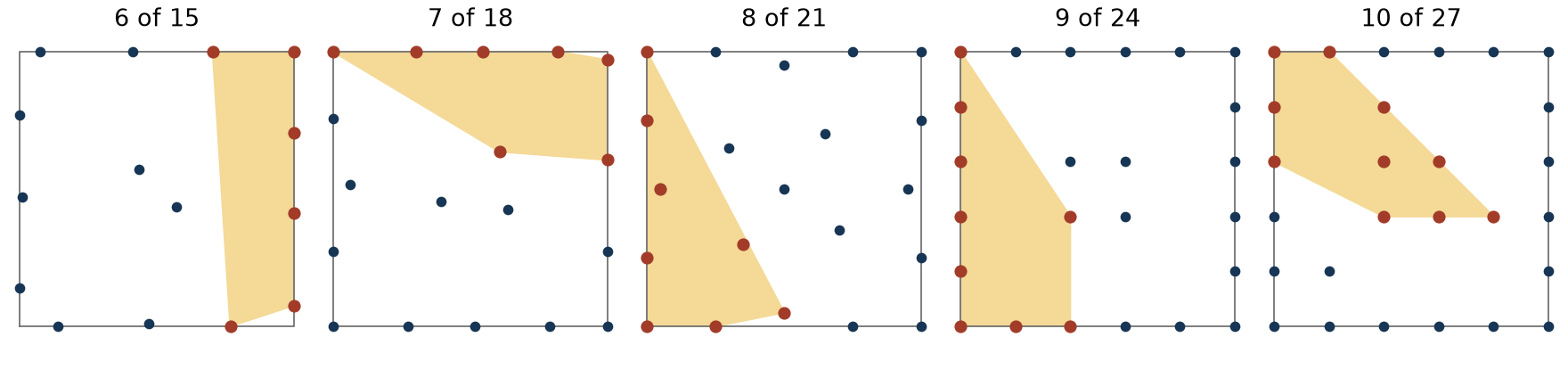
Figure 1. One smallest hull for each placement. In the fourth panel all points lie on the square boundary or at the corners of its central grid cell.
Table 1. Minimum areas for the five placements. Each row counts every selection of the indicated size. The grid benchmark is 25% in every row.
| Points placed | Points chosen | Selections checked | Minimum area | Percent of square |
|---|---|---|---|---|
| 15 | 6 | 5,005 | 15949/62500 | 25.5184 |
| 18 | 7 | 31,824 | 559/2178 | 25.6657 |
| 21 | 8 | 203,490 | 41/160 | 25.625 |
| 24 | 9 | 1,307,504 | 7/25 | 28 |
| 27 | 10 | 8,436,285 | 13/50 | 26 |
Why five placements cover every larger size
Think of two copies of the fifteen-point pattern in the same square. Among any eleven points chosen from the thirty, at least six must come from one copy: taking only five from each would give only ten. The hull of the eleven contains the hull of those six. This argument works however the copies are aligned, provided their points are distinct. A slight reduction in size leaves room to shift the copies apart while preserving their advantage over the grid.
For each pattern in Table 1, let b be one less than the selection size in the table. The five values are b=5,6,7,8,9. Each pattern has 3b sites and guarantees its listed area as soon as b+1 points are chosen. Suppose the values of b for a collection of copies sum to m. The copies then supply 3m points. Choosing m+1 points forces at least one copy to contribute more than its b, so the combined hull encloses at least the smallest area guaranteed by any copy.
Every integer m\ge5 is a sum of these values. Start with the number between 5 and 9 that has the same remainder as m on division by five. Add copies of 5 to reach m. With m=k-1, this gives exactly 3(k-1) points for a selection of k, as long as sites in different copies do not coincide.
To keep the points distinct, scale each copy about the origin by s=9999/10000. Before scaling, all coordinates are multiples of 1/L for L=16500, as the coordinates below show. For r copies, shift copy j to the right by j(1-s)/(rL), numbering the copies from j=0 to r-1. Each shift fits in the unused width 1-s. After scaling, unequal horizontal coordinates are at least s/L apart, more than the difference between any two shifts. Equal horizontal coordinates in different copies become unequal. All sites are therefore distinct rational points in the square. Scaling multiplies the areas in Table 1 by s^2. Even using the smallest entry, every k-point hull has area at least
Coordinates and exact area checks
The following coordinates specify Figure 1 and Table 1. Divide both coordinates by the stated denominator to obtain points in the unit square.
- 15 points, denominator 250. Take (250,250) and the seven points (35,0),(19,250),(118,2),(109,143),(103,250),(250,176),(192,0) together with their reflections across y=x.
- 18 points, denominator 33. Take (0,0),(0,33),(33,32),(33,0),(9,0),(33,9),(27,33),(0,25),(17,0),(33,20),(18,33),(0,9),(26,0),(21,14),(2,17),(10,33),(20,21),(13,15).
- 21 points, denominator 20. Take (10,10) and all four quarter-turn positions about this centre of each of (0,0),(5,0),(15,0),(10,1),(7,6).
- 24 and 27 points, denominator 5. Take all integer boundary sites of [0,5]^2 and the four sites of \{2,3\}^2. For 27 points add (1,1),(2,4),(4,2).
For the comparison of full grids, we could find the smallest area without checking every selection. First slide the selected sites in each occupied row into consecutive positions starting at the left edge. A row containing a given number of sites now spans that number minus one in grid units. The original hull was at least that wide at each occupied row. Between rows, its horizontal width is a concave function of height: it is at least the width obtained by linear interpolation between any two heights. The new hull, with its straight left edge, has the least concave width function covering the compressed row widths. Its width therefore never exceeds the original width, so its area cannot increase. Sliding the sites down each column in the same way leaves the rows nested, with the longest at the bottom. Every resulting shape is specified by its row lengths. Enumerating all nonincreasing row lengths with the required total number of sites thus gives the grid minimum.
For the five placements in Table 1, we checked every selection independently of the search that found the coordinates. To identify the hull edges, we examined each ordered pair of distinct selected points p,q. We kept the directed segment from p to q if all selected points lay on or to its left and all selected points on its line lay between its endpoints, inclusive. For a polygon this gives its edges in the counterclockwise direction, counting an edge only once even if other sites lie along it. With p=(p_x,p_y) and q=(q_x,q_y) in integer coordinates, the sum of p_xq_y-p_yq_x over the retained edges equals twice the hull area. If all selected sites lie on a line, the two opposite segments cancel. For a coordinate denominator D, dividing the sum by 2D^2 gives the area in the unit square. We compared areas using integers for all 9,984,108 subsets in Table 1.
The five placements give a lower bound on the best achievable area; the construction does not determine its exact value. For the next smaller case, five points chosen out of twelve, the searches found no improvement. Whether three rows are optimal at that size remains undecided by this argument.
Reference
Rishikesh Gajjala and Jayanth Ravi (2024). “Improved upper bounds for the Heilbronn’s Problem for k-gons.” Proceedings of the 36th Canadian Conference on Computational Geometry, Conjecture 2, p. 156. Preprint, Conjecture 4.5.