A quarter of bleeds accounted for three quarters of treatment infusions in a German study of hemophilia A
Why it matters
In a German study of a hemophilia medicine, most bleeds were treated with one infusion, yet three quarters of the infusions for bleeding went to the quarter of bleeds that took four or more. In the approval trial, courses that long accounted for only about one infusion in eighteen. Knowing how often one infusion was enough tells a family little about how much of the work went into longer courses.
In hemophilia A, too little of the clotting protein factor VIII makes it hard to stop bleeding. Families who give infusions to treat bleeds need to know how much of that work comes from episodes that take repeated treatment. Reports often describe how many bleeds stop after one infusion. That tells families what to expect for a typical bleed, but a few bleeds that need repeated treatment can account for much of the work. In a German study of rurioctocog alfa pegol, a drug that replaces factor VIII, 93 of 370 bleeds with known counts took four or more infusions. Those bleeds accounted for 74.2–74.3% of the infusions given for bleeding. In the trial used for the drug’s approval, seven of 591 bleeds took that many infusions and accounted for 5.3–5.8% of the total.
Counting infusions per bleed
The approval trial (study 261201) followed 137 adolescents and adults with severe hemophilia A. All had received treatment before entering the trial. AHEAD, a German study of routine care after approval, followed patients with moderate or severe hemophilia A. Of these, 99 received rurioctocog alfa pegol, sold in Germany as Adynovi. Both studies included patients who took regular infusions to prevent bleeding (prophylaxis) and patients who used the drug only when needed (on demand). We counted only infusions given for a bleed.
Most bleeds in both studies took just one infusion: 505 of 591 in the trial and 202 of 370 in AHEAD. Both reports grouped bleeds treated with four or more infusions into a single category, which we call long courses. A bleed treated with four infusions and one treated with twelve each count as one long course. To measure the work those courses represented, we counted every infusion from the first to the last.
Infusions in long courses
Long courses were more common in the German records and took more infusions per bleed (Figure 1). They made up 25.1% of bleeds with known counts in AHEAD, compared with 1.2% in the trial. The 93 long courses in AHEAD averaged nearly 12 infusions each; the seven in the trial averaged about six.
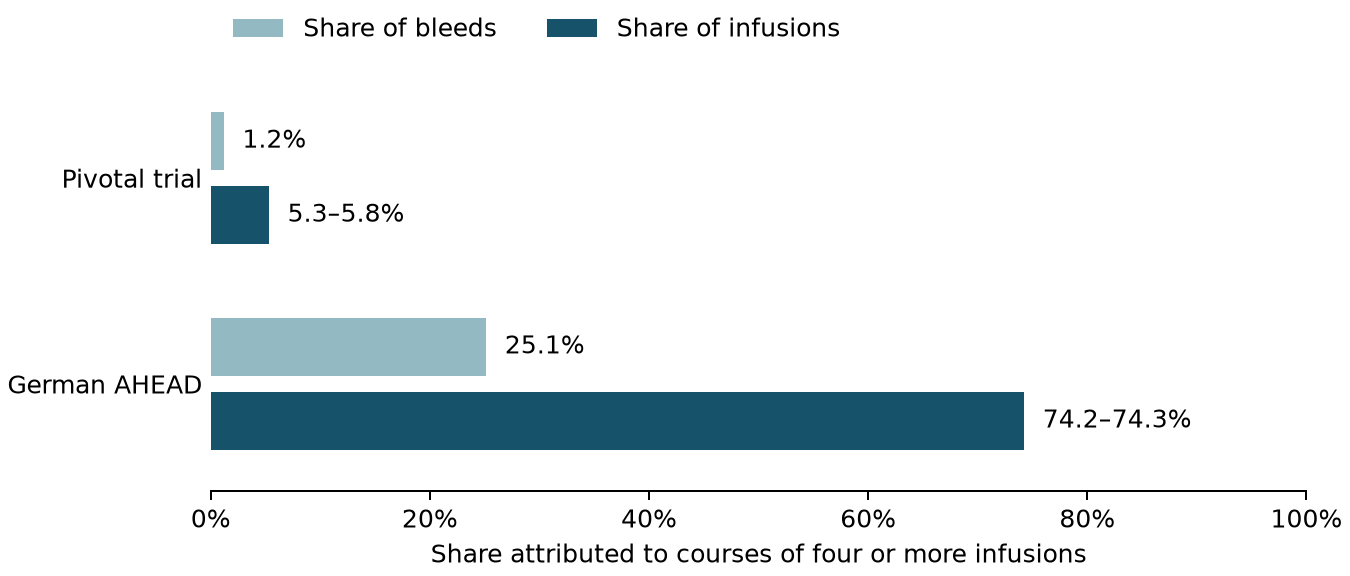
Figure 1. Long courses as a share of recorded bleeds and as a share of infusions given for bleeding. For infusions, each bar shows the lowest share consistent with the rounded figures in the study report. The labels give the full ranges allowed by rounding, rather than confidence intervals.
In Germany, 202 bleeds took one infusion, 52 took two and 23 took three. That accounts for all 375 infusions in short courses. The reported averages put the total for all 370 bleeds between 1,455 and 1,461 infusions. Subtracting 375 leaves 1,080–1,086 infusions in long courses. Even the fourth and subsequent infusions alone made up 55% of the total. In the trial, subtracting the infusions in short courses leaves 38–42 of 716–720 infusions in long courses. The trial maximum gives a simple check: even if all seven long courses had reached the maximum of eight infusions, their share would still have been less than 8%, given the 678 infusions in short courses.
The contrast persisted when we compared patients on the same regimen (Table 1). Among those treated on demand, nearly two thirds of German infusions went to long courses, compared with about one in twenty in the trial.
Table 1. Bleeds with known infusion counts, grouped by the treatment assigned to the patient in the trial and by the treatment in use at the time of the bleed in AHEAD. For patients on prophylaxis, the infusion share counts only infusions given for bleeding.
| Cohort | Regimen | Long courses / treated bleeds | Share of bleed-treatment infusions in long courses |
|---|---|---|---|
| Pivotal trial | Prophylaxis | 3 / 230 | 5.2%–6.1% |
| Pivotal trial | On demand | 4 / 361 | 5.0%–5.6% |
| German AHEAD | Prophylaxis | 81 / 307 | 75.8%–76.0% |
| German AHEAD | On demand | 12 / 63 | 62.8%–63.8% |
Missing counts and treatment after bleeding stopped
The German report listed 414 bleeds, including 44 without infusion counts. The lowest possible long-course share occurs if every missing bleed took three infusions: this adds as many infusions as possible to short courses without adding any to long ones. Even then, long courses account for 1,080 of 1,587 infusions (68%).
Some patients continued treatment after bleeding stopped to maintain clotting. The European assessment of the drug (Table 21) identifies 34 such bleeds in the trial but gives no count of extra infusions. To see how high the trial share could rise if these doses counted toward the same bleeds, we allowed every infusion other than a preventive one to count. The trial safety report (Table 2.7.4-10) lists 6,753 infusions, of which 5,941 were preventive. Assigning each of the remaining 812 infusions to a bleed would add at most 96 to the courses already counted. To maximize the share in long courses, we would first add one infusion to each of the 15 three-infusion courses, then two to each of 40 two-infusion courses. This brings those courses up to four infusions each but still leaves at least 553 infusions in short courses. With the same episode boundaries, the trial share could reach at most 31.9%.
How patients and treatment centers defined an episode also matters. The AHEAD protocol (pp. 26, 33 and 36) asked how many infusions it took to stop a bleed. Its scale for rating the response to treatment distinguished these infusions from later doses to maintain clotting. Patients kept treatment diaries, and centers could add treatments to the record. Recording two bleeds at the same site as a single episode would lengthen the recorded course without changing how many infusions the patient received.
Evidence from other studies of the same drug
Results from a Japanese survey after approval also imply that most on-demand infusions went to long courses. Fourteen previously treated patients contributed 58 bleeds, with a mean of 6.0 infusions per bleed and a standard deviation of 4.45. The rounded mean allows 346–350 infusions in total. At most 39 bleeds could have taken three or fewer infusions. With more short courses, the remaining courses would have to be so long that the standard deviation would exceed the reported value even after allowing for rounding. Short courses could therefore account for at most 117 infusions, leaving at least 66% in long courses.
A later Chinese trial of preventive treatment also had a higher share than the approval trial. For 31 treated bleeds, the mean and standard deviation allow 18–71 of 88 infusions in long courses. That range includes shares below and above half. A South Korean survey (pp. 18–24) grouped all courses of three or more infusions together. It reported total infusions separately without linking them to episodes, so a share for courses of four or more cannot be calculated.
Methods
We searched ClinicalTrials.gov, a public study registry, for studies of hemophilia A or B that had posted results. We screened 3,707 outcome tables from 232 studies, searching their titles and category labels for bleeding and infusion counts. Of these, 17 tables gave usable counts of bleeds grouped by the number of doses of replacement clotting factor. We also examined regulatory reports and studies of rurioctocog alfa pegol after approval. We chose the comparison and the four-infusion threshold after inspecting the data.
For the approval trial, we used all treated bleeds in Table 7 of the US Food and Drug Administration’s statistical review, including those in patients who did not complete treatment according to the protocol. For AHEAD we used the Adynovi columns of Table 61 in the final study report. Patients could switch regimens, and AHEAD excluded periods on a regimen lasting less than 90 days from its bleed analyses. Throughout, we used counts and means that gave each bleed equal weight. Averaging first within patients and then across them would give more weight to individual bleeds in patients who had fewer of them.
To allow for rounding, we accepted values within half a unit of the last printed decimal place on either side of each reported mean or standard deviation. Infusion counts had to be whole numbers. For Germany, the overall mean of 3.9 permits 1,425–1,461 total infusions. The means of 4.2 for 307 bleeds during prophylaxis and 2.9 for 63 bleeds treated on demand require at least 1,275 and 180 infusions, respectively. We kept pairs of regimen totals whose sum also matched the overall mean. For the trial, we enumerated possible lengths for the three long courses during prophylaxis and the four on demand. We required the longest courses to match the reported maxima of six and eight infusions, respectively. We kept combinations that matched the means and sample standard deviations both within regimens and overall.
For Japan, we used the registry’s count of doses per bleed in previously treated patients receiving the drug on demand. For each total allowed by the mean, we asked how many short courses the observed spread in course lengths would permit. Let p be a proposed fraction of short courses and m the overall mean. Assigning three infusions to every short course and spreading the remaining infusions evenly across long courses gives the smallest possible spread for that fraction. The variance across the recorded bleeds (using 58 as the divisor) must therefore be at least p/(1 − p) times (m − 3)². We compared this lower bound with the largest sample variance allowed by rounding, multiplied by 57/58 to put it on the same scale. For China, we enumerated possible sets of course lengths as positive whole numbers in nondecreasing order. We kept those whose totals and sums of squares matched the reported mean (2.839) and sample standard deviation (2.9337) within rounding.
Interpretation
These studies do not represent all settings. Patients and bleed severity differed, and the tables cannot show whether patients and centers marked the end of a bleed consistently. We therefore cannot attribute the contrast to routine care itself. Patients with frequent bleeds contributed more courses. The reports cannot tell us how many families gave the longer courses or how much treatment went unrecorded.
In AHEAD, one infusion was enough for a typical bleed, yet those single infusions accounted for only about one in seven infusions given for bleeding. Reports can show both the typical episode and the work of treating bleeds by giving two figures together: the share of bleeds treated with one infusion and the share of infusions that went to longer courses.