In Horton sets, the color order of 19 points identifies an empty quadrilateral of one color
Why it matters
Horton sets are arrangements of dots that can avoid large empty polygons. With 19 dots in such an arrangement, colored red or blue, you can pick four of one color from the left-to-right list alone and know they will enclose no other dot. As the list grows, the number of guaranteed choices grows with the square of its length.
Given a drawing of red and blue points, look for four points of one color that form the corners of a convex quadrilateral with no other point of either color inside. Call this an empty one-color quadrilateral. Horton sets are a natural place to ask how many such quadrilaterals a coloring can leave: these point arrangements can grow arbitrarily large without containing even one empty convex seven-sided polygon. For four sides, one empty one-color quadrilateral was known to be unavoidable in sufficiently large classical Horton sets. Finding one in each of several disjoint blocks would give a count proportional to the number of points. Joining corners from different blocks might give many more, but a point between blocks could spoil the new quadrilateral.
We show that the left-to-right order of the colors picks out quadratically many empty one-color quadrilaterals. Among n points, at least \lceil\lfloor n/19\rfloor^2/14\rceil distinct choices of four positions work in every allowed drawing with that color order. The reason is that two corners from one block can supply a side of a quadrilateral and two corners from a distant block can supply the opposite side. The first choice that works across drawings is guaranteed at 19 points. If the four positions can be chosen after seeing the drawing, 17 points suffice. Both thresholds are sharp.
How the points are arranged
Number the points from 0 to n-1 from left to right, with distinct horizontal coordinates and no three points on a line. Split the points into two groups, called children: the even indices and the odd indices. Place one child high above the other. This means that every point of the upper child lies above every line through two lower points, and every lower point lies below every line through two upper points. Apply the same rule within each child, splitting its points by taking alternate indices in left-to-right order. In the family of Horton drawings studied here, either child can be upper, independently at each split. The spacing can vary as long as the separation rule holds.
An empty convex quadrilateral is also called a four-hole. For the classical two-colored Horton construction, Devillers, Hurtado, Károlyi and Seara proved that 64 points suffice for a one-color four-hole (Theorem 3.5). The threshold of 17 for the larger family therefore improves the upper bound for the classical construction to 17. A quadratic lower bound for empty one-color triangles in Horton sets was also known. For quadrilaterals, Devillers and colleagues observed that two consecutive points of one child and two consecutive points of the other give a four-hole if all four have the same color. We use the geometry of these pairs to count the holes.
Which four positions work in every drawing?
Follow four indices through the splits until they first divide between two children. Call the group at that split their common node. For example, if all four indices are odd but do not all have the same remainder on division by 4, their common node is the odd indices. Its children are 1,5,9,\ldots and 3,7,11,\ldots. In general, after d splits, the indices in a node all have the same remainder modulo s=2^d. Its children are the two classes of indices within it with different remainders modulo 2s.
Four indices form a four-hole in every drawing, which we call a universal four-hole, exactly when they consist of a consecutive pair in each child of their common node. The pairs can be far apart: at the first split, the even pair 0, 2 can be joined to the odd pair 9, 11. In symbols, the indices must have the form
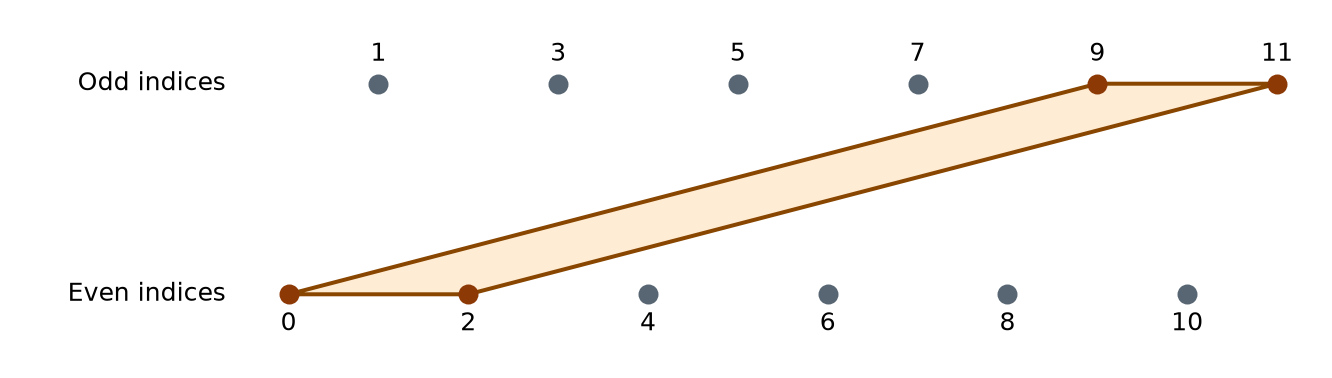
Figure 1. A split viewed at large vertical separation. Moving the children farther apart and rescaling the heights flattens each child to a row. The quadrilateral touches each row only along the chosen pair, however far apart the pairs lie horizontally.
To see why the rule works, first consider points outside the common node. Each such point belongs to the other child at some earlier split. If that child is upper, the point lies strictly above the line along a top edge of the four points’ convex hull (the smallest convex region containing them). The hull lies below that line. A point in a lower child is excluded in the same way by a bottom edge.
Within the common node, move the upper child upward by a distance T. This preserves the clockwise or counterclockwise order of every triple. Points within a child move together; for a triple divided between children, the lone point stays on the same side of the line through the other two. Convexity and containment therefore stay the same. Divide all heights by T and let T increase. In the limit the children lie on two horizontal lines, as in Figure 1. A pair on each line gives four distinct corners of a convex quadrilateral. If each pair is consecutive, every other point lies strictly outside the quadrilateral, beyond an end of the segment on its line. These properties hold for sufficiently large finite separation and hence in the original drawing.
To see why the rule is necessary, suppose first that a pair skips a point of its child. Keep that child fixed. Move the opposite child far away on the side of the pair’s line that contains the skipped point. In the two-row limit the skipped point lies strictly between the pair’s endpoints. It is therefore on the inside of both joining edges and of the opposite edge at sufficiently large finite separation. It is also on the inside of its own pair’s line, by the choice of side. The quadrilateral in this drawing contains the skipped point.
The other possible division puts three points in one child and one in the other. Keep the triple fixed and draw the line through its leftmost and rightmost points. Place the opposite child far away on the side of this line that contains the middle point. By the same joining-edge argument, the middle point is then inside the triangle formed by the outer pair and the lone point. Either local drawing extends to the full set: build the nodes from the bottom up with any prescribed upper-child choices elsewhere. At each earlier split, moving one whole child far enough achieves the required separation while preserving every triple’s order within each child.
Counting quadrilaterals from pairs of blocks
Every sequence of 19 colors contains a universal one-color four-hole. We checked this by starting with the empty sequence and appending either red or blue at the right. We kept an extension if it had no four equal colors at positions satisfying the pair rule and ending at the new index. Every earlier quadruple had already been tested, so this procedure kept exactly the sequences avoiding a universal one-color hole. Counting both choices of first color, 72 sequences survived at length 16, 12 at length 17, two at length 18 and none at length 19. Writing 0 and 1 for the colors, the two at length 18 were 011010011001101001 and its color reversal (swap 0 and 1).
Take b=\lfloor n/19\rfloor disjoint consecutive blocks of 19 points and choose one universal one-color four-hole in each. A choice in a block still works in the full set: adding the block’s starting index to each position preserves the gaps and the difference j-i in the pair rule. Group the choices by their common node in the full set and by their color. Four distinct indices in one class modulo s differ by at least 3s from first to last. A block spans an index difference of only 18, so s can only be 1, 2 or 4. These levels contain at most 1+2+4=7 nodes, giving 14 groups when color is included.
If a group contains t blocks, they supply t distinct consecutive pairs in each child of the same node. Any pair in the first child can be joined to any pair in the second. All four positions have the group’s color and satisfy the pair rule. This gives t^2 distinct choices, since the four indices identify the two pairs. Choices from different groups are distinct because the four indices and their color identify the group. The sizes of the 14 groups, counting empty ones, sum to b. Their squares sum to at least b^2/14 by the inequality between the mean square and the square of the mean. Rounding up gives the stated lower bound.
Quadratic growth is the most one can guarantee. Even before coloring, the classical Horton construction has only O(n^2) empty convex quadrilaterals, meaning that their number is bounded above by a constant times n^2.
The lower bound has leading term n^2/5054. At 38 points it guarantees one universal one-color four-hole, while the exact minimum is 14. To find this minimum, we enumerated all length-19 color sequences for a child of the first split. For each sequence we counted adjacent red pairs and adjacent blue pairs. Among sequences with the same two counts, we kept the smallest number of universal one-color holes within the child. To combine two entries, one for each child, we added their internal hole counts. For holes crossing the split, we added the product of their red-pair counts and the product of their blue-pair counts. Minimizing the total covers every 38-point sequence because its even and odd subsequences can be chosen independently.
Choosing the four positions after seeing the drawing
Every drawing of either surviving 18-point sequence has a one-color four-hole, even though each particular choice of four positions fails in some drawing. We checked the two ways of choosing positions independently of the pair rule by computing hulls for every choice of upper children. A split list specifies which child is upper at each node containing at least three points. One drawing per list suffices: for any triple, its first separating split fixes the side of the pair’s line on which the lone point lies. Together with the pair’s horizontal order, that fixes the triple’s clockwise or counterclockwise order and hence every hull and containment test.
| Points | Split lists | Lists with some coloring free of one-color four-holes | Four-holes shared by all lists | Color sequences avoiding all shared holes |
|---|---|---|---|---|
| 16 | 128 | 8 | 71 | 72 |
| 17 | 256 | 0 | 82 | 12 |
| 18 | 512 | 0 | 94 | 2 |
| 19 | 1,024 | 0 | 107 | 0 |
Table 1. Choosing positions after or before seeing the drawing. The third column tests each drawing separately. Its zeros at 18 and 19 follow by restricting a drawing to its first 17 points. The fourth column counts the four-hole locations common to every drawing. The last column counts the color sequences for which none of those locations has four equal colors. It agrees with the sequence count from the pair rule.
To draw each list, we used the indices as horizontal coordinates and started all heights at zero. Working upward from the smallest nodes, we raised the designated upper child by (2n+1)(H+1), where H was the largest height then in the node. Before the shift, the magnitude of every slope within a child was at most H because horizontal gaps were integers of at least one. The shift therefore sufficed even for lines extended across the full width of the node.
For each set of four points we tested every directed edge, using the sign of an integer determinant to tell which side of the edge a point lay on. We counted edges for which both remaining vertices lay to the left. Exactly four such edges indicate a convex quadrilateral. We kept it if no other point in the drawing lay to the left of all four edges. At sizes 16 and 17 we marked every subset of points containing one of the resulting holes. A coloring avoids one-color holes exactly when neither the red subset nor the blue subset is marked. For the last column of Table 1, we first intersected the hole lists over drawings, then tested every coloring against the shared holes.
We also compared the shared four-hole locations with those predicted by the pair rule at 22, 25, 28 and 32 points. The sets agreed at all these sizes. In particular, 32 is the first power of two large enough for four indices to lie in one node with s=8. Exactly the predicted 367 sets of four indices survived all 32,768 split lists there.
At 16 points, the color sequence 1001010011010110 avoids one-color four-holes in a drawing with split list 0110000. To read the list, take nodes in order of increasing depth, then increasing remainder. At the node with remainder r modulo s, a 0 makes the child with remainder r modulo 2s upper; a 1 makes the child with remainder r+s upper. At 17 points no list admits an avoiding coloring. In any longer drawing, the first 17 points still obey the split rules, and every later point lies to the right of their hull. Thus 17 points force a hole whose location may depend on the drawing. At 19, the colors guarantee a location without seeing the drawing.
The pairing rule depends on the recursive separation of Horton sets and need not hold for arbitrary planar point sets. Even for Horton sets, the best coefficient in the quadratic guarantee remains open.