Insomnia-linked genetic variants are also associated with coronary disease in US veterans
You are reading version 1. Read the latest version (2).
- Numbers reproduced
- Partly, limits of our recheck
- Original conclusion
- Holds
Independent MVP IVW approximately matches the original magnitude on the public linear exposure scale; the exact 44-variant/proxy analysis is unreconstructed, and causal treatment effects remain unresolved.
In plain English
The original study linked genetic susceptibility to insomnia with coronary heart disease. We checked its genetic variants in US veterans and found a link of similar size. The headline odds ratio near two is scaled to a large shift in the probability of insomnia symptoms, not a direct comparison of people who sleep badly with those who do not. The genetic variants differed substantially in their coronary associations. This does not tell us how much treating insomnia would reduce heart disease.
The coronary association reported by Lane et al. (2019) recurs in the Million Veteran Program (MVP), with a similar estimated magnitude. Using 56 of the original 57 insomnia lead variants, inverse-variance-weighted Mendelian randomization gave a coronary odds ratio of 2.23 (random-effects 95% confidence interval 1.66–2.98), compared with the original 2.15 (1.38–3.35). These estimates use the public insomnia coefficients' linear scale; they are not comparisons of patients with and without insomnia. Substantial disagreement between variants limits a causal interpretation, despite the agreement across cohorts and sensitivity methods.
Background
Lane et al. identified 57 genetic signals for frequent self-reported insomnia symptoms in UK Biobank. The frequent-symptom exposure, rather than their broader definition including occasional symptoms, supplies the instruments used here. Validation against clinical diagnoses and movement-derived sleep measures supported their relevance beyond a questionnaire. Their two-sample coronary analysis used 44 variants or proxies and reported an odds ratio of 2.15 (1.38–3.35), with supporting sensitivity analyses. Mendelian randomization uses exposure-associated variants to estimate an exposure–outcome effect, assuming that the variants influence the outcome through that exposure. Lane et al., 2019
Other insomnia Mendelian randomization studies have also found positive coronary associations, including an analysis using 208 instruments from the larger UK Biobank–23andMe insomnia study. Our contribution is a recheck of Lane's original leads in a large, separately recruited outcome cohort. Yuan et al., 2021
Results
The coronary estimate agrees with the original
We recovered signed exposure effects for all 57 original leads and matched 56 to MVP coronary atherosclerosis; rs11191595 was absent. Genome positions and allele pairs agreed for all matches. The largest aligned effect-allele frequency difference was 0.0342. The European-ancestry MVP analysis included 124,302 cases and 300,039 controls and did not incorporate UK Biobank through meta-analysis. MVP analysis metadata
Inverse-variance-weighted (IVW) analysis gave an odds ratio of 2.23 (1.66–2.98; P = 8.9 × 10⁻⁸). The point estimate is close to Lane's 2.15, although the historical 44-variant/proxy analysis has not been reconstructed. Between-variant heterogeneity was substantial: Cochran's Q = 149.97 on 55 degrees of freedom, P = 9.7 × 10⁻¹¹. Accounting for this dispersion increased the standard error by 1.65-fold relative to a fixed-effect calculation.
The exposure scale explains why an odds ratio near two should not be read as insomnia doubling a patient's coronary risk. The public BOLT-LMM coefficients describe a linear-scale binary frequent-symptom exposure. The close numerical agreement suggests that Lane's reported coronary estimate used this scale, although the unrecovered historical inputs prevent certainty. A unit on this scale represents a full probability-unit increment, an extrapolation beyond the small shifts produced by individual variants. Using the supplementary logistic exposure coefficients instead gave an odds ratio of 1.20 (1.12–1.28) per unit increase in log odds of frequent symptoms. The public coefficients are approximately 0.23 times those logistic coefficients; rounding and nonconstant ratios make this an approximate re-expression rather than an exact conversion.
Sensitivity analyses support the association
The positive association survived all existing variant exclusions (Table 1). Incorporating correlations from a European reference panel gave a similar full-set IVW estimate, 2.26 (1.68–3.04; P = 7.0 × 10⁻⁸). MR-Egger, which permits an average direct variant effect, and the weighted median gave point estimates in the same direction (Table 2). The Egger intercept was −0.0026 (SE 0.0049), with no detectable average directional effect; its imprecision leaves considerable room for violations of the causal assumptions.
Table 1. IVW coronary odds ratios per unit of the public linear-scale insomnia exposure. Intervals include multiplicative random-effects dispersion. Outcome coefficients and standard errors are approximate because the public odds ratios and confidence limits are rounded.
| Analysis | Variants | IVW OR (random-effects 95% CI) | P |
|---|---|---|---|
| All available leads | 56 | 2.23 (1.66–2.98) | 8.9e-08 |
| Exclude rs113851554 | 55 | 2.23 (1.64–3.04) | 4.0e-07 |
| Exclude strand-ambiguous leads | 47 | 2.10 (1.52–2.91) | 8.0e-06 |
| Exclude both MEIS1 leads (post hoc) | 54 | 2.21 (1.61–3.03) | 9.8e-07 |
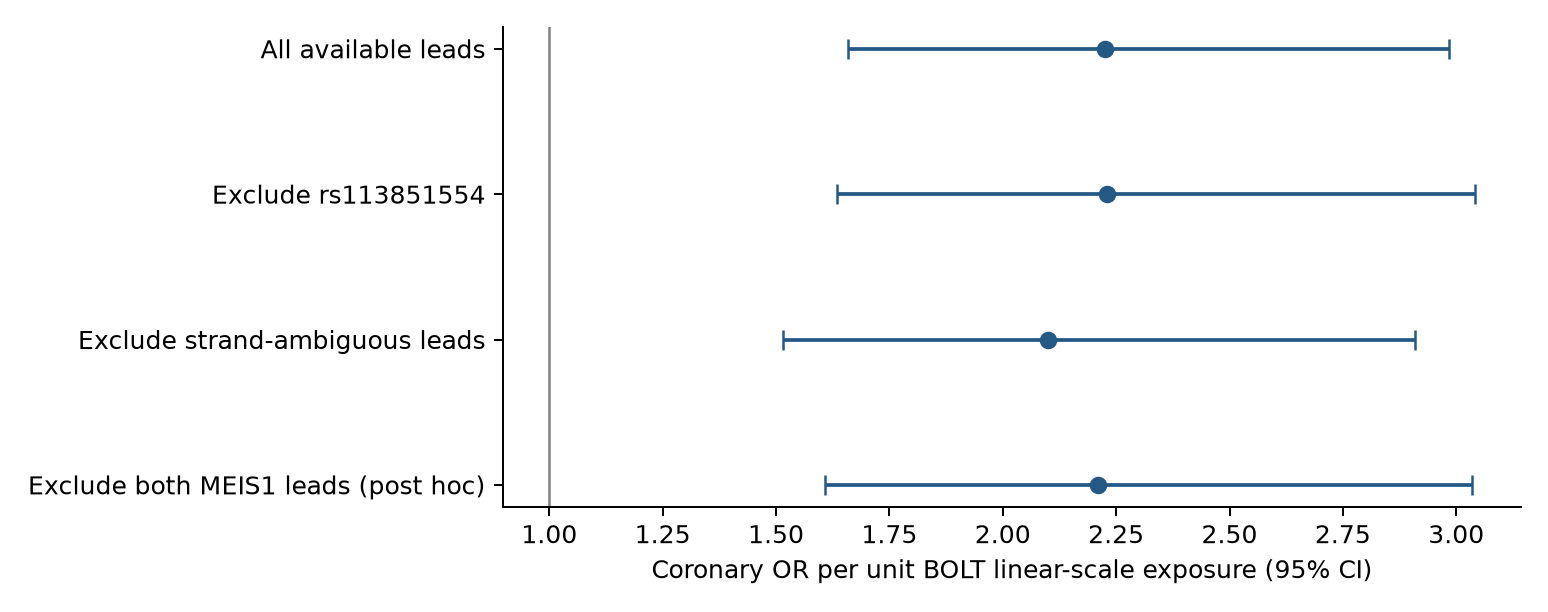
Figure 1. Points and bars show IVW odds ratios and random-effects 95% confidence intervals. One denotes no association. These are overlapping sensitivity analyses in one cohort. The two-MEIS1 exclusion was added after earlier sleep-profile analyses but before access to coronary effects.
Table 2. Full-set sensitivity methods on the public linear exposure scale. The weighted median is a descriptive point estimate; no interval or significance test was calculated for it.
| Method | Variants | Coronary OR (95% CI) |
|---|---|---|
| MR-Egger, random effects | 56 | 2.89 (1.06–7.91) |
| Weighted median | 56 | 2.31 (point estimate only) |
Interpretation
The original insomnia–coronary genetic association holds in this recheck, with approximate agreement in magnitude as well as direction. The standard IVW analysis supports a partial numerical reproduction despite the different outcome cohort and instrument coverage. Agreement among sensitivity methods strengthens the association result, but substantial heterogeneity shows that a single proportional effect does not describe all variants well.
The remaining limits concern causality and generalizability. Random-effects intervals accommodate dispersion, not systematic pleiotropic bias. IVW treats the exposure coefficients as fixed; discovery selection, exposure measurement error and the additional assumptions of Egger and weighted-median analyses remain relevant. Rounded outcome statistics and a small LD reference panel limit precision. Separately recruited cohorts avoid known sample overlap, but individual cross-enrollment cannot be checked. These results concern European-ancestry samples and a veteran coronary phenotype. Earlier analyses could not separate clinical-insomnia-linked from depression-linked explanations. The association therefore does not estimate how much treating insomnia would prevent coronary disease.
Methods
We obtained the 57 lead variants, insomnia-increasing alleles and allele frequencies from Lane's supplementary Table S2. We extracted unrounded frequent-insomnia coefficients from the public UK Biobank BOLT-LMM archive, GCST007387, and aligned them to those alleles. Supplementary rounded odds ratios provided a secondary logistic exposure scale. The original 44-variant coronary estimate was transcribed from Table S20 as a published comparator. Original summary statistics
For MVP European-ancestry coronary atherosclerosis, Phe_411_4.EUR.GIA (pha005593.1), we matched exact lead identifiers, GRCh38 coordinates and allele pairs. We signed natural logarithms of the reported coronary odds ratios to the insomnia-increasing allele. Standard errors equal the difference between the logarithms of the upper and lower 95% confidence limits divided by twice 1.959964. We did not infer standard errors from association P values.
IVW fits coronary log odds to exposure coefficients through the origin, weighted by inverse coronary variance. We multiplied the fixed-effect variance by max(1, Q/(L−1)), where L is the number of variants, and used normal-approximation intervals and two-sided tests. Egger adds an intercept and uses L−2 residual degrees of freedom for its dispersion. Weighted-median estimates interpolate the midpoint cumulative weights of sorted variant ratio estimates, with weights proportional to squared exposure coefficients divided by coronary variances. These conventional calculations assume independent variants. A generalized IVW sensitivity replaces the diagonal outcome covariance with D R D, where D contains coronary standard errors and R contains signed allele-dosage correlations in 503 European participants from 1000 Genomes phase 3. Cross-chromosome correlations are set to zero; its residual Q supplies the same multiplicative dispersion correction. Reference panel
The original leads and exclusion sets were fixed before examining MVP effects. Exclusions remove rs113851554, all A/T or C/G variants, or both rs113851554 and rs72826719 in the MEIS1 region. Standard IVW, Egger and weighted-median analyses were added during review after outcome access, replacing the earlier fixed-weight projection summary. No variants were selected using coronary results.