Mice gained less weight on siremadlin than on CGM097 even when their human tumors grew by similar amounts
Why it matters
Mice carrying the same human tumor usually gained more weight on CGM097 than on siremadlin, even when the tumors grew by similar amounts. Measuring tumor size alone would miss this difference between the treatments. It does not tell us which drug is safer for people.
Researchers testing cancer drugs in mice want to know both how well a drug controls a human tumor and how the mouse fares during treatment. Two drugs can act on the same protein in a human tumor yet differ in how strongly they bind the mouse version. How much can mouse weight differ when tumor growth is similar? Across 40 human tumor models with similar growth over two weeks on the cancer drugs siremadlin and CGM097, weight change was a median 8.3 percentage points lower on siremadlin. The typical mouse on siremadlin stayed near its starting weight, while the typical mouse on CGM097 gained weight. Weight change was lower on siremadlin in all 14 models in which both treated tumors also grew substantially less than an untreated tumor.
The drugs and the mice
Siremadlin (also called HDM201) and CGM097 block the interaction between two proteins. One, p53, can stop cells from dividing. The other, mouse double minute 2 (MDM2), normally keeps p53 levels low. In laboratory tests, CGM097 binds human MDM2 more strongly than mouse MDM2, whereas siremadlin binds both similarly. Mice tolerated CGM097 well in one model of human leukemia, in which it suppressed disease.
Gao and colleagues grew tumors from patient samples in mice. They measured the tumors with calipers and weighed the mice during treatment. We compared mice given siremadlin with mice given CGM097. The treatments shared 106 tumor models at the start, with one mouse per drug for each model. A pair therefore consists of two different mice carrying tumors from the same model.
Weight change at similar tumor growth
Of the 95 pairs with usable two-week measurements, 78 showed a lower percentage change in mouse weight on siremadlin. The median difference within pairs was −7.6 percentage points. To compare mice whose tumors grew by similar amounts, we divided each tumor's day-14 volume by its starting volume. In 40 pairs the larger of these ratios was at most 1.19 times the smaller. They included 16 breast, 17 colorectal and seven non-small-cell lung cancer models.
In 35 of the 40 pairs, the mouse on siremadlin gained less weight or lost more. Median weight changes were −0.6% on siremadlin and +6.4% on CGM097. Subtracting the CGM097 mouse's percentage change from the siremadlin mouse's change within each pair gave a median difference of −8.3 percentage points (nominal 95% confidence interval, −9.6 to −5.3). In grams gained, the median paired difference was −2.1 g. Because the scale weighs the tumor too, we repeated the calculation after subtracting estimated tumor mass at each weighing. The median difference was then −8.1 points. Among the 14 pairs whose mice started within 1 g of each other, the median difference using measured weights was −10.6 points.
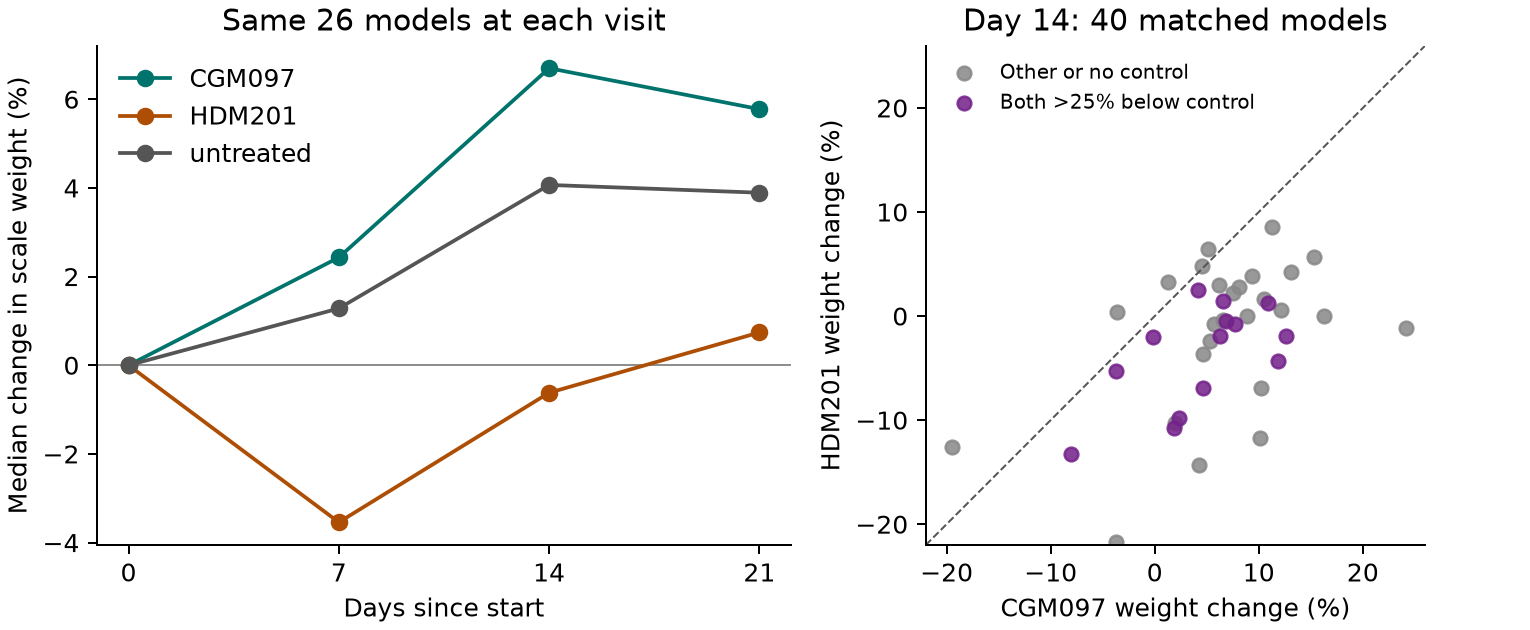
Figure 1. The left panel follows the same 26 models with similar tumor growth on the two drugs at day 14 and measurements through day 21 for both treated mice and an untreated mouse. It shows the median weight change for each group. The median within-pair difference (siremadlin minus CGM097) was −5.7 points on day 7, −8.7 on day 14 and −5.4 on day 21. In the right panel, each point represents one model at day 14. Below the diagonal, the mouse on siremadlin gained less weight or lost more. Purple marks the 14 models in which both drugs also slowed tumor growth relative to untreated mice by the criterion in Table 1.
Comparison with untreated mice
Both treated tumors enlarged in 38 of the 40 matched pairs. To see whether they nevertheless grew less than they would without treatment, we compared them with tumors in untreated mice carrying the same model. Of the 38 models with complete untreated measurements, 14 had a day-14 tumor volume ratio on each drug less than three quarters of the untreated ratio. All 14 showed lower weight change on siremadlin than on CGM097. Weight gain on CGM097 was closer to untreated gain, while weight change on siremadlin fell a median 8.9 points below the untreated value (Table 1).
Table 1. Day-14 differences in percentage weight change. For each comparison, we took the difference between two mice carrying the same tumor model, then took the median across models. Values are percentage points.
| Day-14 comparison | Models | Siremadlin minus untreated | CGM097 minus untreated | Siremadlin minus CGM097 |
|---|---|---|---|---|
| Similar growth on both drugs | 38 | −4.2 | +3.8 | −8.3 |
| Also slower growth on both drugs than untreated¹ | 14 | −8.9 | −1.5 | −8.3 |
¹ Both treated day-14-to-baseline volume ratios were less than 0.75 times the untreated ratio. These 14 models are a subset of the 38.
Measurement timing and missing pairs
When both mice had direct day-14 measurements, the median weight-change difference was −9.6 points (16 matched pairs). We also required growth to match at four time points through day 14, allowing estimates between visits. The median difference was −7.0 points across the 15 qualifying pairs, and 14 differences were negative. Only three pairs had visits on the same days, direct day-14 measurements and matching growth at every visit. Just one of those three showed lower weight change on siremadlin. The evidence for the gap thus concerns tumors with similar growth over two weeks; few pairs had comparable measurements throughout.
Eleven of the 106 starting pairs lacked complete day-14 data. Available tumor volumes ruled out similar growth for two of them. Even if all nine remaining pairs qualified, the median difference would lie between −8.9 and −6.5 points. We obtained these extremes by placing all nine weight-change differences below or above every observed difference. Missing readings among the published pairs could therefore change the size of the gap but could not erase it.
Interpretation
At the regimens tested, mice carrying the same human tumor model often differed in weight change even when both drugs slowed tumor growth to a similar degree. Weighing the mouse alongside measuring the tumor revealed a difference that the tumor measurements alone missed.
The binding results suggest a possible explanation, but mice with similar tumor growth may have had different drug exposures. The comparison cannot separate species differences in binding from differences in dose, schedule, formulation or the groups of mice tested. The bounds for missing measurements apply only to published animals: Gao and colleagues excluded mice sacrificed for an adverse event before day 14. Weight alone cannot identify tissue injury or tell us which drug is safer for people.
Methods
We used repeated measurements of mouse weight (g) and tumor volume (mm³) from Gao and colleagues' Supplementary Table 1. We linked mice given a single drug and untreated mice by tumor model identifier and measured change from each mouse's own day-zero reading. We treated weights outside 10–60 g as missing. If the day of interest fell between visits, we estimated its value by linear interpolation between readings no more than eight days apart. We never extrapolated beyond the readings. To estimate weight without the tumor, we subtracted 0.001 g per mm³ of tumor volume at baseline and follow-up before calculating percentage weight change.
For the growth comparison, we set follow-up volumes below 1 mm³ to 1 mm³ and divided each follow-up volume by its baseline value. We classified growth as similar if the base-two logarithms of the two ratios differed by at most 0.25. For the comparison at four time points, we applied this criterion on days 3.5, 7, 10.5 and 14. Each model contributed one paired weight difference per comparison. To calculate the confidence interval for the median, we ranked the differences and used a two-sided binomial sign test to determine the ranks of the endpoints. The interval is nominal because it does not account for examining this drug pair after an exploratory comparison of 363 pairs of single drugs with at least ten shared models at day 14.