About half the α-tubulin RNA in late-stage moss sperm-producing organs encodes proteins with a changed catalytic site
Why it matters
Moss cells build tiny tubes from a protein called tubulin. Late in development of the organ that makes sperm, about half the RNA instructions for one part of those tubes encode versions with a change at a site that helps control tube stability. Those instructions are less common in released sperm packages; which versions actually go into the tubes is still unknown.
Microtubules, the tubes that help give cells their shape, grow by adding pairs of proteins called α- and β-tubulin. Where two pairs meet, an amino acid in α-tubulin called glutamate helps the neighboring β-tubulin split a bound molecule of guanosine triphosphate (GTP). This reaction affects the stability of the tube. Some moss α-tubulin genes encode a different amino acid at this site. Knowing their sequences tells us little about when the change might matter: the cell could make little of its α-tubulin RNA from those genes, or it could draw heavily on them during development.
In the Gransden strain of the moss Physcomitrium patens, three genes encode asparagine in place of the usual glutamate. Their combined share of α-tubulin RNA rose from less than 1% in early sperm-producing organs (antheridia) to 44–56% in organs collected 14–15 days after reproductive development was induced. In packages of sperm released from day-15 organs, the share was lower, at 1–34%.
The altered site in moss α-tubulin
In experiments with human tubulin, replacing glutamate at position 254 in α-tubulin (Glu254) with asparagine (Asn254) produced microtubules deficient in GTP hydrolysis, the reaction that splits GTP. To find naturally occurring versions of this substitution, we searched the EukProt comparative set, a collection of 5,158,251 predicted proteins from 196 species. Of the 743 sequences that matched α-tubulin over a long stretch and more closely than they matched other tubulin families, 663 had Glu254. Five had asparagine at the corresponding position, including three from P. patens.
The moss reference genome placed the three sequences at distinct genes: Pp3c11_13690, Pp3c13_11460 and Pp3c23_21870. Each predicted protein matched human α-tubulin at 83–84% of the amino acids across 451 aligned positions. Their predicted shapes also placed Asn254 where tubulin pairs meet. When we fitted the protein backbone on either side of Asn254 to the corresponding segment of an experimentally determined microtubule structure, the root-mean-square deviation, a measure of the distance between corresponding atoms after fitting, was 0.48–0.51 angstroms. Nine other near-full-length moss α-tubulins retained glutamate at that position. We compared RNA from these nine Glu254 genes with RNA from the three Asn254 genes.
RNA in developing organs and released sperm packages
We screened all 38 RNA sequencing libraries (samples prepared for sequencing) in the Julca et al. series of samples from moss development. Of these, 15 came from antheridia or released sperm packages. Each organ sample pooled 5–20 antheridia; each sperm sample pooled 2–5 released packages without further cleanup. Of the four late organ pools, two were labeled mature and two were labeled by collection day alone.
Among the short sequences, or reads, that covered the catalytic site, the Asn254 genes accounted for 182 of 243 reads in the four late organ pools, compared with 0 of 277 in eight earlier pools and 1 of 58 in three sperm package pools. This roughly three-to-one majority in late organs shrank when we measured expression elsewhere in the genes. We counted reads at nine other coding positions where the sequence distinguished the two classes across all 12 genes. The Asn254 share was 56–69% in the four late pools, compared with zero in early organs and 0–4.5% in packages. When we combined the four late libraries, eight of the nine positions gave an Asn254 majority. Counting identical read sequences only once per position in each library still gave 52–66% in the late pools.
To measure expression across whole genes, we used the MAdLandExpression atlas, which reports reads that map to a single location, in units of reads per kilobase of gene length per million mapped reads (RPKM). On this scale, the two classes contributed about equally in late organs (Figure 1). Only two of the four late pools had an Asn254 share above 50%. Expression of the Asn254 genes rose sharply in late organs even as expression of the Glu254 genes also rose (Table 1). All three Asn254 genes contributed. By both the nine-position and whole-gene measures, Pp3c13_11460 contributed the most of the three in every late pool.
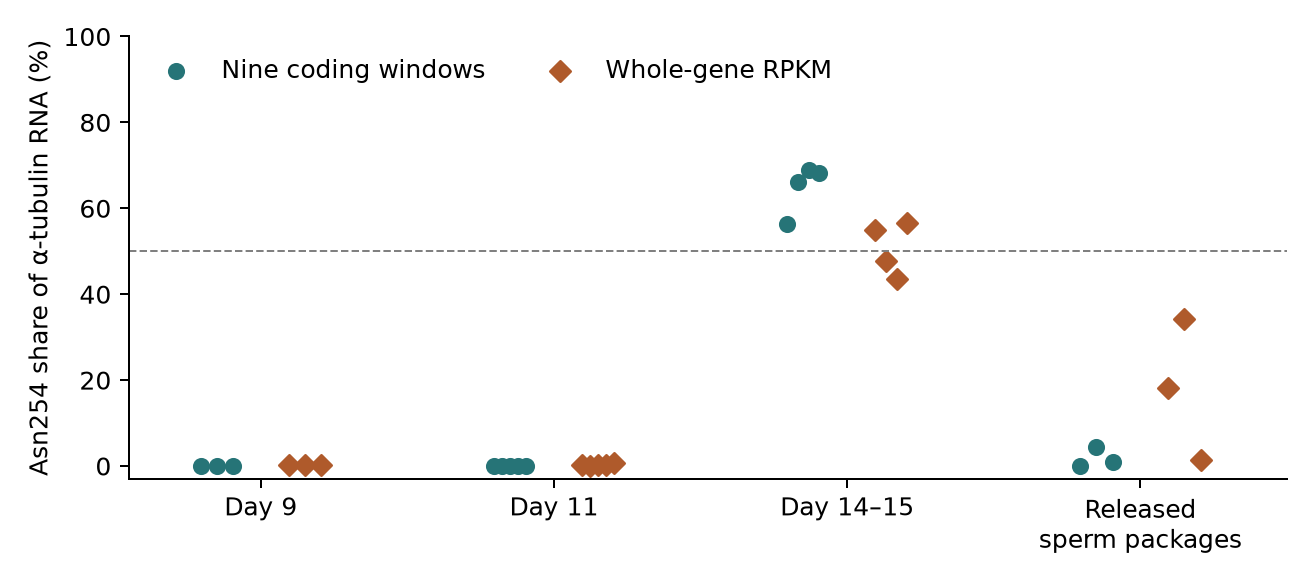
Figure 1. Share of α-tubulin RNA assigned to the three Asn254 genes in Gransden. Each point represents one pool measured by one method. The dashed line marks equal contributions from the Asn254 and Glu254 classes. Both methods use the same libraries. Points are grouped by stage without pairing the estimates for individual pools.
Table 1. Whole-gene expression in the staged series. Each range runs from the lowest to the highest pool in that collection. The percentage is calculated within each pool before taking the range.
| Collection | Pools | Asn254, summed RPKM | Glu254, summed RPKM | Asn254 share (%) |
|---|---|---|---|---|
| Day 9 organs | 3 | 0.53–0.87 | 323.35–489.63 | 0.16–0.18 |
| Day 11 organs | 5 | 0.00–3.58 | 255.75–441.39 | 0.00–0.80 |
| Day 14–15 organs | 4 | 483.86–848.32 | 564.13–777.07 | 43.62–56.48 |
| Released packages | 3 | 4.59–178.53 | 255.96–342.20 | 1.37–34.28 |
The nine-position count samples short coding segments but can retain reads shared by genes in the same class. The atlas uses the full libraries but requires each read to map uniquely. The estimates differ especially in the sperm packages. Both methods place every late organ pool above every package pool.
Independent organ collections
The Asn254 genes also accounted for substantial, though smaller, shares in other collections of mature organs. In a separate Gransden experiment, each wild-type pool contained eight mature antheridia collected on day 18. The three Asn254 genes supplied 15.5%, 20.7% and 39.2% of reads assigned to the 12 genes' coding regions. Adjusting for coding length gave shares of 15.9%, 21.2% and 40.2%. In bundles of organs collected on day 21, reads covering the three-base sequence for the catalytic amino acid (its codon) detected the Asn254 class in both Gransden (44/394) and a second strain, Reute (29/277).
The day-14–15 antheridium is a place to look for microtubules built with a naturally altered catalytic site. The RNA estimates do not count intact molecules directly, and the separate harvests cannot establish a decline from day 15 to day 21 because the day-21 bundles contained organs at different stages. RNA measured across an organ could come from developing sperm or surrounding tissue; protein made during development could persist in released sperm even when its RNA is scarce. Locating the three proteins in cells and determining whether they enter microtubules would connect the RNA shift to the chemistry of the moss microtubule.
Methods
We used DIAMOND, a protein sequence alignment tool, to search EukProt with human members of five tubulin families (α, β, γ, δ and ε). We used sensitive mode with an expectation threshold of 10⁻⁶, a cutoff on the number of matches of that strength expected by chance. We required at least 350 aligned positions and a match to α-tubulin that scored at least 40 bits higher than the match to the next closest family. For the moss reference sequence set (version 3.3), we retained proteins whose best match was the human α-tubulin sequence Q71U36, with at least 65% identity over at least 350 aligned positions and an expectation threshold of 10⁻⁸. We used the alignment to identify the moss residue corresponding to human position 254 and translated the moss nucleotide sequences to locate its codon. To check the position in the assembled microtubule, we used structures predicted by AlphaFold for the three moss proteins (models A9REZ4, A9TVH3 and A9RIJ5). We fitted their backbone α-carbon atoms to those of chain C in experimental structure 6DPU, using the aligned residues within eight positions on either side of residue 254 and excluding residue 254 itself.
For the catalytic-site counts, we searched the first million sequencing spots (sequenced fragments) per run for exact matches to 31-base segments centered on the mapped codon. For the nine-position count, we used the next million spots of each of the 15 organ and package runs in the developmental dataset E-MTAB-9466. Starting at human position 41, we tested positions every 36 residues through 401, skipping those within 30 residues of 254. We kept segments represented in all 12 genes only if their sequences, read in either orientation, matched neither the opposite class nor any unintended coding sequence in the version 3.3 reference. Each matched base had to have a Phred score, a measure of confidence in the base call, of at least 20. A sequence shared among Glu254 genes counted once. Because the libraries were made from small amounts of material amplified by polymerase chain reaction, we measured variation across pools rather than treating reads as biological replicates.
For each atlas sample, we divided the summed RPKM for the Asn254 genes by the summed RPKM for all 12 genes. We also included four additional short or divergent proteins whose best sequence match was α-tubulin. Assigning all their expression to either class left the majority calls unchanged in every late organ and package pool. For day 18, we used the wild-type male samples WM1–3 in the deposited expression dataset GSE205257. We used the reported read counts for each coding region and, separately, those counts divided by predicted protein length. For day 21, we grouped the 16 sequencing runs in the organ bundle dataset PRJNA559055 by their six source libraries, three per strain, before summing reads spanning the catalytic site.