Balanced round robins can make any nine-player pattern more common than chance predicts
Why it matters
Imagine a round robin in which everyone wins exactly half their games. Pick any pattern of results among nine players: even in an arbitrarily large league, the games can be arranged so that this pattern appears at least 15.89% more often than fair coin flips predict. Equal win records alone do not cap any nine-player pattern at its chance frequency.
Can the frequency of one pattern of wins and losses tell us whether a large round robin looks random? Suppose every pair plays once and every player wins half their games. That tells us each player's record, but leaves open how the wins fit together. One way to look for randomness is to pick a small group of players and ask how often their games follow a particular pattern. For some patterns, a frequency close to what fair coins would predict guarantees that all other pattern frequencies are close to their fair-coin values. To identify those patterns, one needs to know which ones have their highest or lowest frequency at the fair-coin value. Král’, Krnc, Kučerák, Lidický and Volec [1] showed that every pattern on ten or more players can exceed that value even when the players' records are balanced. Their result left the nine-player case open.
For each of the 191,536 nine-player patterns, we construct arbitrarily large round robins in which every player wins exactly half their games and the pattern occurs at least 1.15896 times as often as fair coins predict. The construction starts with seventeen players arranged to give two copies of the chosen pattern. Combined with earlier results on minimum frequencies, this shows that exactly eleven nine-player patterns can detect randomness in the sense above.
How two copies among seventeen players give the frequency bound
In mathematics, a tournament represents a round robin with one winner per game. Each player is a vertex and each game is an arrow from winner to loser. A tournament is called regular if every player wins exactly half their games. To measure the frequency, or density, of a pattern H, give its nine players distinct labels. Draw nine distinct players in order from a larger tournament (the host), and assign the labels in that order. The density is the probability that all 36 games come out as prescribed by H. If independent fair coins decide the games, that probability is 2^{-36}. Ignoring the labels multiplies both densities by the same factor and leaves their ratio unchanged.
For each H we found a regular seventeen-player host G with at least two ways to assign the labels and preserve all the winners. Each such assignment is called an embedding. Two embeddings can use the same players if a symmetry of H, called an automorphism, permutes the labels without changing a winner. Seventeen is the smallest regular host size that could accommodate every kind of pattern: a player who wins all eight games in a pattern must have at least eight wins in the host.
To build a larger host, replace each player of G by a group of q players, where q can be any odd number. Arrange each group in a circle and let each player beat the next (q-1)/2 players. Between two groups, give every win to the group whose original player won. Each player now wins 8q+(q-1)/2 games, exactly half of 17q-1.
Each embedding gives q^9 ordered samples with the desired results: choose one player from each of the nine assigned groups. The two embeddings give disjoint sets of samples because they assign at least one label to different groups. There are fewer than (17q)^9 ordered samples of distinct players in total. Counting just the samples from the two embeddings therefore gives a ratio of observed to fair-coin density of at least
How to fit two copies into a balanced round robin
The construction depends on whether the pattern has a player who wins every game (a source) or one who loses every game (a sink). The count by pattern type distinguishes patterns that fit on two different sets of players from those that require two labellings of the same set.
| Nine-player pattern | Two different sets | Two labellings on one set |
|---|---|---|
| Neither source nor sink | 178,232 | 0 |
| Source (including patterns with both) | 6,879 | 1 |
| Sink only | 6,423 | 1 |
| Total | 191,534 | 2 |
Patterns in which everyone wins and loses
Duplicate any player in the pattern. Give the duplicate the same results against the other eight players and decide the game between the twins either way. Either twin can now fill the same role in a copy of the pattern. Before duplication each player had between one and seven wins. After duplication each of the ten has between one and eight.
Seven newcomers suffice to bring everyone to eight wins without changing a game already played. Number the newcomers from 0 to 6 around a circle and let each beat the next three. An old player with d wins needs 8-d wins against newcomers. Give that player wins against the next 8-d names on the repeating list 0,1,\ldots,6,0,1,\ldots, taking up where the preceding player left off. No player needs more than seven names, so none gets the same opponent twice. The ten old players have 45 wins between them and use 80-45=35 names in all. Each newcomer appears five times, so loses to five old players and beats the other five. With three wins against other newcomers, each has eight wins, just like the old players. Beasley and Brown [2] studied the corresponding problem of completing a tournament to a regular one for a single embedding.
Patterns with an unbeaten or winless player
An unbeaten player uses all eight of its host wins inside the pattern. The eight opponents it beats in the host, called its outneighborhood, must therefore play exactly the pattern left after deleting the source. Call this eight-player pattern the core. If two host players each beat a group with the required core, each can play the source in a separate embedding. Alternatively, two ways of labelling the same core suffice. Reversing every game exchanges sources and sinks, so the construction for sources covers sinks as well.
For 6,879 of the 6,880 possible cores, we found a host in which two different players each beat a group of eight with the required results. For the last core we found two labellings of the group beaten by one player. The certificate gives the completed host for each core and specifies the two assignments of labels, one by a fixed rule and the other explicitly. An independent check counted eight wins for every host player and compared all 36 games with the pattern under each assignment. The completeness check in Computational methods accounts for every possible core.
Why one core requires two labellings
The exceptional core has two groups. In the top five, each player beats the next two around a circle. The bottom three form a directed triangle: each beats the next around a circle. All five top players beat all three bottom players. Rotating the triangle gives a different assignment of labels on the same set.
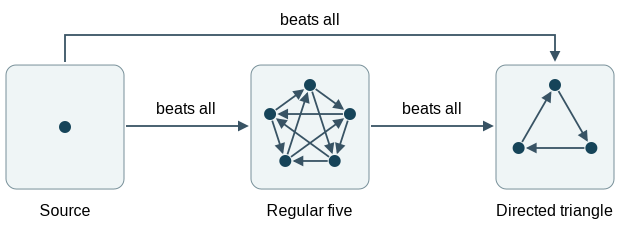
Suppose two players in a regular seventeen-player host each beat a group of eight with this core. Call the winner of the game between them z and the loser y. Then y belongs to the top five or the bottom three beaten by z. Each bottom player already has seven losses: one to z, five to the top group and one within the triangle. Each can lose only one more game.
If y is in the bottom three, it beats just one of the original nine players, a fellow triangle member. The other seven players beaten by y must be new. Every member of the exceptional core loses at least twice within the core. The triangle member beaten by y would therefore have to lose to at least two new players, exceeding its allowance.
If y is in the top five, it beats two other top players and the entire bottom triangle. Where could that triangle fit among the eight players beaten by y? It cannot span the two groups of the second core because all games between groups go the same way. It cannot fit in the second top five either. The two original top players beaten by y both beat the whole triangle, but no player in the core beats three members of its top five. The old triangle must therefore occupy the bottom three again. To fill the second top five requires three new players, each of whom beats the whole triangle. This would give each triangle member three new losses. Thus the exceptional pattern cannot occur on two different sets in this host size. Reversing the games proves the same for the corresponding pattern with a sink.
Which nine-player patterns detect randomness?
The randomness test concerns tournaments that grow in size. Following Král’ et al. [1], call a sequence of such tournaments nearly regular if almost all players win close to half their games. Precisely, for every \varepsilon>0, the fraction of players whose win count differs from N/2 by more than \varepsilon N tends to zero as the number of players N increases. A sequence is quasirandom if every fixed pattern's density tends to its fair-coin value. A pattern forces quasirandomness if, in every nearly regular sequence, convergence to the fair-coin value for that pattern alone guarantees quasirandomness. Král’ et al. use homomorphism densities, which sample players with replacement. For a fixed pattern the chance of drawing a player twice tends to zero, so the limiting densities agree.
When all fixed pattern densities converge along a nearly regular sequence, the resulting limit is called a regular tournament limit; every regular tournament limit arises in this way. Proposition 5 of [1] says that a forcing pattern must satisfy one of two conditions. Either its density in every regular limit is at least its fair-coin value (randomness minimizes the density), or its density in every regular limit is at most that value (randomness maximizes it). For each nine-player pattern, our enlarged, exactly regular hosts keep the density above the fair-coin value by a fixed factor, even along a convergent subsequence. This rules out a random maximum for every one of them.
The patterns with a random minimum are already known. A pattern is transitive if its players can be put in a strict winning order, with each beating everyone below. For nontransitive patterns, Theorem 1 of [1] says that randomness minimizes the limiting density among nearly regular sequences exactly when the players form three nonempty groups, each in strict winning order. Between groups all games go cyclically: the first group beats the second, the second beats the third and the third beats the first. The theorem also says that each such pattern is forcing unless all three groups have size one, an exception impossible with nine players.
There are 28 ordered triples of positive group sizes summing to nine. Starting the cycle at a different group gives the same pattern. Only (3,3,3) is unchanged by rotation, leaving 1+27/3=10 patterns. There is no further duplication: two players belong to a common directed triangle exactly when they come from different groups, so the games determine the groups and their cyclic order. The transitive pattern itself is the eleventh forcing pattern. Coregliano and Razborov [5, Theorem 2.1] proved that for a transitive pattern on at least four players, only a quasirandom limit attains its random minimum, even without the balance constraint.
The host that increases a pattern's density depends on the chosen pattern. With the classification through five players by Noel, Ranganathan and Simbaqueba [3] and the result for ten or more players [1], only sizes six through eight still have open cases for a random maximum. At eight players, counting prescribed placements in fifteen equal groups would require at least ten placements to exceed the random density in the limit, since 9<15^8/2^{28}<10.
Computational methods
Brendan McKay’s tournament catalogues [4] list patterns up to relabelling on eight and nine players. Scanning the full nine-player catalogue, we counted 6,880 patterns with a source and the same number with a sink; 456 have both. We checked the duplication construction directly on every pattern with neither. The finite proof requires only the eight-player certificate, whose coverage we checked independently of either catalogue.
For each core we placed the first copy of the nine-player pattern on vertices 0 through 8, with 8 as the source. We tried each core vertex in turn as the second source. Its wins among the original vertices determine which players the two cores must share. We tried every ordered assignment of distinct core labels to these shared players, gave the remaining labels fresh vertices and discarded any assignment requiring opposite outcomes for the same game.
To complete the host, we first gave the lower-numbered vertex the win in each game left free by the assignments. Along a directed path of free games, each player beats the next. Reversing those games takes a win from the first player and gives it to the last without changing any intermediate player's record or either embedding. We reversed such paths from players above eight wins to players below eight. If no path remained before everyone reached eight wins, we tried the next assignment. We also allowed relabellings of the first core. The proof uses only the completed hosts that pass the independent check.
Each certificate row stores the core and host by listing the upper triangle of each game matrix in row order (1 means the lower index wins). It then gives the host vertex assigned to each of vertices 0 through 8 in the second embedding. To check that the certificate covers all cores, we gave each core a standard string of game outcomes. For each vertex we counted its wins separately against opponents of each possible win count (outdegree), obtaining a tuple of counts. We sorted vertices by these tuples, tried every ordering within ties and kept the lexicographically least upper-triangle string. Relabelling a core gives the same string. The number of orderings yielding that string equals the number a of symmetries of the core, since any two such orderings differ by exactly one of these symmetries.
All 6,880 strings were distinct. Each represents 8!/a distinct labelled cores. Summing over the strings gives \sum 8!/a=268{,}435{,}456=2^{28}, accounting for every way to decide the 28 games. One verified host per core therefore suffices.
References
- D. Král’, M. Krnc, F. Kučerák, B. Lidický and J. Volec. Sidorenko property and forcing in regular tournaments. Theorems 1 and 2, Proposition 5, and Problem 4.
- L. B. Beasley and D. E. Brown. Embedding tournaments.
- J. A. Noel, A. Ranganathan and L. M. Simbaqueba. Forcing quasirandomness in a regular tournament.
- B. D. McKay. Combinatorial data: digraphs. Tournaments on eight and nine vertices.
- L. N. Coregliano and A. A. Razborov. On the density of transitive tournaments. Theorem 2.1.