Two equal queen armies that never threaten each other can each occupy at most one ninth of an odd wraparound chessboard
Why it matters
On a chessboard whose edges wrap around, how many black and white queens can fit without threatening the other side? When the side length is odd and the armies are equal, each can cover at most one ninth of the squares. Counting pairs of lines had left room for one eighth; looking at six squares together reveals why that much space cannot be used.
How many black and white queens can share a chessboard if the two sides have equal numbers and no queen threatens an opponent? Suppose opposite edges of the board join, so that a queen's line of attack continues across an edge. When the side length is odd, any two lines in different directions meet exactly once. Counting those intersections gives an upper limit of one eighth of the squares for each army. The count leaves open whether both armies could come close to that limit on a large board.
We prove that each army can occupy at most one ninth of the squares, at every odd side length. The key is a pattern of six squares. When its two outer rows belong to opposite colours, at least one of the six squares has to be unavailable to either army. Counting how often this happens reveals a restriction that counting intersections misses.
Which squares can hold a queen?
On an n\times n wraparound (toroidal) board, a queen attacks along its row, its column and both its diagonals. Queens of the same colour may share any of these lines. Let t(n) be the largest number of queens per colour in two equal armies that can coexist under this rule, a placement known as peaceable queens. Clinch, Drescher, Huynh and Saffidine constructed placements with at least n^2/12-O(n) queens per army (the subtracted term grows at most linearly in the side length). They proved t(n)\le n^2/8 for odd n (Theorem 1.4). Our bound is t(n)\le\lfloor n^2/9\rfloor, rounding down to a whole number of queens. The reduction in the density ceiling is 1/72 of the board, regardless of how large the board becomes.
Colour each occupied line to match its queens and give each unused line either colour. A square with four black lines can hold a black queen; a square with four white lines can hold a white queen. We can fill all such squares at once because queens of opposite colours cannot then share a line. Removing queens from the larger army makes the armies equal. For a given line colouring, the density each army can achieve is therefore the smaller of the all-black and all-white fractions of the board.
Number the rows and columns modulo n, so that adding n returns to the same position. At square (x,y) the row and column labels are x and y; the diagonal labels are x+y and x-y. At a uniformly chosen square, knowing one label tells us nothing about any one of the other three. Indeed, the map from (x,y) to any pair of labels has determinant \pm1 or \pm2 and is invertible for odd n. So the colours in any two directions are independent. To see why this property alone allows one eighth, represent the four colours by four bits, with one for black and zero for white. Choose uniformly from the eight strings with an even number of ones. Each pair of bits is independent, yet the all-zero and all-one strings each have probability 1/8. What distinguishes this model is that the number of black lines at a square is never odd.
What six squares reveal
Call a square odd if one or three of its lines are black. Such a square is unavailable to either army. We examined all 26 odd boards of side 13 through 63 in Clinch et al., Appendix A. We read the square centres from the original and revised figures and checked whether any occupied line had queens of both colours. At side length 35 we removed the two extracted black sites on the sole conflicting diagonal. For each board we coloured the unused lines all black and then all white, giving 52 completed colourings. The fraction of odd squares ranged from 37/169 to 76/225 (22–34%). To bound the armies on every odd board, we need to know what forces squares to be odd.
We searched all 2^{25}-1=33{,}554{,}431 nonempty subsets of a 5\times5 window. For each subset we counted how often each integer row, column and diagonal label appeared, keeping only the remainder modulo two. We retained patterns in which exactly two labels appeared an odd number of times, both in the same direction. The smallest patterns used six squares. The proof needs just the one in Figure 1.
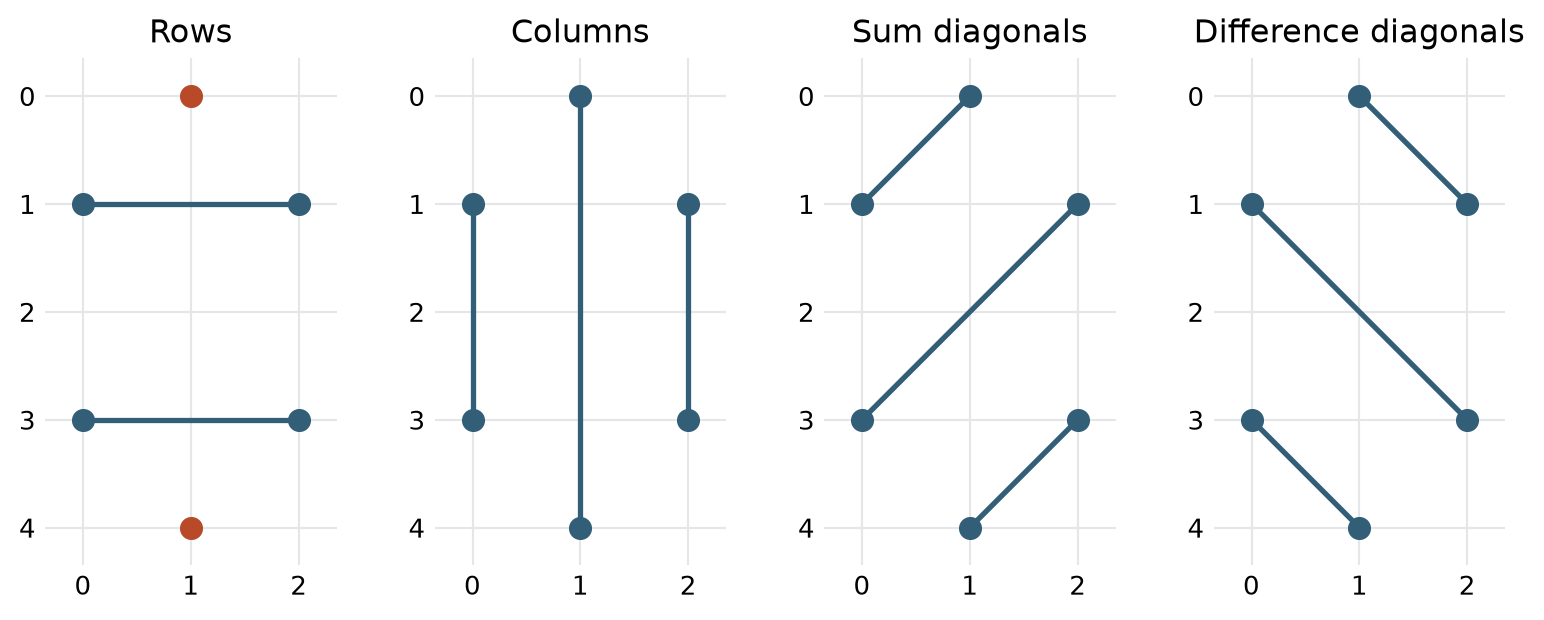
Figure 1. Four ways to group the six squares by the lines they share. Each segment joins two occurrences of the same line. If that line is black, it contributes twice to the black-line count; if white, it contributes nothing. Either way its contribution is even. Only the single squares in rows 0 and 4 remain unpaired. Shifting the pattern or multiplying its offsets by a common factor preserves every cancellation.
Add the black-line counts at the six squares. By the pairing in the figure, the sum is odd precisely when the two outer rows have different colours. When they differ, at least one of the six squares is odd. There is a further restriction: if neither outer square is odd, one of the two middle rows must contain an odd square paired with an even one. Concentrating odd squares in particular rows makes such mixed pairs harder to find.
A nearly balanced direction
Suppose the two armies could each occupy more than one ninth of the board. We first show that in at least one direction the line colours would then have to be nearly balanced. Let K be the number of black lines at a uniformly chosen square and P_j=\Pr(K=j). The available density per army is b=\min(P_0,P_4), so our supposition is b>1/9.
Let p_i be the fraction of black lines in direction i. We use two measures of colour imbalance: r is the root mean square distance of the four fractions from one half, and s measures how far the mean black-line count is from two:
Because each pair of line colours is independent, the variance of K is the sum of the four individual variances, V=\operatorname{Var}K=\sum_i p_i(1-p_i)=1-4r^2. Also s\le4r by the Cauchy–Schwarz inequality. The squares with K=0 and K=4 each have probability at least b. Adding their squared distances from the mean gives a contribution of at least b(8+2s^2) to V. Hence V>8/9 and r<1/6. Combining V\le1-s^2/4 with V>(8+2s^2)/9 also gives s^2<4/17, hence s<1/2.
At least one direction has black fraction p with |p-1/2|\le r, by the definition of r. Use that direction for the rows of Figure 1. Even a diagonal can serve as a row: the invertible coordinate change (x,y)\mapsto(x+y,x-y) exchanges axes and diagonals up to relabelling. Write a=1+|2p-1|, so the more frequent row colour accounts for a fraction a/2 of the rows.
Two counts of odd squares
Place the pattern at random. Multiply its offsets by a scale H chosen uniformly modulo n, then shift it by an independently chosen uniform square (X,Y). Include every scale, even zero and scales without a multiplicative inverse: when squares coincide, we still count each occurrence in the parity sum. The outer rows are X and X+4H. Multiplication by four permutes the residues modulo odd n, so these two rows are independent and uniform. Let M equal one when their colours differ and zero otherwise. The probability of disagreement is m=\mathbb E M=2p(1-p).
Each of the six squares is uniform, and at least one is odd whenever the outer rows disagree. Counting the squares separately therefore gives an odd fraction of at least m/6. To use the pairs as well, let f(u) be the fraction of odd squares in row u. Its mean across rows is the board's odd fraction d=P_1+P_3; call its variance across rows v.
Both counts start with the outer squares. We count each only when it is odd and the outer rows disagree. Given the location of either outer square, the other outer row is still uniform, so its chance of having the opposite colour is at most a/2. The two outer squares together thus contribute at most ad to the probability of disagreement.
For the first count, if neither outer square is odd on disagreement, at least one middle pair has opposite parities. Consider either middle row U=X+jH, with j=1,3. Conditioning on U leaves H and Y independent and uniform. The columns of the pair, Y and Y+2H, are therefore independent and uniform because n is odd. In row U the chance of opposite parities is 2f(U)(1-f(U)). Averaging over rows and adding the contributions of both pairs gives
For the second count, count each of the four middle squares separately, but only when the outer rows disagree. Given X,H, a middle square is equally likely to be anywhere in its row U because the column shift is uniform. Its probability of being odd on disagreement, averaged over placements, is therefore \mathbb E[f(U)\mathbb E(M\mid U)]. The two factors have means d and m. The first has standard deviation \sqrt v; the second, the disagreement probability given the middle row, has standard deviation at most 1/4 when |2p-1|\le1/3. Our choice of direction ensures this condition; the proof of the standard deviation bound follows below. The covariance of the factors is at most the product of their standard deviations. Summing over the four squares gives
Variation between rows can help odd squares coincide with disagreement in (2), but the same variation reduces the chance of a mixed pair in (1).
The upper limit on army size
Adding (1) and (2) lets us bound the odd fraction without knowing how the odd squares are distributed across rows. Both \sqrt v-4v and d-4d^2 are at most 1/16 by completing the square. Rearranging the sum gives the following lower bound D on d:
For the second inequality, use m\ge1/2-2r^2 and a\le1+2r. The first ratio increases with m and decreases with a in this range. For the third, subtract the middle ratio from 1/8. The difference is (r/2+3r^2)/(7+4r-8r^2)\le u.
To see why a minimum fraction of odd squares limits the space for queens, consider the squared distance of K from two. A square with all lines the same colour contributes four, an odd square contributes one, and a square with two black lines contributes zero. Averaging gives
The term 8b accounts for equal numbers of all-black and all-white squares; 4|P_4-P_0| accounts for the surplus of one colour. Since s\le2|P_4-P_0|+d and d\ge D, we obtain
As the line colours become less balanced, the guaranteed odd fraction D falls, but so does the variance 1-4r^2 available to accommodate queen sites.
To finish the contradiction we need the right side of (3) to be below 8/9 throughout the possible range of r. Two quadratic bounds cover that range. First, s^2-\max(D,s)\le16r^2-D because s\le4r. Second, the same expression is at most D^2-D: it increases up to s=D and decreases thereafter for s<1/2. Substituting both bounds into (3), and using u^2\le r^2/49 since r\le1/6, gives
Split the range at r_0=3/98. Up to r_0, A is increasing; from r_0 onward, B is decreasing. Both bounds at the split are below 8/9, by 67/1210104 and 3527/67765824, respectively. This contradicts the supposition b>1/9.
How much a middle row tells us about the outer rows
The remaining step is the standard deviation bound used in (2). Encode the colour of row u by c(u)=+1 for black and -1 for white. Its mean is t=2p-1. Relative to the first middle row, the outer rows have offsets -H and 3H. Their colours have product +1 when they agree and -1 when they disagree. Averaging over uniform scales h therefore gives
Reversing h gives the same average for the other middle row.
To measure how much g varies across rows, write the row colouring as a sum of periodic waves, its Fourier expansion c(u)=\sum_k C_k e^{2\pi iku/n}. Here k labels a frequency modulo n and C_k is its coefficient. In the product of the two expansions for c(u-h) and c(u+3h), averaging over h cancels every term whose phase varies with h. Only products C_{3k}C_k remain, at frequencies 4k. These frequencies are distinct. Parseval's identity expresses the variance as the sum of squared coefficient magnitudes excluding the constant term:
Because c is real, opposite frequencies have equal coefficient magnitudes. Group the nonzero frequencies into pairs j=\{k,-k\} with weight w_j=2|C_k|^2. Their total weight is S=1-t^2. Each source pair j contributes a product with its target pair Tj=\{3k,-3k\}. At side lengths divisible by three, 3k can be zero; in that case assign the target weight w_0=2t^2\le S/4, using |t|\le1/3. The variance formula becomes 2\operatorname{Var}g=\sum_j w_j w_{Tj}. No pair targets itself, since 3k=\pm k would force k=0 for odd n.
This sum is at most S^2/2. If every weight is at most S/2, multiply that bound on each target by the total source weight S. Otherwise let L>S/2 be the largest weight. Its target is either among the remaining pairs, of total weight S-L, or at zero, of weight at most S/4. The remaining sources together contribute at most (S-L)L. When S-L\ge S/4, the sum is therefore at most 2L(S-L)\le S^2/2. When S-L<S/4, both S-L and the largest source's target weight are at most S/4. The sum is then at most LS/2\le S^2/2. Thus \operatorname{Var}g\le S^2/4\le1/4. Since \mathbb E[M\mid U]=(1-g(U))/2, the standard deviation of the disagreement probability is at most 1/4, as required.
Computational checks and scope
As an independent check of the two counts, we enumerated every assignment of black or white to the lines in all four directions: 2^{12}=4{,}096 assignments at side length 3 and 2^{20}=1{,}048{,}576 at side length 5. Counting odd squares row by row verified (1) and, when the colour balance satisfied its hypothesis, (2). We also tested the variance calculation for every row colouring with |2p-1|\le1/3 at odd side lengths 3 through 19. For each possible middle row we counted the scales at which the outer rows disagreed. All colourings satisfied the variance bound, including at side lengths 3, 9 and 15, where tripling a nonzero frequency can give zero.
Among the 52 completed board colourings, the highest density available to both armies was 28/289 (9.69%). The ceiling of one ninth (11.11%) rules out approaching one eighth along any sequence of odd side lengths, but the optimal uniform ceiling remains unknown. The proof applies specifically to odd boards. At even side lengths two diagonals of different slopes can miss each other, and scaling the six squares no longer samples the outer rows independently.
Reference
Katie Clinch, Matthew Drescher, Tony Huynh and Abdallah Saffidine. “Constructions, Bounds, and Algorithms for Peaceable Queens.” Proceedings of the 2025 Symposium on Algorithm Engineering and Experiments (ALENEX). Published paper; full text and board configurations.