Only two or three patterns of marked faces can repeat in almost every cube section
Why it matters
Two colored edges that meet can appear on every square of a large cube, while two opposite colored edges must miss some fixed fraction of the squares. The same question has an answer for squares and larger faces too: beyond coloring everything or nothing, only a checkerboard pattern can repeat almost everywhere, and only when the section has an odd number of dimensions more than the faces being colored.
Suppose we mark edges of a cube and look at one square at a time. Two marked edges in a square can meet at a corner or lie opposite each other. Can we arrange the marks so that almost every square shows the picture we want, even as the cube grows in dimension? Counting marked edges cannot distinguish the two pictures. What matters is whether the pictures fit together where squares share edges.
The answer for edges in squares is that exactly three patterns can repeat this way: no edges marked, all edges marked, or two marked edges that meet. The same classification works for faces of any dimension k viewed in sections of any larger dimension d, with 1\le k<d. If the difference d-k is even, only the empty and fully marked patterns qualify. If it is odd, there is exactly one more. In that pattern, whether a face is marked depends on whether an even or an odd number of its fixed coordinates are ones.
How to recognize a pattern
A vertex of the n-dimensional cube Q_n is a string of n bits. Holding all but d bits fixed gives a smaller cube called a coordinate d-section. A k-face is described in the same way, with k free bits. Writing a star for a free bit, 0{*}1 is the edge joining 001 to 011. Two patterns have the same shape if a symmetry of the section takes the marked faces of one to exactly the marked faces of the other. Such a symmetry can reorder the coordinates and flip bits (exchange zero and one in selected positions).
The parity rule marks a face if its fixed bits contain an even number of ones. In a section, the bits fixed outside the section contribute the same number of ones to every face. If that number is even, we see the even rule on the coordinates of the section; if odd, we see its complement, with marked and unmarked faces exchanged. Whether the two pictures count as the same shape depends on whether a symmetry takes one to the other.
For marked vertices the two pictures always have the same shape: flipping any one coordinate exchanges even and odd. Goldwasser and Hansen studied the maximum frequency of vertex shapes under the name hypercube inducibility. For edges and higher-dimensional faces, a coordinate can be fixed in one face but free in another. Figure 1 shows why this matters. Both pictures mark six edges, yet no symmetry takes one to the other because symmetries preserve the number of marked edges meeting at a corner.
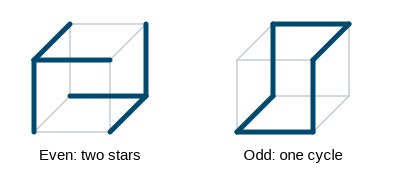
Figure 1. Edges with an even (left) or odd (right) number of fixed ones in a three-dimensional cube. On the left, three marked edges meet at each of two opposite corners. On the right, just two marked edges meet at each corner of the cycle.
What repeats in small cubes
Baber’s edge-density calculations give rigorous upper bounds on the frequency of 91 edge patterns in squares and three-dimensional cubes. Just three rows in the bounds table have an upper bound of one: the two empty patterns and the pair of edges that meet. Exchanging marks and blanks throughout the larger cube gives the same bound for the complementary target. We tested whether each of the 87 listed three-dimensional targets could occur in every three-dimensional section of a larger cube. Twelve could in dimension four; only the empty pattern among those listed could in dimension five.
For marks on square faces, the three-dimensional cube has three pairs of opposite squares. The number of marks in each pair, written in increasing order, specifies the whole shape up to symmetry. Table 1 gives the results for all ten shapes. For example, 012 and 111 each have three marked squares, and each has the same shape as its complement. Yet only 111, with one mark in each opposite pair, can repeat in every three-dimensional section in dimension five.
Table 1. Can the squares of a larger cube be marked so that every three-dimensional section has the indicated shape?
| Marked squares per opposite pair (sorted) | All sections in dimension 4 | All sections in dimension 5 |
|---|---|---|
| 000, 111, 222 | Yes | Yes |
| 001, 002, 011, 012, 022, 112, 122 | Yes | No |
We also allowed the parity rule to vary with the orientation of a face, meaning its set of free coordinates. For each orientation we could mark either the even or the odd faces. Across all 1,116,468 choices for 1\le k<d\le6, using the same rule in every orientation gave a shape equivalent to its complement exactly when d-k was odd. At even d-k, six other shapes were equivalent to their complements. None could repeat in every section in dimension seven.
Why almost every section implies every section
Fix a target shape H in Q_d. Write a_n(H) for the largest fraction of d-sections that can display H, over all markings of the k-faces of Q_n. This fraction can only decrease or stay the same as n increases. To see why, choose a uniform random m-section and then a uniform random d-section inside it, where n\ge m\ge d. The resulting d-section is uniform in Q_n, and within each m-section the chance of seeing H is at most a_m(H). Thus a_n(H)\le a_m(H).
The limit of these fractions is the inducibility of H. If it is one, every fraction in the sequence equals one. Each cube has only finitely many markings, so in each dimension some marking displays H in every d-section. Call such a marking perfect. Conversely, perfect markings in all dimensions give a limit of one. This lets us use an exact condition to classify shapes whose frequency can approach one.
What equal counts tell us about neighboring faces
Two parallel k-faces are neighbors if their fixed bits differ in just one position. Even if all we know is that every section has the same marked fraction p, that tells us something about these pairs: their average mark, counting a mark as one and a blank as zero, stays close to p on average in a large cube.
More precisely, suppose n\ge d+k and fix an orientation I. Let f_I(x) be the mark, zero or one, on the face with free positions I and fixed bits x\in\{0,1\}^{n-k}. Choose x uniformly and, independently, choose a uniform coordinate j outside I. Flipping bit j gives the neighbor with fixed bits x^j. For each orientation, the mean squared difference between the pair average and p satisfies
To derive this bound we first separate the orientations. Take any (d+k)-section and call its set of free coordinates U. For each k-element subset I of U, let b_I be the marked fraction among faces of that orientation in the section. Choose any d-element subset D of U. When we average over sections with free coordinates D inside the chosen cube, each of the \binom dk orientations within D receives equal weight, and we sample all its faces uniformly. Since each section has marked fraction p, we have
Now put q=n-k, the number of input bits. We can express f_I-p as a weighted sum of parity functions: for each subset S of the inputs, the function \chi_S(x)=(-1)^{\sum_{i\in S}x_i} records whether their sum is even or odd. Its weight in the sum is its Fourier coefficient. These functions form an orthonormal basis under uniform sampling: the mean square of the sum is the sum of the squared weights.
Averaging over a bit cancels every term that uses that bit and leaves the others unchanged. Averaging f_I-p over any d bits gives zero, so any coefficient whose set S omits at least d bits must vanish. In particular f_I has mean p. When we average just a neighboring pair, the term for S survives precisely when the flipped bit j lies outside S. That happens with probability (q-|S|)/q, at most (d-1)/q for every nonzero coefficient. By orthogonality, the left side of (1) sums the squared coefficients weighted by these probabilities. The squared coefficients themselves sum to p(1-p), the variance of a zero-or-one mark with mean p. This proves (1).
Equal counts alone still allow some neighbors to agree. For example, in an even-dimensional cube, pair up the coordinate directions. For edges in direction i, apply the parity rule to all fixed bits except the bit in its partner direction. Mark even parity for one partner and odd parity for the other. In a square on paired directions, both edges in one direction are marked and neither in the other is. In any other square, one edge in each direction is marked. Every square therefore has two marks, yet a random parallel neighbor has the same mark with probability 1/(n-1). This example attains the bound (1) for k=1,d=2.
Why a repeated shape forces neighbors to alternate
Suppose H has inducibility one and marked fraction p. In a perfectly marked cube, choose a uniform d-section, then a uniform neighboring parallel pair inside it. By cube symmetry this gives a uniform neighboring pair in the whole cube. Its mean squared deviation in (1) can also be calculated just by averaging over pairs in H, since every section displays that same shape. This number is fixed, while the upper bound in (1) tends to zero as the dimension grows. The number must be zero. Thus the marks on every neighboring pair in H sum to 2p.
For a shape other than empty or full, the only possible integer sum is one. Neighboring faces therefore alternate between marked and unmarked. The same is true throughout every perfectly marked cube, because any such pair fits in a d-section (k+1\le d). Starting with all fixed bits zero and flipping one bit at a time now determines every mark. If s_I=f_I(0) is the starting mark for orientation I, the rule is
When even and odd give the same shape
Think of s_I as one of two colors assigned to each k-element set of coordinate directions. The finite hypergraph Ramsey theorem says that, given sufficiently many directions, some set D of d directions has the same color on all its k-element subsets. Take a perfectly marked cube large enough for this theorem and look at the section on D with exterior bits zero. It uses the same parity rule for every orientation. The parallel section with exactly one exterior bit set shows its complement. Both sections display H. Thus H must be the shape of the common parity pattern, and some symmetry must take that pattern to its complement.
Within a section, each k-face has r=d-k fixed positions, its codimension. Permuting the coordinates preserves the even pattern, so we need only consider flipping a set T of coordinates in D. For a face with fixed positions R, the flip changes parity precisely when |T\cap R| is odd. To exchange the entire pattern with its complement this must hold for every r-element set R. Since 1\le r\le d-1, we can compare two such sets that agree except for exchanging any chosen pair of positions. For the two intersection counts to have the same parity, the exchanged positions must either both belong to T or both lie outside it. This holds for every pair. Flipping nothing leaves the marks unchanged, so the only candidate is to flip all of D. That changes the parity of every face exactly when r is odd.
Conversely, mark every k-face in Q_n whose fixed bits contain an even number of ones. Each section shows either the even or the odd pattern, depending on its exterior bits. At odd codimension, flipping all free coordinates of the section identifies the two shapes. The parity rule therefore realizes the third shape in every section, just as the two constant markings realize the empty and full shapes.
Every other fixed shape misses a positive fraction of sections in sufficiently large cubes. The proof classifies which shapes can reach a limiting fraction of one; it leaves the best fraction for the other shapes undetermined.
Finite search methods
For the edge and square searches, we represented a marking on a section by a binary word with one bit per face. Starting from the target, we listed the allowed words by applying all coordinate permutations and flips. We fixed one allowed word on the first section because each symmetry of that section extends to the larger cube. Whenever the choices on overlapping sections forced a face to be marked or unmarked, we discarded incompatible words on every section containing it. If a section had no allowed word left, that branch was impossible. Otherwise, if the assignment was still undecided, we tried each remaining word on an unresolved section. For a completed marking we checked every section against the target.
For the parity search, we used one bit per orientation to specify the choice of even or odd. A coordinate flip toggles that bit for every orientation in which the coordinate is fixed. A coordinate permutation reorders the orientation bits. We grouped choices connected by single flips and swaps of adjacent coordinates, then checked whether inverting every bit gave a choice in the same group. For each of the six exceptional groups at even codimension, we tried assignments of orientation bits on seven directions, requiring that each restriction to d directions belong to that group. This covers every possible extension: the target shapes alternate on neighboring parallel faces, so the orientation bits determine all marks.
As a direct check, we also constructed the common even-parity marking in dimension d+2 and enumerated its sections for every 1\le k<d\le7. Across the 2,044 section tests, every odd-codimension section matched the even pattern up to symmetry. At each even codimension exactly half matched.