Arranging and coloring points together lowers the upper bound for empty single-color triangles by 31%
Why it matters
Among red and blue dots, count the triangles whose corners are all the same color and whose interiors contain no dots. By choosing where to put each color, we can keep that count about 31% below the bound obtained by coloring dots at random in a carefully chosen drawing. How few such triangles are unavoidable is still open.
Place n points in the plane, with no three on a line, and color each point red or blue. Three points of one color form an empty monochromatic triangle if there is no other point of either color inside. How few such triangles can a drawing have? The difficulty is that an arrangement with few empty triangles may still be hard to color: changing the color of one point affects every triangle that has a corner there. The best previous constructions we found give an upper bound of about 0.405n^2 on the minimum.
We construct drawings with about 0.27917n^2 empty monochromatic triangles, a 31% reduction in the leading coefficient. The count is (67/240+o(1))n^2, where o(1) tends to zero as the number of points grows. The red and blue point counts differ by at most one. The key step is to look for consecutive points of the same color in left-to-right order and place a point of the other color far below each such gap. This adds points without adding any same-color pair that can form an empty triangle with a point high above the drawing.
Known bounds on the minimum
Write M(n) for the smallest possible count when both the positions and the colors are free to vary. A lower bound tells us how many triangles every drawing must have. Aichholzer, Fabila-Monroy, Flores-Peñaloza, Hackl, Huemer and Urrutia (2009) proved that M(n)=\Omega(n^{5/4}): for sufficiently large n, the minimum is at least a positive constant times n^{5/4}. They conjectured that the same holds with n^2 in place of n^{5/4}. Pach and Tóth raised the lower bound to \Omega(n^{4/3}). The quadratic lower bound remains open for empty triangles. Bhattacharya et al., Theorem 1 proved it when triangles with one interior point also count.
For an upper bound, it suffices to exhibit a drawing. Bárány and Valtr, Theorem 1 constructed uncolored sets with about 1.6195n^2 empty triangles. If each point independently receives red or blue with equal probability, each empty triangle has probability 1/4 of being monochromatic. Some coloring therefore achieves a count at or below the average, about 0.405n^2.
Aichholzer et al., §3 achieved the same coefficient without random coloring. They placed a blue copy of an m-point red set a small distance to its right. If the red set has h empty triangles, the doubled set has exactly h empty monochromatic triangles on 2m points. Starting with the Bárány–Valtr set gives a coefficient of h/(2m)^2\approx 1.6195/4. The factor of 5.23 reported for this example is the ratio of all empty triangles to empty monochromatic triangles within the doubled drawing. Applying it to the original drawing's coefficient would mix counts from different drawings.
Counting triangles between two groups
Arrange the points in two groups with distinct horizontal coordinates. The groups can interleave in any prescribed left-to-right order. Draw each on its assigned coordinates, then raise the upper group H until every point of H lies above every line through two points of the lower group L, and every point of L lies below every line through two points of H. Starting with single points and repeating this operation gives a drawing with no three points on a line.
Consider a pair of lower points as the base of a triangle whose third vertex, or apex, belongs to the upper group. Call the base open above in its group if none of that group's points horizontally between its endpoints lies above the line through them. An open-above base makes an empty triangle with every upper apex; any other base makes one with none. For a base in the upper group the test is the reverse: it must be open below. Consecutive points in a group are open on both sides.
To see why the test works, raise H by a further distance h. The separation conditions still hold, so no triple changes orientation and no point enters or leaves a triangle. Now divide all heights by h and let h grow. A triangle with a lower base approaches one with its base at height zero and its apex at height one. Each other upper point approaches height one at a different horizontal coordinate, outside the triangle. A lower point horizontally outside the base interval also lies outside. A lower point strictly between the endpoints approaches the base strictly between the two sloping sides. For large finite h it is inside precisely when it lies above the base line. Reversing up and down gives the test for an upper base.
To count by color, write F for the pair of point counts (red, blue) in a group. Write U and D for the corresponding pairs of same-color base counts open above and below, respectively. Let T count empty monochromatic triangles. A triangle entirely in one group keeps its emptiness status because every point in the other group is beyond its upper or lower boundary. Adding the triangles that span the split gives
A repeating pattern for the upper points
For the points above the gaps we use a drawing called a Horton set. Number the positions from left to right starting at zero, place the odd positions high above the even ones as in the split above, and repeat within each group using its own numbering. Devillers, Hurtado, Károlyi and Seara, §3 showed that cycling through three colors from left to right avoids monochromatic empty triangles entirely. Combining two of those colors produces the repeating pattern 001, with 0 and 1 denoting the two colors. Its triangle count has leading coefficient 4/9, as calculated below.
We tested all two-color patterns with period lengths through 25 and ran 1,360 local searches at periods up to 192. We compared patterns of lengths 6, 12 and 24 with equal numbers of each color, in which gaps between consecutive 0s alternate with gaps between consecutive 1s. Scoring both the internal triangles and the open same-color bases gave the following pattern for the upper group, which we call G. Read it from left to right and repeat:
These counts follow from a simple rule for a Horton set. Its open-above pairs are the adjacent pairs of the full sequence together with the open-above pairs of its upper group. Two lower points always have an upper point between them. A nonadjacent pair with one endpoint in each group also has an intervening upper point. It lies above the pair's line because the lower endpoint lies below the line through the two upper points. Between two upper endpoints, only an upper point can block the base. Exchanging upper and lower gives the rule for open-below pairs.
For a repeating pattern, let f,u,d be the limiting values of F,U,D divided by the number of points, and let t be the limiting value of T divided by the square of that number. Write a=(a_0,a_1), where a_c is the number of adjacent pairs of color c in one period divided by the period length, including the pair from the last letter to the first. The lower and upper groups read every second letter, starting at positions 0 and 1, respectively. Each contains half the points in the limit. The rule for open pairs and the triangle count (1) then give
Each split halves the period length of the 24-point pattern until the length reaches three. At period three, reading every second letter simply permutes the positions. Every such permutation has the same f and a because the cycle visits all three unordered pairs. A common solution for the permutations therefore satisfies u=a+u/2, d=a+d/2 and 4t=2t+(u+d)\cdot f. This gives u=d=2a and t=2a\cdot f. For example, 001 has f=(2/3,1/3) and a=(1/3,0), giving t=4/9. For G, applying (2) from length 3 back through 6, 12 and 24 gives the counts below. Each row uses the size of its own group.
| Points | Fraction of color 0 | Open above per point, colors (0, 1) | Open below per point, colors (0, 1) | Empty monochromatic triangles / size² |
|---|---|---|---|---|
| Even positions | 5/12 | (1/12, 7/12) | (1/6, 1/2) | 25/72 |
| Odd positions | 7/12 | (1/2, 1/6) | (7/12, 1/12) | 25/72 |
| Full period | 1/2 | (5/12, 1/4) | (1/4, 5/12) | 23/72 |
To verify that these solutions give the limiting counts, take the first m points, even if they end partway through a period. Point counts and adjacent-pair counts differ from their periodic averages times m by bounded amounts. An open-base count follows only one group at each split and adds a bounded error there, including rounding the group size. The total error is O(\log(2m)), meaning it grows at most as a constant times \log(2m). Subtracting tm^2 from (1) leaves the errors of the two smaller groups plus O(m\log(2m)). At each level the group sizes sum to at most m, and there are O(\log(2m)) levels down to single points. Thus T=tm^2+O(m\log^2(2m)) for every length, including where the splits repeat the same period-three patterns.
Filling the gaps
Insert a lower point of the opposite color in each gap between like-colored neighbors of G. Every open-above base of G stays open, and no new same-color base is open above. Two lower points have an upper point between them. A base joining the groups is blocked by any intervening upper point, so a lower point can form an open-above base only with its nearest upper neighbor on either side. Both neighbors have the opposite color.
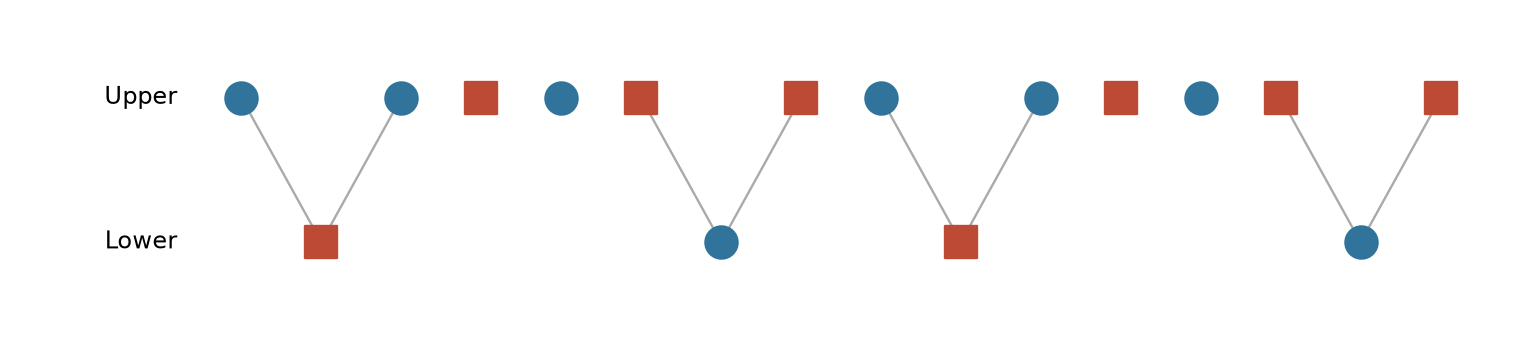
Figure 1. The first 12 upper points and their four insertions. Shape denotes color. The horizontal order is exact; the heights indicate only group membership. The combined sequence alternates in color.
The eight gaps filled in each 24-letter period start at positions 0, 4, 6, 10, 12, 16, 20 and 22. The colors of their endpoints alternate, starting with 0. The inserted points therefore alternate starting with 1, while the combined sequence alternates starting with 0. This lets us use a smaller copy of the same construction, with colors exchanged, to draw the lower group. The colors match for any initial stretch of the sequence, even one ending inside a gap.
Call the drawing of the first m points of the combined sequence A_m. Assign their horizontal coordinates, draw the upper points as G, then draw the lower points by the same procedure on their assigned coordinates with colors exchanged. Each nonempty sequence starts with an upper point, so the recursive call always has fewer points. If the last lower point has only one upper neighbor, that neighbor still has the opposite color.
Of every 32 positions, 24 are upper. Thus A_m has g=3m/4+O(1) upper points and k=m/4+O(1) lower points, where O(1) allows a bounded difference for an incomplete period. Its open-above same-color bases all come from G, giving (2/3)g+O(\log(2m))=m/2+O(\log(2m)) such bases.
Let p be the leading triangle coefficient for A_m. The smaller copy contributes p k^2 to leading order, and the upper group contributes (23/72)g^2 from the table. Across the split, there are 1/2 same-color bases per lower point facing up and 2/3 per upper point facing down in the limit. Each base matches half the apices in the opposite group up to bounded error because the point counts of the two colors in each group differ by a bounded amount. Dividing (1) by m^2 gives the equation for p and its solution:
The final drawing and its count
The side of A_m with few open bases faces up. To make two such sides face each other, draw copies on the even and odd positions of n horizontal coordinates, with sizes \lceil n/2\rceil and \lfloor n/2\rfloor. Reflect the second copy across a horizontal line, exchange its colors, and place it high above the first. The opposite starting colors keep the two color counts equal to within one in the combined drawing.
Each group now presents about n/4 same-color bases to the other, each matching about n/4 apices. The triangles between groups therefore contribute a coefficient of 1/8, while the triangles within groups contribute p/2. The resulting count is
The finite counting rule gives an exact integer count using the actual group sizes and color counts, including for incomplete periods. We checked it independently on drawings with integer coordinates at seven sizes from 17 to 257. For every same-color triple, we tested each other point against the three sides using the sign of a determinant to tell which side of each line the point occupied. Counting triangles with no point inside all three sides gave the same answer as (1) at every tested size, including 16,664 triangles at 257 points.
The construction and its error bound apply to arbitrary sizes. They give an upper bound on the unrestricted minimum M(n): another drawing could achieve a smaller coefficient, and the minimum could even grow more slowly than n^2.