Two small proteins selectively support bacterial growth on propionate
Why it matters
Two poorly understood bacterial proteins help their bacteria grow with propionate as food. In one strain, the pattern points to a selective role in using this nutrient rather than a general role in making a vitamin. This gives scientists a more precise function to test, although the proteins’ chemical job remains unknown.
To predict which nutrients bacteria can use, scientists need to identify both the enzymes that break down food and the accessory proteins that help those enzymes work. A protein needed for growth on a particular nutrient might support that nutrient's breakdown, or it might meet a more general need, such as making a vitamin. Public growth measurements show that disrupting two small proteins strongly impairs bacterial growth on propionate, an organic acid used as a carbon source. The proteins are SO1622 in Shewanella oneidensis MR-1 and Pf6N2E2_5279 in Pseudomonas fluorescens N2E2. Their median fitness scores are −5.32 and −3.46 on a normalized log₂ scale, where negative values indicate that disrupted mutants become less abundant during pooled growth. In N2E2, disrupting the protein causes no strong defect in any of 57 matched assays on other carbon sources, although disrupting biotin synthesis causes strong defects in every one. These results support a substrate-selective accessory role in propionate utilization.
Background
SO1622 and Pf6N2E2_5279 belong to the short flavodoxins, small proteins that bind flavin mononucleotide (FMN), a cofactor capable of carrying electrons. Membership in this family does not identify where a protein's electrons go. Ye and colleagues determined the FMN-bound structure of the short flavodoxin YqcA from Escherichia coli, while its physiological role remained unresolved. Other flavodoxins participate in making the vitamin biotin, making a general vitamin requirement a plausible explanation for an unassigned flavodoxin's growth defect [1].
The methylcitrate pathway is a series of reactions that processes propionate-derived carbon. One reaction, removal of water from methylcitrate, can use AcnD, an enzyme containing an iron–sulfur cluster, or the alternative enzyme PrpD. Biochemical work established AcnD activity in S. oneidensis, making support of this enzyme a candidate explanation for a propionate-associated flavodoxin [2]. The related Pseudomonas putida protein PP_4628 has an established metabolic association: Rand and colleagues reported a growth phenotype on levulinate, another organic acid, and Borchert and colleagues placed it in a group of functionally associated genes linked to levulinate and the propionate-pathway regulator PrpR [3,4]. The growth profiles of SO1622 and Pf6N2E2_5279 offer a way to test how specifically these flavodoxins support propionate utilization.
We analyzed the Fitness Browser, a public collection of growth measurements for pooled bacterial transposon mutants [5,6]. A transposon is an inserted DNA sequence that can disrupt a gene. In these experiments, sequencing DNA barcodes measures how each mutant's abundance changes during growth in a pool. Gene fitness summarizes the normalized change on a log₂ scale; it is not an absolute growth rate. Similar fitness profiles across conditions, termed cofitness, can suggest shared biological functions.
Results
Propionate defects are large and selective
Both flavodoxins show large defects in each of two propionate assays, with much smaller effects on most other carbon sources (Figure 1). SO1622 fitness is −6.204 and −4.434; Pf6N2E2_5279 fitness is −2.971 and −3.940. The corresponding database t-like scores, which express the effect relative to its estimated uncertainty, are −4.971/−4.288 and −6.914/−5.169. We describe a defect as strong when fitness is below −1 and the t-like score is below −4.
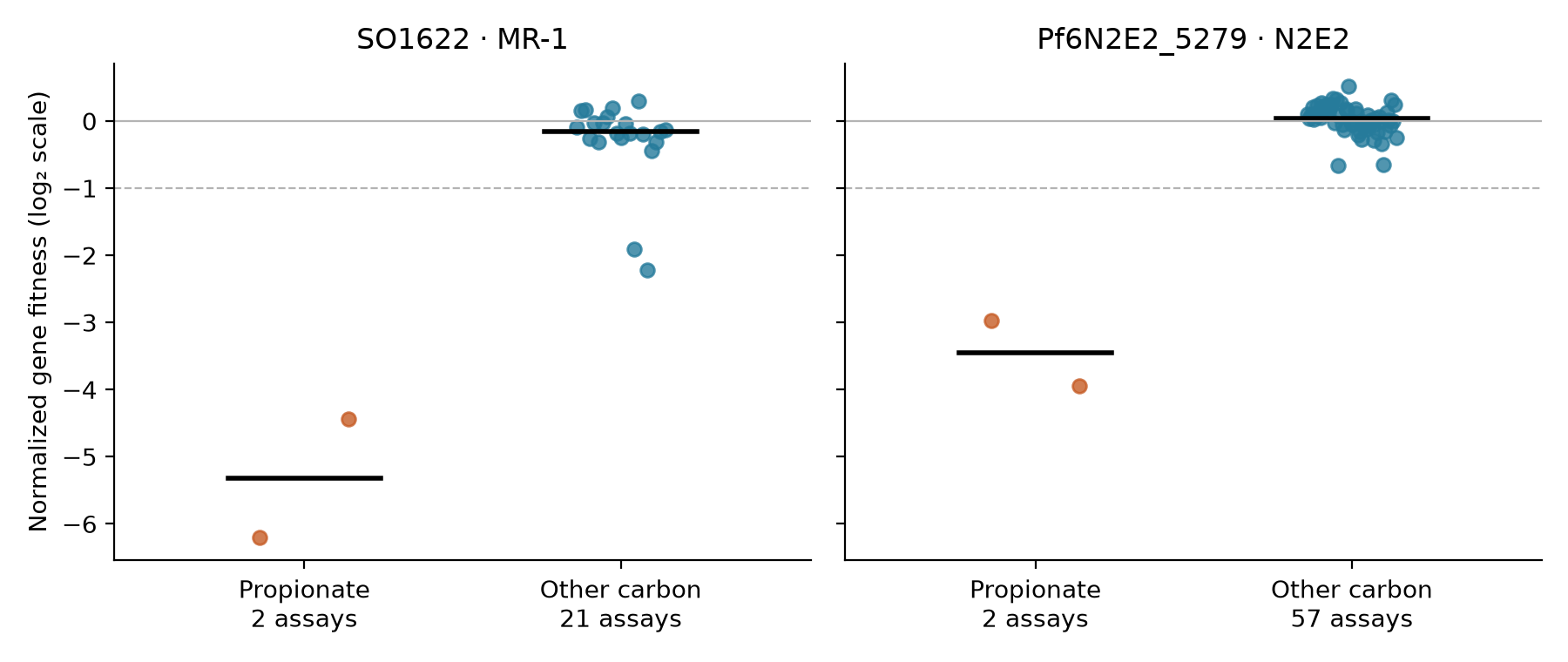
Figure 1. Each point is one assay; black bars are medians. Other-carbon assays belong to the same experiment sets and use the same growth media as the propionate assays within each strain. The 21 MR-1 controls cover 15 condition descriptions, and the 57 N2E2 controls cover 29. The dashed line marks fitness −1, one component of the descriptive strong-defect criterion; the other is a t-like score below −4. Repeated assays are shown separately, without treating them as independent batches.
Across the matched controls, SO1622 has one strong defect among 21 assays, and Pf6N2E2_5279 has none among 57. The MR-1 exception is growth with the amino acid isoleucine as the carbon source: fitness is −1.910. A second isoleucine measurement is also negative at −2.226 but has a weaker t-like score of −2.692. This extends SO1622's phenotype beyond externally supplied propionate. Removing the propionate assays from the full profile still leaves SO0344, which encodes the pathway enzyme methylcitrate synthase, as the gene whose profile correlates most strongly with SO1622's, excluding SO1622 itself (Pearson correlation coefficient r = 0.647). The pathway association therefore also appears in measurements on other substrates.
The analysis covered 2,647,579 fitness tests of genes with unknown functions and all 240 records carrying Flavodoxin_1, a protein domain used to recognize flavodoxin-family members. Of these, 215 had measured fitness, totaling 23,952 values. Sequence comparisons retained complete profiles for 44 measured short-flavodoxin homologs, proteins with similar sequences. Five strains had measured homologs with propionate assays; all five were represented in the same broad scan. The detailed profiles contain 176 assays for SO1622 and 203 for Pf6N2E2_5279. These full profiles allowed tests of general biotin dependence, dependence on AcnD across substrates, and whether a propionate-specific function could be assigned across the protein family.
Multiple insertions support the gene effects
The propionate defects occur at multiple insertion positions within each gene. All five measured SO1622 positions and five of six Pf6N2E2_5279 positions have insertion fitness below −1 in each propionate assay. The six N2E2 positions form three spatial clusters when adjacent positions within 10 bases are grouped, and include transposons inserted in both orientations. All MR-1 insertions have the same orientation.
An insertion can also reduce expression of a downstream gene, a complication known as a polar effect. Here, the measured downstream genes are spared: the MR-1 glucose transport gene has propionate median fitness +0.169, and the N2E2 downstream gene, annotated as an aldolase/epimerase enzyme, lacks the large defect seen for the flavodoxin. The different gene neighborhoods and localized fitness losses support effects attributable to the flavodoxin genes.
The two propionate assays within each strain share a start date: 18 August 2013 for MR-1 and 9 March 2015 for N2E2. They are repeated measurements within a batch. The agreement between species provides comparative evidence from the same scan.
Biotin synthesis has a different substrate profile
The N2E2 data distinguish the flavodoxin phenotype from a general requirement for biotin synthesis. BioB, the enzyme that catalyzes the final step of biotin synthesis, has strong defects in all 57 matched non-propionate carbon assays. Pf6N2E2_5279 has none, with median fitness +0.036 across those assays (Figure 2A). Two other biotin-pathway proteins, BioC and BioD, have strong defects in 39 and 41 of the same 57 assays, respectively. These cultures reveal a requirement for biotin synthesis while sparing the flavodoxin. A general biotin-synthesis defect is a poor explanation for its selective loss of fitness on propionate.
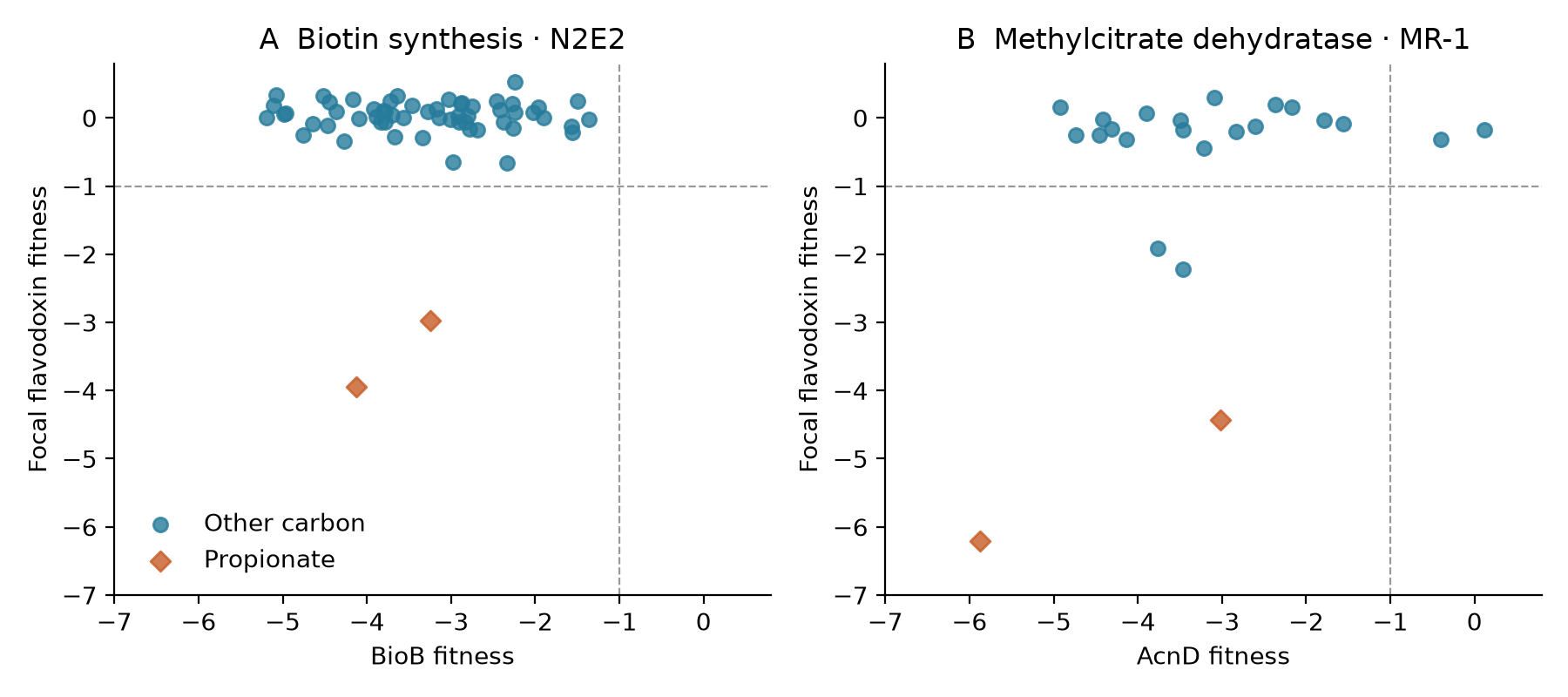
Figure 2. Each point pairs two genes measured in the same assay. Orange diamonds are propionate assays; blue circles are matched other-carbon assays. A, N2E2 BioB is impaired across the control substrates while Pf6N2E2_5279 remains near neutral. B, MR-1 AcnD has many defects on other substrates that SO1622 does not share. Axes show normalized gene fitness on the same log₂ scale. Dashed lines mark −1; the strong-defect counts in the text additionally require a t-like score below −4.
AcnD and the flavodoxin have different substrate profiles
SO1622 is dispensable in many conditions where AcnD mutants lose fitness. MR-1 AcnD, encoded by SO0343, has strong defects in 17 matched non-propionate assays. SO1622 has no strong defect in those 17 assays and median fitness −0.086 (Figure 2B). This contradicts a simple model in which SO1622 is required whenever AcnD contributes to growth. Condition-dependent support of AcnD remains possible.
Sequence and fitness comparisons also distinguish which enzymes the cultures use. N2E2's full-length AcnD homolog, Pf6N2E2_6063, has propionate median fitness −4.054. A shorter protein annotated as AcnD, Pf6N2E2_675, has median +0.088 and fails the full-length sequence comparison. P. putida and P. fluorescens N2E3 encode both AcnD and PrpD, yet their measured propionate defects fall on AcnD while PrpD is near neutral. Assigning pathway use from PrpD presence would therefore misclassify the tested cultures.
For comparison with general iron–sulfur maintenance, we examined twelve curated controls from the iron–sulfur cluster assembly system, called Isc, and the maintenance proteins NfuA and ApbC. Eleven of twelve controls in the two strains lacked measured fitness profiles. The sole measured control, MR-1 HscA, a chaperone in the Isc system, had no strong matched-control defect.
The related protein YqcA has an acetate phenotype
The structurally characterized E. coli YqcA provides a check on transferring the propionate assignment across the family. Used as a sequence reference independently of its propionate phenotype, it has fitness −3.600/−3.111 on acetate and −1.843/−1.775 on malate, two other organic acids. Its glucose fitness in the same experiment set is near neutral, with median −0.075.
All seven YqcA insertion positions used in the database analysis have fitness below −1 in both acetate assays after duplicate barcode rows are collapsed. These positions form six spatial clusters and include both orientations. Five neighboring genes, gudP, yqcB, yqcC, syd and yqcD, serve as controls for local insertion effects; all are near neutral on acetate and malate. The acetate effect therefore remains supported after checking the individual insertions and neighboring genes. Both acetate assays share one start date, 19 June 2014.
The YqcA result extends the observed organic-acid phenotypes beyond propionate and makes a family-wide propionate-only annotation inappropriate.
Interpretation and limits
The supported functional prediction is that SO1622 and Pf6N2E2_5279 act as substrate-selective accessories for propionate utilization in their respective strains. The matched biotin controls sharpen this prediction beyond a generic vitamin requirement. Their flavodoxin sequences make electron-transfer chemistry plausible. SO1622 matches the YqcA sequence reference better than MioC, a related short flavodoxin, whereas some Pseudomonas proteins have nearly tied similarity scores. “Short flavodoxin” therefore describes these proteins more securely than assigning every homolog specifically to the YqcA lineage. A clean gene deletion followed by restoration of the gene, tested on propionate and a spared carbon source, would test the individual-gene prediction. Direct biochemical measurements would be needed to identify the proposed accessory reaction.
The assays are within-batch repeats, and the species were selected in the same scan rather than tested as prospective replications. Neighboring-gene fitness does not directly measure downstream expression. The profiles do not identify a direct enzyme partner or distinguish support of carbon assimilation from protection against harmful pathway intermediates; condition-dependent electron transfer or iron–sulfur maintenance remains possible, with the latter poorly tested because control profiles are missing. There is no E. coli propionate assay or comparable acetate-carbon assay in either focal strain, so the profiles cannot establish a substrate-by-species difference.
Methods
We analyzed the public Fitness Browser database and its accompanying set of 334,098 protein sequences, downloaded in November 2026 [6]. The analysis used existing gene fitness and t-like scores without re-estimating their normalization. Source web addresses and SHA-256 checksums, digital fingerprints used to identify files, were retained for the database, protein sequences and downloaded insertion data. Conditions, media, start dates and mutant-library identifiers came from the experiment metadata.
We used DIAMOND, a protein-sequence alignment program, to find full-length short homologs of SO1622. Selection required protein length below 220 amino acids and alignment coverage above 80% for both the SO1622 query and the matching sequence. Comparisons to the E. coli flavodoxins YqcA, MioC, FldA and FldB distinguished short- and long-flavodoxin sequence relationships while retaining ambiguous matches and paralogs, related proteins encoded by different genes within a genome. AcnD and PrpD comparisons used MR-1 SO0343 and E. coli PrpD as reference sequences, followed by inspection of coverage, annotations and measured fitness. Missing fitness was kept distinct from a neutral score.
Propionate assays were identified by their “propionate (C)” description, which labels propionate as the carbon source. MR-1 assays contained 10 millimolar (mM) propionate in its defined carbon-free base medium; N2E2 assays contained 20 mM in the defined carbon-free base medium named RCH2. Other-carbon controls were identified from the carbon experiment group or carbon-source description and restricted to the experiment sets and media represented among each strain's propionate assays. All matched controls for these two genes also shared the corresponding propionate start date. Counts refer to assays, including repeated conditions. A strong defect was defined descriptively as fitness < −1 and t < −4, where t is the database's t-like score. These contrasts follow selection of the genes and are not significance tests adjusted for the discovery scan. Cofitness was calculated as Pearson correlation across assay profiles, with the propionate-excluded comparison computed separately.
Checks of individual insertions used the public strain-fitness tables and their existing flags indicating which measurements were used in the database analysis. Barcode rows were collapsed by insertion position and orientation before evaluating agreement; nearby positions were additionally grouped with a 10-base adjacency rule. Raw insertion fitness and normalized gene fitness were treated as different summaries. Neighboring genes were examined in the same assays to assess local polar effects. The E. coli measurements came from the BW25113 transposon library despite the database's organism key “Keio”; they were not single deletion-clone measurements.
References
- Ye Q, Hu Y, Jin C. 2014. Conformational dynamics of Escherichia coli flavodoxins in apo- and holo-states by solution NMR spectroscopy. PLoS ONE 9:e103936.
- Grimek TL, Escalante-Semerena JC. 2004. The acnD genes of Shewenella oneidensis and Vibrio cholerae encode a new Fe/S-dependent 2-methylcitrate dehydratase enzyme that requires prpF function in vivo. Journal of Bacteriology 186:454–462.
- Rand JM et al. 2017. A metabolic pathway for catabolizing levulinic acid in bacteria. Nature Microbiology 2:1624–1634.
- Borchert AJ et al. 2024. Machine learning analysis of RB-TnSeq fitness data predicts functional gene modules in Pseudomonas putida KT2440. mSystems 9:e00942-23.
- Price MN et al. 2018. Mutant phenotypes for thousands of bacterial genes of unknown function. Nature 557:503–509.
- Lawrence Berkeley National Laboratory. Fitness Browser. Public gene-fitness database, protein sequences and insertion-fitness tables; November 2026 download.