Two nearly equal chains give the fewest convex pentagons in point sets built from separated groups
Why it matters
How can you place dots so that as few groups of five as possible are the corners of a pentagon? Among arrangements built by repeatedly placing one group high above and to one side of another, two curved rows of nearly equal size do best. Anyone looking for a placement with still fewer pentagons must look outside this family.
How few convex pentagons must appear among n points in the plane? Assume no three points lie on a line. Count a group of five whenever all five lie at corners of the smallest convex polygon enclosing them (their convex hull). Other points inside that polygon do not affect the count. One way to get very few pentagons is to arrange the points along two chains that bend in opposite directions, so that every pentagon lies entirely on one chain. The difficulty is to show that dividing the points into more groups cannot give fewer.
We prove that two chains of nearly equal size attain the minimum at every size among arrangements built by repeatedly placing one group high above and to one side of another. In large sets of this kind, the smallest fraction of five-point subsets that form convex pentagons tends to 1/16. The exact minimum count is
The arrangements covered by the proof
Subercaseaux, Mackey, Heule and Martins conjectured that the same minimum holds for all point sets in general position (no three on a line) and certified equality through 16 points. At ten points, two chains of five give just two pentagons (Figure 1). Proving optimality requires showing that every allowed arrangement has at least two.
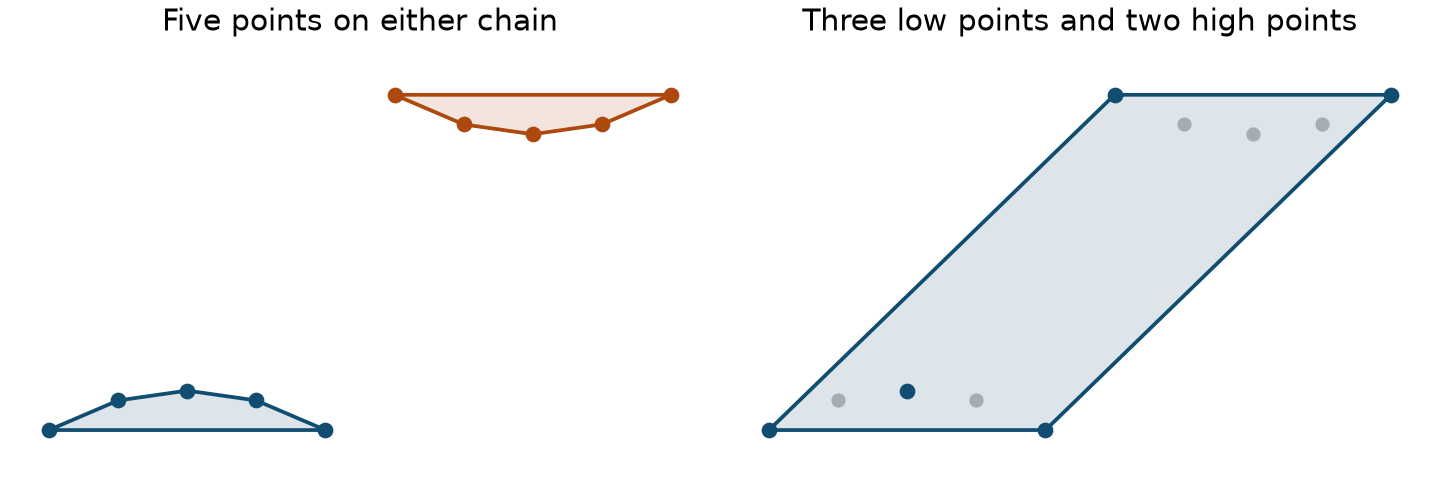
Figure 1. The ten-point construction. On the left, each shaded hull is a convex pentagon. On the right, the selection uses both chains, and only four of the five selected points are on its boundary.
Fix a horizontal axis and require the points to have distinct horizontal coordinates. A single point qualifies. A larger set qualifies if it can be split into two qualifying groups with disjoint horizontal ranges, one high above the other. Every point in the high group must lie above every line through two low points, and every low point must lie below every line through two high points. Either group may be on the left. Baek and Balko studied the size of the largest convex polygon under a related splitting rule. Here the quantity to minimize is the number of pentagons, and the horizontal ranges must be disjoint at every split.
Counting across a split
Think of the splits as a tree. The whole set is its root, the two groups at a split are its children, and the individual points are its leaves. At each split, list the low child before the high child. This gives the leaves a tree order, which can differ from their horizontal order.
To see which selections form a convex polygon, consider points in increasing horizontal order. Call such a chain a cup if the successive slopes between points increase and a cap if they decrease. Single points and pairs count as both. Reflect the group at a split from left to right if necessary so that its low child lies to the left. This preserves cups, caps and convexity. By the high-above condition, a line joining the two children has greater slope than any line within a child that shares its endpoint.
Now select points from both children. Trace the bottom edge of their hull from left to right: it follows the lower hull of the selected low points and then goes straight to the rightmost selected high point. The top edge runs from the leftmost selected low point to the upper hull of the selected high points. This gives two counting rules:
- A selection from both children forms a convex polygon exactly when it takes a cup from the low child and a cap from the high child.
- A selection from both children forms a cup exactly when it takes a cup from the low child and one high point. It forms a cap exactly when it takes one low point and a cap from the high child.
The polygon rule applies even when one child contributes only one point.
This rule explains Figure 1 at every size. Put a cap of m=\lfloor n/2\rfloor points low and a cup of n-m points high. Any mixed five-set takes at least three points from one child. Three low points bend the wrong way for a cup, and three high points bend the wrong way for a cap. Every five-set in a single child is convex, giving exactly the claimed count. Both chains admit recursive splits: to grow a cap, join a low singleton to the left of a cap; to grow a cup, join a high singleton to the right of a cup. Each join can be realized by placing the parts in disjoint horizontal intervals and translating the right part sufficiently far up. For n=1 the count is zero.
To prove the matching lower bound we need to count pentagons in an arbitrary splitting tree, including those completed at a later split. For the group represented by any subtree, let P count its convex pentagons and let U_j,V_j count its cups and caps of j points, respectively. Its leaves occupy a consecutive interval in tree order. Let A count the leaves before the interval and B those after it. To track the contribution of shorter chains as well as pentagons, give the subtree the weighted count
We computed the minimum by working from short intervals to long ones. For each interval we tried every split in (1), using the minima already computed for its children. This gave the two-chain count at all 255 sizes from 2 through 256 and at 2,048 points, where it was 18,582,371,985,408. Choosing the split by a shortcut could give a different answer. At 256 points we tried splitting off one leaf from whichever end had fewer exterior leaves (the left end in a tie). Even with an optimal continuation, this choice missed the minimum in 7,011 of 32,640 nonsingleton intervals. The proof below avoids having to choose the best split at each interval.
Following the middle of the tree
Instead of finding the best split, consider any splitting tree. Follow its middle down from the root and give each branch that falls away a lower bound. Adding these bounds will give a minimum count that applies to every tree. Write n=2m+e, e\in\{0,1\}, so each half has m leaves after setting aside the middle leaf if there is one. Mark the middle leaf if e=1, or the gap between the two middle leaves if e=0, always in tree order. Follow the mark down the tree. At a split, remove the child that misses the mark; it is a block wholly within the first m or the last m leaves. For an even size, when the split is at the marked gap, remove one child and then the other. Stop at the central singleton or the empty interval. Thus A,B, initially zero, end at m,m.
First consider a block of x leaves removed on the left. If all its points form a cap, its weighted count is
Now let A,B be the counts before a left removal of size x, and h=2m+e-A-B-x the size left after it. Add the bound for the removed block to the two terms in (1) for the split itself. This gives a lower bound on the contribution of the move:
A lower bound for every removal order
Every removal order starts and ends with the same exterior counts. Assign a value E to each pair of exterior counts. If the contribution of each move is at least the increase in E, adding over the path leaves just the final value minus the initial value as a lower bound.
Put u=\min(A,B), v=|A-B|, and z=m-\max(A,B). Use the symmetric potential
For all nonnegative integers A,B,x,m with A+x\le m, B\le m,
In each chart let y denote the four nonnegative integer variables. The difference f(y) in (3) is a polynomial of total degree at most five. Expand it in products of binomial coefficients, each of which is nonnegative for these inputs. The coefficient of \prod_s\binom{y_s}{i_s} is
| e | coefficients across five charts | negative | zero | positive | largest |
|---|---|---|---|---|---|
| 0 | 630 | 0 | 383 | 247 | 76 |
| 1 | 630 | 0 | 370 | 260 | 77 |
In both rows every coefficient is nonnegative. Each product it multiplies is also nonnegative for every allowed choice of gaps, which proves (3). We found E by using the coefficients of an unknown degree-five polynomial as the variables in a linear program, a search subject to linear constraints. The displayed finite sum verifies the resulting formula with exact arithmetic.
Exchanging A and B gives the same inequality for right removals. Summing along the path cancels all intermediate potentials. The endpoints give
This equals the count attained by the two chains. Dividing by \binom n5 gives the limiting fraction 2(1/2)^5=1/16.
Independent geometric check
Direct counts on integer point sets agreed with the split identity on every one of the 6,909 ordered trees with 5 through 10 leaves. For every split of the required size, we paired each possible low subtree with each possible high subtree. We placed the leaves at consecutive integer horizontal coordinates and shifted the right child up until the lines through pairs of points met the high-above condition. Reflecting selected groups horizontally let us check both orientations. For each five-set we tested whether any point lay inside a triangle formed by three others. We used signed triangle areas to determine which side of each triangle edge the point lay on. This happens exactly when the five-set is not convex. At sizes 9 and 10 the respective minima were 1 and 2, over 1,430 and 4,862 trees. Agreement on each tree checks the counting rule even for arrangements far from the minimum; the move inequality supplies the lower bound for arbitrary size.
The restriction that matters is geometric: every split must separate the horizontal ranges as well as put one group high above the other. Any counterexample to the unrestricted conjecture must fail this recursive separation condition.