A genetic change that lowers a blood metabolite shows limited evidence of pneumonia protection
Why it matters
A genetic change that strongly lowers a sugar-like substance in blood was associated with little difference in bacterial pneumonia. The study narrowly rules out a large benefit from this particular lifelong genetic change, but a smaller benefit remains possible. It does not establish what a drug blocking the same kidney transporter would do or challenge treatment for rare inherited immune-cell disorders.
Lowering the blood concentration of a sugar-like molecule, 1,5-anhydroglucitol (1,5-AG), improves immune-cell defects in rare inherited metabolic disorders. Whether the same approach could prevent infections more widely is unknown. We tested a genetic change that disrupts sodium-glucose cotransporter 5 (SGLT5), a kidney protein that returns filtered 1,5-AG to the blood. Each copy of the variant lowers 1,5-AG by 9.31 micrograms per millilitre (µg/mL). In FinnGen, a Finnish genetic study with 22,740 bacterial-pneumonia cases, the variant had an odds ratio of 0.969 (95% confidence interval 0.826–1.138), where a value below one indicates lower odds of disease. Expressed per 10 µg/mL reduction in 1,5-AG, the interval narrowly excluded 20% lower odds but allowed a 10% benefit. UK Biobank, an independent British cohort linking genetic and health data, gave a similar estimate for a broader pneumonia definition. These results limit the general-population benefit associated with this lifelong change in transporter activity.
Background
Neutrophils are immune cells that help control bacterial infections. They convert a small amount of the circulating sugar-like molecule 1,5-AG into 1,5-AG-6-phosphate. Normally, a metabolic-repair pathway removes this product. In glycogen storage disease type 1b and severe congenital neutropenia type 4, that pathway fails; the product accumulates and impairs neutrophil metabolism. Lowering blood 1,5-AG can improve neutrophil counts and function in these disorders. [1]
The gene SLC5A10 encodes SGLT5. Diederich and colleagues established its transport activity and identified human protein-changing variants that impair it. These variants provide a way to ask whether reducing the amount of 1,5-AG available to neutrophils also improves defense against infection when the repair pathway is generally intact. Selecting variants with measured transport defects ties the test to a specific protein rather than to low 1,5-AG from any cause. [1]
We joined these functional results to public genetic associations with circulating 1,5-AG and infection diagnoses. The primary question was whether reduced SGLT5 transport provides substantial protection against bacterial pneumonia. Before examining infection estimates, we defined a useful precision target as excluding 20% lower odds per 10 µg/mL lower 1,5-AG. This statistical precision threshold distinguishes a sizeable benefit from a smaller effect worth further study.
Results
Transport-reducing variants substantially lower blood 1,5-AG
Two alleles, or versions of a genetic variant, reduced transport in cell assays and had strong associations with human 1,5-AG concentrations and usable infection data. The A allele of variant rs61741107 changes glycine to glutamate at protein position 471 (Gly471Glu); the resulting protein had no measurable transport in the cell assay. In the Atherosclerosis Risk in Communities (ARIC) study, a population cohort used here to estimate blood concentration changes, each copy was associated with 9.31 µg/mL lower serum 1,5-AG. The T allele of rs148178887 changes asparagine to isoleucine at position 96 (Asn96Ile) and lowered serum 1,5-AG by 10.38 µg/mL. Both associations were measured among 6,589 European-ancestry participants without diagnosed diabetes. [1,2]
Table 1. Functional alleles with usable infection estimates. Concentration effects and standard errors (SE) come from ARIC. The F statistic measures the strength of the genetic association with 1,5-AG and is the squared effect-to-SE ratio; both values greatly exceed the prespecified minimum of 10. UKB denotes UK Biobank.
| Allele | Protein change | Cell-assay result | 1,5-AG lowering, µg/mL (SE) | F statistic | Infection data |
|---|---|---|---|---|---|
| rs61741107-A | Gly471Glu | No measurable transport | 9.31 (0.59) | 249 | FinnGen and UKB |
| rs148178887-T | Asn96Ile | About sixfold lower efficiency | 10.38 (0.82) | 160 | UKB only |
A separate study that tested genetic variants across the genome for associations with plasma metabolites, catalogued as GCST90199648, confirmed the lowering direction for both alleles: coefficients were −1.694 (SE 0.097) and −1.534 (SE 0.148), respectively, in that dataset's native units. We used ARIC to express infection associations per unit of concentration change because the plasma-study coefficients are in different units. [3] The third assay-selected allele, rs754390288-A (arginine replaced by histidine at position 401, or Arg401His), was unavailable in the extracted exposure and infection data. We used only the selected variants, without substituting nearby variants as proxies.
FinnGen limits the size of a pneumonia benefit from rs61741107
The variant that eliminated measurable transport in the cell assay had a pneumonia estimate close to no association. FinnGen release 13 (R13) included 22,740 bacterial-pneumonia cases and 409,571 controls. For rs61741107-A, the per-copy odds ratio was 0.969 (0.826–1.138; P=0.703). Its allele frequency was 0.0037. The other two transport-reducing alleles were absent from the extracted FinnGen outcome regions.
We used Fieller intervals, which account for uncertainty in both the infection association and the ARIC concentration effect. With this method, the odds ratio per 10 µg/mL lower 1,5-AG was 0.967 (95% Fieller interval 0.812–1.150; Figure 1). The lower limit lies just above the prespecified 0.80 threshold. Thus the result narrowly meets that precision target under the assumptions used to translate genetic effects into concentration changes, while remaining compatible with modest protection.
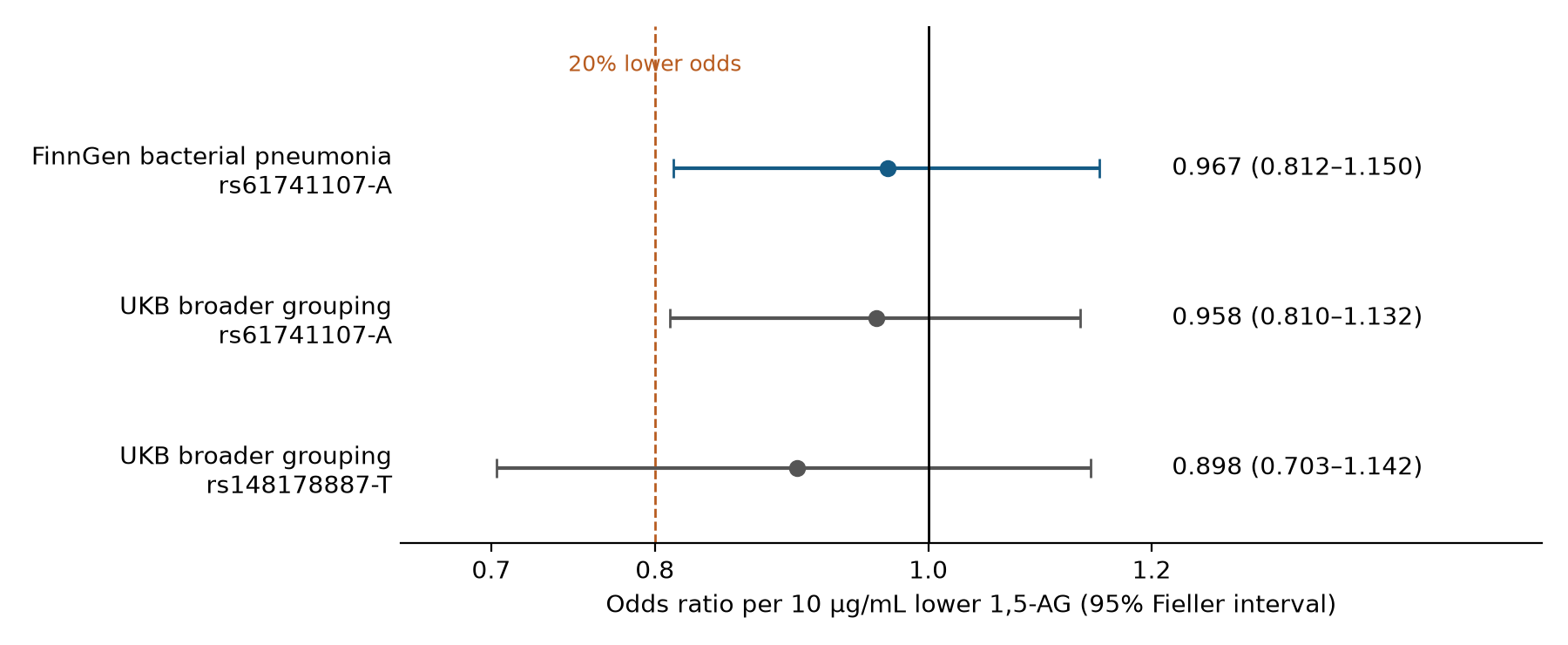
Figure 1. Pneumonia associations calibrated to 10 µg/mL lower circulating 1,5-AG. Points are odds ratios calculated from the ratio of each genetic effect on infection to its effect on 1,5-AG; bars are 95% Fieller intervals, which include uncertainty in the independent ARIC exposure estimate. The dashed line marks 20% lower odds. FinnGen is the primary analysis. The UK Biobank grouping includes unspecified lobar pneumonia and therefore measures a broader outcome. Alleles and cohorts are displayed separately.
UK Biobank gives a similar estimate for the same allele
The independent UK Biobank estimate was similar, but its diagnostic grouping was less specific for bacterial disease. Pan-UK Biobank (Pan-UKB) provides public genetic-association results from UK Biobank, separated by ancestry. In its European-ancestry analysis, rs61741107-A had an odds ratio of 0.961 (0.823–1.122) among 9,453 cases assigned to the bacterial-pneumonia grouping. The second functional allele, rs148178887-T, had an odds ratio of 0.895 (0.698–1.147). Both passed the supplied variant-level checks for sparse counts. Calibrated estimates appear in Figure 1.
The released diagnostic mapping assigns unspecified lobar pneumonia, code J18.1 in the International Classification of Diseases, tenth revision (ICD-10), to this grouping. The grouping is called phecode 480.1; phecodes combine related diagnoses for genetic analyses. Its label therefore does not establish bacterial infection. [5,6] The narrower analysis of ICD-10 J15, bacterial pneumonia not elsewhere classified, had only 604 cases and was imprecise; the second allele was flagged low-confidence and excluded from calibrated inference. All-pneumonia estimates were directionally protective but also allowed no association (Table 2).
Table 2. Per-copy infection associations for the two available transport-reducing alleles. Intervals are 95% confidence intervals. OR denotes odds ratio and CI denotes confidence interval. The UKB pneumonia outcomes overlap and were not pooled. Septicaemia outcomes are specifically “other septicaemia,” rather than all sepsis.
| Cohort and outcome | Cases / controls | rs61741107-A: OR (95% CI) | rs148178887-T: OR (95% CI) |
|---|---|---|---|
| FinnGen bacterial pneumonia | 22,740 / 409,571 | 0.969 (0.826–1.138) | Unavailable |
| UKB broader bacterial-pneumonia grouping | 9,453 / 405,999 | 0.961 (0.823–1.122) | 0.895 (0.698–1.147) |
| UKB ICD-10 J15 | 604 / 419,927 | 0.764 (0.424–1.378) | Low-confidence; excluded |
| UKB all pneumonia | 14,054 / 405,999 | 0.924 (0.813–1.051) | 0.873 (0.711–1.072) |
| FinnGen other septicaemia | 19,048 / 433,757 | 1.005 (0.846–1.194) | Unavailable |
| UKB other septicaemia | 5,512 / 415,019 | 1.126 (0.923–1.373) | 0.790 (0.574–1.086) |
As a sensitivity analysis, combining rs61741107 across FinnGen and the broader UK Biobank grouping gave a calibrated odds ratio of 0.962 (0.853–1.085). This requires a common effect across different diagnostic definitions. The primary bacterial-pneumonia bound remains the FinnGen-only interval.
Other infections, blood glucose and neutrophil counts
Other-septicaemia estimates showed no consistent protective pattern across alleles and cohorts (Table 2). UK Biobank associations with glycated haemoglobin, a marker of longer-term blood glucose, were close to zero for both alleles: −0.0010 (SE 0.0131) and +0.0154 (0.0208) in inverse-normalized units, a rank-based scale transformed to follow a normal distribution. In the same allele order, neutrophil-count coefficients were −0.0025 (0.0113) and +0.0435 (0.0180). The second allele's count association reached nominal statistical significance; counts measure neutrophil abundance rather than infection-fighting function.
The comparator rs12604020-T, which left transport unchanged in the cell assay, had a small positive plasma 1,5-AG association, +0.158 (SE 0.051). This association ruled out using it as a control expected to leave 1,5-AG unchanged in people.
Interpretation
A large reduction in circulating 1,5-AG through a transport-disrupting SGLT5 allele was accompanied by a pneumonia estimate close to no association in two cohorts. FinnGen narrowly excludes a 20% reduction in bacterial-pneumonia odds at the specified concentration scale. The second allele remains compatible with substantial protection, so the evidence is strongest for the particular change in transport produced by rs61741107. The result tempers the case for extending a rare-disease mechanism to broad pneumonia prevention while leaving a smaller benefit open.
Methods
We selected all three variants with reduced 1,5-AG transport in Diederich and colleagues' assays before querying infection associations. Protein changes use that study's numbering. We required an association with lower 1,5-AG and an F statistic greater than 10 and retained the assay-neutral comparator rs12604020-T, which replaces alanine with valine at position 522 (Ala522Val). We matched genomic position and both alleles using the human reference-genome assembly GRCh38 for FinnGen and the plasma-metabolite data and GRCh37 for Pan-UKB. Annotations from Ensembl, a genome database, confirmed each protein substitution. For rs148178887, whose alleles are A and T, we mapped directly to the reference genome's forward strand to identify the same allele across datasets. The allele letters alone cannot distinguish the two DNA strands for this variant.
For concentration calibration we used the European-ancestry ARIC coefficients and standard errors in Loomis and colleagues' Table 1, whose A2 column identifies the effect allele. [2] The public plasma-metabolite summary statistics, which report association estimates rather than individual records, provided an independent direction check. [3] All analyses used summary-level public data.
The primary FinnGen R13 endpoint was bacterial pneumonia, J10_PNEUMOBACT, with controls excluding the influenza/pneumonia endpoint group. Other septicaemia, AB1_OTHER_SEPSIS, was secondary. Counts came from the R13 summary-statistics manifest, the release's index of datasets. [4] For Pan-UKB we used both-sex European-ancestry estimates for phecode 480.1, ICD-10 J15, all pneumonia (phecode 480), and other septicaemia (ICD-10 A41). These outcomes were selected from the manifest before fetching their variant estimates. The released ICD mappings were checked against their labels. All four UKB infection outcomes carried a manifest flag indicating that their estimated heritable component was not statistically significant. This outcome-wide flag differs from variant-level low-count flags, which we retained and used to exclude low-confidence estimates from calibration. [5,6]
We exponentiated per-allele log-odds coefficients and their normal-approximation 95% intervals. To express an association per 10 µg/mL lower 1,5-AG, we divided the outcome coefficient by the positive ARIC lowering effect expressed in units of 10 µg/mL. Fieller intervals incorporated uncertainty in both coefficients, assuming independent exposure and outcome samples and a linear log-odds relationship over that scale. Different alleles were not pooled, avoiding an assumption about linkage disequilibrium, the correlation between inherited variants, that we had not measured. The cross-cohort sensitivity combined the same allele's outcome coefficients by inverse-variance weighting, which gives more weight to more precise estimates, before applying their shared exposure calibration. Secondary outcomes and physiological checks were descriptive.
Limitations
The principal limits concern dose, mechanism and diagnosis. ARIC's concentration calibration must transfer to FinnGen despite differences in population and blood-glucose levels; confirmation of the lowering direction in another dataset does not establish identical absolute effects. Most carriers have only one copy of the variant, so an inactive mutant protein does not imply complete transporter inhibition in the person or reproduce a short-term drug intervention. SGLT5 transports other sugars, and effects of linked variants at FAM83G, a gene overlapping SLC5A10, remain possible; the ratio estimates therefore cannot isolate the contribution of 1,5-AG itself. Diagnosis-code misclassification could dilute associations, particularly in the broader UK Biobank grouping. These population results do not test treatment in patients with metabolic-repair deficiencies.
References
- Diederich J, et al. SGLT5 is the renal transporter for 1,5-anhydroglucitol, a major player in two rare forms of neutropenia. Cellular and Molecular Life Sciences (2023). Article and functional assays.
- Loomis SJ, et al. Rare variants in SLC5A10 are associated with serum 1,5-anhydroglucitol (1,5-AG) in the Atherosclerosis Risk in Communities (ARIC) Study. Scientific Reports (2019). Article; absolute-unit estimates in Table 1.
- Chen Y, et al. Genomic atlas of the plasma metabolome prioritizes metabolites implicated in human diseases. Nature Genetics (2023). Article; GWAS Catalog study GCST90199648.
- FinnGen release 13. Summary-statistics manifest, bacterial-pneumonia definition, and other-septicaemia definition.
- Pan-UK Biobank. Public summary-statistics and quality-control documentation.
- Pan-UK Biobank. Released ICD-10-to-phecode mapping.