Doctors who agreed on an AI diagnosis were more often right when both chose it unaided than when both switched
Why it matters
We paired doctors who read the same skin photograph without seeing each other’s answers. When both backed the AI diagnosis, it was right 96% of the time if both had already chosen it themselves, compared with 56% if both switched to it. We saw the same contrast on chest X-rays: knowing what the doctors thought without AI helped explain how much to trust their agreement.
When a doctor accepts a diagnosis suggested by artificial intelligence (AI), a second doctor’s agreement might offer reassurance. But if both saw the same suggestion, their final answers alone cannot tell us whether either doctor recognized the disease independently. We paired doctors who assessed the same skin photograph without seeing each other’s answers. When the first doctor switched to the AI diagnosis, it was correct 51% of the time. That figure rose to 56% when the second doctor also switched and to 86% when the second doctor had already chosen the diagnosis unaided. On chest X-rays, too, agreement with the model was more reliable when both doctors had endorsed its finding unaided than when neither had.
Accuracy of individual doctors
Groh and colleagues studied whether AI advice helped doctors diagnose skin diseases from photographs of people with different skin tones. Doctors listed up to three diagnoses in order of preference. After seeing the model’s suggestion, they could keep their answers, add the suggestion to their list, or make it their leading diagnosis.
We reproduced the authors’ finding that individual doctors named the right disease more often with assistance. For the study’s eight main diseases, dermatologists ranked the correct diagnosis first on 27.3% of readings without advice and 36.4% with advice from the study’s standard model. For primary care physicians the rates were 13.2% and 21.8%. Counting the diagnosis anywhere on the list, accuracy rose from 37.2% to 59.9% for dermatologists and from 16.9% to 46.6% for primary care physicians. The study allowed a fourth diagnosis after advice. Even when the suggestion replaced the third choice, assisted list accuracy reached 59.4% for dermatologists and 46.3% for primary care physicians. All these percentages match the published results at their reported precision.
What the second doctor’s answer added
We took each pair of doctors in both orders. We counted a first endorsement whenever the first doctor’s leading diagnosis after advice matched the AI suggestion. Across 486 doctors and 343 skin images, 68.8% of first endorsements matched the study’s reference diagnosis (the disease used to judge the answers). The table shows how often the suggestion was correct, first using the first doctor’s answer alone, then taking the second answer into account. “Named it unaided” means the doctor ranked that diagnosis first before seeing the suggestion.
| First physician | Before considering the second answer | Second named it unaided | Second switched to it | Second declined it |
|---|---|---|---|---|
| Named it unaided | 88.1% | 96.3% | 85.7% | 83.1% |
| Switched to it | 51.2% | 85.7% | 55.6% | 43.5% |
When the first doctor switched, a second switch raised the estimated percentage correct by 4.5 points over the first endorsement alone (95% interval −5.1 to 13.9). That range includes no gain in accuracy from a second switch. If the second doctor had named the diagnosis unaided, the increase over the same baseline was 34.6 points (25.8–42.4). The value 85.7% appears twice because a pair with one unaided endorsement and one switch contributes in both orders.
How often did advice turn disagreement into agreement? We held the first endorsement fixed and compared the same second doctor’s leading diagnosis before and after advice in the same session. Every initial match persisted, so the last row counts only new confirmations.
| When the second physician confirmed | Confirmations per 100 first endorsements | Correct per 100 | Incorrect per 100 | Correct among confirmations |
|---|---|---|---|---|
| Before advice | 24.1 | 22.4 | 1.7 | 93.1% |
| By the end of the advice step | 38.9 | 32.9 | 6.0 | 84.5% |
| Only after adopting the suggestion | 14.9 | 10.5 | 4.4 | 70.6% |
Per 100 first endorsements, the 95% intervals for the additional confirmations were 8.0–13.3 correct and 2.9–6.3 incorrect. Advice brought the percentage correct among confirmations down by 8.6 points (95% interval 5.2–12.9). The estimate fell for each of the eight diseases the model could suggest. Even so, two final endorsements were more often right (84.5%) than the first endorsement alone (68.8%). When the second doctor initially chose another diagnosis, 61.1% of suggestions were correct. The suggestions that doctor went on to adopt were 9.4 percentage points more often correct than that starting set (95% interval 2.4–15.4).
Among pairs who agreed with the model after advice, the percentage correct was 40.7 points higher when both had named the diagnosis unaided than when both switched (95% interval 25.8–55.6). The difference had the same sign for each of the eight suggested diseases. Some photographs showed diseases the model could never suggest. Restricting the comparison to photographs of its eight named diseases reduced the gap to 30.6 points. Applying the original study’s restrictions on physician qualifications and image order as well reduced it to 21.6 points (7.9–42.0). Pairs in which both doctors switched accounted for 7.5 of the 38.9 final confirmations per 100 first endorsements, but 3.3 of the 6.0 incorrect confirmations.
Agreement on chest X-rays
In a separate study of radiologists reading chest X-rays, Collab-CXR, readers estimated the probability that a finding was present. We examined two broad findings: airspace opacity (an area of lung that appears denser than expected) and cardiomediastinal abnormality (an abnormal appearance of the heart or the central part of the chest). We included findings for which the model gave a probability of at least 50%. We counted a reader’s score of at least 50% as an endorsement and judged it correct if the expert reference classified the finding as present.
Two study designs recorded an unaided and an assisted score from each reader on the same case. In one design the readings took place in separate sessions; in the other the reader scored the case unaided and then with advice in the same session. We paired different radiologists within each design. The designs included some of the same patients.
Among pairs who endorsed a finding with assistance, the percentage correct was higher when both had endorsed it unaided than when neither had (Figure 1). The gap was 32.9 percentage points for separate sessions (95% interval 11.5–54.2) and 31.7 for readings in the same session (4.4–69.5). Pairs with one unaided endorsement did not consistently fall between those groups. In the same-session design, pairs in which both doctors switched came from just 16 patients and accounted for 5.7 confirmations per 100 first endorsements.
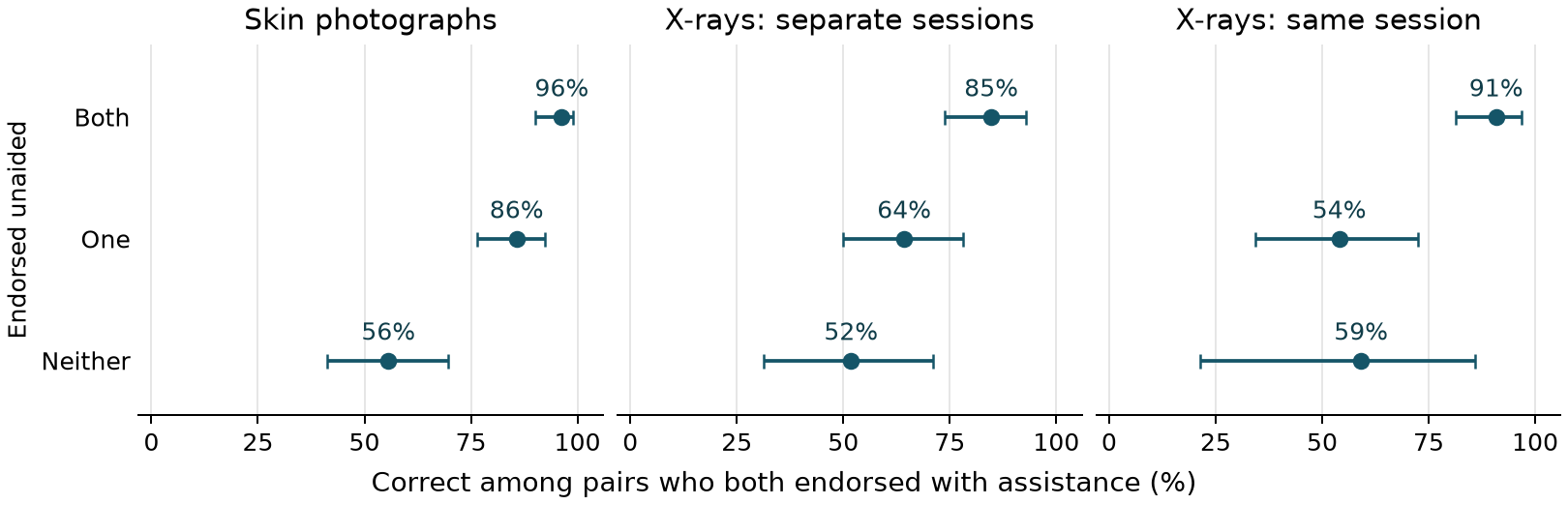
Figure 1. Each pair agreed with the model after advice. Points show the percentage of agreements that matched the reference, grouped by how many doctors had already endorsed the diagnosis or finding unaided. The 95% intervals account for repeated cases and readers.
When the first reader switched, the second reader’s answer had a less consistent relationship to correctness on X-rays than on skin photographs. In separate sessions, 53.4% of findings that the first reader endorsed only with AI were present. That figure was 51.8% when the second reader also endorsed only with AI and 64.3% when the second reader endorsed both with and without it. For readings in the same session, the corresponding figures were 48.1%, 59.1% and 54.0%. Across studies, the clearest difference was between two unaided endorsements and none.
Comparing second opinions that confirmed equally often
A doctor who confirms more findings may include less certain cases. The skin study recorded choices rather than confidence after advice, but the X-ray probability scores let us compare equally selective rules. We included a third X-ray design in which different readers assessed each case with and without AI.
At the same 50% cutoff, assisted second readers confirmed more often than unaided readers, and the percentage correct among confirmations fell by about five points in each design. Using a training group of patients, we raised the assisted reader’s cutoff just enough to match the unaided confirmation rate, without using the reference diagnoses. When we applied those stricter cutoffs (59.2–63.1%) to patients left out of training, the overall confirmation rates and the percentages correct were close to those for unaided readers.
| Reading design (patients; readers) | Confirmations per 100 first endorsements: unaided / assisted / stricter assisted | Percent correct among confirmations: same order | Stricter assisted minus unaided, percentage points correct (95% interval) |
|---|---|---|---|
| Different readers per case under each condition (72; 159) | 55.9 / 72.4 / 55.8 | 80.7 / 75.8 / 79.3 | −1.5 (−6.7 to 3.6) |
| Same readers in separate sessions (71; 33) | 57.5 / 79.6 / 57.3 | 77.6 / 72.4 / 77.8 | +0.2 (−6.0 to 5.4) |
| Same readers, unaided then assisted (70; 35) | 67.2 / 81.6 / 67.0 | 82.4 / 77.6 / 82.3 | −0.1 (−4.9 to 5.4) |
For example, when different readers assessed each case with and without AI, the 50% assisted cutoff added 9.8 correct and 6.8 incorrect confirmations per 100 first endorsements. Compared with the unaided rule, the stricter cutoff gave 0.9 fewer correct and 0.8 more incorrect confirmations. The intervals allow differences of several percentage points in reliability even at similar confirmation rates. The rates also varied across test groups: in separate sessions, the stricter rule confirmed between 11 fewer and 11 more cases per 100 than the unaided rule.
Methods
For the individual accuracy comparison we used the public skin study records and the authors’ eligibility rules. We included readings of images 2 through 10 in the sequence from doctors who saw at least ten images and passed the attention check. We required one of the eight main reference diagnoses and excluded the test text response. We retained the original groups of board-certified or board-eligible dermatologists and primary care physicians. For unaided readings we pooled doctors assigned to the standard and experimentally enhanced models; for assisted readings we used the standard model. Applying the published baseline filter gave 2,080 dermatologist readings, one more than the original Figure 5 caption reports, with no change to the rounded percentages.
For the pair analysis, we screened all 28,519 skin-study round records. We used records of the standard-model advice step, which included both answers. We included all physician groups, required a passed attention check and excluded the first image. Of 5,935 such readings, 5,662 had both an identifiable named suggestion and a reference diagnosis; 5,107 had a nonblank initial leading diagnosis. We identified diseases from the authors’ codes rather than the doctors’ exact spelling. The interface preserved an initial match. Otherwise a doctor had to adopt the suggestion as the leading diagnosis to endorse it; appending it to the list did not count. Treating blanks as initial nonmatches gave 11.7 additional correct and 5.5 additional incorrect confirmations per 100 first endorsements. Restricting instead to the original professions, reference diseases and positions in the image sequence gave 13.7 and 2.5.
We gave each image equal weight and divided that weight equally among its ordered pairs of distinct physicians before restricting to first endorsements. Otherwise, an image seen by more doctors would count more simply because it generated more pairs. To calculate correct or incorrect confirmations per first endorsement, we divided their weighted counts by the weighted count of all first endorsements. To calculate the percentage correct among confirmations, we used all confirmations under the same rule as the denominator.
We screened the 2,717,728 rating records in the public X-ray dataset. We chose the two broad categories because the reporting interface could hide subsidiary findings. We excluded practice readings and matched readers on patient, finding and availability of clinical history. We required at least two readers in each condition for each matched combination and weighted those combinations equally within each design. In the two designs with repeat readings, we required both scores from each reader. In every design, the first and second readers were different people. We used the study’s present-or-absent reference classification, which combined external experts’ readings.
For each X-ray design, we split patients randomly into five groups. We fitted the assisted cutoff on four fifths of the patients and tested it on the remaining fifth, rotating through all five groups. When scores tied at the cutoff, we counted the fraction of ties needed to reach the training confirmation rate and applied that same fraction to ties in the test group.
To calculate 95% intervals, we repeatedly assigned random weights to each image (each patient for X-rays) and each reader, drawing independently from an exponential distribution with mean one. Each reader kept the same weight across cases and conditions. We multiplied the two readers’ weights for each pair, normalized the products within each case or matched combination, then applied the case weight. We took the 2.5th and 97.5th percentiles of 4,000 skin estimates or 1,600 X-ray estimates, refitting the X-ray cutoffs each time.
Interpretation
The pairs were reconstructed from readings of selected images and judged against study reference labels. Cases on which both doctors switched may have been harder, so the differences describe what agreement meant rather than the effect of making doctors switch. The skin accuracy recheck did not address disparities across skin tones. The X-ray cutoffs do not establish a clinical threshold or show how an equally selective rule would perform on skin diagnoses. Neither study measured outcomes of actual consultations.
Keeping each doctor’s initial answer makes the final agreement easier to interpret: two doctors who independently saw the same diagnosis were more often right than two who adopted the same suggestion. Where confidence scores are available, comparing rules that confirm equally often helps separate how reliably doctors confirm a finding from how readily they say yes.
References
Groh M et al. Deep learning-aided decision support for diagnosis of skin disease across skin tones. Nature Medicine (2024). Replication archive.
Moehring A et al. A dataset for understanding radiologist-artificial intelligence collaboration. Scientific Data (2025). Collab-CXR data.