A common variant that reduces a digestive enzyme’s activity has little association with colorectal cancer risk
Why it matters
A common version of a sugar-digesting enzyme, less active in laboratory tests, was linked to at most a small average difference in bowel cancer odds in these European genetic data. This does not tell us whether medicines that block the enzyme would prevent cancer, because its effect on digestion in people remains uncertain.
Could reducing carbohydrate digestion help prevent colorectal cancer? Less complete digestion in the small intestine could change the material reaching the colon, but its consequences for cancer risk are uncertain. We examined a common genetic variant, Val15Phe, that reduces the activity of the digestive enzyme sucrase-isomaltase in cells. In European genetic data covering 78,473 colorectal cancer cases and 107,143 controls, each inherited copy of Val15Phe had an odds ratio of 1.005 (95% confidence interval 0.989–1.021). An odds ratio of one means equal odds; this interval spans approximately 1.1% lower to 2.1% higher cancer odds per copy. Finnish estimates for cancer and benign growths were also close to one. The result precisely bounds this variant’s average cancer association, but its weak associations with digestive symptoms and stool frequency leave the consequences of inhibiting the enzyme unresolved.
Background
Sucrase-isomaltase, encoded by the gene SI, acts at the small-intestinal surface to break down sucrose and products of starch digestion. Reduced activity can leave more carbohydrate available for fermentation in the colon. Severe inherited deficiency causes symptoms including diarrhoea, pain and bloating. A milder, lifelong reduction could therefore connect digestion to the colonic environment, but a molecular effect alone does not establish a change in cancer risk.
Henström and colleagues identified Val15Phe, a substitution of phenylalanine for valine at amino acid 15, as a common variant of sucrase-isomaltase that retains partial activity. An allele is an inherited version of a gene; here, 15Phe denotes the version carrying phenylalanine and 15Val the version carrying valine. Separately expressed 15Phe protein had approximately 35% lower activity than 15Val in cells. They also reported an association with irritable bowel syndrome (IBS), a disorder involving abdominal pain and altered bowel habits, with stronger evidence for forms involving diarrhoea. These observations motivate testing the allele against cancer and checking whether its digestive associations are apparent in larger population datasets. [1]
We used that functional study to select Val15Phe and four rare variants implicated in inherited sucrase-isomaltase deficiency, without using their cancer associations to guide selection. We estimated how cancer odds change per inherited copy of each selected allele.
Results
Common-allele cancer association
The primary dataset was the European component of a large colorectal cancer genome-wide association study, which tests genetic variants across the genome for associations with disease. Its public summary results are available under the identifier GCST90255675. Summing the study's supplementary sample table gave 78,473 cases and 107,143 controls. The table also labels 3,161 participants as having adenomas, a type of benign growth that can precede cancer, so the consortium outcome includes some participants without invasive cancer. [2]
Val15Phe had an odds ratio of 1.005 (95% confidence interval [CI] 0.989–1.021; P=0.534). A 5% increase or decrease lies outside this interval under the additive genetic model, which assumes that each additional copy has the same effect on log odds. The 5% threshold describes the observed precision; it was not chosen in advance as a margin for declaring equivalence.
FinnGen, a Finnish biobank linked to health registers, provided an outcome restricted to colorectal adenocarcinoma, cancer arising in gland-forming cells of the bowel lining, in release 13 (R13). Among 8,624 cases, the Val15Phe estimate was 0.978 (0.945–1.012; P=0.208). For benign colon neoplasms, or noncancerous growths, the estimate among 26,439 cases was 1.005 (0.985–1.025; P=0.642). These register-recorded benign growths were not uniformly confirmed adenomas. Finnish cohorts contribute to the consortium, so the estimates were kept separate rather than combined as independent evidence. [3]
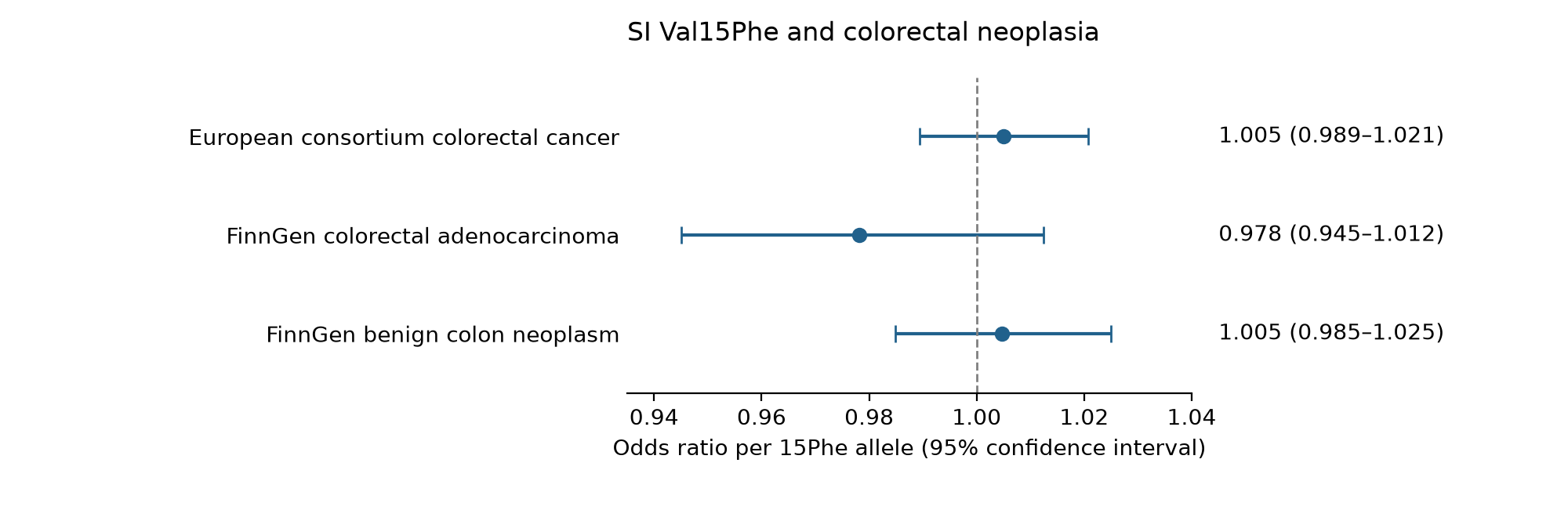
Figure 1. Val15Phe associations with colorectal neoplasia. Points show odds ratios per 15Phe copy and horizontal lines show 95% confidence intervals. The dashed line marks equal odds. The variant’s database identifier is rs9290264; all three estimates refer to copies of its genomic A allele, which encodes 15Phe. The consortium supplies the primary precision estimate; the FinnGen outcomes provide corroborating evidence with different case definitions.
Rare deficiency alleles
The rare alleles could not provide comparably precise cancer estimates. Only two of the four selected alleles were available in each cancer dataset, and their confidence intervals allowed substantial increases and decreases in odds (Table 1). Arg1124Ter was absent from both datasets. We treated missing alleles as missing information and retained the available estimates separately.
Table 1. Cancer odds ratios (95% CI) per selected rare SI deficiency allele.
| Variant | European consortium cancer | FinnGen adenocarcinoma |
|---|---|---|
| Val577Gly | 1.230 (0.864–1.751) | 1.264 (0.733–2.182) |
| Gly1073Asp | 0.904 (0.700–1.167) | Absent |
| Arg1124Ter | Absent | Absent |
| Phe1745Cys | Absent | 1.677 (0.803–3.502) |
“Absent” means that the exact position and allele pair were not present in the extracted summary statistics. It does not imply that the allele was absent from every participant. The rare alleles were analysed separately because their digestive effects lack a common quantitative scale for estimating a combined effect.
Associations with digestive symptoms and stool frequency
Val15Phe also showed little association with digestive outcomes used to check whether its cellular effect translates into measurable differences in people (Table 2). FinnGen IBS included 13,914 cases. The larger, symptom-inclusive IBS dataset and stool-frequency analysis provided exploratory checks.
The IBS discovery analysis from UK Biobank, a population cohort, and the Bellygenes research initiative included 53,400 cases and 433,201 controls, combining symptom-defined, self-reported and clinically recorded disease. It yielded an odds ratio of 0.991 (0.977–1.005). [4] The stool-frequency study included 167,875 Europeans. It ranked participants by frequency and transformed those ranks to an approximately normal distribution for analysis. Its effect estimate was also close to zero. [5] These broad measures provided little evidence of an average digestive effect in the populations studied.
Table 2. Digestive associations per SI 15Phe allele. OR denotes odds ratio.
| Digestive phenotype | Effect per 15Phe allele (95% CI) | P |
|---|---|---|
| FinnGen irritable bowel syndrome | OR 0.993 (0.967–1.020) | 0.616 |
| UK Biobank/Bellygenes irritable bowel syndrome | OR 0.991 (0.977–1.005) | 0.215 |
| Stool frequency | 0.0031 (-0.0028 to 0.0090) | 0.297 |
IBS estimates are odds ratios. Stool frequency is expressed in rank inverse-normal units, not bowel movements per day. These analyses share some source populations and were not pooled.
A separate UK Biobank study reported a Val15Phe carrier odds ratio of 1.21 (1.03–1.41) for IBS recorded as a primary inpatient diagnosis. That study compared carriers with noncarriers and used an inpatient diagnosis; the analysis here estimated an effect per copy and combined several ways of identifying IBS. [6] These differences leave room for associations in particular clinical subgroups.
Interpretation
The principal finding is a narrow cancer-risk interval for a common, experimentally characterised SI allele. Val15Phe is unlikely to confer a large average change in colorectal cancer odds per copy in the European populations studied. The rare deficiency alleles remain too imprecise to determine whether stronger inherited impairment has a different effect.
The main limitation is the lack of a quantitative link between inherited copies of Val15Phe and digestion in people. The cellular activity contrast does not measure the reduction in human digestion per copy, and the IBS and stool-frequency results do not measure carbohydrate delivery to the colon or overturn the cellular assay. Diet, physiological compensation and susceptible subgroups could affect that link. The per-copy estimates cannot isolate effects requiring two copies or depending on diet, and the data cover European populations only. The cancer association therefore cannot predict whether inhibiting sucrase-isomaltase would prevent cancer or be free of cancer-related effects.
Methods
Variant selection and alignment
The selected panel comprised rs9290264 (Val15Phe), rs121912615 (Val577Gly), rs121912616 (Gly1073Asp), rs200451408 (Arg1124Ter) and rs79717168 (Phe1745Cys). Selection used the functional study rather than cancer association strength. We checked each chromosome, position, reference and alternate allele against Ensembl, a genome annotation database, and verified the amino-acid change using its gene-transcript record ENST00000264382. The functional article's figure and the transcript identify rs121912615 as Val577Gly; parts of its text label it Val557Gly. Because SI is read from the reverse strand of DNA, genomic A at rs9290264 encodes 15Phe. All results were oriented toward the selected function-altering allele.
Public summary data
For the consortium and FinnGen release 13, we extracted chromosome 3 positions 164,900,000–165,200,000 on the GRCh38 reference genome assembly from indexed public summary files. FinnGen endpoints were colorectal adenocarcinoma (C3_COLORECTAL_ADENO), benign colon neoplasm (CD2_BENIGN_COLON) and IBS (K11_IBS). Case totals refer to participants retained after genotype quality control. The cancer endpoint excludes other cancer diagnoses from controls; benign-neoplasm controls are participants without that endpoint; IBS controls exclude the designated other-intestinal-disease group. Definitions and exclusions follow FinnGen's endpoint documentation. [3]
The exploratory stool-frequency analysis used GCST90002250, and the IBS extension used the discovery summary data in GCST90016564, excluding its separate replication sample from the genetic-testing company 23andMe. We independently checked coordinates for these files against GRCh37, the earlier reference genome assembly they use. The complete stool-frequency download was verified against the published checksum, a digital fingerprint used to check file integrity. Targeted retrieval from the IBS file identified rs9290264 by identifier, position and both alleles; it was not used to infer coverage of rare variants. Source files and downloaded windows were retained with checksums. Sample counts for the primary cancer dataset were independently summed from supplementary Table ST1. [2,4,5]
Statistical analysis
We used the published additive association coefficients and standard errors without refitting participant-level models. For binary outcomes, we exponentiated the aligned log-odds coefficient and its limits, coefficient plus or minus 1.96 standard errors. The IBS discovery study's supplementary methods confirm conversion of its linear-model coefficients to log odds before meta-analysis, the statistical combination of estimates from multiple samples. Stool-frequency intervals use the same normal approximation on the reported transformed scale. P values are those in the source files, avoiding discrepancies caused by rounded coefficients.
The principal estimate is the consortium's per-copy Val15Phe association. All other cancer estimates and the digestive checks are reported individually. The 35% cell-assay contrast was not used to rescale the associations. We estimated direct allele–outcome associations rather than fitting a multi-variant Mendelian-randomization model, which would use genetic effects on digestion to estimate its causal effect on disease. No cross-dataset meta-analysis was performed because participant overlap was unresolved. The analysis used public summary data; the consortium data retain their academic/noncommercial-use restriction.
References
- Henström M et al. Functional variants in the sucrase–isomaltase gene associate with increased risk of irritable bowel syndrome. Gut. doi:10.1136/gutjnl-2016-312456.
- Fernandez-Rozadilla C et al. Deciphering colorectal cancer genetics through multi-omic analysis of 100,204 cases and 154,587 controls of European and east Asian ancestries. Nature Genetics. doi:10.1038/s41588-022-01222-9. European summary data: GCST90255675; sample audit uses supplementary Table ST1.
- FinnGen R13 endpoint documentation: colorectal adenocarcinoma, benign colon neoplasm, and irritable bowel syndrome.
- Eijsbouts C et al. Genome-wide analysis of 53,400 people with irritable bowel syndrome highlights shared genetic pathways with mood and anxiety disorders. Nature Genetics. doi:10.1038/s41588-021-00950-8. Discovery data: GCST90016564.
- Bonfiglio F et al. GWAS of stool frequency provides insights into gastrointestinal motility and irritable bowel syndrome. Cell Genomics. doi:10.1016/j.xgen.2021.100069. Data: GCST90002250.
- Zheng T et al. Rare Hypomorphic Sucrase Isomaltase Variants in Relation to Irritable Bowel Syndrome Risk in UK Biobank. Gastroenterology. doi:10.1053/j.gastro.2021.06.063.