With four stamp values, a negative value extends the range from eight stamps onward
Why it matters
Choose four numbers and add exactly eight of them, using any number as often as you like. With four nonnegative choices you can cover every total from zero to 89; putting −4 on the list alongside 1, 13 and 14 extends that run to 99. Giving a place on the list to a negative number pays off for every count from eight onward, but shortens the run for every smaller count.
Choose four different stamp values and use a fixed number of stamps for each total. Values must be integers, and stamps of the same value can be used repeatedly. The goal is to make every total from zero as far as possible without a gap. A negative stamp can offset a positive one to make a small total, but choosing it leaves one fewer place for a nonnegative value. When is that trade worthwhile?
With exactly eight stamps, the four values \{-4,1,13,14\} make every total from 0 through 99. No four values do better, and the best nonnegative choice reaches only 89. Requiring a negative gives a shorter range with fewer than eight stamps and a longer one at every stamp count from eight onward.
The classical postage stamp problem
Let h be the number of stamps used for each total, called the order. For a list A of four distinct denominations (stamp values), write hA for the set of totals made with exactly h stamps. The endpoint is the last total before the first gap when counting from zero. Write P(h) for the best endpoint among nonnegative lists and S(h) for the best among signed lists, meaning lists with at least one negative value. Each sum uses stamps from its list; it need not use every value.
A nonnegative list needs a zero stamp to make zero. Because zero stamps can fill unused places in any sum, finding P(h) is the classical postage stamp problem with three positive denominations and at most h stamps. A signed list has the same four places, with no extra place for zero. Nathanson asked how negative values affect the best endpoint. For three denominations, van Doorn, Monticone and Nathanson proved that requiring a negative sometimes ties the nonnegative optimum but never beats it. For eleven denominations, Henrici gave a list reaching 48 with two stamps, against 46 for nonnegative lists (Alter and Barnett, A Postage Stamp Problem). These results leave open both when a negative helps with four denominations and whether the gain lasts.
Why the eight-stamp list wins
At every stamp count through seven, the best signed list falls short of the best nonnegative list (Table 1). The difference is just one at five stamps and two at seven. At eight stamps the signed list wins by ten.
Table 1. Optimal endpoints for lists of four denominations. An endpoint of 99 means that all 100 integers from 0 to 99 occur.
| Stamps per total | 1 | 2 | 3 | 4 | 5 | 6 | 7 | 8 |
|---|---|---|---|---|---|---|---|---|
| Negative required | 2 | 6 | 12 | 24 | 34 | 48 | 67 | 99 |
| Nonnegative | 3 | 8 | 15 | 26 | 35 | 52 | 69 | 89 |
To see how the unique signed winner at eight works, add 4 to each of its values. The resulting list B=\{0,5,17,18\} misses 1, yet its eight-stamp totals include every integer from 32 through 131 (Figure 1). Restoring the original values subtracts 4 from each of eight stamps, shifting every total down by exactly 32. The unbroken interval now starts at zero: it covers [0,99]. For zero itself, one 14, two 1s and five copies of -4 sum to zero.
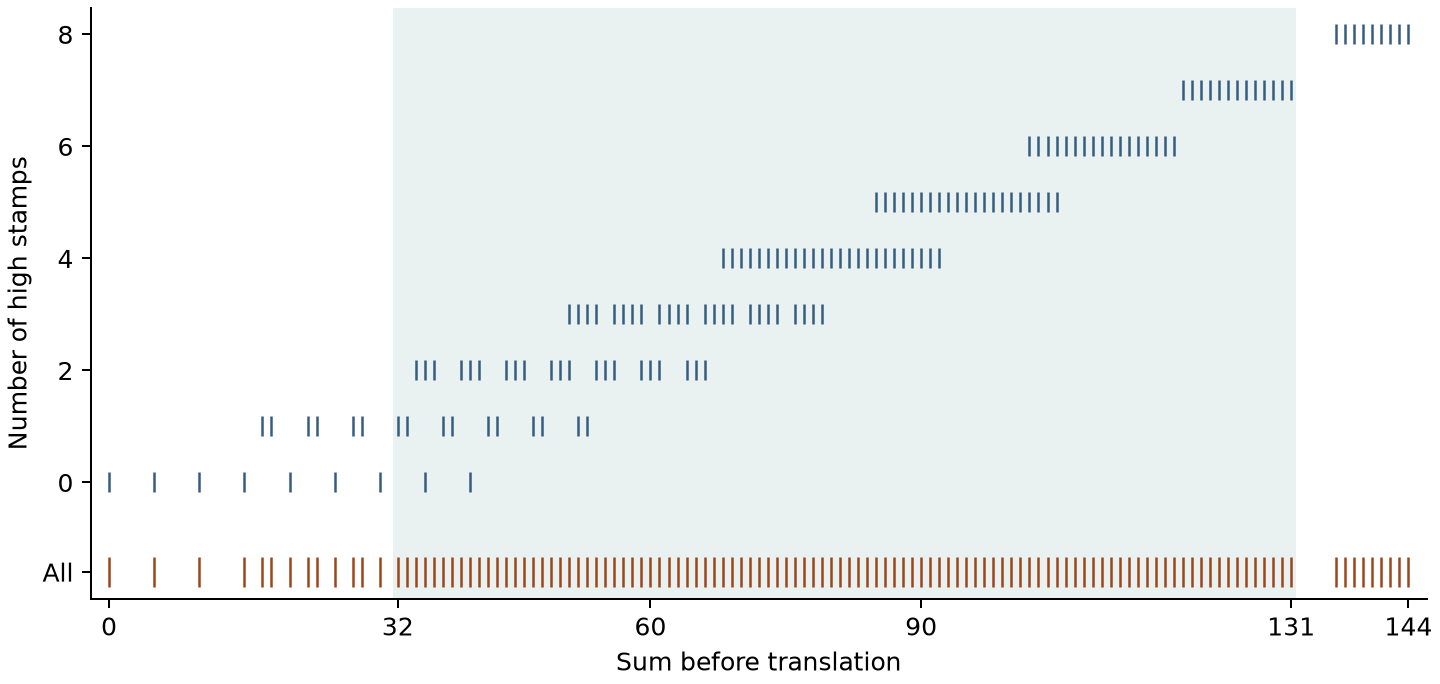
Figure 1. Each mark is an attainable sum from \{0,5,17,18\}. Row j uses exactly j stamps of value 17 or 18; the bottom row combines all nine rows. Gaps in individual rows disappear when several rows reach the same part of the number line. The gap at 132 becomes the first missing total, 100, after translation.
How the search rules out a better list
Although denominations can be arbitrarily large, only finitely many lists could match the endpoints in Table 1. First shift all four values by the same amount so the smallest becomes zero. Call the shifted list B=\{0,x,y,c\}, with 0<x<y<c. The largest shifted value, c, is the span of the original list. To recover that list, subtract the same integer t from each value, giving B-t. This subtracts ht from every total. To measure coverage from zero for the original list, count consecutive totals starting at ht in hB. For a signed list to cover zero its smallest value must be negative and its largest at least zero, so 1\le t\le c. For a nonnegative list that covers zero, t=0.
The span has a useful bound because adding a stamp of value 0 or c leaves the remainder on division by c unchanged. Each total therefore has the same remainder as some ix+jy, where i,j are nonnegative stamp counts with i+j\le h. There are only M=\binom{h+2}{2} such pairs. If c>M, any M+1 consecutive integers have different remainders. At least one must be missing. From two through eight stamps, both endpoints in Table 1 are at least M, so a list of span greater than M cannot tie either one. With just one stamp, the totals are the denominations themselves. A negative value leaves at most three places for 0, 1 and 2.
The search examined 986,714 combinations of order and list shape (x,y,c) at orders two through fifteen, taking c\le M and omitting triples with a common divisor greater than one, whose sums cannot cover consecutive integers. Starting with the single sum zero, we formed each successive set of sums by adding each of the four denominations to the preceding set and taking the union. For each allowed shift t, we counted consecutive totals starting at ht.
As an independent check through order eight, we included every triple up to the span bound and formed the sums directly as ix+jy+kc with i+j+k\le h and nonnegative counts. Both enumerations gave the signed endpoints in Table 1; the second also reproduced the classical endpoints in sequence A001208 of the On-Line Encyclopedia of Integer Sequences.
A construction for every larger order
The eight-stamp example suggests a way to build a signed list for larger stamp counts. First choose two pairs of nonnegative values whose sums cover a long interval. Then shift all four values so that the interval covers zero. For a positive integer spacing a, take the low pair 0,a and the high pair c-b,c, where b=a+1. If exactly j stamps come from the high pair, the smallest total in that group (a layer) is j(c-b). Switching x low stamps and y high stamps to the larger value in their pair gives all sums
The consecutive step sizes a,b fill the middle of each such layer. The distance c between the extremes determines whether these middles join.
To see what one layer covers, consider ax+by for 0\le x\le X, 0\le y\le Y. Put F=ab-a-b. When X\ge b-1 and Y\ge a-1, every integer in
occurs. Indeed, fixing y gives a row of sums spaced by a, all with the same remainder modulo a. Because a and b have no common factor greater than one, each remainder (residue) has a first row y_0 between 0 and a-1 with by_0 in that residue. The next row of the same residue starts ab higher. Each row contains at least b points spaced by a, so there are no gaps within the residue from its first point to its last. A missing point below the first is at most by_0-a\le F. Replacing (x,y) by (X-x,Y-y) reflects each sum about the midpoint of the full range, so a missing point above its residue's last point must exceed aX+bY-F-1.
In the stamp problem, X=h-j and Y=j. Adding back the starting total, we find that for each j from a-1 through h-a, the layer covers
Choose c=ah-2a^2+4a+1 so that the interval for j=a starts one integer past the end of the interval for j=a-1. The later intervals also join: subtraction gives U_j+1-L_{j+1}=j-(a-1)\ge0. With c-b>a both endpoints increase with j. We get one interval from L=L_{a-1} to U=U_{h-a}, with
Now round L/h up to the integer t=\lceil L/h\rceil and subtract t from each denomination. This places the new zero at the first multiple of h at or above L. Rounding costs fewer than h units of coverage, leaving a guaranteed endpoint G(h)=U-ht.
The interval length tells us how to choose the pair spacing. If a grows as \alpha h, the coefficient of h^3 in the leading term of U-L is \alpha(1-2\alpha)^2, largest at \alpha=1/6 on [0,1/2]. In a scan of 250,499 admissible choices of order and spacing through order 1,000, the best interval guarantee beat the classical endpoint at every order from nine through 1,000. At eight it reached only 88; the eight-stamp result comes from Table 1.
For all h\ge9, a single rule suffices. Round h/6 to the nearest integer, taking halves upward. This gives a\ge2, c-b>a, and L>0, so the four denominations are distinct and the translated list contains a negative.
This choice guarantees
Indeed, write h=6a+r, with -3\le r\le2. Then h-2a+1=2h/3+1+r/3\ge2h/3, while
Multiplying the two bounds in the formula for U-L and subtracting the rounding loss gives the inequality. In particular, ht\le U, as required for the translated interval to include zero.
Comparing the guaranteed range with the classical optimum
Choosing the spacing by rounding h/6 gives a guaranteed endpoint above the classical optimum at every order from 9 through 80. The narrowest guaranteed win is at ten stamps: the proof gives 150 for \{-2,0,16,19\}, direct counting gives 154, and the best nonnegative list reaches 146.
Table 2. Smallest guaranteed advantage in each block of orders. Each comparison uses the endpoint promised by the interval proof, even when the list reaches farther.
| Orders checked | Order of smallest margin | Guaranteed endpoint | Classical optimum | Margin |
|---|---|---|---|---|
| 9–15 | 10 | 150 | 146 | 4 |
| 16–32 | 16 | 466 | 418 | 48 |
| 33–48 | 33 | 3324 | 2584 | 740 |
| 49–64 | 49 | 10078 | 7532 | 2546 |
| 65–80 | 65 | 22783 | 16549 | 6234 |
For each of these 72 orders we enumerated all nonnegative counts of the four translated denominations summing to h. The totals covered the promised interval in every case.
We also recomputed the classical optimum. A nonnegative list covering 0 and 1 has the form \{0,1,d,e\}, with 1<d<e. If d>h+1, the endpoint is just h. Otherwise, let g be the first gap using only 0,1,d. If e>g, the new stamp is too large to fill the gap. We therefore recorded g-1 as the endpoint for all those choices and tested each e with d<e\le g. For each count k of the largest stamp we added ke to all sums using at most h-k stamps of values 1 and d, and measured the endpoint of the union. Every maximum agreed with the classical endpoint table.
From order 81 on, a formula for the classical optimum makes the comparison possible without further search. Challis’s Theorem 101 and Table 103 give the classical optimum in terms of the quotient q and remainder s when the stamp count is divided by nine: h=9q+s\ge81, 0\le s\le8. Its cubic and quadratic terms are 36q^3+(54+12s)q^2; its linear coefficient is at most 204 and its constant term at most 86. Expanding 4h^3/81 and using q\ge9 therefore gives
The signed bound 2h^3/27-h exceeds the last expression by h(2h^2/81-h-1)>0 at every h\ge81. Thus the signed list keeps its advantage for every larger stamp count.
The same formula gives P(h)\sim4h^3/81. In other words, the classical endpoint grows like a cubic with leading coefficient 4/81. Thus the lower limit of S(h)/P(h) is at least (2/27)/(4/81)=3/2. The signed construction therefore guarantees a leading coefficient at least half again as large as the classical one; whether another signed list can improve the leading coefficient 2/27 remains open.