Six short arcs can keep convex hexagons below one in 200 sets of six points
Why it matters
Any 17 dots on a page, with no three on a straight line, contain six that form the corners of a convex hexagon. Yet by crowding the dots onto six short curves in different proportions, we can make such hexagons account for fewer than one in 200 choices of six dots, even in very large drawings. That narrows the gap between how often a hexagon is guaranteed and how rarely an arrangement can produce one.
Choose six points from a drawing and stretch a rubber band around just those six. If each is a corner of the band, they form a convex hexagon. Other points in the drawing may lie inside it. The 17-point theorem of Szekeres and Peters guarantees a convex hexagon among any 17 points in the plane if no three lie on a line. That tells us hexagons are unavoidable, but how rare can we make them in a large drawing?
We placed points on six short arcs so that the fraction of six-point subsets forming convex hexagons approaches 0.4951% as the drawing grows. This lowers the upper bound of 0.5822% reported by Goaoc and colleagues by about 15%. The key feature is a division of the arcs into two groups. Every convex hexagon draws all its corners from a single group.
The minimum fraction
For each number of points n, consider the smallest fraction of six-point subsets forming convex hexagons in any drawing with no three points on a line. This minimum cannot decrease as n grows. Deleting one point chosen at random leaves the fraction unchanged on average, so at least one deletion gives a fraction no larger than that in the original drawing. The minimum fraction thus has a limit, called c_6. Goaoc, Hubard, de Joannis de Verclos, Sereni and Volec proved c_6\geq 0.0018311 and reported c_6\leq 0.005822 (Proposition 1 and the discussion following it). To lower the upper bound, it suffices to give one family of arbitrarily large drawings and count its hexagons.
How the arcs restrict the choice of corners
Each site in Figure 1 is the start of a short arc. About a third of the points lie on the arc at A. Follow the arrow at A: the arc bends left, while every other site lies to the right. Choose three points in order along A and a fourth on another arc. The middle point on A lies inside the triangle formed by the other three. Even if we add more points, that middle point cannot be a corner. Thus A supplies at most two corners of any convex hexagon that also uses another arc. The direction of the bend matters. The arc at E bends towards A, so five points from E can form a convex hexagon with one from A.
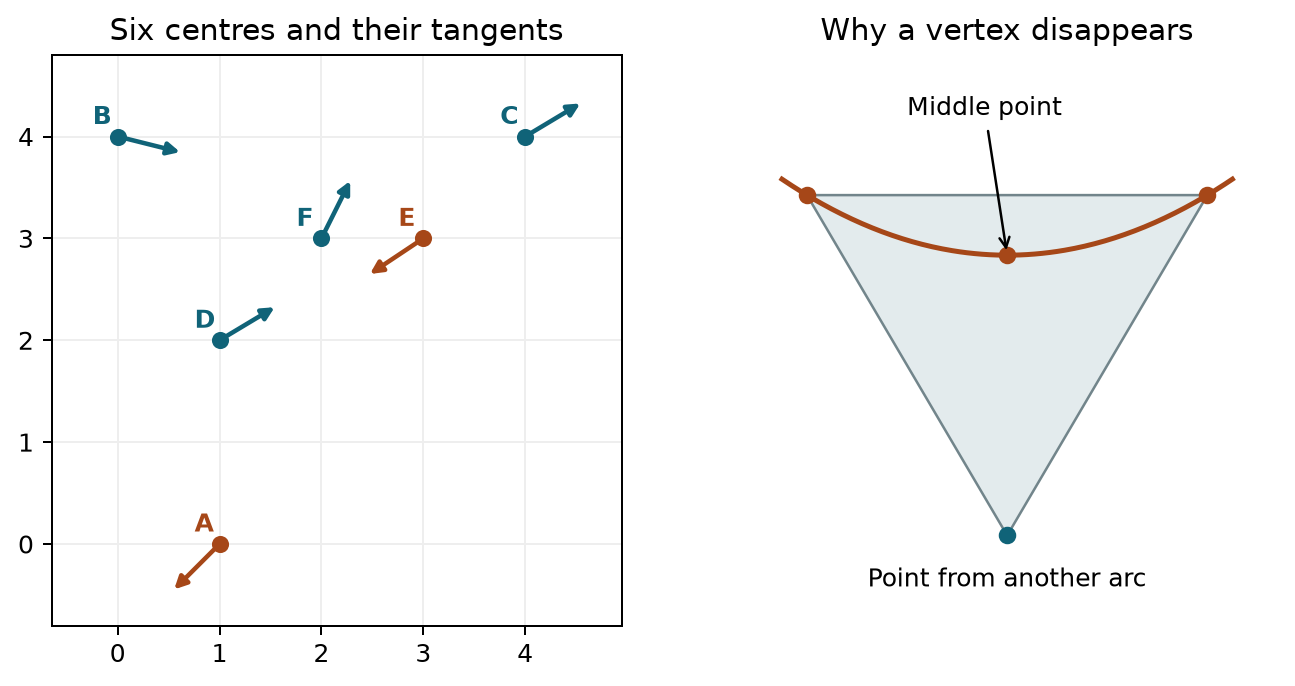
Figure 1. Left: each arrow gives the direction at the start of an arc; arrow lengths are enlarged for visibility. The two colours distinguish sites A and E from sites B, C, D and F. Right: a magnified schematic of three points on an arc and a fourth on the side away from its opening. Adding more points cannot restore the middle point as a corner.
Table 1 specifies the drawing. At site i, start at the centre P_i, move along the vector V_i, and bend towards its quarter-turn to the left, R V_i, where R(x,y)=(-y,x). A parameter t gives the position along the arc, and a small scale factor \epsilon keeps the arc close to its centre. The points lie on the parabola
| Site | Centre P_i | Tangent V_i | Parts in 33 | Parts in 1,000 |
|---|---|---|---|---|
| A | (1,0) | (−1,−1) | 11 | 331 |
| B | (0,4) | (4,−1) | 5 | 152 |
| C | (4,4) | (5,3) | 5 | 153 |
| D | (1,2) | (5,3) | 3 | 92 |
| E | (3,3) | (−3,−2) | 5 | 154 |
| F | (2,3) | (1,2) | 4 | 118 |
Which subsets form hexagons?
Of the 462 ways to distribute six points among the arcs, 36 give convex hexagons. For each distribution, either every selection works or none does. To see why, think of visiting three selected points in order. Whether the path turns left or right is the orientation of that ordered triple. Sliding points along their arcs without changing their order preserves every such turn, as we verify below. It therefore preserves which points lie inside a triangle of other selected points. Those are exactly the points that fail to be corners.
Table 2 gives the full count. In the left column, letters written together name the sites used in one selection; commas separate alternatives. On the right, each digit gives the number of points taken from the corresponding site. For example, 114 at BCD means one point from B, one from C and four from D.
| Occupied sites | Counts in site order |
|---|---|
| A, B, C, D, E, F | 6 |
| AE, BD, BF, CD | 15, 24 |
| BC, DF | 15, 24, 33, 42, 51 |
| CF | 42, 51 |
| BCD | 114 |
| BCF, CDF | 141 |
| BDF | 114, 123, 132, 141, 213, 222, 231 |
Every successful selection comes entirely from A and E or entirely from B, C, D and F. Even within the latter group, no hexagon meets all four sites. On BDF, for instance, D and F are both to the right of B's tangent, so B can supply at most two vertices. All seven ways to use those three sites with at most two points from B do occur.
How the number of points on each arc affects the count
Unequal populations make a substantial difference even with the arcs fixed. Write w_i for the population at site i in parts and W for the sum of the parts. Let m be the common multiplier, giving mw_i points at site i. A pattern assigning h_i points to that site (zero at an unused site) occurs in exactly \prod_i\binom{mw_i}{h_i} subsets. Summing over the patterns in Table 2 counts the hexagons. To get their limiting fraction, divide by the total number of subsets, \binom{mW}{6}, and let m tend to infinity. This gives
Why one finite drawing suffices for the count
The fixed arc length works for arbitrarily many points, however close two points on the same arc become. To see this, recall that the determinant of two plane vectors is the signed area of the parallelogram they span. Its sign tells whether the second vector lies to the left or right of the first. For three different sites, test the orientation of their centres using the two vectors from the first centre to the other two. For two points at one site i, with parameters s<t, divide the vector from the first point to the second by \epsilon(t-s). The resulting vector is V_i+\epsilon(s+t)R V_i, even when the parameter gap is tiny. To locate a point at another site j relative to this line, the unperturbed determinant is thus \det(V_i,P_j-P_i).
In both cases the unperturbed vectors in Table 1 have lengths below 6 and their determinants are nonzero integers. Moving a point from its centre changes its position by less than 0.007. Each difference of positions changes by less than 0.014, and the divided vector along the arc's chord differs from V_i by less than 0.014 as well. Expanding the determinant with these changes gives two terms that each use one original vector and one change, plus a term using both changes. Their total contribution in absolute value is at most 2(6)(0.014)+0.014^2<1, so its sign is preserved. Finally, three points on one arc, in parameter order s<t<u, have positive orientation: their determinant is \epsilon^3\|V_i\|^2(t-s)(u-s)(u-t). This proves both the orientation claim and the absence of collinear triples. For instance, one can always take parameters j/(mw_i) for j=1,\ldots,mw_i.
One drawing of 36 points now suffices to check Table 2. Place six points at t=j/6, j=1,\ldots,6, on each arc. This realizes all \binom{11}{5}=462 distributions. Multiplying both coordinates by 6000^2 makes them integers. For each six-point subset we sorted the points by horizontal coordinate, breaking ties by vertical coordinate. To trace the lower edge of the rubber band around the six points, we worked from left to right, removing the last vertex whenever the next point would make a right turn. Reversing the turn test gave the upper boundary. The subset counted if the two boundaries contained all six points. This boundary test found 16,430 hexagons among 1,947,792 subsets. Grouping them by site gave Table 2; for each listed pattern the number found equalled \prod_i\binom{6}{h_i}.
Search for the arrangement
To find promising arc positions and directions, we searched existing point drawings. We sampled six centres from three published point drawings of Duque, Fabila-Monroy and Hidalgo-Toscano and a 29-point drawing from the PyDCG collection, retaining 16 distinct arrangements. We treated two as equivalent if relabelling the points or reflecting the drawing, or both, made all triangle orientations agree. At each centre the lines to the other five divide the possible tangent directions into ten sectors. We scored all 10^6 combinations for each arrangement, first with equal populations and then with each site in turn doubled. Equal populations alone never gave a fraction below 0.00587 in this scan. For each starting allocation we varied the populations of shortlisted arrangements numerically, then placed the centres of the chosen arrangement at the integer coordinates in Table 1.
The upper bound follows from the integer populations and the exact count of convex hexagons. Another arrangement could give a smaller fraction; the minimum over all drawings remains open.