Repeating a six-point pattern at every scale maximizes its frequency in only six of 156 cases
Why it matters
To pack as many copies of a pattern as possible into a large network, one idea is to repeat the pattern inside itself. For a five-dot ring and a sixth dot touching none of it, putting just the ring inside each group gives about 57 extra matches per million groups of six dots sampled. That difference settles the last open case in the list of six-dot patterns for which repetition works best.
How often can six points chosen at random from a large network form a particular pattern of connections? One way to make the pattern common is to divide the network into equal groups, connect the groups in the desired pattern, then repeat that pattern inside each group at every scale. For six points, one case stood between two possible answers to when this strategy works best: a ring of five points (a pentagon) plus a sixth point with no connections to the ring (an isolate). Exchanging connections and missing connections gives the same question for a second pattern, called its complement.
Keeping the six outer groups but putting just a pentagon inside each raises the fraction of samples that form a pentagon plus an isolate from 6232/402745 to 629/40500, about 57 extra copies per million samples. This settles both the pattern and its complement. Two patterns are optimal by repetition for a simple reason: if every pair is connected, or if no pair is connected, every sample matches. Balanced repetition gives the highest possible fraction for just four other six-point patterns: a ring of six, a triangle with a separate point attached to each corner (the net), and their complements.
The conjecture about the pentagon and the isolate
In graph terminology, the points are vertices and the connections are edges. A sample of vertices forms an induced copy of a pattern if it matches both the edges and the missing edges, regardless of how the vertices are labelled. Write F for the pentagon plus an isolate. Five vertices in an induced copy of F must form a cycle with no extra edges, and the sixth must touch none of the five. The largest possible fraction of samples that form induced copies in the limit of large graphs is the inducibility of the pattern.
Balanced repetition of F starts with six equal groups, one for each vertex of F. Put every possible edge between two groups if the corresponding vertices are adjacent in F, and none otherwise. Repeat the construction inside each group. Stopping after a finite number of levels and leaving the final groups edgeless approximates the limiting construction: two independently sampled vertices have probability 6^{-d} of still sharing a group after d levels. A pattern whose balanced repetition attains its inducibility is called an asymptotic fractalizer. Optimality here concerns the limiting fraction of copies rather than the best graph at every finite size.
Bodnár and colleagues narrowed the number of nontrivial six-vertex asymptotic fractalizers to four or six, excluding the full and empty graphs as trivial. They use F_{29} for F, \lambda_{F_{29}} for its inducibility and W(P,E) for the graphon (limit graph) obtained by balanced repetition of F. In Conjecture 4.7 of The inducibility of 6-vertex graphs, they predict “\lambda_{F_{29}}=\frac{24}{1555}, with the optimum attained at the graphon W(P,E)”. This would give six fractalizers because complementing both the pattern and the graph it is sampled from preserves the fraction of copies.
Where the copies occur
A copy of F can occupy the outer groups in three ways. It can take one vertex from each of the six groups or lie entirely in one group. It can also place the whole pentagon in one group and the isolate in another group with no edges to the first. This third arrangement explains both why the conjectured construction contains more copies than predicted and how another construction can beat it.
To see why these are the only possibilities, consider any two occupied groups. Each vertex of one connects to all or none of the sampled vertices in the other. A set of vertices that every outside vertex treats uniformly in this way is called a module. No two, three or four vertices of a pentagon form a module, as one can check around the cycle. Nor can a module of F contain the isolate and some but not all of the pentagon. A cycle edge leaving that subset leads to a vertex connected to a member of the subset but not to the isolate. Thus if a group contains more than one vertex of a copy but fewer than all six, it must contain exactly the pentagon.
Let c be the probability that five sampled vertices form a pentagon in balanced repetition of F, and b the probability that six form F. Each vertex independently enters one of the six outer groups. A pentagon either lies in one group, where repetition gives it probability c again, or uses each of the five cycle groups once. Among the 6^5 equally likely assignments there are six of the first kind and 5! orderings of the second. Hence 6^5c=6c+5!. For six sampled vertices the corresponding count is
Putting pentagons inside the groups
Keep the same six outer groups, but divide each into five equal classes arranged around a pentagon (Figure 1). Put all possible edges between consecutive classes and no other edges inside the group. Five vertices in a group form a pentagon exactly when they occupy all five classes, with probability 5!/5^5. No group contains an entire copy of F. Among six vertices in five classes, two must share a class, making that pair a module, which F does not have.
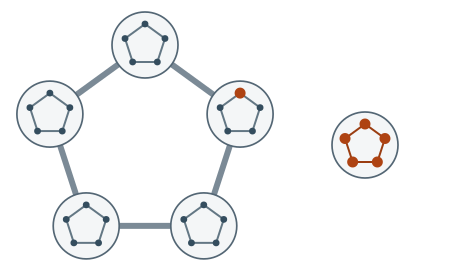
Figure 1. The 30 equal classes of the competing construction. A thick line means that every vertex of one outer group connects to every vertex of the other. Within a circle, a dot represents an edgeless class and a thin line joins two classes completely. Taking one vertex from each highlighted class gives a copy with its pentagon in one group and its isolate in another.
Substituting the new within-group probabilities into the six-vertex count gives a density of
Table 1. Expected copies per million six-vertex samples, by location in the outer groups. Entries are rounded from exact probabilities.
| Location of the six vertices | Balanced repetition | Pentagon interiors |
|---|---|---|
| One vertex in each group | 15,432.10 | 15,432.10 |
| Pentagon in one group, isolate in another | 39.72 | 98.77 |
| All six in one group | 1.99 | 0.00 |
| Total | 15,473.81 | 15,530.86 |
A direct count checks the new density. Take one vertex per class in Figure 1 and enumerate all six-vertex subsets. In exactly 15,725 subsets, the numbers of neighbours of the six vertices within the subset are 0,2,2,2,2,2. This forces a pentagon and an isolate: the only simple graph in which five vertices each have two neighbours is a five-cycle. Every copy in the large graph uses six distinct classes, since a pair sharing a class would be a module. Each counted subset can be sampled in 6! orders, so the limiting density is 6!\cdot15{,}725/30^6, again 629/40500.
Which six-vertex patterns favour repetition?
There are 156 six-vertex graphs up to relabelling. For 150 of them, an exact comparison gives a graph in which the pattern occurs more often than in its own balanced repetition. We checked these exclusions independently of the published density tables.
We used 4,726 entries as templates for connecting equal outer groups. These included all graphs on two through seven vertices up to relabelling. For eight and nine vertices we used every choice of distances around a circle, joining pairs at the chosen distances. We also used the nine-vertex graph with one vertex per square of a three-by-three board and edges between squares in the same row or column. For ten through 23 vertices we used all 3,442 graphs in the Royle–Holt vertex-transitive census, a catalogue of graphs in which any vertex can be mapped to any other by relabelling without changing the edges. For each template, we tested four ways of filling its groups: leave them edgeless, include all edges, repeat the template, or alternate it with its complement at successive levels. This search found denser constructions for 148 patterns. Figure 1 and its complement give the other two.
We verified each inequality using exact fractions. For a fixed labelling of the sampled vertices, we counted group assignments consistent with every required edge and nonedge between groups. For each assignment we multiplied the probabilities of obtaining the required pattern inside each occupied group, evaluating smaller subsets first. If all vertices fall in one group of a repeating template, the original probability appears again. This gives a linear equation for the probability, or two coupled equations when the template alternates with its complement. Multiplying the labelled probability by the number of distinct labellings gives the fraction of samples that form the pattern.
For the remaining six patterns, optimality follows separately. The complete and edgeless graphs each attain density one. Brandt's thesis records the result of Brandt, Lidický and Pfender establishing optimality for the six-cycle. Blumenthal and Phillips proved it for the net. Complementation gives the other two.
Why an isolate breaks repetition
The pentagon illustrates a general result: appending an isolate to any connected graph on at least two vertices makes balanced repetition suboptimal. A graph is connected if every pair of vertices is linked by a path. Filling each outer group with the connected pattern alone, as in Figure 1, improved the density for only 19 of the 30 connected graphs on two through five vertices in exact comparisons. What always allows an improvement is the separation created by repeating the pattern inside the isolated group.
To see why, let H be a connected graph on k\ge3 vertices and take H plus an isolate as the target. Suppose a limit graph splits into three parts, each containing a positive fraction of the vertices, with zero edge probability between parts. Such a graph cannot maximize the target density. Every copy must place its connected H entirely in one part. Write x for the fraction of vertices in that part. For samples drawn within it, let c be the probability that k vertices form H, and f the probability that k+1 form the target. The part contributes
For a fixed interior, the contribution per unit of mass (fraction of all vertices) is g(x)/x=x^kf+(k+1)x^{k-1}(1-x)c. Both x^k and x^{k-1}(1-x) increase strictly on 0<x\le(k-1)/k. The two smallest parts have combined mass s\le 2/3\le(k-1)/k. Merge them and fill the merged part with whichever of their interiors gives the higher contribution per unit of mass at size s. If either old rate was positive, enlarging that interior increases its rate, while neither rate decreases. The higher rate at s therefore exceeds the mass-weighted average of the two old rates. If both rates were zero, fill the merged part with equal classes connected according to H instead. This gives c>0, and the remaining part supplies isolates. Either merger strictly increases the density.
Balanced repetition creates just such a partition. At the outer level, the groups belonging to H have no edges to the isolated group. Inside the isolated group the next level separates its own H groups from its own isolated group, making three mutually separated parts in all. For k=2 the merger still works in balanced repetition: the two regions inside the isolated group have combined mass 1/3, below the threshold 1/2.
Even-Zohar and Linial, Table 2, give two-part constructions for patterns with an isolate. Two separated parts can in fact be optimal, as Bodnár and Pikhurko proved for a four-cycle or a three-edge star (three edges sharing one endpoint) with an isolate appended. The merger rules out the separation produced by repetition without requiring an optimal graph to split into parts. For the pentagon plus an isolate, the exact inducibility remains open; the strict improvement suffices to settle the six-vertex classification.