A small bacterial protein helps cells use isoleucine as carbon under specific conditions
Why it matters
Disrupting a small bacterial protein puts one Shewanella strain at a disadvantage when it uses the amino acid isoleucine as food, but spares its use of a downstream breakdown product. A nearly identical protein is dispensable in a related strain under different test conditions, showing why protein similarity alone does not establish the same nutritional role.
A growth defect can reveal that a bacterial protein helps cells use a nutrient, but identifying its role is harder. The protein might help break down that nutrient or support machinery shared by many foods. Distinguishing these roles is essential for assigning functions to proteins whose activities are unknown.
In the bacterium Shewanella oneidensis MR-1, disrupting the gene SO4462, which encodes a small protein of unknown function, strongly reduced mutant abundance when the amino acid isoleucine supplied carbon. Median fitness was −4.60, compared with +0.11 when isoleucine supplied nitrogen and +0.80 when propionate supplied carbon. Here, fitness is the normalized log₂ change in a mutant's abundance during growth in a mixture of mutants. Negative values mean that the mutant loses ground to the mixture; the score is not an isolated strain's growth rate. Comparisons with known enzymes place SO4462's requirement in the isoleucine-specific part of carbon use. A closely related protein was dispensable under the tested conditions in the related strain Shewanella ANA-3, so the assignment depends on the conditions.
Background
An amino acid can supply nitrogen without its carbon skeleton being fully used for growth. Isoleucine carbon use requires further breakdown into central metabolic intermediates, including propionyl-coenzyme A (propionyl-CoA), a product that must be processed further. The methylcitrate pathway processes propionyl-CoA and is also needed when cells grow on externally supplied propionate. Earlier comparative genomics reconstructed the branched-chain amino-acid degradation pathways in Shewanella, including the enzyme cluster termed ivd. These reactions also use electron-transfer flavoproteins (ETF), which carry electrons from metabolic enzymes toward the respiratory chain. Kazakov et al. (2009)
These shared routes provide tests of where SO4462 acts. A general methylcitrate-pathway factor should be needed on propionate as well as isoleucine. A general ETF factor should resemble ETF components on other substrates that require them. A more restricted isoleucine-associated factor can be spared in both comparisons. We compared these predictions using public data from experiments in which mixtures of gene-disrupted bacteria were grown under different conditions. These pooled-mutant fitness data were described by Price et al. (2018).
Results
The strong defect is concentrated in isoleucine carbon use
An exploratory scan compared fitness when the same compound supplied carbon or nitrogen, covering 248,578 gene–compound comparisons across 19 organism identifiers. We examined SO4462 using all available MR-1 measurements and carbon sources chosen to test the shared metabolic pathways. Carbon-versus-nitrogen comparisons used different media and dates.
Only two of the 176 experiments measuring SO4462 have fitness below −2, and both use isoleucine as carbon. The two isoleucine-carbon scores are −5.31 and −3.90. Both experiments began on August 18, 2013 in the same experiment set. Isoleucine-nitrogen scores are +0.09 and +0.13, measured three days later (Figure 1).
Other carbon-source controls are largely spared. SO4462 has median fitness +0.05 on pyruvate and +0.53 on L-lactate. A single D,L-lactate assay reaches −1.53, so the profile is strongly concentrated in isoleucine carbon use rather than entirely exclusive to it.
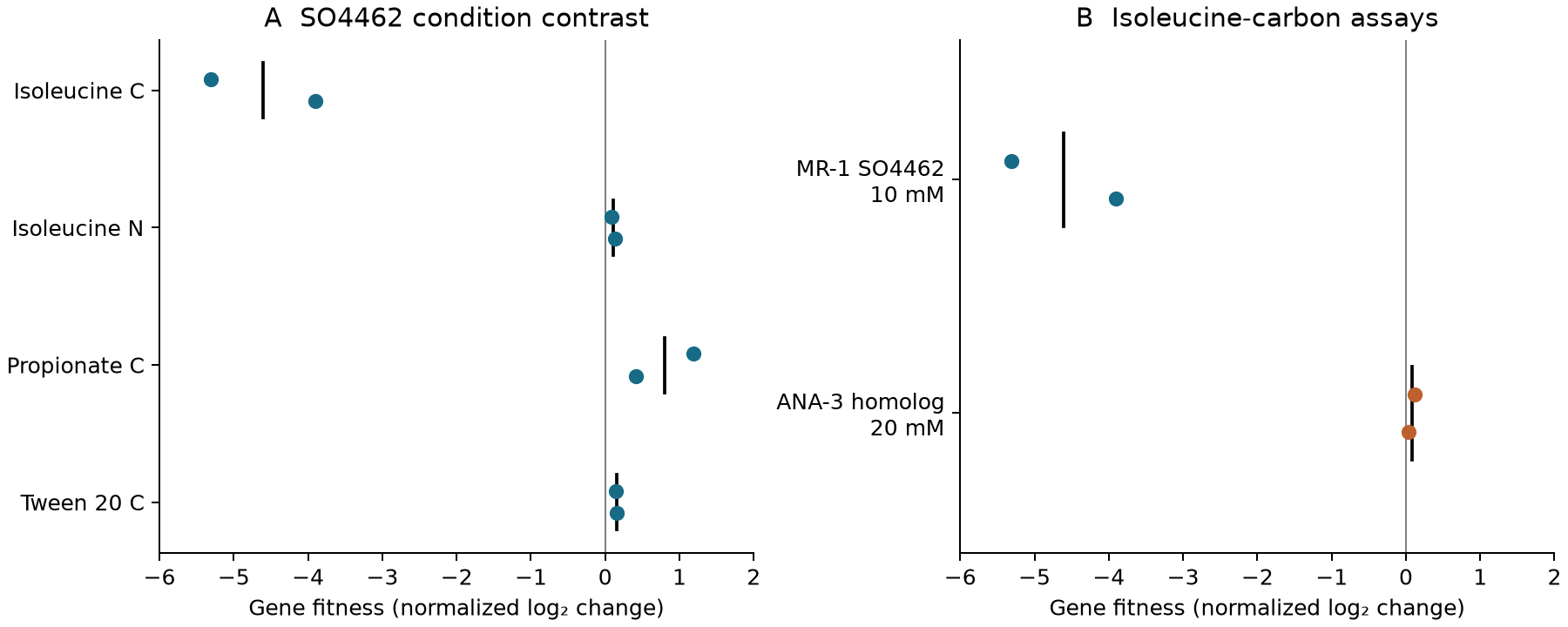
Figure 1. Individual assay scores and medians for SO4462 and its homolog, a protein with a shared evolutionary origin, in ANA-3. Each dot is one experiment; black ticks are medians. Panel A compares carbon (C) and nitrogen (N) uses in MR-1. Panel B shows the homolog contrast on isoleucine carbon. Panel B compares the strains under their respective assay conditions.
Other carbon sources distinguish SO4462 from shared machinery
Mutants with disrupted SO4462 retain fitness on carbon sources that still require the shared downstream machinery (Table 1). Tween 20, a fatty-acid-containing surfactant supplied as carbon, tests the requirement for ETF. On propionate, SO4462 median fitness is +0.80, whereas the methylcitrate-pathway enzymes methylcitrate synthase SO0344 and methylisocitrate lyase SO0345 score −6.16 and −5.51. Both enzymes are also strongly required on isoleucine. Thus, the supplied propionate reaches a shared pathway that remains functional in the SO4462 mutant pool.
Table 1. Median MR-1 gene fitness in the pathway-control comparisons.
| Gene or component | Isoleucine carbon | Propionate carbon | Tween 20 carbon |
|---|---|---|---|
| SO4462, unassigned | −4.60 | +0.80 | +0.15 |
| SO0344, methylcitrate synthase | −5.42 | −6.16 | −0.08 |
| SO0345, methylisocitrate lyase | −4.85 | −5.51 | −0.19 |
| SO1677, ivd-region enzyme | −4.87 | −0.19 | −0.21 |
| SO1678, ivd-region enzyme | −5.26 | −0.10 | +0.04 |
| SO1679, ivd-region enzyme | −5.20 | −0.17 | +0.00 |
| SO1682, ivd-region enzyme | −4.13 | −0.06 | −0.24 |
| SO3144, ETF component | −5.04 | −1.22 | −2.48 |
| SO3145, ETF component | −5.12 | −1.40 | −2.32 |
| SO4453, ETF oxidoreductase | −4.99 | −0.78 | −2.15 |
Each entry summarizes two assays. All began on August 18, 2013 in the same carbon-source base medium. The database groups experiments into sets: both isoleucine assays belong to set3; propionate and Tween 20 each have one assay in set2 and one in set3. Isoleucine and propionate concentrations were 10 millimolar (mM); Tween 20 was 0.5% by volume. The ivd-region labels identify enzymes from the previously reconstructed branched-chain amino-acid degradation cluster.
Tween 20 provides a second separation. ETF components SO3144 and SO3145 and SO4453, an ETF-ubiquinone oxidoreductase that passes electrons to the respiratory chain, have fitness between −2.48 and −2.15 on this substrate. SO4462 scores +0.15. The pathway controls therefore demonstrate an ETF-dependent condition in which SO4462 is spared. Its pattern instead resembles the ivd-region enzymes, which lose fitness on isoleucine but are spared on propionate and Tween 20.
These comparisons disfavor a general role in methylcitrate assimilation or ETF function. They support a requirement before, or alongside, the conversion of isoleucine into shared downstream metabolites. Uptake sufficient for carbon use, regulation of the isoleucine route, and support of an early catabolic reaction remain possible mechanisms.
Multiple gene disruptions support the SO4462 requirement
The mutations were made by inserting a transposon, a piece of DNA that disrupts a gene, at different positions. Each mutant carries a DNA barcode used to track its abundance. The MR-1 defect occurs at positions distributed across SO4462 (Figure 2). Seven of eight usable insertion positions score below −1 in each isoleucine-carbon assay. Because adjacent positions may provide partly redundant evidence, we grouped successive positions separated by at most 10 base pairs. The resulting five spatial clusters all have median fitness below −1 in both assays. Two clusters in one assay and three in the other fall strictly below −2. Both insertion orientations support depletion; nitrogen use and propionate use remain largely spared.
SO4462 lies on the reverse DNA strand and converges with the neighboring gene SO4461, meaning their transcription points toward one another. This arrangement disfavors the common explanation that an insertion blocks transcription of a downstream gene in the same operon, a group of genes transcribed together. The insertion pattern supports a requirement associated with SO4462, with some disruptions causing weaker defects than others.
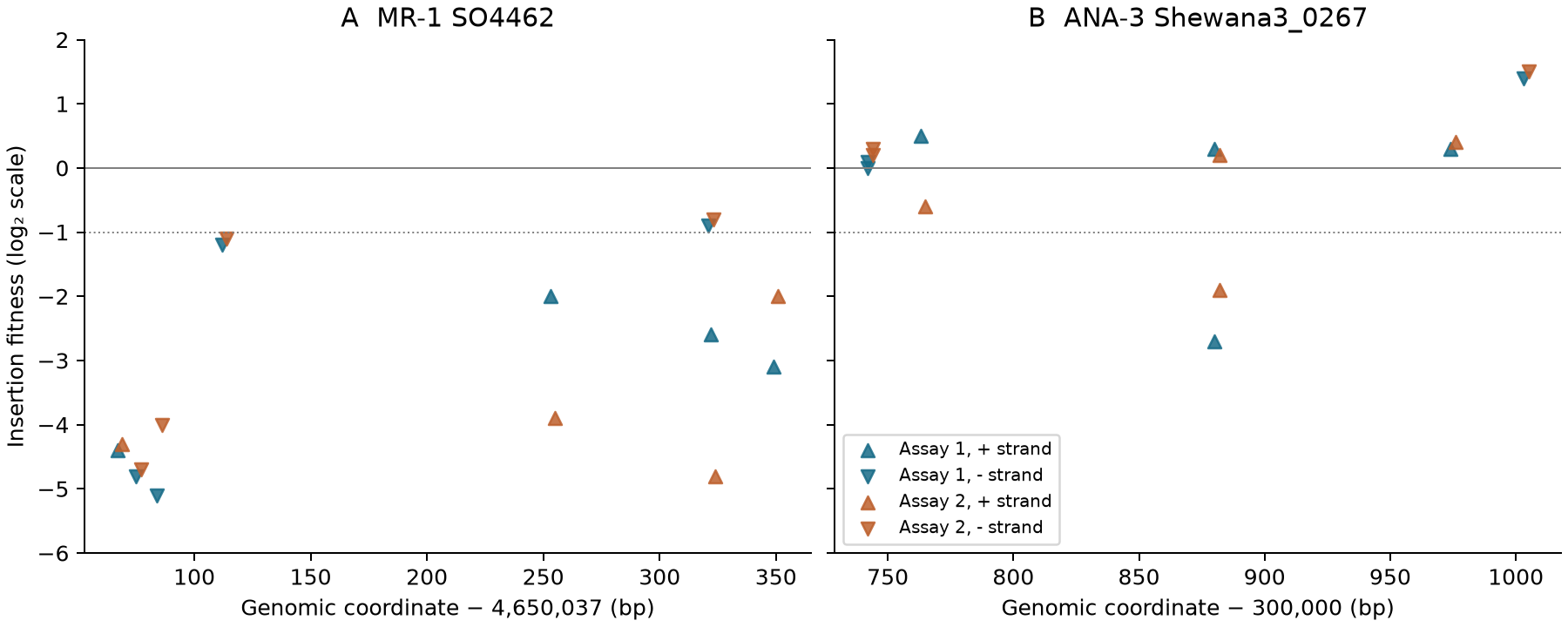
Figure 2. Usable insertion measurements across the MR-1 and ANA-3 loci in the two isoleucine-carbon assays. Colors distinguish assays and triangles show transposon orientation relative to the reference genome. MR-1 has one usable barcode per position; ANA-3 retains multiple barcodes at two positions. Points are shifted horizontally by one base pair in each direction to separate assays. The dotted line marks fitness −1, a descriptive depletion threshold. The discordant ANA-3 barcodes near coordinate 300,881 remain visible.
The close ANA-3 homolog limits transfer of the requirement
The ANA-3 homolog Shewana3_0267 is 89.8% identical in amino-acid sequence but has isoleucine-carbon fitness +0.12 and +0.04, a median of +0.08. Seven usable barcodes sample five separated insertion positions and both orientations. Four positions are largely spared in both assays. At the fifth, coordinate 300,881, one barcode is near neutral and another scores −2.7 and −1.9 (Figure 2). The neutral gene score therefore reflects several sampled disruptions, although the individual insertions are not uniformly neutral.
ANA-3 still requires the familiar catabolic machinery. Homologs of the four ivd-region enzymes in Table 1 have median isoleucine-carbon fitness from −5.88 to −3.04. The SO4462 homolog's neutrality is therefore compatible with active use of that route. It is also part of a broader condition-dependent contrast: among 2,571 measured ortholog pairs, genes paired across the strains by shared ancestry, 286 MR-1 genes score below −2 on isoleucine, and 68 of their ANA-3 counterparts score above −0.5.
The comparison shows that a close homolog need not share the measured requirement.
Interpretation and limits
The supported functional proposal is that SO4462 assists isoleucine carbon entry in MR-1 under the tested conditions. Propionate bypasses that requirement, and the tested ETF-dependent Tween 20 route remains functional. This assignment narrows the search to the isoleucine-associated portion of metabolism without specifying a catalytic reaction. Spared nitrogen use remains compatible with an uptake role needed only when larger amounts of carbon must enter the cell.
Additional analyses tested for proteins or regulatory signals associated with SO4462. The correlation between SO4462 and SO1678 fitness across experiments falls from 0.694 to 0.287 after removing all isoleucine assays; the SO1679 correlation falls from 0.612 to 0.059. Thus, the similarity between these genes' fitness profiles largely reflects their shared requirement on isoleucine. Comparisons of protein shapes yielded no persuasive match to a protein with a known function. Examination of genes near eight proteins with similar structures found no repeated association with isoleucine enzymes. SO4462 was absent from the supplement listing regulons, groups of genes controlled by the same regulator, in the reconstruction of Shewanella regulatory networks by Rodionov et al. (2011). An upstream-sequence scan gave no positive support for regulation by LiuR, the regulator associated with branched-chain amino-acid degradation, but missed two of nine control promoters, DNA regions that initiate transcription. Regulation by LiuR therefore remains possible.
The evidence comes from pooled-mutant measurements selected through an exploratory scan. The two focal carbon assays share a date and experiment set, and the pathway controls come from the same resource rather than independent validation. MR-1 received 10 mM isoleucine and ANA-3 received 20 mM on different dates, leaving strain, dose and other experimental context inseparable. Insertions can affect local gene regulation, and fitness measures neither the rate of nutrient processing nor protein chemistry. The evidence supports a conditional helper role for SO4462; its molecular activity remains unresolved.
Methods
We analyzed the public Fitness Browser, a database of bacterial mutant fitness measurements, using its snapshot and insertion-level tables downloaded in November 2026. Gene fitness values were taken as reported by the resource, without recalculating gene scores from rounded insertion values. For the initial carbon-versus-nitrogen scan, we retained organism–compound combinations with at least two experiments in each nutrient-use category, summarized gene scores by their median, and ranked contrasts among genes with uncharacterized annotations. The scan covered 27 distinct compound labels across 19 organism identifiers. The thresholds describe effect sizes rather than genome-wide statistical significance.
We joined all MR-1 and ANA-3 fitness measurements to gene annotations and experiment metadata. We summarized carbon-source scores by gene and substrate, checked individual assay values and experiment sets, and compared SO4462 with annotated methylcitrate, ivd-region and ETF genes. The carbon-source comparisons in Table 1 share the date and base medium. The isoleucine-nitrogen comparison uses nitrogen-source medium and a different date. The cross-strain analysis used all database ortholog pairs with measured isoleucine-carbon fitness in both organisms. We calculated Pearson correlations, a measure of linear similarity between fitness profiles, across MR-1 experiments. We repeated the calculation after excluding every experiment whose named substrate was isoleucine.
For the insertion analysis, we used measurements marked usable by the database and positions within the annotated gene boundaries. We summarized barcodes at a coordinate by their median, then grouped sorted MR-1 positions into clusters whenever successive gaps were at most 10 base pairs. Cluster scores were medians of position scores. We inspected both orientations and retained individual ANA-3 barcodes to expose discordant measurements. Gene coordinates and strand assignments supplied the local transcriptional arrangement.
For the structure comparisons, we used a model of the exact SO4462 sequence from AlphaFold, a protein-structure prediction method. We searched experimental and predicted structures with Foldseek, software for finding proteins with similar shapes. We also inspected annotated genes near eight active structural homologs and checked the published regulatory supplement. The promoter screen searched for the published LiuR consensus, a DNA pattern associated with binding by that regulator: STTTACGTWWACGTAAAS. Here S allows either G or C, and W allows either A or T. We compared every possible placement within 300-base-pair windows upstream of 4,068 MR-1 protein-coding sequences, oriented each window in the direction of transcription, and counted mismatches while allowing these ambiguous bases. Published genes leading LiuR-regulated transcription units supplied positive controls. This simple screen was used only to seek supporting evidence, because it did not recover every control.
References
Price MN et al. (2018). Mutant phenotypes for thousands of bacterial genes of unknown function. Nature 557, 503–509. Article.
Kazakov AE et al. (2009). Comparative genomics of regulation of fatty acid and branched-chain amino acid utilization in Proteobacteria. Journal of Bacteriology 191, 52–64. Article.
Rodionov DA et al. (2011). Comparative genomic reconstruction of transcriptional networks controlling central metabolism in the Shewanella genus. BMC Genomics 12(Suppl 1), S3. Article and supplements.