A protein family appears to help build or power the machinery that moves Shewanella bacteria
Why it matters
A small protein labelled by its proximity to a DNA-repair gene appears to help Shewanella bacteria use the machinery that propels them. Related proteins share the same pattern, giving researchers a specific family to test when studying bacterial movement. Mutants become more common in some mixed liquid cultures, but this does not show that they grow faster on their own.
To understand how bacteria move, researchers need to identify the proteins that build and operate their flagella, the rotating structures that propel them. A mutant that spreads poorly through soft agar may have faulty propulsion or faulty navigation, so this assay alone cannot assign a protein's role. Public experiments support a role in the propulsion machinery for SO4725, a protein of Shewanella oneidensis, and two related proteins in other species. Across experiments excluding every date on which migration was measured, their mutant-abundance patterns correlate with those of genes for the flagellum's base and connecting hook at 0.77–0.95. Correlations with genes for chemical navigation are approximately zero. These results support a shared role for this membrane-associated protein family in helping the flagellar machinery function.
Background
Flagella propel bacteria through their environment. Their basal body anchors a rotating apparatus, a hook connects it to the external filament, and an export system delivers components during assembly. Motor proteins drive rotation; chemotaxis proteins guide movement in response to chemical signals. Defects in any of these systems can reduce migration through soft agar. A migration phenotype alone therefore leaves a protein's role unresolved.
SO4725 has a predicted membrane-spanning helix at residues 7–26 and the annotation in UniProt, a protein-information database, “membrane anchored protein associated with MutM.” MutM repairs damaged deoxyribonucleic acid (DNA), and its gene lies next to SO4725. That neighborhood provides a functional hypothesis rather than an established biochemical assignment. UniProt Q8E8E0
We analyzed pooled insertion-mutant experiments from the Fitness Browser, a public database of mutant performance across conditions. Each pool contains bacteria with transposons, inserted DNA segments, disrupting different genes. Gene fitness summarizes the normalized base-2 logarithm (log2) of the change in mutant abundance from the starting pool. Negative values indicate depletion and positive values enrichment. Similar fitness profiles across conditions, termed cofitness, can connect genes acting in the same biological process. Price et al., 2018
The SO4725 migration defect was already present in the public experiment collection of Deutschbauer and colleagues, who used genome-wide fitness profiles to annotate S. oneidensis genes. The unresolved question is whether the family supports flagellar function across species, and which part of the system its phenotype resembles. Deutschbauer et al., 2011
We compared the family with neighboring MutM genes, genes for chemotaxis (navigation in response to chemicals), and genes for the flagellar apparatus. Similar effects from insertions at different positions within a gene help distinguish a gene-wide phenotype from an effect confined to one insertion site. Comparisons across species test whether related proteins, or homologs, share that phenotype.
Results
Migration defects are shared across the family and largely spare MutM
Mutants of SO4725 and its homologs were depleted in migration assays, whereas mutants of their neighboring MutM genes remained near neutral (Table 1). The four mutant collections comprise S. oneidensis MR-1 (MR1), Shewanella sp. ANA-3 (ANA3), S. amazonensis SB2B and S. loihica PV-4 (PV4), with 633 assays in total.
Table 1. Migration fitness and insertion coverage. Fitness values are medians across assays labelled motility. Insertion positions are distinct sites used by the Fitness Browser in the central 10–90% of the focal gene. SB2B includes two center-cut and four later outer-cut assays; its outer-cut median is −2.17. Center cuts sample the population's center; outer cuts sample cells that reached its expanding edge. These scores measure representation in the sampled population, rather than swimming speed.
| Strain | Focal gene | Migration assays | Focal fitness | Neighbor MutM fitness | Insertion positions |
|---|---|---|---|---|---|
| MR1 | SO4725 | 3 | -5.30 | -0.03 | 15 |
| ANA3 | Shewana3_4083 | 4 | -4.62 | -0.27 | 8 |
| SB2B | Sama_0118 | 6 | -1.95 | -0.08 | 6 |
| PV4 | Shew_3689 | 4 | -4.42 | -0.35 | 2 |
Multiple insertion sites support the strongest phenotypes. At all eight positions in Shewana3_4083, median fitness was below −1 in each of four outer-cut assays. SO4725 had 12–14 of 15 positions below −1 across its three assays. Sama_0118 had 3–6 of six positions below −1 in its four outer-cut assays. Insertions oriented in either direction along the DNA supported negative effects. PV4 has only two positions and a median gene-level t score of −1.34. This score expresses the fitness effect relative to its estimated uncertainty, so the evidence is weak. We treat Shew_3689 as lower-confidence support.
The neighboring MutM genes are SO4726, Shewana3_4084, Sama_0117 and Shew_3690. Their preserved migration fitness argues against a simple polar effect, in which insertion into the focal gene reduces downstream MutM expression and thereby causes the phenotype. Reanalysis of the Deutschbauer collection, containing 3,355 genes across 195 assays, also recovered a strong migration defect for SO_4725, the identifier used there for SO4725: eight values ranged from −4.33 to −5.83, with median −5.52. The neighboring MutM gene, recorded as SO_4726, had median −0.06. In this separate experiment collection, genes with similar fitness profiles outside migration assays were less specifically flagellar. It therefore supports the migration phenotype more directly than the apparatus assignment.
Liquid-culture enrichment extends beyond isolated insertions
The focal mutants gained representation in selected liquid cultures, with agreement across insertion positions. In two MR1 assays using gelatin as a carbon source, SO4725 fitness was +2.38 and +2.46; 15/15 and 14/15 positions exceeded +1. In two ANA3 assays using serine as a carbon source, fitness was +1.55 and +1.67, with 7/8 positions exceeding +1 in each. In two SB2B glutamate assays, fitness was +3.41 and +3.42, with all six positions exceeding +1 in both.
Known flagellar mutants share the broader pattern across liquid conditions, providing a clue to the family's function.
Profiles outside migration dates favor the flagellar apparatus
The family tracks flagellar apparatus genes across conditions that were not measured on migration dates (Figure 1). We used the annotated functions of MR1 genes to define a comparison panel of known flagellar and chemotaxis genes. We then used protein-sequence similarity to identify corresponding genes in each other strain. Panel membership was independent of the observed fitness correlations. The measured panel contained 54, 45, 48 and 42 entries in MR1, ANA3, SB2B and PV4, respectively, including the focal and MutM genes.
Removing every date containing a migration assay left 568 assays. We collapsed repeated descriptions within each date and starting pool, yielding 125, 56, 128 and 73 grouped conditions, termed contexts, across 4, 4, 7 and 4 dates, respectively. Genes were grouped into modules according to their role, such as building the base and hook or powering the motor. Each module was represented by the median fitness of its measured genes.
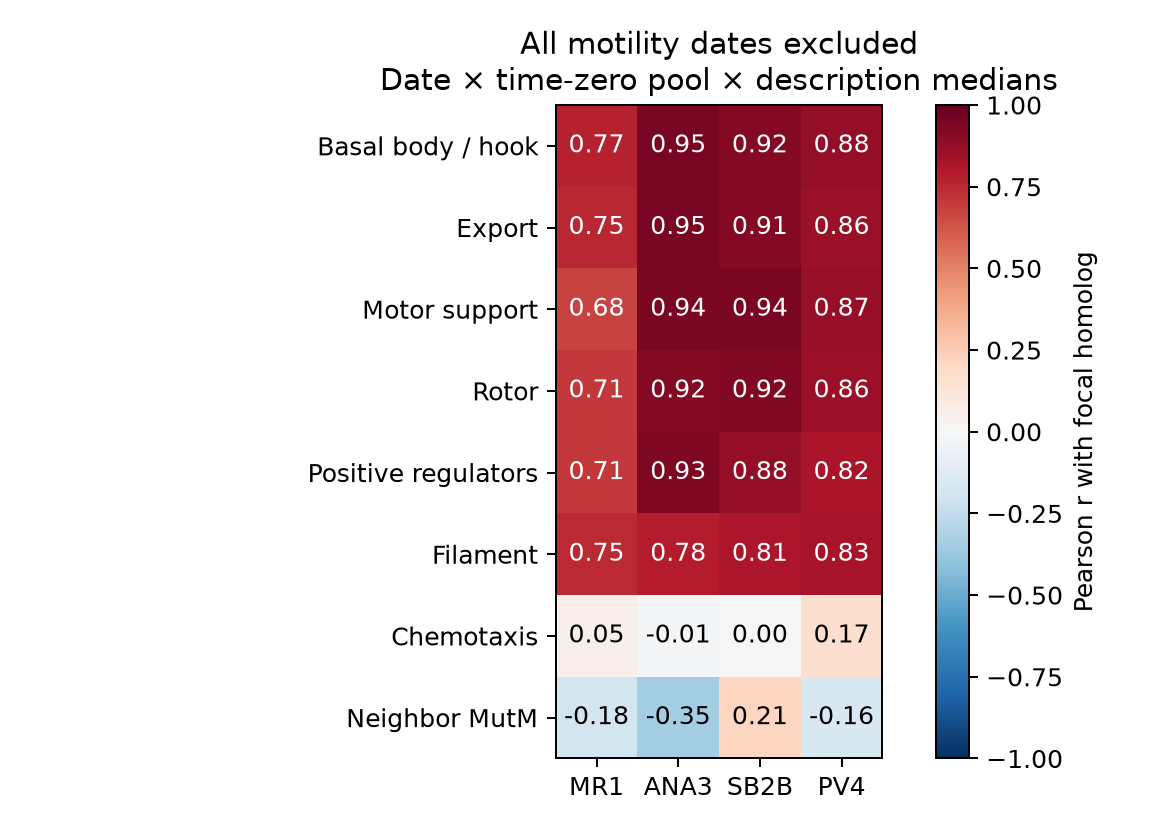
Figure 1. Focal-gene cofitness after excluding all dates containing migration assays. Cells show Pearson correlation, a measure of how closely two profiles vary together, between the focal homolog and each module across context medians. Red indicates shared responses and blue opposing responses; contexts are not independent biological replicates. The basal-body/hook, export and motor modules correlate strongly with the family. Chemotaxis and neighboring MutM show much weaker module-level correspondence. PV4 retains lower confidence because its focal phenotype rests on two insertion sites.
Basal-body/hook correlations were 0.769, 0.950, 0.921 and 0.882 in MR1, ANA3, SB2B and PV4. Removing each additional date in turn left ranges of 0.746–0.866, 0.874–0.966, 0.819–0.931 and 0.720–0.889. Thus, no single remaining date accounts for the association. In a genome-wide comparison including unannotated and nonflagellar rivals, 17, 18, 14 and 13 of the 20 genes most strongly correlated with the focal gene, excluding the focal gene itself, belonged to the comparison panel.
Chemotaxis-module correlations were 0.053, −0.014, 0.005 and 0.170. This contrast includes active controls: ANA3 and SB2B mutants of CheA, a chemotaxis signaling protein, had migration defects but little focal cofitness outside migration dates. SB2B mutants of the chemotaxis proteins CheY and CheR behaved similarly. Individual chemotaxis genes were heterogeneous, with positive associations for some proteins, including the chemotaxis protein CheB. The module-level result favors a contribution to apparatus function over an impairment restricted to navigation.
Assembly and motor support remain indistinguishable
The apparatus modules are too similar to identify a particular molecular step. Basal-body/hook profiles correlate with export profiles at 0.956–0.997 and with motor profiles at 0.894–0.983 across the four strains. A slightly higher focal correlation with one branch cannot reliably select that mechanism.
A separate experiment measured whether the family depends on regulators that control flagellar gene expression, including genes expressed late in assembly. In S. putrefaciens CN32, the full-length SO4725 homolog SPUTCN32_RS20175 is 68.2% identical to SO4725. Schwan and colleagues measured ribonucleic acid (RNA), an indicator of gene expression, in unmodified bacteria and strains lacking FliA, FlrA or RpoN, regulators involved in flagellar gene expression. Their deposited data contain two cultures per genotype, grown in liquid lysogeny broth (LB), a nutrient-rich medium, at 30°C to an optical density of 0.5, a measure of culture density. GSE207531
The normalized log2 expression changes for this homolog were +0.31, +0.30 and −0.07 in the respective deletions. In contrast, the basal-body rod gene flgG decreased by −5.02 and −5.36 in the FlrA and RpoN deletions. The focal homolog therefore lacks a large transcriptional dependence on these regulators under this condition. This is compatible with the regulator-independent expression of some flagellar components reported by Schwan and colleagues. Schwan et al., 2022
Interpretation and limits
A membrane-associated flagellar accessory is the functional prediction best supported for SO4725, Shewana3_4083 and Sama_0118. It explains a conserved migration defect and resemblance to apparatus mutants across other conditions, while their neighboring MutM genes largely lack the phenotype. A clean deletion complemented in trans (with an intact copy of the gene supplied elsewhere in the cell) should impair flagellar function. Imaging the flagellar filament and then measuring rotation would distinguish assembly support from motor support.
This computational assignment leaves assembly support and motor support unresolved. Pooled insertions cannot exclude local regulatory effects or indirect physiological causes; cofitness establishes neither physical interaction nor a measured saving in flagellar energy. Liquid-culture enrichment does not measure faster growth in isolation, and the examples selected after inspecting the profiles establish no substrate specificity. Exploratory selection and related assay contexts preclude independent confirmatory tests of the correlations; independence of mutant lineages in the two experiment collections is also unverified. The fifth-species RNA comparison is descriptive, with two replicates per genotype, and establishes neither equivalent expression nor constant expression across environments, nor a regulatory role for the protein.
Methods
The exploratory analysis covered six protein families and 22,795 context summaries. We used the public Fitness Browser database, protein sequences and strain-fitness tables, retaining its supplied gene-level fitness estimates. Motility assays were identified by the database's experiment-group label. For analysis outside migration dates, we excluded all assays sharing a start date with any motility assay. We calculated module medians within assays, then collapsed assays by exact start date, starting-pool identifier and experiment description. Pearson correlations used these context medians. Genome-wide comparisons used the same exclusions and grouping for every measured gene.
The control panel covered the export system, basal body and hook, rotating component (rotor), motor, external filament, proteins that activate flagellar gene expression (positive regulation), proteins that position the flagellum, proteins that inhibit sigma transcription factors (anti-sigma regulation), and chemotaxis, alongside MutM and the focal family. Protein searches used DIAMOND, a sequence-comparison program, in its ultra-sensitive mode. Matches required an E-value of at most 10⁻⁵, a threshold for the expected number of chance matches, and alignment over at least 60% of both sequences. An accepted match had to be the best match in the target organism and, when searched back against the comparison panel, match its original reference best. This reciprocal check was confined to the panel and therefore does not establish the same relationship across the whole genome. Missing measurements were excluded rather than treated as neutral. Fragments of MotY, a motor-associated protein, and closely related filament proteins called flagellins limit control coverage. Selection of the focal family required at least 70% coverage of both sequences.
For insertion validation, we retained browser-used sites in the central 10–90% of each gene and collapsed DNA barcodes, which identify individual mutants, sharing a genomic position by their median fitness. We summarized both orientations and counted positions below −1 or above +1. These position summaries differ from the browser's normalized gene-level estimator. The Deutschbauer fitness and condition workbooks were joined by their original assay identifiers.
For CN32, we matched proteins to the protein sequences translated from reference genome NC_009438.1 and analyzed all 4,115 rows in the deposited read-count matrix. To adjust for differences in sequencing depth, we divided each gene's count by its geometric mean across samples and used the median ratio as each sample's size factor. This calculation used the 4,055 genes with positive counts in all eight sequencing libraries. Expression changes were log2 ratios of mean normalized counts, with a 0.5 pseudocount added before taking logarithms. Scaling counts to counts per million sequenced reads gave the same qualitative focal result. We did not test statistically for expression differences or for equivalence of expression.
References
Deutschbauer A et al. (2011). Evidence-based annotation of gene function in Shewanella oneidensis MR-1 using genome-wide fitness profiling across 121 conditions. PLOS Genetics 7:e1002385. Article and supplementary workbooks.
Price MN et al. (2018). Mutant phenotypes for thousands of bacterial genes of unknown function. Nature 557:503–509. Article. Fitness Browser data resource.
Schwan M et al. (2022). FlrA-independent production of flagellar proteins is required for proper flagellation in Shewanella putrefaciens. Molecular Microbiology 118:670–682. Article. Deposited expression data.
UniProt. SO4725 protein record Q8E8E0.