Three eighths of all triples can form empty triangles while almost none of those triangles are one color
Why it matters
With equal numbers of red and blue dots, three eighths of all triples can form triangles with no dot inside even as the share of those empty triangles with three corners of one color shrinks to zero. Above three eighths by any fixed margin, a fixed share must have all three corners the same color. This rules out counting all empty triangles and keeping a fixed share as a shortcut to proving how many one-color triangles must be empty; that question remains open.
Draw points on a page, with no three on a line. Three points form an empty triangle if no other point lies inside it. Now color half the points red and half blue. Can we use the total count of empty triangles to infer how many have all three corners the same color? Equal numbers of red and blue points tell us how many triples have each color combination, but their positions determine which triangles are empty.
Three eighths of all triples is the most that can form empty triangles while the one-color share vanishes. We construct larger and larger sets in which the fraction of triples forming empty triangles tends to 3/8, while the fraction of empty triangles that are all one color (monochromatic) tends to zero. If the empty fraction exceeds 3/8 by a fixed amount, the monochromatic share stays above zero by a fixed amount too.
The question arises from a conjecture of Aichholzer et al.: every sufficiently large set of n two-colored points with no three on a line should contain at least a constant times n^2 monochromatic empty triangles. Pach and Tóth proved a lower bound of order n^{4/3}. Aichholzer et al. also compared the monochromatic and total counts directly. By putting a blue copy very close to each point of a red set, they obtained about 5.23 empty triangles per monochromatic one. They reported no family in which the ratio grew without bound as points were added. In our construction there are asymptotically n/16 empty triangles per monochromatic one.
Bounds on the two counts
Write n=2r for the size of a balanced set (r points of each color) in general position (no three collinear). Let E count its empty triangles and M its monochromatic empty triangles. In the bounds below, O(f(n)) denotes a term whose magnitude is at most a constant times f(n) for large n.
Theorem 1 (construction). For every positive even n there is a balanced set satisfying the bounds below. The floor and ceiling symbols round r/2 down and up to whole numbers.
Theorem 2 (upper bound). Every such set satisfies
Corollary (sharp threshold). Consider sequences of balanced sets in which n grows and M/n^3 tends to zero, written M=o(n^3). There are \binom n3 triples of points. The largest attainable upper limit for the fraction that form empty triangles is
Proof of Theorem 2: counting pairs at each apex
Fix a blue point x as one corner (the apex) of a triangle. Make a graph whose vertices are the r red points. Join two red points a and b by an edge exactly when the triangle xab is empty. The number of edges then counts the empty triangles with this blue corner and two red corners.
Why expect a bound near r^2/4 edges per apex? For even r, imagine splitting the vertices into two equal groups and joining every pair from different groups. This graph has r^2/4 edges but no three vertices all joined in pairs. Appreciably more edges force many such triples. In the graph built from the blue apex, these triples have a geometric meaning.
If three red vertices a,b,c are all joined in pairs (a graph triangle), the three empty triangles xab,xbc,xca together cover the red triangle abc. Indeed, a ray from x through an interior point of abc reaches the far boundary on one of its edges. No other point of the set can lie on the covering triangles' sides, by general position. Thus abc is empty or has x as its sole interior point. An empty red triangle can occur in the graphs of at most r blue apices. If a nonempty red triangle occurs, its sole interior point identifies the apex, so it occurs only once. Writing t_x for the number of graph triangles and M_R for the number of empty red triangles gives
In any graph on r vertices with e edges and t triangles, e\le r^2/4+3t/r. To verify this, the endpoints u,v of each edge have at least d_u+d_v-r common neighbors, where the degree d_u counts the neighbors of u. Each graph triangle has three edges, and the degrees sum to 2e. Summing the common-neighbor bound over edges and applying the sum-of-squares inequality gives 3t\ge\sum_v d_v^2-re\ge 4e^2/r-re. When e\ge r^2/4, the last expression is (4e/r)(e-r^2/4)\ge r(e-r^2/4), as required. For fewer edges the bound holds directly.
Now sum the edge bound over all 2r apices, using opposite-color vertices for each graph. Each mixed empty triangle (one using both colors) counts once, at its single blue or single red vertex. The two colors together give at most rM+2\binom r3 graph triangles across the apices. Adding back the M monochromatic empty triangles gives
Proof of Theorem 1: four clusters at the corners of a square
Group the points into four tight clusters, two red and two blue. A triangle taking one point from each of three clusters must then use both colors. The geometric problem is to keep every such triangle empty, whichever three points we choose.
Place the center of each cluster (its site) at a different corner of a square inscribed in the unit circle. Make each cluster long and thin along the tangent, the line that touches the circle at its site. The other three centers all lie strictly on the inward side of that tangent. Thus either direction along the tangent takes a point outside the angle towards any two other centers.
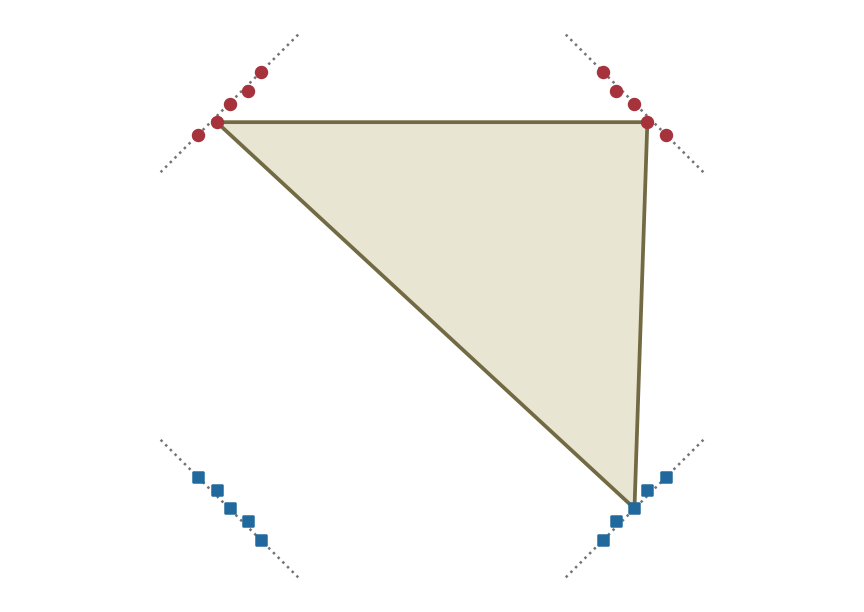
Figure 1. The clusters are enlarged to show their directions. Red circles and blue squares mark the two colors. The fourth cluster lies beyond the shaded triangle.
To specify the positions, start with a local drawing in which point i has horizontal coordinate i and height h_i. Use successive integers for the horizontal coordinates and let \varepsilon>0 set the scale of a cluster. At a site s, let u be a unit vector along the tangent and v a unit vector perpendicular to it pointing into the circle. Put point i at
Every three-site triangle is now empty. Points at the unused site stay outside because their center is strictly outside the center triangle. At each used site the displacement to any other local point tends in direction to one of the two tangent rays, both strictly outside the corner angle. There are finitely many choices for each n, so one scale suffices for all of them. Divide the r points of each color as evenly as possible between its two sites, giving sizes a=\lfloor r/2\rfloor and b=\lceil r/2\rceil. There are ab ways to choose a pair from different red sites and r choices of blue apex, and the same count with the colors exchanged. This gives 2rab=n^3/16-O(n) mixed empty triangles. Dividing by the number \binom n3 of all triples gives the limiting fraction 3/8 from these triangles alone.
Keeping the monochromatic count quadratic
Every monochromatic triangle uses at most two sites. To bound the number that are empty, we need a cluster with few internal empty triangles and few pairs that form an empty triangle with a distant apex. We use a Horton set, a drawing built by interleaving two smaller drawings and lifting one high above the other. The height separation lets us count both the pairs and the triangles.
At each site, “above” means in the direction of increasing local height, along the inward normal. Call a pair of local points open above if no point with index between theirs lies above their joining line. Define open below by reversing the inequality. Take two points at one site as the base of a triangle and a point at another site as its apex. The triangle is empty exactly when the base pair is open above. At small scale, a local point lies between the two long sides precisely when its index lies between the base indices: the displacements are nearly tangent and the long sides are transverse to the tangent. Between those indices the point blocks the triangle exactly when it is on the inward side of the base, the side of increasing local height. Other points at the apex site miss the narrow angle there, and the two unused centers lie off the segment joining the used centers.
For a cluster of m points indexed from 0, recursively draw the even indices as a low group L and the odd indices as a high group H. Translate H far enough upwards that its points lie above all lines through two low points, and all low points lie below every line through two high points. Start singletons at height zero and choose each translation sufficiently large for the finite drawing at that split. Let U(m) and D(m) count pairs open above and below, and T(m) count internal empty triangles. When m\ge2, there are l=\lceil m/2\rceil low points and h=\lfloor m/2\rfloor high points. The counts for the full cluster follow from those for the two groups:
To count pairs open above, start with the m-1 consecutive pairs. All are open because no index lies between their endpoints. A nonconsecutive pair with a low endpoint has an intervening high point above its line. For two low endpoints this follows from separation; for a mixed pair it follows because the low endpoint lies below the line through the two high points. For a pair entirely in H, only intervening high points can block it. Reversing high and low gives the count for openness below.
For the triangle count, consider a low base and a high apex. As the high group moves up, the two long sides approach vertical at the base endpoints. A low point blocks exactly when it is between those endpoints and above their line. A second high point has a different horizontal coordinate from the apex and falls outside the narrowing triangle at its height. Hence each open-above low pair works with all h high apices. The reversed argument counts high bases. Triangles internal to either group keep their previous interiors.
All three counts are zero for a site with at most one point. The recurrences give U(m),D(m)\le 2m and T(m)\le 2m^2 by induction: the mixed terms in the last recurrence add at most 4lh to 2l^2+2h^2. A site of size m thus contributes at most 2m^2 internal empty triangles and at most 2m(r-m) empty triangles with base there and apex at its same-color partner. Summing 2mr over the four sites bounds the monochromatic count by n^2.
To see how closely M approaches n^2, track the gap between each count and its upper bound as the cluster splits into smaller groups.
Each pair-count deficit, 2m-U(m) or 2m-D(m), is at most two greater than the corresponding deficit for the smaller group in its recurrence, so both are O(\log(2m)) for m\ge1. Thus 2m^2-T(m) equals the sum of the triangle-count deficits in the two smaller groups plus h(2l-U(l))+l(2h-D(h))=O(m\log(2m)). At each level of splitting, the group sizes sum to at most m. Repeated halving takes O(\log(2m)) levels. Including the singleton deficits gives T(m)=2m^2-O(m\log^2(2m)).
The exact monochromatic count from a site is T(m)+(r-m)U(m), since each base open above works with every apex at the same-color partner. Summing gives M=n^2-O(n\log^2 n). The two theorems give E=n^3/16+O(n^2) here, hence E/M\sim n/16.
Effect of changing the cluster directions
A search over small cluster arrangements compared how many three-site triangles could be empty while monochromatic empty triangles remained sparse. None improved on the square’s leading count of n^3/16.
To isolate the effect of cluster direction, we counted empty triangles exactly in two drawings of 128 points. Both used the same four 32-point local drawings and the same centers. In one, the long axes of the clusters were parallel. In the other, each axis followed its own tangent. Only the three-site count changed. With parallel axes, only 4,096 of the 131,072 possible three-site triangles were empty. With tangent axes, all were empty.
| Direction of the four axes | Empty at one site | Empty across two sites | Empty across three sites | Monochromatic empty |
|---|---|---|---|---|
| Parallel | 5,376 | 21,888 | 4,096 | 12,672 |
| Tangent to circle | 5,376 | 21,888 | 131,072 | 12,672 |
Table 1. The first three count columns partition the empty triangles; the final column counts a subset of them.
Counts computed exactly with integer coordinates agreed with the cluster formulas on all 12 tangent drawings tested, from 8 to 256 points, including drawings with unequal cluster sizes.
The numerical check covers the chosen scale only at the sizes tested. For arbitrary n, Theorem 1 proves that a sufficiently small scale exists. The construction separates the total and monochromatic counts, but the conjectured quadratic lower bound on the monochromatic count for all two-colored sets remains open.