When patients stopped atorvastatin but not placebo, only one in five other month pairs showed the same pattern
Why it matters
In a blinded trial, people who stopped a cholesterol pill because of symptoms but kept taking a look-alike placebo often stopped tablets in other months too. In two different months from the same person, only about one comparison in five showed the same result; about one in five put the stop on the placebo instead. A single comparison can tell a trial who had trouble that month, but it gives limited guidance about which pill the person will stop another time.
Trials of alternatives to statins, drugs that lower cholesterol, need to identify patients who cannot tolerate a statin. One way to qualify is to stop taking the statin because of symptoms but keep taking a look-alike placebo, without knowing which tablet is which. A single comparison leaves open whether the same person would qualify again. We examined this question in SAMSON, a trial in which patients tried both atorvastatin and placebo in several different months. When a patient stopped atorvastatin early but had no recorded stop on placebo, 58% of other month pairs from that patient included a stop, compared with 16% when neither tablet was stopped in the original pair. Only 21% of the other month pairs for an atorvastatin-only stop showed the same pattern; 21% showed the reverse, a stop on placebo alone. These comparisons used different months regardless of their calendar order.
Why compare months within a patient?
In GAUSS-3, a trial of two alternatives to statins, patients first tried atorvastatin and placebo in separate periods without knowing which they were taking. Of the 491 patients who started this blinded comparison, 209 developed intolerable muscle symptoms on atorvastatin but not on placebo. That result qualified them to try the other cholesterol-lowering drugs.
The SAMSON trial gave each participant four opportunities to try each tablet. Its 60 participants had previously stopped a statin because of symptoms that began within two weeks of starting it. Each received 12 monthly bottles in random order: four with atorvastatin (20 mg), four with matching placebo and four empty. Participants could stop taking a month's tablets if symptoms became intolerable and still start the next bottle. The investigators reported early stops in 46 of 213 atorvastatin months and 38 of 221 placebo months. To see whether stopping recurred in the same person, we compared one atorvastatin month and one placebo month, then compared two other months, one on each tablet.
Results
Among the 49 participants who completed all 12 months, 21 had at least one pair of months with a recorded stop on atorvastatin alone. We call this a positive pair. The participant could still have had symptoms in the placebo month. Of these 21 people, 11 had two positive pairs that shared no month, and 15 had both a positive pair and a separate pair with a stop on placebo alone. The groups overlap. Participant 1, for example, stopped atorvastatin in month 9 and had no recorded stop on placebo in month 7. In months 3 and 4, the stop was on placebo alone. This person stopped atorvastatin in only one month, so no two separate pairs could both be positive.
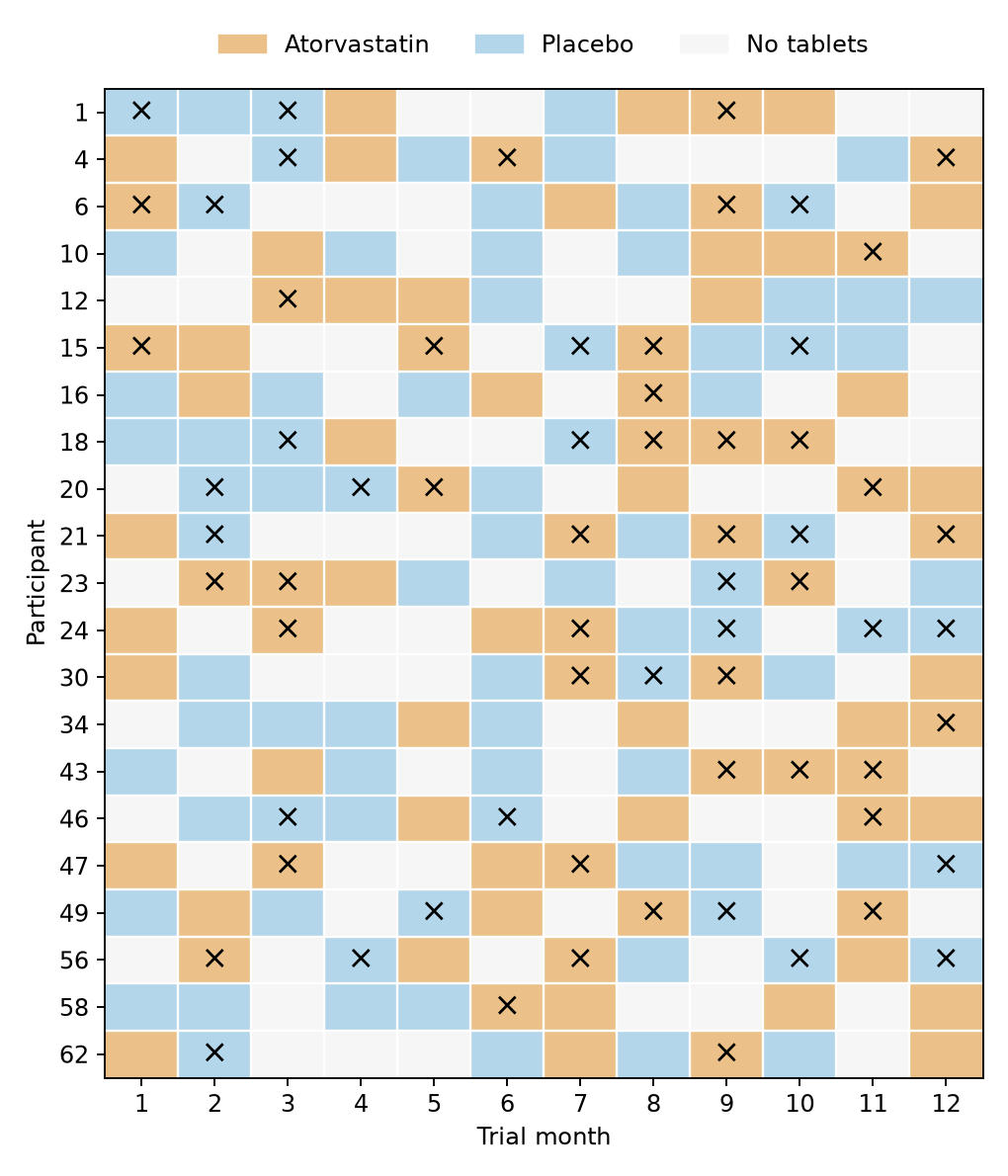
Figure 1. Each row shows the 12 months of one participant with a positive pair, in calendar order. Colors identify the contents of each bottle. A cross marks a recorded early stop. The other 28 participants who completed the trial had no positive pair.
We took each possible pairing of an atorvastatin month and a placebo month in turn as the starting pair (the “index pair” in Table 1). To form a comparison pair, we chose one of the three remaining atorvastatin months and one of the three remaining placebo months. Of the 784 starting pairs, 100 were positive, giving 900 choices of comparison pair.
Table 1. What happened in two other months from the same participant? Each column groups starting pairs by which tablet the participant stopped. Each row gives the outcome for the comparison pair, as a count and a percentage of the column total. Counts represent choices of four months, so a participant can contribute many times. The table omits starting pairs with stops on both tablets.
| Stop in comparison pair | Atorvastatin only in index pair | Placebo only in index pair | Neither in index pair |
|---|---|---|---|
| Atorvastatin only | 192 (21.3%) | 186 (32.3%) | 378 (7.4%) |
| Placebo only | 186 (20.7%) | 60 (10.4%) | 228 (4.5%) |
| Both | 144 (16.0%) | 102 (17.7%) | 186 (3.7%) |
| Neither | 378 (42.0%) | 228 (39.6%) | 4,284 (84.4%) |
| At least one | 522 (58.0%) | 348 (60.4%) | 792 (15.6%) |
| All choices | 900 | 576 | 5,076 |
Stopping either tablet once went along with stopping tablets in other months. For starting pairs with a stop on atorvastatin alone, 58.0% of comparison pairs included at least one stop, compared with 15.6% when neither tablet was stopped in the starting pair (difference 42.4 percentage points; 95% interval 26.8 to 56.9). A stop on placebo alone also went along with frequent stopping in other months (60.4%).
Which tablet the patient stopped was harder to predict. Among comparisons for a positive starting pair, 21.3% repeated the atorvastatin-only stop and 20.7% showed a placebo-only stop. The difference was 0.7 percentage points (95% interval −17.5 to 18.1). Either outcome could be appreciably more common than the other. These percentages describe a randomly chosen positive pair, so people with more positive pairs contribute more often. Giving each of the 21 people equal weight instead, then choosing among that person's positive pairs, gave 13.2% repeats and 27.5% reversals.
Monthly symptom scores can capture differences too small to make someone stop a tablet. For positive starting pairs, we examined the comparison pairs with scores available for both months. Symptoms averaged 22.9 out of 100 on atorvastatin and 20.6 on placebo (average within-pair difference 2.3; 95% interval −3.3 to 7.2). The scores covered the whole month, including days after an early stop.
Comparisons in calendar order
In 41 complete histories, the bottle order allowed another month on each tablet after the starting pair had ended. Only 11 people had a positive pair with both kinds of tablet still to come. Among the later comparisons for those positive pairs, 26.8% repeated the atorvastatin-only stop and 14.4% showed the reverse (difference 12.4 percentage points; 95% interval −19.8 to 38.9). The estimate favored a repeat, but the data leave open which outcome was more likely on a later test. At least one later stop occurred in 64.9% of comparisons for a positive starting pair, versus 22.5% when neither tablet was stopped in the starting pair.
When the starting pair had to use the first bottle of each kind, three people had a positive pair. At the next bottle of each kind, one repeated the atorvastatin-only stop and one stopped neither tablet. The third had no placebo bottle left.
Missing stops and incomplete histories
The charts for all 60 participants showed 45 of the 46 published atorvastatin stops and 37 of the 38 placebo stops. Assuming the visible marks were correct, we placed the two missing stops in every combination consistent with the published participant totals. Among participants with complete histories, the resulting frequencies were 18.7–21.8% for repeats and 19.7–22.0% for reversals. The difference in the frequency of any stop between comparisons for positive starting pairs and those for starting pairs with neither tablet stopped remained 40.9–43.5 percentage points.
With early withdrawal, whole months could be missing. One participant stopped both recorded atorvastatin months and had no placebo month. Of the 11 partial histories, only two supplied two usable months on each tablet once we excluded an unmarked final month in which tablet use was uncertain. Including those two histories gave 23.7% repeats and 20.0% reversals. The other histories ended too soon to tell what a second comparison would have shown.
Methods
We used the individual symptom charts for all 60 SAMSON participants. Colors identified treatments and shading marked early stops. An unmarked month counted as having no recorded stop. For participants with complete histories, we matched the chart colors to the points in the monthly symptom report, using the order in which the points were drawn for each person. Three of 588 monthly points were missing. Where colors were readable, they agreed after matching. We resolved the remaining assignments using the fact that each person received four bottles of each kind. For partial histories, we used only months shown on the chart. Among the observed bottle schedules, we identified the unique sequence that matched the readable colors up to withdrawal. When placing the missing stops, we added one stop on each tablet and allowed either stop to fall outside the complete histories. We kept the published totals of 26 people stopping atorvastatin, 23 stopping placebo and 31 stopping either tablet.
For each analysis, we gave eligible participants equal weight and divided each person's weight equally among their allowed four-month choices before grouping the choices by the result of the starting pair. Empty bottles kept their calendar positions and never counted as placebo. The main analysis allowed all 16 starting pairs per person and nine comparison pairs per starting pair. For comparisons in calendar order, the earlier pair had to end before the later pair began. Consecutive bottles sometimes contained the same treatment. Excluding choices in which any selected month continued the preceding month's assignment gave 13.4% repeats and 22.7% reversals.
Counting all choices gives exact frequencies for the recorded histories. Reusing months does not add independent patients, so we calculated uncertainty by sampling whole patient histories. We resampled eligible participants with replacement 30,000 times, keeping each person's months together. The 95% intervals run from the 2.5th to the 97.5th percentile of each recalculated estimate or paired difference.
Interpretation
A stop on atorvastatin alone identified patients whose other tablet months often ended early. It gave much less information about which tablet they would stop in a different comparison. For a trial that seeks patients who repeatedly stop the statin alone, a second blinded comparison would directly test whether someone who qualified once meets that rule again.
These frequencies describe short treatment periods, stops for any intolerable symptoms and patients able to complete repeated comparisons. Few patients contributed to the estimate for a later retest. GAUSS-3 used two periods of up to ten weeks and required muscle symptoms. The SAMSON results cannot reclassify those participants or determine whether an individual should take a statin.