In stony asteroid families, fast spinners reflect less near-infrared light relative to blue than slower siblings
Why it matters
Among asteroids of similar size and shape from the same rocky families, those turning once every 2.2 to 3 hours reflected a little less near-infrared light compared with blue light. This gives astronomers a color difference to explain when they model how spinning asteroids shed material, but it cannot tell them whether a particular asteroid has exposed fresh rock.
Can the color of an asteroid reveal whether fast rotation has exposed fresh rock? Loose material can slide as an asteroid spins faster, uncovering rock that has spent less time at the surface. But color also varies with size and composition, and fast-spinning asteroids tend to be rounder. We compared 111 pairs of main-belt asteroids of similar diameter and shape, each pair drawn from a predominantly stony family of fragments thought to share a parent. Asteroids turning once every 2.2–3 hours reflected 3.4% less near-infrared light (around 0.90 micrometers, μm) relative to blue light (around 0.51 μm) than their 4–8 hour siblings. This average excludes the most extreme pair differences. A ground-based survey found a shift in the same direction when it measured the same pairs.
Rotation and surface color
Few kilometer-sized asteroids turn faster than once every 2.2 hours. For an asteroid made of loosely bound fragments, gravity alone can hold material at the equator only up to a spin rate that depends on density and shape. Pravec and Harris documented both this apparent spin limit and the tendency for fast rotators to be nearly spherical.
Fresh surfaces of silicate rock can reflect more blue light relative to red than surfaces weathered by the solar wind and small impacts. Graves et al. showed that a model in which faster spin exposes fresh material can explain a trend in visible color with asteroid size. Polishook et al. studied the spectra of asteroid pairs thought to have split apart through rotation. We asked whether color varies with measured rotation period among ordinary main-belt asteroids. Members of an asteroid family follow related orbits. Comparing them reduces differences in starting material without selecting individual asteroids by color.
Color differences within families
We first compared five rotation-period ranges with a reference group turning once every 4–8 hours. We compared several color measures and asteroid groups, using two ways to account for size. Among 447 eligible comparisons, short-period members of predominantly stony families appeared bluer. The Gaia space telescope measures reflectance, the fraction of incoming light a surface reflects, at a series of wavelengths. Ratios of reflectances measure color independently of overall brightness.
Within the visible spectrum, the result depended on which asteroid shape models we used. We compared each fast rotator to all compatible slower siblings. With full shape models alone, the fast-minus-slow difference in the natural logarithm of the ratio of reflectance at 726 nanometers (nm) to reflectance at 506 nm was −0.013. Including partial models, for which the longitude of the spin axis is uncertain, gave −0.002. The spectra of fast and slow rotators differed more at longer wavelengths. We therefore compared near-infrared and blue light using three Gaia wavelength channels around 902 nm and three around 506 nm.
Of 143 fast and 488 slow rotators with the required measurements, we could match 111 pairs without reusing an asteroid. We matched family, diameter and two measures of shape: the ratios of the longest axis to the intermediate and shortest axes. The fast rotators were 3.4–12.3 km in diameter, and the median diameter difference within a pair was 0.36 km. The fast member had the lower near-infrared-to-blue ratio in 77 pairs. The average difference after trimming was −3.4% (95% interval −4.6% to −2.0%); the median pair difference was also −3.4%. Six families contributed. Two of them, Flora and Eunomia, supplied 75 pairs. Excluding both gave a similar difference, as did comparing asteroids with full and partial models separately (Table 1).
Table 1. Difference in the 902-to-506 nm reflectance ratio for 2.2–3 hour rotators relative to 4–8 hour controls. Each row matches on family, diameter and both shape measures. Each restriction allows a new assignment of pairs. Observing angle is the Sun–asteroid–observer angle; albedo measures how efficiently a surface reflects sunlight.
| Comparison within families | Pairs | Difference (%) | 95% interval (%) |
|---|---|---|---|
| Diameter and both axis ratios | 111 | −3.4 | −4.6 to −2.0 |
| Full shape models only | 71 | −3.2 | −4.6 to −1.7 |
| Partial shape models only | 26 | −3.3 | −5.8 to −0.9 |
| Exclude Flora and Eunomia | 36 | −3.1 | −4.8 to −1.3 |
| Also match on observing angle and brightness | 85 | −3.6 | −4.9 to −2.2 |
| Also match on visible albedo | 93 | −3.4 | −4.6 to −2.2 |
The difference was still evident near the slow end of the 2.2–3 hour range. Only seven of the 111 fast members turned in less than 2.6 hours. When we matched narrower period ranges separately to 4–8 hour controls, the differences were −2.6% at 2.6–2.8 hours and −3.2% at 2.8–3.0 hours (Figure 1). Even compared directly with 3–4 hour siblings, the 2.2–3 hour rotators had a 2.1% lower ratio (98 pairs; 95% interval 0.7–3.5% lower). The comparisons locate a difference among the shorter periods but give no sharp threshold.
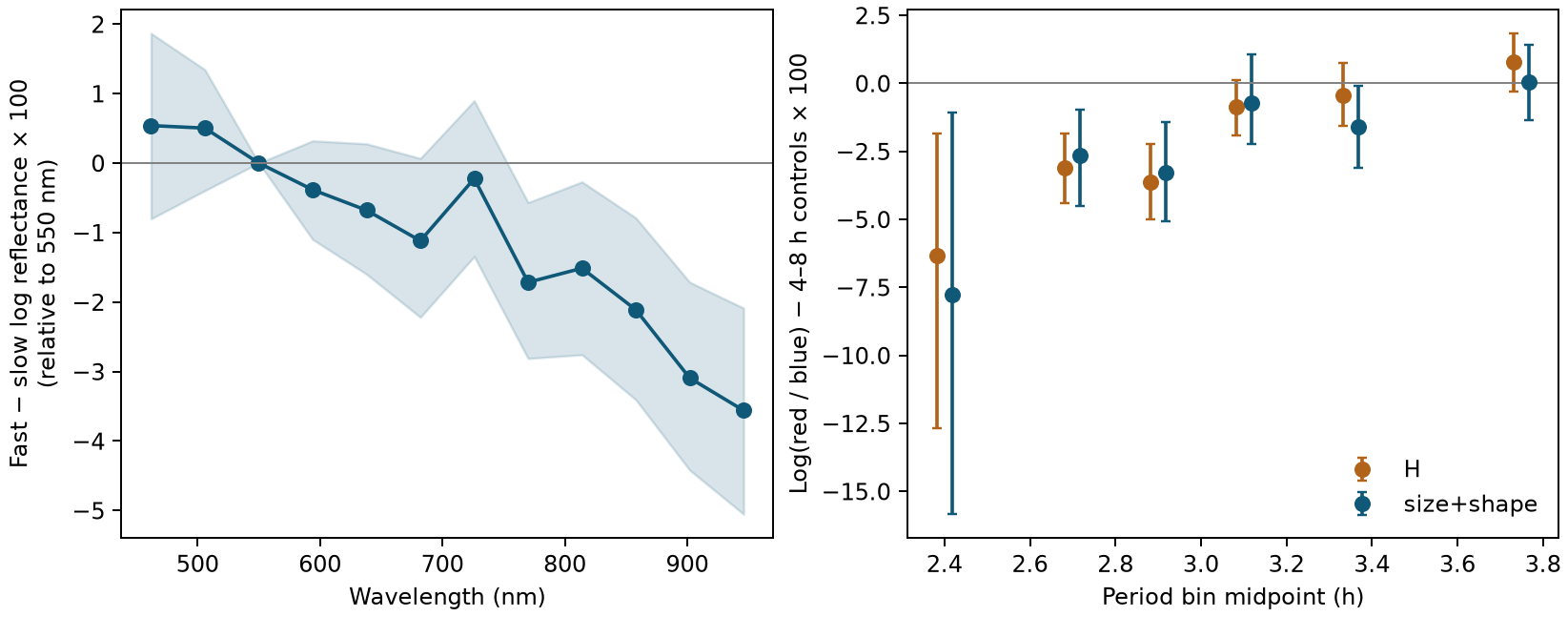
Figure 1. Left: the difference between paired spectra after setting both reflectances to one at 550 nm. Right: each period bin is matched separately to 4–8 hour rotators in the same family, either by absolute magnitude (H, a measure of intrinsic brightness) or by diameter and shape. Bin edges are 2.2, 2.6, 2.8, 3.0, 3.2, 3.5 and 4.0 hours. Both vertical axes show natural-log differences multiplied by 100, approximately percent differences. Each interval applies to one estimate; a control asteroid can appear in more than one period bin.
Silicate minerals absorb light near 1 μm. A lower near-infrared-to-blue ratio could reflect stronger absorption there or a more gradual change in color across the spectrum. In the same pairs, the ratio at 682 nm relative to 506 nm was 1.0% lower in fast rotators (interval −2.1% to +0.1% for the signed difference). For each asteroid, we used the change in visible reflectance with wavelength to predict its reflectance at 902 nm. Comparing what remained after subtracting that trend gave a difference of −0.6% (−2.6% to +1.2%). The spectra do not distinguish the two explanations.
Observing conditions and ground-based colors
Illumination can change the apparent color of the same rock. From individual Gaia visits we measured each asteroid’s mean phase angle (the Sun–asteroid–observer angle) and apparent magnitude (brightness as seen by the telescope). Matching these as well as family, diameter and shape left a 3.6% lower near-infrared-to-blue ratio in the fast rotators (Table 1).
Two ground-based sky surveys, SkyMapper and the Sloan Digital Sky Survey, measured a similar color using a blue-green filter (g) and a near-infrared filter (z). The difference in magnitude between the filters, g−z, is smaller for a bluer object. Neither survey supplied brightness measurements for the shape models. Matching pairs separately for each survey gave a fast-minus-slow difference of −0.045 magnitudes in SkyMapper (61 pairs; −0.076 to −0.015) and −0.036 in Sloan (28 pairs; −0.072 to +0.001).
SkyMapper also measured both members of 35 original Gaia pairs. Keeping those pairs gave a difference of −0.054 magnitudes (−0.104 to −0.015), confirming the direction of the color shift on the same rocks. Only ten original pairs met the Sloan requirements; neither Gaia nor Sloan resolved a difference in those ten.
Selection of asteroids with measured periods
An asteroid’s period is easier to measure when its brightness varies strongly as it turns. Using periods measured by the Palomar Transient Factory sky survey, we matched on the amplitude of that variation and on absolute magnitude. The Gaia ratio was 2.5% lower in fast rotators (38 pairs; 0.3–4.4% lower). This comparison did not require shape models, though 19 of its fast rotators had them.
We then excluded every asteroid in the spin and shape catalog and used periods from other sources. Matching on intrinsic brightness gave a Gaia difference of −1.3% in 37 pairs (−4.2% to +1.8%). The Sloan estimate outside the catalog went the other way (+0.025 magnitudes in 18 pairs; −0.037 to +0.092). Outside the catalog, even the direction of the difference remains uncertain.
Interpretation
Models of asteroid surfaces now have a color difference to explain. Across 0.51–0.90 μm, relative reflectance differs by a few percent with spin rate among family members of comparable size and overall shape with measured periods. A present-day period cannot date a landslide, and shared family membership does not determine an individual fragment’s density or mineral composition. Both the exposure of fresh rock and the preferential survival of different materials at fast spins could explain the color difference. Spectra extending across the far side of the 1 μm absorption band would help distinguish stronger absorption from a change in the underlying slope.
Methods and data sources
We used asteroid identification numbers to link four sources: the Nesvorný family lists, the Ďurech and Hanuš catalog of rotation periods and shape models, diameters inferred from heat radiation by the Wide-field Infrared Survey Explorer (WISE) and reflectance spectra from Gaia Data Release 3. The candidate families were Agnia, Barcelona, Eunomia, Flora, Gefion, Iannini, Juno, Koronis, Maria, Massalia, Merxia and Rafita. We used the original family lists, discarded objects assigned to multiple original lists and required absolute magnitude 9 < H < 20. “Stony” describes the selected families, not a spectral classification of every member. WISE diameters required a reported error below 30%, positive albedo and at least three detections in each of the W3 and W4 thermal bands. To summarize each convex shape model, we calculated its volume moments of inertia assuming uniform density and found the ellipsoid with equivalent moments. We used that ellipsoid’s long-to-intermediate and long-to-short axis ratios, taking the median ratio when the brightness measurements allowed two mirror-image models.
We required positive reflectances and errors and a quality flag of zero at 462, 506, 550, 638, 682, 726, 858, 902 and 946 nm. We took geometric means within successive groups of three channels. For the 902-to-506 nm ratio, we divided the mean for the last group by the mean for the first. To test whether the spectrum bent away from its visible trend, we extrapolated linearly in log reflectance versus wavelength from the blue and middle groups to the center of the last group. The three-group requirement kept the wavelength comparisons on identical objects.
In both period groups, we kept only objects with all measurements needed for that comparison. Each period range included its lower edge and excluded its upper edge. Within each family, we maximized the number of disjoint pairs subject to maximum differences of 0.22 in natural-log diameter and 0.10 in each natural-log axis ratio. When several assignments gave the same number of pairs, we divided each difference by its limit, squared the result and chose the assignment with the smallest sum. Color played no part in matching. For the illumination check we added maximum differences of 1.5° in mean phase angle and 0.6 magnitudes (mag) in mean apparent brightness. We used Gaia visits with position measurements and brightness measurements. For each visit, we calculated the phase angle from the viewing direction, Gaia’s position and the asteroid’s distance from the Sun. We obtained that distance by propagating the asteroid’s orbital state. The averages across visits approximate the observing conditions of the mean spectra. The albedo check added a maximum natural-log albedo difference of 0.30.
We took each object's median ground-based color over qualifying visits. SkyMapper filter exposures had to fall within 0.01 day of each other with color error below 0.10 mag. Sloan required good position and photometry flags in the four bands from g through z, valid flags for colors r−g and r−z (r is the red filter), positive g and z errors, and z error below 0.12 mag. We matched Sloan pairs within 5° in median phase angle. For comparisons without shape models we matched absolute magnitude within 0.5 mag; the Palomar amplitude match added a limit of 0.10 mag. Palomar periods required the catalog reliability flag Q3 = 1 and a reported error under 10%. Outside the spin-model release we used a reliable Asteroid Lightcurve Database period (quality 2+, 3− or 3) when available, then Palomar, then a period from the Transiting Exoplanet Survey Satellite (TESS) with an exact-period classification score of at least 0.8.
We took the fast-minus-slow difference within each pair, trimmed 10% of differences at each end and averaged the rest. For Gaia ratios we worked in natural logs and exponentiated the estimate to express it as a percentage change. To estimate precision, we drew 8,000 samples of whole pairs with replacement and repeated the calculation for each sample. The intervals enclose the central 95% of those estimates. They describe precision for the matched pairs and families. Choosing the wavelength comparison after exploring the spectra adds uncertainty that these intervals do not capture.