Four branches repeated along a path give the fastest growth in distinct tree shapes
Why it matters
Deleting tips from a family tree can leave the same branching pattern in many different ways. We found that a tree with four branches repeated along one path can gain a factor of 65 in the number of distinct patterns for every ten tips added, in the long run. No tree can sustain a faster rate.
How many branching patterns can one tree reveal when only some of its leaves are visible? Even if we try every choice of leaves, many choices reveal the same pattern once the leaf names are gone. In a tree whose branches split in two, for example, there are almost 2^n ways to retain some of its n leaves, yet every pair of leaves gives the same two-leaf shape.
We find that the largest possible number of distinct shapes grows as 65^{n/10}, up to constant factors. A tree attains this growth rate by repeating four side branches along a path. Each repeat uses ten leaves. The proof that no tree grows faster rests on counting which shapes a new branch can still add to those already present.
Counting the shapes in one tree
In a rooted binary tree, every fork has two children. Swapping the children at any fork leaves the shape unchanged. Choose a nonempty set of leaves and discard every branch that leads to none of them. Wherever a vertex has only one surviving child, replace it with that child, even at the root. The remaining tree is a leaf-induced shape. Count each shape once, however many choices of leaves produce it. Let S(n) be the largest such count among trees with n leaves.
Clifton and colleagues asked how fast S(n) grows. They built a tree with alternating one- and three-leaf branches along a path, obtaining a growth factor of five per four leaves. Their upper bound used two counts for each number j of retained leaves: the number of ways to choose those leaves and the number of binary tree shapes with that many leaves. The number of shapes any tree can supply is at most the smaller count. Summing these bounds over j gave an upper exponential base of 1.8648, compared with their lower base of 5^{1/4}=1.49535\ldots. What the upper bound leaves out is that the shapes at all sizes must come from the same tree.
Our result is S(n)=\Theta(65^{n/10}). That is, fixed positive multiples of 65^{n/10} bound S(n) from below and above for all sufficiently large n. The exponential base, the limit of S(n)^{1/n}, is therefore 65^{1/10}=1.5180683844\ldots.
A path that attains the rate
To describe the four branches, write ab for the tree with children a and b at a new root. Let x be a leaf. Then c=xx is a pair of leaves, t=xc joins a leaf to a pair, and s=x(ct) joins a leaf to the tree with children c and t. Along a path from the root, attach x,c,x,s in that order (Figure 1). These four branches have ten leaves altogether. After k repeats, end the path with any fixed seven-leaf tree and keep all seven of its leaves.
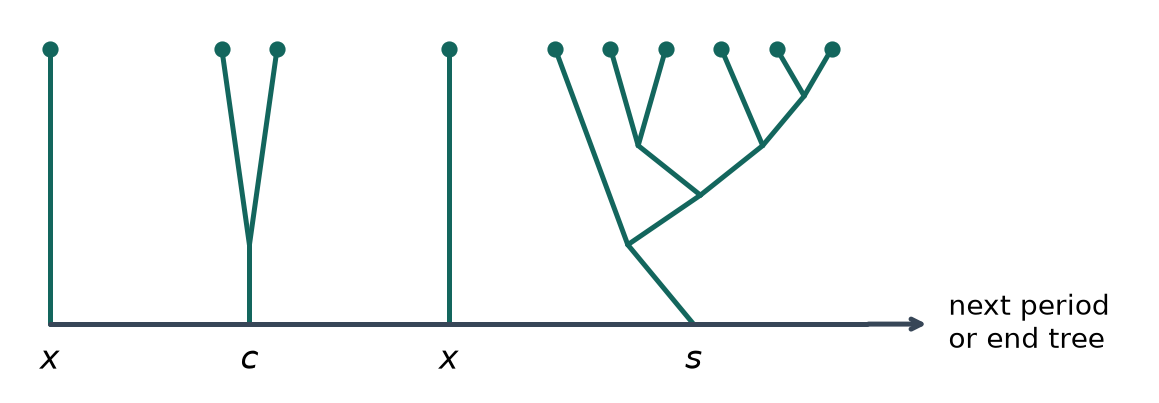
Figure 1. Follow the path from the root at left toward the end tree at right. Each side branch can disappear entirely or contribute any of its leaf-induced shapes.
Think of each retained side shape as a letter. Reading them in order, skipping the discarded branches, gives a word. We can recover this word from the resulting tree even though the children at a fork have no left or right labels. As long as more than seven leaves remain, the child containing the end tree has at least seven leaves, while the side child has at most six. Record the smaller child's shape and follow the larger child until the intact end tree is reached. Thus distinct words give distinct shapes.
There are nine letters. To name them, let f=xt, g=cc, and e=ct. In the order we will use for counting, the letters are
Count the words after each branch by grouping them according to their last letter, with a separate count for the empty word. If the next branch offers the letter i, appending i to every previous word gives distinct words ending in i. These include every old word ending in i: its prefix was available earlier simply by discarding the branch that supplied its last letter. So the new count ending in i equals the previous total. For a letter the branch cannot supply, the count stays unchanged.
The fourth branch makes all nine counts equal because it offers every letter. If each count is v at the start of a repeat, the total including the empty word is 1+9v. At the next three branches the totals become 2+17v, 5+41v, and 8+65v, respectively. The fourth branch then sets each letter's count to 8+65v. Starting with all letter counts zero, the number of distinct shapes with the end tree intact after k repeats is exactly
We found the repeat by comparing 12,984 ordered sequences of side trees. The search allowed all 399 tree shapes with up to eleven leaves as sides and at most twelve leaves in a sequence. We treated cyclic rotations of a sequence as equivalent. To rank sequences numerically, we used the linear update of the last-letter counts, including a coordinate for the empty word. For each sequence we took the largest absolute value of an eigenvalue of its update over a full repeat and raised it to the reciprocal of the number of leaves in that repeat. This measures growth per leaf. The four-leaf search recovered Clifton and colleagues' factor of five. The ten-leaf sequence ranked highest overall; the word count gives its rate exactly.
How many new shapes can a branch add?
At an arbitrary fork we can treat either child as the tree we started with and the other as a branch we attach. Some shapes produced by the attachment were already present in the first child. To bound how many can be new, we keep a count for each of the same nine letters.
For a tree T, write F(T) for its set of induced shapes, now including the empty shape 0, and P(T)=|F(T)| for the count. Define a0=a, including 00=0, because a fork disappears if a child is empty. In a tree TU with children T and U, we can choose the leaves independently in the two children. Thus
For a nonempty shape i, consider every join of i to a shape in F(T). Call the number of these joins missing from F(T) the gap for i:
Suppose we know an upper bound w=(p,(q_i)_{i\in I}) for z(T): the count is at most p and each gap is at most its corresponding q_i. Let M be the set of letters in I available from the attached branch U, and let r be the number of other nonempty shapes it offers. The number of new shapes in F(TU) is at most
The same d bounds the next gap for any i\in M. Every join of that i to an old shape is now present, so only joins to the new shapes could be missing. For i\notin M, at most q_i joins to old shapes could still be missing as well. Writing \mathbf 1_{i\notin M} for the indicator equal to one when i is absent from M and zero otherwise, the update is
An upper bound for every tree
Table 1 gives fifteen possible sets of bounds on the count and the gaps. The scale of each bound grows with the number of leaves; choosing a row lets the gaps differ in proportion to the count. Specifically, put b=65^{1/10}, C=153/100 and a=1/(8C^2). Call a tree T with n leaves covered if some table vector v satisfies z(T)\le ab^n v. A separate list E handles the small trees that need individual bounds.
Three finite checks let us pass from children to parent:
- The table contains v_*=(9,8,\ldots,8), and the first entry of each vector is at most 8C.
- The list E contains 24 trees, including the leaf. Joining any two listed trees gives another listed tree or a covered tree.
- For every listed tree U and table vector v, some table vector v' satisfies L_U(v)\le b^{|U|}v', where |U| is the number of leaves in U.
To see why these checks suffice, start at the leaves and work toward the root. If both children are listed, the second check handles their parent. If T is covered and U is listed, apply the linear gap update to the bound for T. The third check supplies a row for the parent, with the factor b^{|U|} accounting for the added leaves.
If both children are covered, the first check gives each child T a count P(T)\le a(8C)b^{|T|}=b^{|T|}/C. Multiplying the children's counts bounds the parent's count by b^n/C^2, where n is their combined number of leaves. This also bounds each gap. Every entry of ab^n v_* is at least b^n/C^2, so the parent is covered. This proves that every tree is either listed or covered.
The largest listed tree has ten leaves. Hence S(n)+1\le (100/153)65^{n/10} for n>10, where the extra one counts the empty shape. This upper bound has the same exponential base as the lower bound from the repeating path.
Building and checking the bounds
Tracking only the five letters with up to four leaves counted larger shapes as potential additions each time they reappeared. Tracking all nine letters supplied by s allowed the bounds, after division by the growth factor for the added leaves, to return exactly to their starting values.
To build Table 1, we started with v_* and applied the scaled update b^{-|U|}L_U for each side tree U with up to five leaves. We processed each new vector in turn, keeping an output only if no vector already kept bounded it in every coordinate. To build E, we started with the leaf and joined previously listed trees in order of increasing combined size. We added the result whenever no table row covered it.
Table 1. To read a row, take the integer vector u after the first column h and multiply it by b^{-h} to get the table vector v. The column P corresponds to the total count, and the lettered columns correspond to the gaps. For example, attaching x,c,x takes the first row to the row with h=4 and integer total 65. Applying the update for s to that integer vector gives 65v_*. Scaling for all ten leaves returns exactly to v_*.
| h | P | x | c | t | f | g | xf | xg | e | s |
|---|---|---|---|---|---|---|---|---|---|---|
| 0 | 9 | 8 | 8 | 8 | 8 | 8 | 8 | 8 | 8 | 8 |
| 1 | 17 | 8 | 16 | 16 | 16 | 16 | 16 | 16 | 16 | 16 |
| 2 | 25 | 16 | 16 | 24 | 24 | 24 | 24 | 24 | 24 | 24 |
| 3 | 41 | 24 | 24 | 40 | 40 | 40 | 40 | 40 | 40 | 40 |
| 4 | 57 | 40 | 40 | 40 | 56 | 56 | 56 | 56 | 56 | 56 |
| 3 | 41 | 16 | 32 | 40 | 40 | 40 | 40 | 40 | 40 | 40 |
| 4 | 65 | 24 | 48 | 64 | 64 | 64 | 64 | 64 | 64 | 64 |
| 5 | 97 | 40 | 80 | 80 | 96 | 96 | 96 | 96 | 96 | 96 |
| 7 | 201 | 136 | 136 | 136 | 200 | 200 | 200 | 200 | 200 | 200 |
| 9 | 393 | 328 | 328 | 328 | 328 | 328 | 392 | 328 | 392 | 392 |
| 9 | 393 | 328 | 328 | 328 | 328 | 328 | 392 | 392 | 328 | 392 |
| 7 | 217 | 120 | 120 | 200 | 216 | 216 | 216 | 216 | 216 | 216 |
| 8 | 337 | 136 | 272 | 272 | 336 | 336 | 336 | 336 | 336 | 336 |
| 10 | 721 | 328 | 656 | 656 | 656 | 656 | 720 | 656 | 720 | 720 |
| 10 | 721 | 328 | 656 | 656 | 656 | 656 | 720 | 720 | 656 | 720 |
To specify the list E, give the leaf index 0 (distinct from the empty shape). Each pair below names the two children of a listed tree by their indices. Read in order, the pairs define trees 1 to 23:
(0,0), (0,1), (0,2), (1,1), (0,3), (0,4), (1,2), (0,6),
(0,7), (1,3), (1,4), (2,2), (0,9), (0,10), (0,11), (1,6),
(1,7), (0,16), (0,17), (1,9), (0,20), (2,9), (0,22).
We checked the bounds independently of the searches that produced the table and list. We enumerated every leaf subset of each listed tree and sorted the children at every surviving fork so that equal shapes had the same representation. For each of the 300 unordered pairs of listed trees, allowing a tree to pair with itself, we joined all pairs of induced shapes, including the empty shapes. Exactly 23 of the 300 tree joins were themselves listed. For each of the other 277 we counted the nine gaps by taking the set differences in the definition of g_i. In every case a single table vector covered all ten coordinates. Finally, we applied the gap update for each listed tree to every row. All 24\times15=360 outputs met the third check.
All comparisons used integers. For example, take an entry y in the updated integer vector L_U(u) from a row with exponent h. If t is the corresponding integer entry of a candidate row with exponent k, raising the required inequality to the tenth power gives 65^k y^{10}\le 65^{h+|U|}t^{10}. The coverage check uses the same tenth power after clearing the denominator of a. The bound for trees of every size therefore holds without rounding the growth rate.
The matching bounds determine how fast the maximum grows. Which tree has the most shapes at a particular finite size remains open.
Reference
A. Clifton, É. Czabarka, A. A. V. Dossou-Olory, K. Liu, S. Loeb, U. Okur, L. Székely and K. Wicke. Decks of rooted binary trees. European Journal of Combinatorics 124 (2025), 104076. Theorems 4.10 and 4.13 and Problem 5.2 in the preprint.