Bacteria with disrupted sulfur metabolism genes fall further behind in magnetic sorting at higher iron
Why it matters
Some bacteria make tiny magnets that help them line up with Earth's magnetic field. Bacteria with a disruption in one set of sulfur-processing genes kept pace with their neighbors during growth, yet fewer turned up in the magnetic fraction relative to the rest of the population, especially when iron was plentiful. Counting which bacteria grew would have missed that difference.
The bacterium Magnetospirillum magneticum AMB-1 aligns with a magnetic field because it builds a chain of magnetite crystals inside compartments called magnetosomes. Many genes that build magnetosomes are known. A harder question is which metabolic genes help cells stay magnetic as the iron supply changes. If few cells with a particular mutation turn up in a magnetic sample, they might sort poorly in a magnetic field, or they might simply have grown poorly before sorting.
Three neighboring genes that encode a predicted sulfite-oxidizing enzyme, SoeABC, showed a difference at sorting. During low-oxygen growth, mutants with a DNA insertion in any of the three genes kept nearly their starting share of the population. At 30 micromolar (µM) iron, their share of the nonmagnetic fraction was about four times their share of the magnetic fraction. At 150 µM iron, the ratio rose to eight to ten. All 41 insertion positions measured at both concentrations showed a larger sorting defect at higher iron.
Separating magnetic sorting from growth
McCausland and colleagues grew AMB-1 mutants together, each carrying a DNA insertion with an identifying sequence called a barcode. They sampled each culture before passing the cells through a magnetic column, which separated them into magnetic and nonmagnetic fractions. By sequencing the barcodes, they showed that mutations in known magnetosome genes changed recovery from the column, in some cases more strongly at high iron. Their growth medium contained thiosulfate, a sulfur compound. We used their data to ask whether sulfur metabolism genes outside the cluster of magnetosome genes also affected sorting.
For each mutant, we divided its share of the barcode reads in the magnetic fraction by its share in the nonmagnetic fraction of the same culture. A ratio of one means the mutant sorted like the pool, regardless of how many cells entered each fraction. We express sorting scores on a base-two logarithmic (log₂) scale: a score of −1 means the mutant's share was half as large in the magnetic fraction. To measure its success during growth, we compared its share just before sorting with its share at inoculation. Three conditions had both sorted fractions and a well-sequenced sample before sorting for each of three replicate cultures: low oxygen at 30 or 150 µM iron, and growth without oxygen at 30 µM iron.
Iron supply and the Soe genes
The three genes, amb3541–amb3543, encode the predicted subunits SoeA, SoeB and SoeC of sulfite dehydrogenase, an enzyme that converts sulfite to sulfate. All three ranked among the 17 strongest losses from the magnetic relative to the nonmagnetic fraction in every condition, out of 2,048–2,342 genes scored. In the six low-oxygen cultures, mutants in each gene were within 10% of their starting share just before sorting (Figure 1).
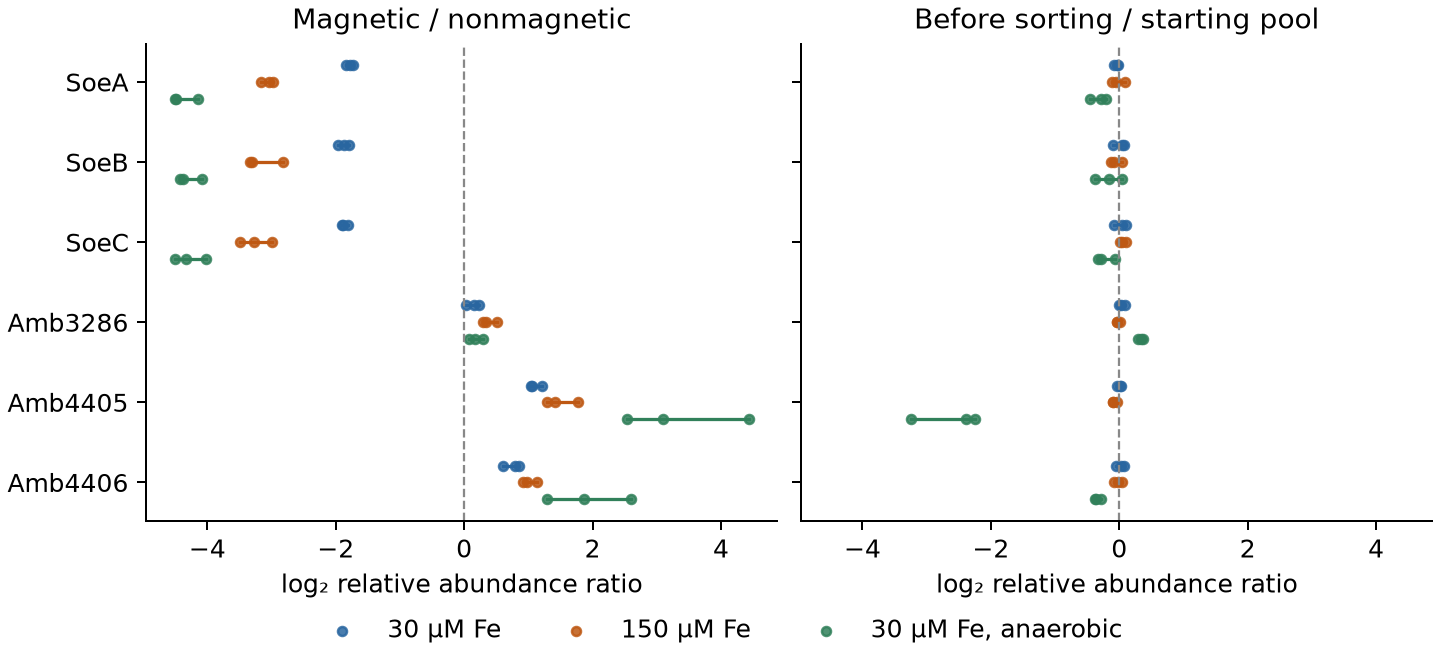
Figure 1. Each dot represents one culture. Lines span the three cultures at each combination of iron and oxygen levels. On the left, −1 means a mutant's share of the reads was half as large in the magnetic fraction as in the nonmagnetic fraction. On the right, −1 means its share halved during growth. The comparison genes encode a subunit of another sulfur enzyme (Amb3286) and two membrane proteins encoded by neighboring genes (Amb4405 and Amb4406).
At higher iron, Soe mutants lost ground in the magnetic fraction and gained ground in the nonmagnetic fraction. At 30 µM iron, for example, the SoeA mutants' share in the magnetic fraction was 76% of their share before sorting. In the nonmagnetic fraction it was 2.5 times their share before sorting. At 150 µM iron the corresponding values were 49% and 4.2 times.
Comparing only insertion positions observed in all six low-oxygen cultures, the sorting scores fell by 1.40, 1.37 and 1.32 log₂ units at higher iron for SoeA, SoeB and SoeC, respectively. These were the fourth through sixth largest drops among 2,288 genes. Only two genes for transporting ferrous iron and a magnetosome gene, mamT, showed larger drops.
High iron also widened the sorting defects of all 12 measurable magnetosome genes that McCausland and colleagues had identified as depleted from the magnetic fraction under standard conditions. Their median additional loss was 0.42 log₂ units. Two magnetosome genes, mamS (1.32) and mamT (1.49), resembled the Soe genes. A larger defect at higher iron was common among these mutants, but the change for the Soe genes was large even by that standard.
Of the 41 shared insertion positions, 22 were in soeA, ten in soeB and nine in soeC. We also grouped nearby positions so that clusters of insertions carried no extra weight, and measured each gene's score relative to the genome-wide median for its culture. For each Soe gene, every high-iron culture still scored at least 0.90 log₂ units below every standard-iron culture. The effect extended to soeC, the last gene in the cluster, whose next neighbor lies on the opposite DNA strand.
Comparison with other sulfur metabolism genes
The catalog accompanying the screen gives the three Soe proteins different enzyme labels. Their sequences support the existing AMB-1 Soe annotation: SoeA, SoeB and SoeC share 73%, 78% and 51% amino-acid identity, respectively, with the corresponding subunits of the experimentally characterized SoeABC enzyme in Allochromatium vinosum. Ten AMB-1 proteins share a region of SoeA characteristic of molybdenum-containing enzymes. Eight had scores in all three conditions. None of the other seven had a sorting defect as large as SoeA's in any condition.
Another predicted sulfur enzyme, tetrathionate reductase, drew attention because its subunits Amb3286, Amb3288 and Amb3289 turned up in isolated magnetosomes. Wan and colleagues found these proteins enriched in magnetosome preparations when MamE, a magnetosome enzyme that cuts proteins, was inactive. Yet their mutants gave no indication that magnetosome formation required tetrathionate reductase. In their protein inventories we found all three subunits in all five preparations with inactive MamE and none of five with active MamE. The sorting data agree with their mutant results. Across the three genes and three conditions, all nine sorting scores lay between −0.23 and +0.52 log₂ units, compared with −4.49 to −1.79 for SoeABC.
A pair of membrane protein genes
Insertions in amb4405, a gene encoding a membrane protein of unknown function, shifted sorting in the opposite direction. To find genes whose mutants consistently favored the magnetic fraction, we ranked the 2,011 genes scored in every condition by their lowest magnetic-to-nonmagnetic ratio across the three conditions. On this measure amb4405 ranked first. Mutants in its upstream neighbor, amb4406, which encodes a membrane protein of the TauE family, also favored the magnetic fraction. For both genes, the mutants' relative scarcity in the nonmagnetic fraction accounted for most of the enrichment. After growth without oxygen, for example, amb4405 mutants had only 14% of their presort share in the nonmagnetic fraction and 106% in the magnetic fraction. This gives little reason to expect extra magnetite per cell.
The two genes also occur together in other bacteria. The Fitness Browser, a database of genes and mutant growth measurements, contained ten members of the Amb4405 protein family. All ten had a TauE-family gene immediately upstream on the same DNA strand. In six other strains we could compare how disrupting each gene affected growth across at least ten conditions. In five strains the TauE mutant ranked among the six closest genome-wide matches to the growth pattern of the Amb4405-family mutant. In the sixth it ranked 294th of 2,530. Gene order and growth patterns thus support a functional pair.
Interpretation
The Soe genes stand out as candidates for how sulfur metabolism helps AMB-1 remain magnetic when iron is plentiful. The mutants kept nearly the same share of the growing population under low oxygen, yet fell further behind the rest of the pool during magnetic sorting as iron increased.
The column sorts whole cells relative to the pool, so the gap could widen if other cells became more magnetic while Soe mutants failed to keep pace. The screen neither varied sulfur supply nor measured sulfite oxidation. Insertions can affect expression of neighboring genes, so the Soe results apply to the cluster as a whole; neighboring gene expression may also contribute to the evidence for the Amb4405–Amb4406 pair. The data identify neither a compound transported by the pair nor a direct link to SoeABC. To distinguish smaller crystals from unequal inheritance of a crystal chain, one could measure crystal size and the fraction of cells inheriting a chain at both iron concentrations, comparing a Soe mutant with a strain in which the disrupted function has been restored.
Methods and data
We used the barcode counts, gene map and sample descriptions from the sorting experiment. The low-oxygen iron comparison used cultures from the same experimental batch, with iron supplied as ferric malate and malate balanced between conditions. The complete series grown without oxygen came from a separate batch, so differences in magnitude cannot isolate an oxygen effect. A separate, earlier run lacked the nonmagnetic fraction. Its two adequately sequenced anaerobic cultures showed smaller losses of SoeA mutants in the magnetic fraction relative to the presort sample (−0.35 and −0.03 log₂ units versus −1.09 in the complete series). The high-iron anaerobic series had too few magnetic and presort reads.
We combined barcodes at the same genomic position within the central 10–90% of each coding sequence. To calculate a position's normalized count, we added half a read to its observed count and divided by the sample's total reads from central positions. Scores are log₂ ratios of these normalized counts. We pooled starting samples by experimental date using the dataset's starting-sample grouping, labeled Time0. Each retained starting, presort and magnetic sample needed at least 100,000 central reads. We required ten starting reads and five presort reads per position, and four eligible positions per gene. For the separate growth comparison we applied only the starting-read criterion to positions so that mutants lost during growth could still contribute. We took the median across positions within each culture, then across the three cultures in each condition. Using the dataset's magnetic and nonmagnetic labels, the known magnetosome mutant mamE ranked among the three strongest magnetic-fraction losses in every condition.
For the comparison between iron concentrations, we calculated the difference between condition medians at each shared position, then took the median difference across positions. To check the separation between cultures, we grouped successive shared positions at most ten bases apart and took the median within each group. We gave each group equal weight in calculating gene scores and subtracted the median gene score for each culture. The magnetosome gene comparison covered all 14 genes the original authors named as depleted under standard conditions; two lacked four shared positions. Ranks describe the genes in this screen. Cultures were the experimental replicates.
We identified proteins related to SoeA by their shared molybdenum-enzyme domain, designated PF00384, and checked the Soe assignment against reviewed protein sequences. In Wan and colleagues' inventories of protein fragments (peptides), we counted each target protein once per preparation. For members of the Amb4405 family, designated PF09608, we retrieved neighboring genes from the Fitness Browser. Within each strain, we combined assays with the same group, medium and condition description by taking the median growth score for each gene. For genes measured across the shared set of conditions, we ranked the similarity of their growth patterns to that of the Amb4405-family mutant using Spearman correlation, which compares the rank order of scores.