Three counts of ones are no better than two for marking cube faces with an L
Why it matters
A high-dimensional cube can be marked so that one in three of its three-dimensional faces shows exactly three dots in an L shape in the limit. If the marking uses only the counts of ones in three groups of bits, keeping all three counts can do no better than combining the two smaller ones. To reach one in three, the largest group must contain half the bits in the limit.
How many faces of a cube can we mark with an L? Think of each vertex of a high-dimensional cube as a string of bits. Fix all but three bits and let those three vary: the resulting eight vertices form a three-dimensional face. We mark vertices of the whole cube. A face has an L if it contains exactly three marked vertices, one of which differs from each of the other two in a single bit. The challenge is that the faces share vertices: a mark that completes an L on one face can spoil one on another.
One marking rule counts the ones in each of two equal groups of bits. As the number of bits grows, it puts an L on one face in three. The upper bound for unrestricted markings, 0.333399 [2], leaves open whether another rule can do better. We prove that splitting the bits into three groups and using all three counts still gives at most 1/3 in the limit. For any group sizes, the best limiting fraction stays the same if we add the counts of the two smaller groups. It reaches 1/3 precisely when the largest group contains half the bits in the limit.
Maximum density for each split
Call the L a corner and the fraction of three-dimensional faces with a corner its density. Goldwasser and Hansen call the pattern W_5 [1]. Their rule marks a string if neither of its two counts is divisible by three. With two groups, some vertices on every face share the same pair of counts and must receive the same mark. A third group removes that constraint on faces with a free bit in each group: all eight vertices then have distinct triples of counts. Baber's upper bound [2] allows every vertex to be marked separately. Bodnár and Pikhurko determined the exact maximum densities for five other patterns on three-dimensional faces [3].
Partition the n bit positions of the cube \{0,1\}^n into three blocks. Suppose block i has size n_i and its proportion n_i/n tends to p_i as n grows. Write x=\max_i p_i for the largest limiting proportion. A block's weight is its number of ones. Among all rules that decide whether to mark a vertex from its three block weights, the maximum density tends to
Three equal blocks give 8/27. Figure 1 shows why the formula has two branches. One marking rule tests both counts for divisibility by three; the other tests one for divisibility by three and the other for oddness.
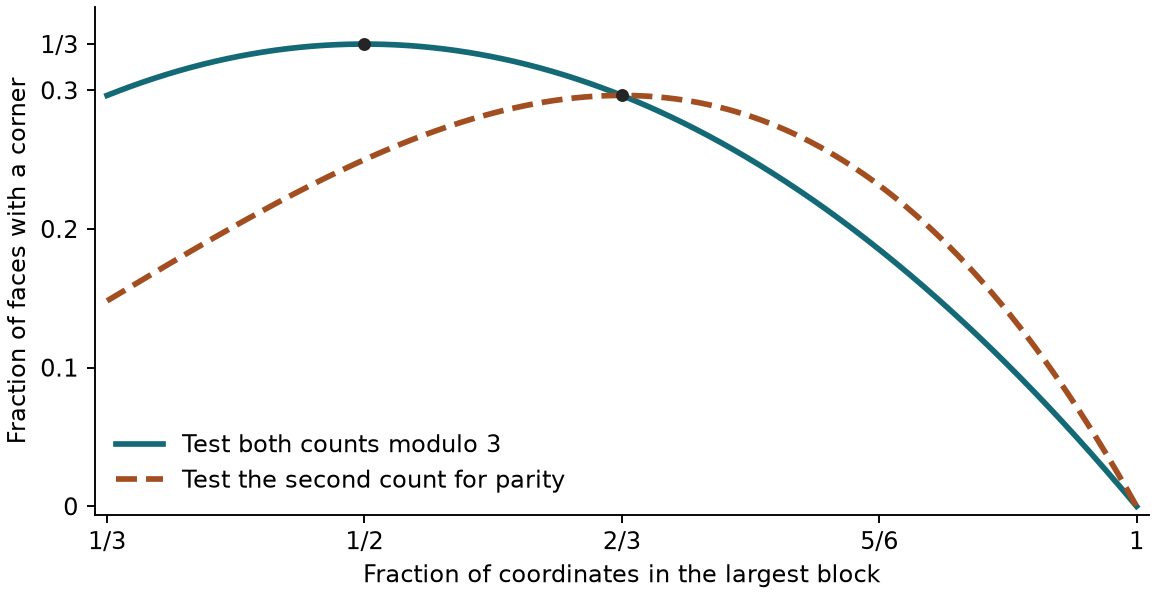
Figure 1. At each largest-block proportion, the higher curve gives the maximum over all three-count rules. The density peaks at 1/2; the rules cross at 2/3.
Two counts attain the maximum
Let a be the weight in a largest block and b the total weight in the other blocks. Both rules require a to have a nonzero remainder on division by three. The first also requires b to have a nonzero remainder on division by three. The second requires b to be odd.
On a given face, set the free bits to zero to get the starting counts. The rules depend only on the remainders of these counts, using division by two for the oddness test. Table 1 gives the chance of a corner for independent, uniformly sampled starting remainders, given that k of the three free bits lie in the largest block.
| Rule | k=0 | k=1 | k=2 | k=3 |
|---|---|---|---|---|
| Two modulo-three tests | 0 | 4/9 | 4/9 | 0 |
| Modulo three and parity | 0 | 0 | 2/3 | 0 |
To see where the entries come from, take k=2. Fixing the free bit outside the largest block cuts the face down to a square. Across that square the first count takes the values a,a+1,a+1,a+2, where a is its starting value. Excluding either end value leaves an L; excluding the middle value leaves two opposite vertices. So the first test leaves an L for two of three starting remainders. The second test must accept exactly one of the two parallel squares. Testing divisibility by three does this for two of three starts; testing oddness does it every time.
For k=1, exchanging the counts gives the same answer for the first rule. The second rule marks an even number of vertices, since each parity occurs twice among the settings of the two free bits outside the largest block. If all free bits lie on one side, each set of vertices with the same count is marked or unmarked as a whole. Each set of size three has no adjacent pair, and the two singleton sets together have size only two.
For x<1, the starting counts on the two sides are independent given any feasible k. Their binomial distributions become insensitive to a unit shift, as proved below, so their remainders approach the uniform distributions used in Table 1. The distribution of k approaches that of the number of successes in three independent trials with success probability x. Weighting the two rows by these probabilities gives \frac43 x(1-x) and 2x^2(1-x), respectively. Above 2/3 the gain from the oddness test on faces with k=2 outweighs the loss on faces with k=1. At x=1 almost every face has all its free bits in the largest block, and the limiting density is zero.
Periodic marking rules
A rule based on two counts can be pictured as a grid: the row and column are the counts, and each cell says whether to mark the vertex. We scored every rectangular table of marks with both side lengths between two and four, repeating the rectangle in both directions to fill the grid. For each of the 74,896 tables we tried every starting cell and both ways to split the three free bits between the two directions with bits in both. Some of the best tables for equal blocks had stripes. Each blank row was followed by two identical rows marking two columns out of every three. Successive pairs of rows could skip different columns.
With three counts, each value of the third count selects a layer of the grid. We tested 126,864 unordered pairs of stripe layers, allowing transposed layers, repetitions, and square periods of 3, 6, 9 or 12. We placed one free bit in the third block so that changing it switched layers. We assigned each of the other two bits independently to either original block with equal probabilities. At every period the best density conditional on this split was exactly 1/3. Switching layers could therefore tie the two-block rule but gave no first-order gain as a small third block was added. The upper bound for arbitrary layers and block sizes comes from the agreement between overlapping pieces of the grid.
A grid viewed from a random face
To bound even rules that change with n, we sample the face before looking at the rule. Choose three distinct coordinates uniformly in random order as the free bits and assign independent fair bits to the rest. Every face is equally likely. Let d=(d_1,d_2,d_3) record the block labels of the chosen coordinates. As n grows, the labels approach three independent draws with probabilities p=(p_1,p_2,p_3). Given the labels, let k_i count how often block i occurs. Its starting weight has distribution \mathrm{Bin}(n_i-k_i,1/2), the number of ones in n_i-k_i independent fair bits. These weights are independent across blocks.
For the upper bound we can sample an origin for the grid independently of the labels. Take independent weights B_i\sim\mathrm{Bin}(n_i,1/2). For a fair binomial distribution with m trials, shifting by one changes the probability of any event by at most the probability of its most likely value. Indeed, the largest such change (the total variation distance) equals that probability because the binomial probabilities rise and then fall. The distance is O(m^{-1/2}). Adding at most three trials gives a mixture of shifts by bounded amounts. Thus, when all chosen labels have p_i>0, replacing the starting weights by the B_i changes their joint law by a distance tending to zero, denoted o(1), regardless of the rule. Choosing any label with p_i=0 has probability o(1).
Extend the rule's table arbitrarily to all triples of integers, and view it from the origin B=(B_i). Along each axis with p_i=0, freeze the coordinate at B_i so the view is constant in that direction. Translating any fixed window by a bounded amount changes its pattern distribution by o(1): the binomial estimate applies on growing, positive-proportion axes, and a frozen axis gives no change. Take a subsequence along which the densities approach their upper limit. By taking successive subsequences for the finite windows and then a diagonal subsequence, we can make all their pattern probabilities converge. The limiting distributions agree when restricted to smaller windows. They describe a stationary random table on the integer grid \mathbb Z^3: every translated window has the same pattern probabilities as the original. Bounding the score of such a table, sampled independently of the labels, bounds the limiting density without any periodicity assumption.
Let e_i be a unit step along count axis i. Given labels d, a setting v of the free bits reads the table at
Let h(d) be the probability that the eight settings mark a corner. Settings that read the same site still count as separate vertices. If the three labels are drawn independently with respective distributions r,s,t, their score is
This expression is linear in each argument separately (trilinear). It is symmetric because reordering the free bits preserves a corner. The density we must bound is T(p,p,p).
Reducing the upper bound to 22 tests
Order the blocks by decreasing proportion, so the first is largest. Table 1 gives comparison scores even when the label distributions differ among draws. If the probabilities of the first block in the three draws are u,v,w, the two rules score
The bracket in M is the probability that the free bits fall on both sides; the bracket in P is the probability that exactly two fall in the first block. Like T, both scores are symmetric and trilinear on label distributions, since each is an average over independent draws.
Every sorted vector of proportions lies in a triangle. To divide it into regions where one comparison rule suffices, use five points, written here as ratios (divide each by its coordinate sum):
The full triangle is ABE. The line where the first proportion equals 2/3 joins C on BE to D on AE. Cutting the remaining quadrilateral along AC leaves three triangles in all: ABC,ACD,CDE.
The finite tests establish the following inequalities for every stationary table. Choose any three vertices from triangle ABC, allowing repetitions, and use them as the arguments of T and M. Then T\le M. The same holds for triangle ACD. For triangle CDE, the inequality is T\le P.
These vertex tests give the bound throughout each triangle. Express p as a weighted average of its triangle's vertices, and use those weights to sample a vertex independently for each argument. By trilinearity, averaging the tested scores gives T(p,p,p) on the left and the corresponding rule's density at p on the right. Since the rule attains that density, it is optimal. Testing only triples of identical vertices would miss terms in this average. For example, the bound for (A,A,C) is 28/81, greater than 1/3. It is the coefficient required by M when two draws use A and one uses C, rather than a density at one common proportion.
Checking the local inequalities
The tests use a simple constraint on the grid. If a large box is cropped to a smaller box, the probability of seeing a given pattern in the crop must equal its probability in a box of the smaller shape. Stationarity makes this true whichever end we crop.
Call a binary marking of a box a word. A label triple using two blocks reads a box of shape 3\times2\times1 in some axis order; one using all three reads a 2\times2\times2 box. Triples using a single block always score zero. For fixed label distributions, assign each word of shape s a score c_s: for each label triple that reads this shape, add the triple's probability if the word produces a corner. If W_s is the random word in a box of shape s, then T=\sum_s\mathbb E c_s(W_s).
To bound this sum, we transfer score between boxes. Suppose deleting the first or last layer of a box of shape s leaves a box of shape t. Assign a signed number, or price q, to a word w in that crop. Subtract q from the score of every parent word whose crop is w, and add q to the score of w at shape t. The expected sum stays the same because the crop has the distribution of W_t. Denote the adjusted scores by c'_s.
We can average over the eight choices of reflecting or preserving each of the three axes. Reflecting an axis flips the free bits with that label, preserving adjacency on the face. Stationarity absorbs the shift in the box origin, so this averaging leaves every h(d) unchanged. Write G_s for the set of box symmetries used in the average and gw for the word obtained by applying symmetry g to w. The expected score at a shape is at most the largest symmetry-averaged score at that shape. Thus
We average before taking the maximum. For every test except (A,A,A) we keep the axis labels fixed and use all subboxes of 3\times2\times2 and 3\times3\times1 in every axis order. These give 23 shapes and 14,550 labelled words.
The equal-proportion test (A,A,A) needs a larger box. Here all block labels are equally likely, so uniformly permuting the axes of the entire table preserves the total score. We use boxes inside 3\times3\times2 with side lengths in nonincreasing order. Only two shapes have nonzero initial scores: a corner earns 18/27 in shape (3,2,1) and 6/27 in shape (2,2,2), from the numbers of ordered label triples using two and three blocks respectively. We retain crops with side lengths still in nonincreasing order and include permutations of equal-length axes in G_s. Checking (1), including all 2^{18} words of the largest shape, gives 8/27. The symmetry comes from the arguments of T(A,A,A), so this test also applies when the actual proportions p are unequal.
We found the prices by linear programming. The variables were nonnegative word probabilities, and the objective was to maximize the sum of expected scores. We required the one-site probabilities to sum to one. For each crop we equated each child word's probability to the sum of the probabilities of parent words giving that child. These constraints make the probabilities sum to one at every size. We also equated probabilities of reflected words. For the equal-proportion test we included the additional axis symmetries and used only crops keeping the origin fixed; reflection gives the opposite crops. Even here we matched each labelled child word separately. For example, shortening the long side of a 3\times2 rectangle leaves a square. The square can exchange axes, but the rectangle cannot, so matching only a total over rotated child words would lose a constraint.
The dual of the linear program assigns prices to the probability constraints. We converted the numerical prices to rational numbers and independently checked (1) by enumerating all words. We counted a corner when exactly three vertices were marked and their pairwise distances, measured in differing bits, were 1,1,2. All 22 rational bounds equal the comparison scores. Table 2 groups them by value; each string lists the three arguments of T.
| Upper bound | Triples certified at this value |
|---|---|
| 0 | EEE |
| 2/9 | CEE, DEE |
| 8/27 | AAA, CCC, CCD, CCE, CDD, CDE, DDD, DDE |
| 26/81 | AAB, BCC |
| 1/3 | ABB, BBB, BBC |
| 28/81 | AAC, AAD, ABC, ACC, ACD, ADD |
The rational crop prices specify (1) in full. Three-digit keys use digits 0 to 4 for A to E. Each row lists the three parent side lengths, the crop axis (numbered from zero), the side (zero for a crop keeping the origin fixed), the child word, and the signed price numerator. For AAA the side keeping the origin fixed is implicit. For side lengths (s_1,s_2,s_3), the bit at zero-based coordinates (i,j,k) has index i+s_1(j+s_2 k). The prices use the unnormalized ratio vectors listed above. Weight the initial scores by those vectors, divide the price numerators by the listed common denominator, and divide (1) by the product of the three vector sums. For AAA the initial weights are 18 and 6 in these units, and the final divisor is 27.
Merging the two smaller blocks preserves the best limiting density at every split. Other rules may tie the merged rule. To exceed one third, however, a marking must use information beyond the weights of three blocks.
References
- John Goldwasser and Ryan Hansen. Inducibility in the hypercube. Journal of Graph Theory.
- Rahil Baber. Induced Turán Hypercube Data (2013). Rigorous induced-vertex bounds, row 3-6: the marked vertices numbered 5, 6 and 7 form the corner.
- Levente Bodnár and Oleg Pikhurko. Some exact values of the inducibility and statistics constants for hypercubes.