Scoring specific protein functions reverses which prediction method performs better
You are reading version 1. Read the latest version (3).
In plain English
In a test of computer predictions about what human genes do, some supposedly new findings had already been reported, and even the highest-ranked correct predictions described broad activities rather than the specific functions tested in experiments. For readers weighing headlines about computers making biological discoveries, this shows why predicting a database update is different from uncovering how a gene works.
Research manuscript · 29 October 2026 · For human review
Abstract
A reference-dated annotation is not necessarily a new human functional discovery, and a highly ranked biological process need not predict the experiment's specific claim. We audited all 45 reference-passing assertions on 33 proteins, including gains, ties and losses, in a locally locked human Gene Ontology (GO) time-split benchmark. This post-hoc, bounded literature audit found earlier human process support for 11 assertions, earlier nonhuman or mixed support without secured human novelty for six, and later human functional support with no earlier matching human report located for 17. Eleven remained unresolved. These are evidence classifications, not certified first-discovery dates.
Five of the nine proteins whose homology ranking improved over frequency had later human functional assays without an earlier human match located. Yet only 21/45 direct assertions were scoreable: none ranked in the multispecies top five, and only two in the top ten, both broader than the experimentally tested ligand or substrate. RPUSD2 illustrates a distinct bottleneck: a retained historical yeast donor carried the exact pseudouridylation label, but the frozen vocabulary excluded it. The unchanged primary result remains positive—multispecies mean average precision (AP) 0.1559 versus frequency 0.0527, difference 0.1032 (publication-component 95% interval 0.0308–0.1816). Thus some ranking gains accompany later human experiments, but the endpoint does not establish specific-function nomination success or an integration advantage.
1. What survives an experiment-level audit
The main contribution is a complete, assertion-level account of what remains after reference screening—not another demonstration that homology can beat term frequency. We applied the same search-and-evidence procedure to every retained protein: retrieve the cited primary reports, search symbols/aliases with function-related words for earlier work, search endpoint titles for preprints, inspect available experiments and follow relevant earlier references. Each assertion records the measured claim, earliest located report, earlier related evidence, protein/model species, vocabulary status and unchanged ranks. The search is bounded and the judgments are from one auditor after outcomes were exposed. Missing methods and uncertain attribution remain explicit; failure to locate an older experiment is never proof of first discovery. Protocol; all 45 evidence judgments.
Cohort audit. “Earlier human support” is at the process level and does not date every new mechanism in the cited paper. “Later human support” requires an identified human perturbation or human-protein assay, but permits older nonhuman homolog evidence. The nonhuman/mixed category does not secure new human functional knowledge; unresolved cases include ambiguous species or annotation-to-assay matches. Gain/loss/tie refers to the original protein-wise multispecies–frequency AP difference, not a new score. Assertions from the same protein or paper are not independent.
| Evidence classification | Assertions | Proteins | Gains / losses / ties | Scoreable direct |
|---|---|---|---|---|
| Earlier human support: before 2023 feature cutoff | 4 | 2 | 0 / 1 / 1 | 2 |
| Earlier human support: 2023–2025 interval | 7 | 6 | 1 / 0 / 5 | 2 |
| Earlier nonhuman/mixed support; human novelty not secured | 6 | 5 | 1 / 2 / 2 | 2 |
| Later human functional support; no earlier human match located | 17 | 13 | 5 / 0 / 8 | 9 |
| Unresolved experimental attribution or human support | 11 | 7 | 2 / 1 / 4 | 6 |
Earlier reports survive a reference-date screen
The seven assertions with human support between the 2023 feature cutoff and the 2025 validation boundary comprise choline transport by SLC35F2–F5, PEX39/C6orf226-dependent peroxisomal import, and two FAM118B immune-process assertions. Beyond the four previously identified choline cases, a May 2024 PEX39 preprint already describes human PTS2-import experiments. A September 2024 FAM118B preprint uses the name SIRanc rather than the later SIRal: its human macrophage knockdown experiments already distinguish late TRIF-dependent TLR4 responses from early TNF induction. Title matching and full-text identity checks recover evidence missed by a symbol-only search. These are failures to date supporting experiments, not leakage into the 2023 features. PEX39 preprint; FAM118B preprint, Fig. 2h.
Other earlier evidence needs species and resolution qualifications. The September 2024 SLC45A4 preprint already contains the pain experiments, but causal pain evidence comes from mice alongside human genetic association. Earlier mouse MDGA2 work established synapse suppression; the later human-variant study adds disease evidence, not a first description of the general process. AFF1's older human elongation/genotoxic-response experiments and ADAL's older human modified-nucleotide catabolism provide process-level support without anticipating the newer PARylation or three-substrate/AMPK mechanisms. The ledger separates these old process claims from the later mechanistic reports. SLC45A4 preprint; MDGA2 mouse experiments; AFF1 experiments; ADAL catabolism.
Later human experiments survive, but specificity usually does not
The 17 assertions on 13 proteins with later human functional support include five of the nine AP-improving proteins: SLC7A4, TGDS, RPUSD2, SLC25A45 and SLCO5A1. They are credible examples of later human experiments connected to historical process-level signal, not certified first discoveries or historical public predictions. Their assays resolve leucine uptake, an enzyme-rescue metabolite, tRNA pseudouridylation, methylated-amino-acid import/carnitine synthesis, and substrate-dependent amino-acid/vitamin transport, respectively. The frozen scores cannot be credited with those details merely because an ancestor ranks well. The other eight proteins in this category tie frequency; the audit did not select only apparent successes. Complete ranks and source-specific qualifications.
Across the whole cohort, 0/21 scoreable direct assertions rank in the top five and 2/21 in the top ten, using the worst rank within a score tie. These are observed recoveries, not precision estimates. The two top-ten labels are MRGPRE's cell surface receptor signaling (rank 6) and SLC25A45's amino acid transmembrane transport (rank 10). Neither identifies the tested ligand/substrate: tryptophan-conjugated cholic acid for MRGPRE, or methylated amino acids such as trimethyllysine for SLC25A45. The latter's human knockout, complementation and mitochondrial metabolomics distinguish methylated from unmethylated substrates; a generic transport label does not. MRGPRE's human receptor-assay attribution remains unresolved from accessible primary material, despite its favorable broad rank. The 24 excluded direct assertions are unranked, not counted as failed predictions. SLC25A45 experiments; MRGPRE primary abstract.
The unresolved category is substantive, not a residual presumed-success group. For example, ENHO's endpoint report compares expression and serum adropin in patients and controls rather than perturbing human energy homeostasis. For SUCLA2, the located primary preprint tests a human succinate-CoA-ligase side reaction that produces malyl-CoA; CLYBL removes it. That does not straightforwardly establish SUCLA2-mediated toxic-metabolite repair. We leave the annotation-to-process interpretation unresolved rather than declare either a valid discovery or a proven curation error. Other unresolved cases lack enough accessible primary methods to identify the species or exact assay behind the asserted process. ENHO study; malyl-CoA experiments, Table 1.
2. A homology signal survives a later, previously unused test
The practical question was whether historical public evidence could predict functions subsequently established for experimentally underannotated human proteins. The ranking test froze scores before the endpoint was acquired; the experiment-level audit above was conducted afterward. This was a retrospective, locally locked test, not a historical public submission: model choice followed exposed development results, and the later annotations already existed publicly when the design was locked.
We retained 2023-vintage predictions, ontology and vocabulary, excluded all 498 development-evaluated proteins, and required continued experimental underannotation in the 2025 snapshot. This left 8,573 eligible targets. The 2026 endpoint yielded 246 proteins with new, previously unrepresented biological-process annotations, but only 33 after reference dating and exclusion of defined development-reference overlap. Those 33 carried 305 propagated positive protein–term pairs in 27 publication components. “Reference-dated” means that all resolved supporting references fall after 2025-02-15 and through 2026-09-01; it does not mean the function was first discovered then. The locked design and cohort/code lock specify these rules.
There are three distinct questions here: can scores rank later database entries; can they rank functions not already represented in earlier annotations; and can they anticipate genuinely new experiments at the claimed functional resolution? The primary test addresses the second question with reference-date screening. The date and resolution audits show why that is not sufficient to answer the third. AP is evaluated only for proteins acquiring retained positive outcomes—not across all 8,573 eligible targets. Proteins without such outcomes are unobserved for this purpose, not demonstrated prediction failures.
On this primary endpoint, multispecies homology exceeded frequency by 0.1032 AP. The publication-component interval excluded zero, as did protein resampling (0.0272–0.1940) and shared-retained-donor resampling (0.0305–0.1913). This result extends beyond the development cohort, where two proteins, FAHD2A/FAHD2B, contributed 69.3% of the homology–frequency gain. In the later test, nine proteins improved, four worsened and twenty tied; the median difference was zero. The largest positive publication component contributed 29.3% of the net gain, and every leave-one-component-out point difference remained positive (0.0777–0.1152). These influence diagnostics were specified before acquisition; no influential target was removed from the primary result.
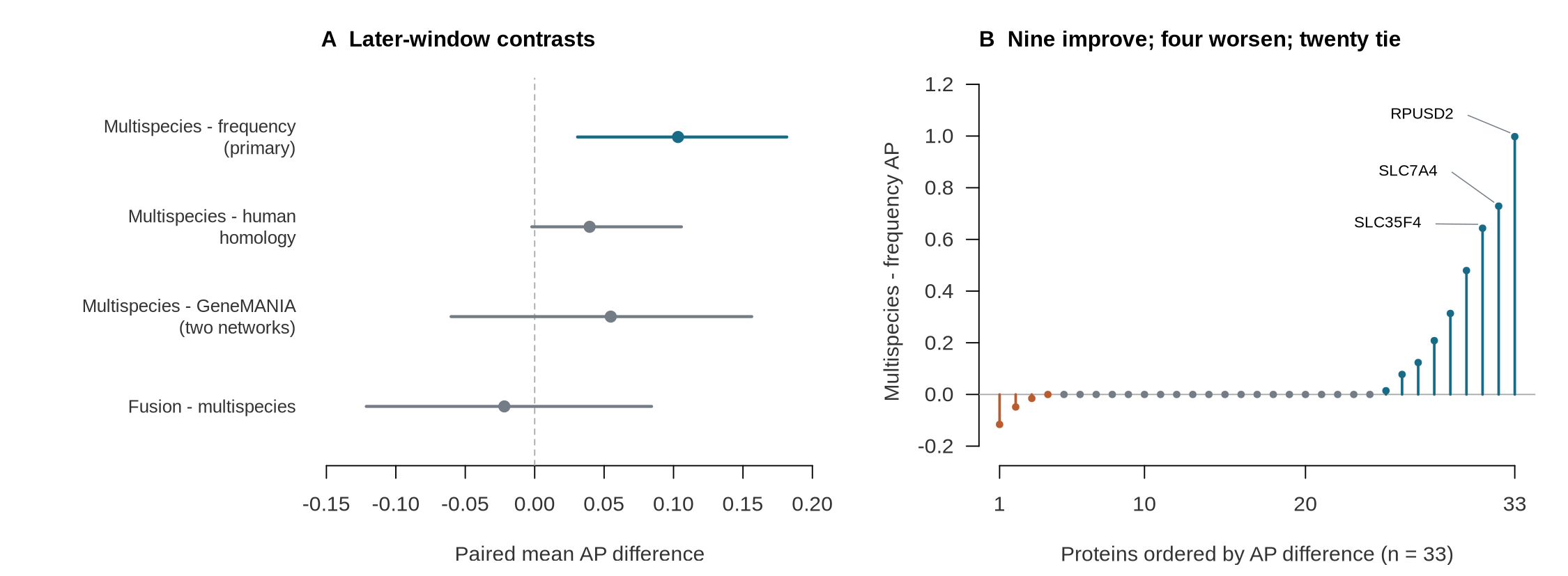
Figure 1. Homology improves average ranking over frequency, not every protein's ranking. A: paired mean AP differences on the same 33 proteins; lines are 95% percentile intervals from 10,000 publication-component bootstrap draws. Only multispecies minus frequency is the primary contrast; the other comparisons are unadjusted secondary analyses. B: all 33 individual differences, ordered from smallest to largest; labels identify the three largest gains. Zero differences are shown, not omitted. Plotted contrasts, individual differences.
Stronger comparisons are less decisive. Multispecies minus human homology was 0.0396 (publication-component interval −0.0021–0.1057), and minus GeneMANIA was 0.0548 (−0.0602–0.1563). Equal-weight physical-interaction/CRISPR/multispecies fusion scored 0.1340, a difference from multispecies alone of −0.0218 (−0.1213–0.0842). These intervals establish neither stronger-comparator superiority nor equivalence. GeneMANIA received two molecular networks rather than a homology input, so that contrast cannot isolate algorithm quality.
Table 1. Mean protein-wise AP across endpoints. Methods within a row share candidates and positives. Rows differ in cohort, labels and/or masking; their differences are not paired effects of date filtering. “Dated and novel” means reference-dated and all-evidence novel. Fusion is the fixed arithmetic mean of PPI, CRISPR and multispecies scores. Generated table and source values.
| Endpoint | Proteins | Frequency | Human homology | Multispecies homology | Three-source fusion | Two-network GeneMANIA |
|---|---|---|---|---|---|---|
| Development: experimental arrivals | 498 | 0.0689 | 0.1803 | 0.2560 | 0.1890 | 0.1149 |
| Development: all-evidence novel | 361 | 0.0389 | 0.0828 | 0.1104 | 0.0821 | 0.0662 |
| Development: dated and novel | 73 | 0.0434 | 0.0483 | 0.0746 | 0.0447 | 0.0506 |
| Later test: all-evidence novel | 246 | 0.0514 | 0.0922 | 0.1139 | 0.0933 | 0.0820 |
| Later test: dated and novel (primary) | 33 | 0.0527 | 0.1163 | 0.1559 | 0.1340 | 0.1011 |
The later test also offers two useful qualifications. On the same 33 proteins without reference-date restriction, multispecies AP was 0.1607 versus 0.0566 for frequency, difference 0.1041 (0.0346–0.1834): date screening did not create the advantage. Among the 13 proteins with zero experimental terms in both earlier snapshots, multispecies AP was 0.2387 versus 0.0722 for frequency and 0.2488 for human homology. The multispecies–frequency difference was 0.1665 (0.0449–0.2979), but this secondary subset contains only 11 publication components. It cannot support dependable inference for all poorly studied genes. All 33 primary targets had alignments, yet only 16 had any retained donor carrying an eligible experimental BP label; the corresponding count in the zero-term subset was seven. These are annotation-supported, not merely sequence-coverage, limitations. Complete later-test results.
3. New database entries are not necessarily new discoveries
Delayed annotation evaluation is established by CAFA, and its susceptibility to existing knowledge and curation lag is established prior work. Our contribution is not to discover that problem, but to quantify it in these cohorts and follow it through to predictor interpretation. GO's GAF date records when an annotation was made, not necessarily when its supporting experiment became public. Radivojac et al., 2013; Gillis and Pavlidis, 2013; GAF specification.
In development, copying accepted pre-existing GO annotations scored 0.3047 AP, versus 0.0689 for frequency, on later experimental annotation arrivals. Removing direct pairs already asserted under any positive evidence did not eliminate the advantage: copying still exceeded frequency by 0.1263 (publication-component interval 0.1047–0.1484). This remaining advantage includes already represented ancestors. Masking all candidates represented under accepted baseline positive evidence makes copying and frequency equal by construction, not because biological prediction has failed. Confirming an earlier computational annotation can be valuable science; it is simply different from nominating a previously unrepresented function.
Table 2. Copying existing annotations can perform well on experimental arrivals. “Novel direct assertions” removes direct evidence upgrades before propagation; “all-evidence novel” additionally masks already represented candidate ancestors. Zero-term counts refer to baseline direct experimental GO terms across all aspects. Generated source values.
| Development endpoint | Proteins | Zero-term | Frequency AP | Copying AP |
|---|---|---|---|---|
| Experimental arrivals | 498 | 94 | 0.0689 | 0.3047 |
| Novel direct assertions | 403 | 75 | 0.0645 | 0.1908 |
| All-evidence novel | 361 | 69 | 0.0389 | 0.0389 |
| Reference-dated only | 73 | 15 | 0.0564 | 0.1019 |
| Reference-dated and all-evidence novel | 73 | 15 | 0.0434 | 0.0434 |
Of 690 new direct BP pairs in development, journal dates alone identified 578 as citing pre-cutoff work. Linked preprints increased that count to 590, and public PubMed indexing dates to 593. Ninety-four pairs passed the later-date screen; three were unresolved. The later test showed a similar pattern: 327/377 pairs cited work dated before its 2025 publication boundary, 45 passed and five were unresolved. Eight of the older pairs also overlapped the excluded development-reference set. These are counts of assertions, not independent discoveries or papers.
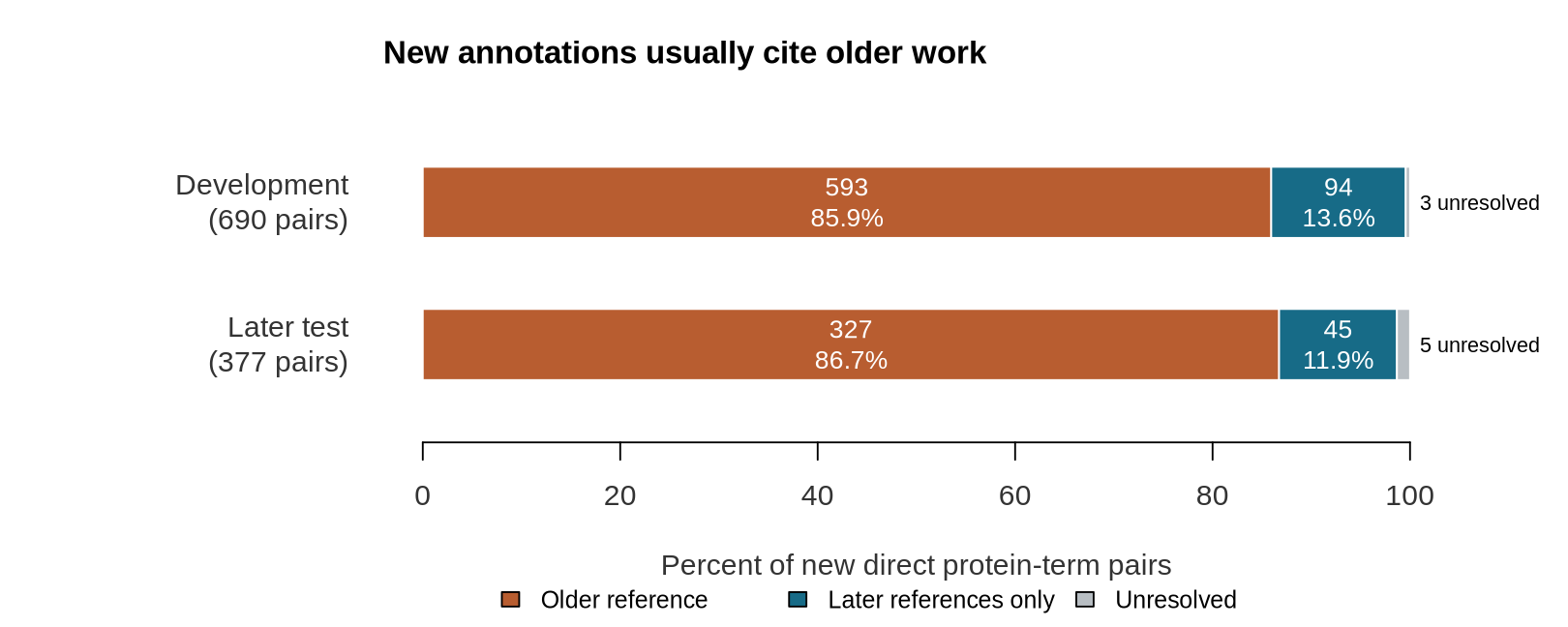
Figure 2. Reference screening removes most new direct assertions in both windows. A pair is “older” if any supporting reference has a definitely earlier public date; it passes only when every reference resolves inside the allowed later interval. Boundaries are 2023-01-15 for development and 2025-02-15 for the later test. Counts precede propagation and removal of ancestors supported by disqualified pairs. The similar percentages are descriptive; they do not establish a general curation-lag rate. Plotted counts.
Reference screening reduced development to 73 evaluable proteins. Multispecies homology retained an exploratory gain over frequency (0.0312, publication-component interval 0.0013–0.0795), but it was concentrated in the FAHD2A/FAHD2B component: 11 proteins improved, 11 worsened and 51 tied. This motivated the later fixed-score test, rather than additional model variants on the same outcomes. Earlier network controls, less favorable comparisons and matched-cohort diagnostics remain in DEVELOPMENT_RESULTS.md. Cross-endpoint AP changes cannot be attributed solely to removal of older literature because the evaluated proteins and positive sets also change.
4. The gain often concerns broader processes, not the assigned function
A post-hoc audit reconstructed all later-test candidate masks, labels and original scores. Only 21 of 45 passing direct assertions were themselves retained candidates. Eighteen of 33 proteins, including five of the nine improving over frequency, had no scoreable direct new term. Their measured success concerned broader propagated ancestors.
We therefore kept the same candidate universe and scores but changed the positive set in two descriptive checks. The most-specific retained set removes any positive that is an ancestor of another retained positive. “Most-specific” is relative to the frozen candidate vocabulary, not necessarily the biological claim made in the experiment. It preserves all 33 proteins but reduces 305 positives to 61. The direct-only set retains directly assigned candidate terms, leaving 15 proteins and 21 positives. The former still favors homology over frequency; the latter is sparse and uncertain (Table 3).
Table 3. Functional resolution changes the ranking question. Intervals use publication-component resampling. The first row preserves the original primary interval; the other rows use 10,000 post-hoc draws with seed 23019. Removed ancestors remain unlabelled candidates, and direct-only scoring selects a smaller cohort. Thus AP decreases do not estimate a “fraction of false signal.” The direct-only interval's small negative lower bound is shown rather than rounded to zero. All five methods and full-precision values.
| Positive set | Proteins / blocks | Positives | Frequency AP | Human AP | Multispecies AP | Multispecies − frequency [95% interval] |
|---|---|---|---|---|---|---|
| Propagated (primary) | 33 / 27 | 305 | 0.05265 | 0.11633 | 0.15589 | 0.10324 [0.03084, 0.18158] |
| Most-specific retained (post-hoc) | 33 / 27 | 61 | 0.00222 | 0.01641 | 0.02826 | 0.02604 [0.00516, 0.05224] |
| Direct assertions only (post-hoc) | 15 / 14 | 21 | 0.00280 | 0.01735 | 0.01291 | 0.01011 [-0.00002, 0.02645] |
Donor tracing explains both the value and the limits of high propagated AP. We reconstructed labels for all 88 labelled donors among 504 retained donor edges, and reproduced all 3,700 multispecies scores for each of the 33 targets. Unlabelled donors remained in normalization denominators. The complete audit above includes all gains, ties and losses. Three high-gain cases illustrate the donor-level mechanisms in more detail.
RPUSD2 shows coherent broad-process transfer. Its retained positives—tRNA metabolism, processing and modification—ranked first through third. The direct tRNA-pseudouridylation term was outside the candidate vocabulary. The retained historical yeast donor P53294 carried the exact direct GO:0031119 pseudouridylation label (PMID:11406626), while the later human study supplies depletion-based evidence. This is a vocabulary-imposed inability to score the tRNA-specific reaction, not absence of historical donor evidence; it does not show that the reaction would have ranked highly under a different vocabulary. Generic pseudouridine synthesis (GO:0001522) is in the vocabulary but excluded by the candidate mask for both RPUSD1 and RPUSD2. Supplemental lookups also find leucine, tyrosine, glutamine and glycine transport, UDP-D-xylose biosynthesis and bile-acid signaling outside the frozen vocabulary; these are named checks, not an exhaustive semantic mapping. Direct assertions and alternative-term probes. AP 1 therefore supports process-level transfer, not prediction of particular modified positions or RNA substrates. Xu et al., 2025, Fig. 1.
SLC7A4 illustrates why transport is not substrate specificity. L-amino acid transport ranked first, but neutral amino acid transport ranked 1603–1646, and the direct leucine-import term was outside the vocabulary. The later paper measures human SLC7A4-mediated leucine uptake with mutant controls. The benchmark's favorable broad ranking is not demonstrated prediction of that selectivity. Kolokouris et al., 2026, Fig. 3.
SLC35F4 exposes both a resolution limit and a dating failure. Three of its four evaluated ancestors received support from a human SLC35F3 thiamine-transport label. Choline transport was outside the vocabulary, and quaternary-ammonium transport ranked 2697–2837. Its AP of 0.6504 is not a substrate-specific choline prediction. More importantly, all four SLC35F2–F5 endpoint assertions cite a 2025 paper, yet a retrieved 2024-08-03 paper already reports choline-uptake experiments and kinetics for those transporters. These experiments predate the 2025 validation boundary, though not the 2023 feature cutoff: the failure concerns first-discovery dating, not predictor feature leakage. Redeker and Brockmöller, 2024, Tables 2–3; extracted evidence.
Removing all four affected proteins, including three on which homology tied frequency, leaves 29 proteins and a difference of 0.09529 (0.01842–0.18644). The signal survives this particular counterexample. This is a selected-case sensitivity, not a systematically corrected discovery cohort, an estimate of the literature-error rate, or certification of the other 29 outcomes. We retain the original primary result unchanged. Earlier resolution and selected-case audit. The complete experiment-level audit in section 1 supersedes its limited case coverage, not its unchanged sensitivity calculation.
5. Methods and reproducibility
Frozen records, eligibility and outcomes
Development uses GO releases 2023-01-01 and 2025-02-06, with buffered cutoffs 2023-01-15 and 2025-02-15 because some file-generation dates postdate nominal releases. The baseline GPI and ontology define 19,244 primary human UniProtKB protein records, joined by exact accession without current crosswalks. These are not a complete gene universe or independently verified gene-level units. Eligibility requires at most three accepted direct experimental GO terms across all aspects: 9,416 proteins, including 3,241 with none. “Understudied” here means experimentally underannotated in GO, not necessarily little studied in the literature.
Accepted experimental codes are EXP, IDA, IPI, IMP, IGI, IEP, HTP, HDA, HMP, HGI, HEP. We exclude negations, direct positive/negative conflicts, roots and ND; apply aspect-specific relation rules; resolve alternate IDs in the baseline ontology; and propagate only is_a and within-aspect part_of. Human isoform/context assertions collapse to primary protein–term units. Later terms absent from the frozen ontology cannot contribute outcomes. Candidate BP terms have propagated baseline experimental support in at least ten proteins and at most 10% of the universe, yielding 3,700 terms.
All-evidence novelty removes terms and ancestors already represented by accepted positive annotations, not merely experimental ones. For the later cohort, this mask is the union of both earlier snapshots, preventing withdrawn old annotations from becoming apparently novel. After excluding 498 development-evaluated proteins, another 345 original targets fail the 2025 underannotation requirement, leaving 8,573 targets; 2,763 have zero direct experimental terms in both snapshots. No coverage-based exclusions are applied.
The later endpoint is GO 2026-08-05, with human GAF generated 2026-07-28. Its renamed human UniProt GAF product required two URL corrections and a header-check correction before any endpoint annotation bytes were acquired. Original locks and amendments are retained; the release and scientific design did not change. Upstream packaging/QC changes remain possible temporal dataset shift. The endpoint manifest records the exact file and hash.
Reference dates and independence
All references attached to each novel direct assertion are collected across annotation rows. Current Europe PMC metadata, linked preprints and original PubMed date components are evaluation-only. Partial dates remain intervals. Received/accepted dates and pmc-release do not count as public dates; definite older publication, linked-preprint or public-indexing evidence takes precedence. Missing, non-PMID or boundary-ambiguous evidence remains unresolved. Every reference must resolve to the allowed interval for a pair to pass. In the later test, a reference attached to an experimental annotation of an excluded development protein in the 2025 snapshot also disqualifies the pair. After propagation, ancestors supported by older, unresolved or development-reference pairs for the same target are subtracted.
An older preprint might lack an experiment added later, while an older uncited experiment can evade screening. These rules therefore classify reference dates, not exact first-experiment dates, and provide no certified bound on genuine discoveries. Target and defined reference disjointness do not guarantee independence across biological families or all publications.
Predictors
Term frequency is the fraction of baseline protein records with an experimental annotation propagated to a candidate. The diagnostic copying baseline prioritizes previously accepted annotations and uses frequency to break ties. All molecular and sequence scores come from archived data and code, never from biological prose or later papers supplied by a language model.
Human and multispecies homology use canonical Swiss-Prot 2022_04 sequences and DIAMOND 2.1.8, very-sensitive mode, E-value ≤0.001, identity ≥30%, and coverage ≥50% of both sequences. Accession self hits are removed. Up to 50 donors are selected by identity times minimum coverage, with stable accession tie-breaking, before considering labels. Scores are weighted fractions carrying each frozen experimental BP label; all retained donors, including unlabelled ones, enter the denominator. No qualifying donor triggers frequency fallback; all scores receive a 10^-6 × frequency tie-breaker. Thus donors without labels can yield the same ranking as frequency without frequency-scale scores. Sequence specification; Buchfink et al., 2021.
Nonhuman labels come from nine historical GAFs: residual UniProt non-IEA, MGI, RGD, SGD, FlyBase, WormBase, ZFIN, TAIR and PomBase. They require exact primary accessions or unique historical source mappings, matching taxa, accepted positive relations and qualifier/conflict checks. Swiss-Prot GO display cross-references do not supply labels. The panel contains 547,962 nonhuman sequences, but only 28,010 nonhuman donors have eligible propagated BP labels. Exact species/strain matching loses some valid model-organism coverage. This baseline is neither orthology-aware nor taxon-balanced; the larger search database also changes E-values and donor composition relative to human-only transfer. Multispecies specification.
Molecular graphs use DepMap 22Q4 version 1 Chronos gene effects (16,932 mapped genes) and BioGRID 4.4.216 human physical interactions (730,647 unique undirected edges). The DepMap input is the Harmonia-integrated Avana/KY model-level matrix, not an Avana-only dataset; see the release README. DepMap mapping uses historically unique symbols; BioGRID uses exact unambiguous baseline accessions. CRISPR votes use the 50 strongest positive Pearson correlations, not Wainberg's covariance-corrected pipeline. Frozen experimental labels supply neighbor votes. Fusion averages the three uncalibrated score arrays equally. Network specification; Wainberg et al., 2021.
The local GeneMANIA adaptation uses the same two molecular graphs. It fits nonnegative-pruned ridge weights with an unpenalized intercept on positive–positive and positive–algorithmic-negative pairs, including zero-edge pairs. Algorithmic negatives have experimental annotation but not the tested term; they are not established biological negatives. Graphs are symmetrized and degree-normalized. Propagation solves (I + D − W) f = y by conjugate gradients at relative tolerance 10^-8, with specified seed biases, fallback and score scaling. This is an implementation of published ideas, not the deployed service or a reproduction of its reported accuracy. Exact fitting conventions and dense-reference checks are in GENEMANIA_PILOT.md. Mostafavi et al., 2008.
Scoring, uncertainty and analysis status
For each protein, noninterpolated AP sums precision at each distinct score threshold, weighted by the fraction of positives entering at that threshold. Equal scores form one group. We average AP equally over proteins with observed positive outcomes; unannotated candidates are not verified biological negatives. These AP values measure annotation ranking, not experimental success probabilities. All methods share candidates within each comparison, and targets without source coverage remain included.
The later test fixes one primary contrast: multispecies minus frequency on reference-dated, all-evidence-novel outcomes. We use 10,000 paired percentile-bootstrap draws. Publication components connect proteins sharing references in the complete new-pair ledger, including unevaluated bridging proteins. Blocks are sampled with replacement; each draw retains protein-weighted means rather than giving every component equal weight. Protein and shared-retained-donor resampling are sensitivities; donor components are not established evolutionary families. Comparisons to stronger methods, zero-term results and influence diagnostics were specified before acquisition but remain secondary and unadjusted. Fewer than 20 components is flagged as sparse. Seeds and draw order are fixed in VALIDATION.md.
Development outcomes were exposed before successive molecular and sequence pilots. Freezing each pilot before its evaluator ran does not remove that hindsight. The broader scope and preregistration documents are design archives, not evidence that their full proposed pipeline was completed or approved. The resolution, selected-case and complete-cohort experimental audits are explicitly post-hoc. Local hashes document the sequence of work but are not independently trusted timestamps.
Complete-cohort experimental audit
The experimental audit uses a fixed assertion universe, not a sample selected by AP. Its 112 Europe PMC queries, explicit aliases and follow-ups, retrieval attempts, source hashes and single-auditor judgments are supplied separately. Two broad searches hit the 1,000-record API cap and received narrower follow-ups; no exhaustive literature coverage is claimed. Primary-text access varies, and an HTTP success is not treated as proof of full-text availability. Bibliographic projections permit deterministic count/rank regeneration without relying on a changing live search index. The earliest located mechanism report and older process-level evidence are separate fields; human assays, nonhuman experiments and human associations are not interchangeable. These limitations preclude a certified first-discovery census or a novelty-corrected efficacy estimate. Full protocol and category rules.
The pipeline requires Python, NumPy, SciPy, pandas, requests and DIAMOND 2.1.8; figure generation uses base R, not additional plotting packages. The manuscript build used Python 3.12, NumPy 2.5.4, SciPy 1.18.1, pandas 3.1.0, requests 2.34.2 and R 4.4.3.
Validation used the exact 44 derived citation/date projections used in evaluation without rewriting historical manifests or locks. New acquisition metadata are logged separately. The only transport reconstruction replaces a randomized BioGRID email-protection token with its original encoding, requiring the same decoded address and an exact whole-page hash match. Other changed bytes fail. This is an explicit acquisition repair, not a new prediction lock or an independently timestamped deposit. Protocol, metadata snapshot and transport rule.
A completed empty-data reproduction downloaded 24 inputs (2.233 GB), rebuilt all predictors and regenerated all 34 benchmark CSV ledgers, which matched byte for byte. Original locks, prediction hashes, cohorts, resolution outputs and the four PNG/SVG figure files also matched. Only the later summary's evaluation timestamp—and consequently the paper asset manifest—changed. The first failed acquisition attempt is retained. Clean reproduction report; acquisition fault checks. Independent AP/bootstrap and resolution checks also passed. Later checks; resolution checks. This replay covers the original benchmark and resolution assets, not the new complete-cohort literature audit or the separate biological extension.
6. What this establishes—and what it does not
The cohort audit separates later human experimental support from older reports, species extrapolation and unresolved attribution. Five AP-improving proteins have later human assays without an earlier human match located, but no top-ten ligand/substrate-specific success is established by the two direct labels recovered there. Historical homology also retains useful annotation-ranking signal against frequency in a previously unused target cohort. Its practical boundary is concrete: a broad process can rank well without the direct function being a candidate at all, and a newly cited paper can report a function already tested elsewhere. Annotation arrival, confirmation of an existing assignment, a previously unrepresented assignment and first experimental discovery are different outcomes.
For this program, the benchmark supports retaining historical homology as a baseline, not advancing a gene to experimental follow-up on AP alone. A discovery-oriented nomination needs a stated functional resolution, an audit of prior experiments rather than only cited dates, and evidence bearing on that function. The SLC35F4 case makes the distinction concrete: transfer from a thiamine-transport label can help rank broad transport processes without predicting choline selectivity. We have not demonstrated an integration advantage. The tested uncalibrated averages and two graph constructions do not exhaust multi-omic methods; no co-expression, structure or population-constraint predictor was evaluated. Wide secondary intervals do not establish universal network failure or homology superiority over modern alternatives. Revised methods require another unused test, not tuning against these now-exposed outcomes.
Both windows are selected by what researchers study and curators annotate. Incomplete labels, restricted vocabulary, accession/taxon mapping, correlated outcomes and stale 2023 scores limit generalization. The small reference-screened cohort and sparse zero-term subset do not estimate genome-wide nomination precision. The present whole-cohort audit remains bounded, single-auditor and post-hoc; its no-earlier-match category is not certified first discovery. Independent literature adjudication could change its category counts. A specified functional resolution and prospective experimental follow-up would still be needed to establish useful specific-function nominations. No prospective gene nominations are issued here.
Separate exploratory biological follow-up
A separate code-nominated TMEM60 follow-up illustrates why these results do not by themselves justify a biological nomination. Its proposed ER-calcium role remained unvalidated after RNAi and STING non-confirmations. Some CRISPR covariance survived shared-guide exclusion, but depended on library/processing and did not clearly replicate in a later 40-model Cas12 panel. We therefore deprioritized high-confidence nomination, without claiming the hypothesis was disproved. The guide/library audit is exploratory, outside the benchmark test, and changes none of its scores or outcomes.
References
- Radivojac P et al. (2013). A large-scale evaluation of computational protein function prediction. Nature Methods 10:221–227. doi:10.1038/nmeth.2340.
- Gillis J, Pavlidis P (2013). Characterizing the state of the art in the computational assignment of gene function: lessons from the first critical assessment of functional annotation (CAFA). BMC Bioinformatics 14(Suppl 3):S15. doi:10.1186/1471-2105-14-S3-S15.
- Mostafavi S et al. (2008). GeneMANIA: a real-time multiple association network integration algorithm for predicting gene function. Genome Biology 9(Suppl 1):S4. doi:10.1186/gb-2008-9-s1-s4.
- Wainberg M et al. (2021). A genome-wide atlas of co-essential modules assigns function to uncharacterized genes. Nature Genetics 53:638–649. doi:10.1038/s41588-021-00840-z.
- Buchfink B, Reuter K, Drost HG (2021). Sensitive protein alignments at tree-of-life scale using DIAMOND. Nature Methods 18:366–368. doi:10.1038/s41592-021-01101-x.
- Xu H et al. (2025). A comprehensive tRNA pseudouridine map uncovers targets dependent on human stand-alone pseudouridine synthases. Nature Cell Biology. doi:10.1038/s41556-025-01803-w.
- Kolokouris D et al. (2026). Structural basis for pH-responsive amino acid transport via SLC7A4. Nature Communications. doi:10.1038/s41467-026-70956-5.
- Redeker K-EM, Brockmöller J (2024). Several orphan solute carriers functionally identified as organic cation transporters: Substrates specificity compared with known cation transporters. Journal of Biological Chemistry 300:107629. doi:10.1016/j.jbc.2024.107629.
Versioned GO, Swiss-Prot, DepMap and BioGRID inputs are indexed with acquisition URLs and hashes in the label, network, sequence, multispecies and later-endpoint manifests. Primary-paper retrievals are indexed in the paper manifest.