An Alzheimer-linked immune gene variant shows little association with breast cancer
Why it matters
An inherited TREM2 change linked to Alzheimer disease showed almost unchanged breast-cancer odds in two biobanks; their uncertainty range still allows about one-tenth lower odds. A second change was too rare for a comparably clear answer. These results concern developing cancer, not whether a TREM2 drug can help treat an existing tumor.
Could weakening an immune receptor increase Alzheimer disease risk while protecting against cancer? The receptor, TREM2 (triggering receptor expressed on myeloid cells 2), helps immune cells respond to their surroundings. Reducing its activity can impair brain immune function yet improve tumor control in mice. Whether that trade-off extends to people's chances of developing cancer remains unsettled and matters for interpreting TREM2 as a treatment target.
In two independent biobanks, collections linking genetic data to health information, an Alzheimer-risk variant of the TREM2 gene called R62H showed almost unchanged breast-cancer odds. Its pooled odds ratio was 0.997 (95% confidence interval 0.918–1.083; interval adjusted for six tests 0.892–1.114). An odds ratio below one means lower disease odds per copy of the variant; one means no association. The adjusted range allows roughly 11% lower breast-cancer odds. A protective association in a separate collection of breast-cancer studies, significant before adjustment for multiple tests, was not reproduced in the biobank pool. Colorectal and lung estimates were less conclusive; a rarer TREM2 variant, R47H, remained too sparsely measured to test a comparable trade-off.
Background
TREM2 occurs on immune cells, including microglia, the resident immune cells of the brain, and macrophages, immune cells found in tumors and other tissues. It recognizes molecules outside the cell and helps regulate the cell's response. Two Alzheimer-associated variants, R47H and R62H, replace the amino acid arginine with histidine at positions 47 and 62 of the protein. Each variant form of the gene is called an allele. Kober and colleagues showed that these variants bind less well to molecules on cell surfaces. These binding partners, called ligands, include glycosaminoglycans, sugar-containing molecules on cell surfaces. These variants alter a binding surface rather than simply eliminating the receptor. 1
In mouse tumor models, Molgora and colleagues found that deleting TREM2 or blocking it with an antibody reduced tumor growth and improved responses to immunotherapy that blocks programmed cell death protein 1 (anti-PD-1), releasing a brake on immune-cell attack. They also detected TREM2 in macrophages from human tumors. Those findings motivate a human susceptibility question: do inherited changes that impair TREM2 binding and increase Alzheimer risk also protect against cancer? 2
We selected R47H and R62H from the functional evidence before inspecting their cancer associations. We examined colorectal, breast and lung outcomes separately. Alzheimer disease served as a positive control: an outcome already associated with these variants that could confirm their biological relevance in the data. FinnGen links Finnish genetic data to health records; Pan-UKB provides genetic association results from UK Biobank, a British health research cohort. Larger collaborations combining colorectal and breast cancer studies supplied additional estimates. All analyses used European-ancestry results. Below, OR abbreviates odds ratio and CI abbreviates confidence interval; an OR above one means higher disease odds.
Results
R62H breast-cancer odds are near one in independent biobanks
Pooling FinnGen and Pan-UKB gave an R62H breast OR of 0.997 (95% CI 0.918–1.083; P=0.94), with little evidence that the estimates differed between sources (heterogeneity P=0.47). These are separate Finnish and UK populations. The six-test interval, widened for the two selected alleles across three cancer sites, was 0.892–1.114. Smaller reductions remain compatible with the data.
The Breast Cancer Association Consortium (BCAC), a collaboration combining breast-cancer studies, had a more protective estimate, OR 0.915 (0.852–0.983; P=0.0146). Combining BCAC with Pan-UKB gave 0.942 (0.885–1.002; P=0.059). Adding FinnGen gave 0.949 (0.899–1.002; P=0.057), with a six-test interval of 0.883–1.020. The biobank pool is the principal estimate because it uses separate populations. The all-source pool tests how the result changes when BCAC is included; Finnish BCAC studies could share participants with FinnGen.
Table 1. Cancer associations per copy of the histidine-encoding allele. Intervals are ordinary 95% confidence intervals. NSCLC means non-small-cell lung cancer, a broad group of lung cancers; all histologies means all tissue types. CRC abbreviates colorectal cancer, R13 identifies FinnGen release 13, and EUR identifies European-ancestry results. The colorectal consortium includes some adenomas, precancerous growths; FinnGen counts colorectal adenocarcinoma, cancer arising from gland-forming cells. Unavailable means no estimate was recovered.
| Source and endpoint | R47H OR (95% CI) | R62H OR (95% CI) |
|---|---|---|
| CRC consortium, colorectal cancer | 1.044 (0.753–1.447) | 1.101 (1.002–1.209) |
| FinnGen R13, colorectal adenocarcinoma | 0.902 (0.374–2.174) | 0.857 (0.719–1.020) |
| Pan-UKB EUR, colorectal cancer | 1.220 (0.837–1.777) | 1.067 (0.883–1.289) |
| BCAC 2017, breast | Unavailable | 0.915 (0.852–0.983) |
| FinnGen R13, breast | 0.797 (0.481–1.319) | 0.971 (0.870–1.083) |
| Pan-UKB EUR, breast | 1.126 (0.868–1.461) | 1.033 (0.910–1.172) |
| FinnGen R13, NSCLC | 1.875 (0.731–4.808) | 1.015 (0.837–1.232) |
| Pan-UKB EUR, lung (all histologies) | 0.820 (0.502–1.338) | 0.807 (0.630–1.034) |
Lower-precision studies contribute to the BCAC estimate
BCAC combines studies using OncoArray and iCOGS, two platforms for measuring genetic variants, with earlier studies. OncoArray, the largest component, supplied 64.2% of the statistical weight and had OR 0.965 (0.883–1.055). Imputation estimates unmeasured genetic variants from nearby markers; the INFO score summarizes the certainty of those estimates. iCOGS had lower INFO, a lower frequency of the variant among controls without breast cancer and a more protective estimate (Table 2). Omitting iCOGS and earlier studies from the all-source pool gave OR 0.982 (0.924–1.043; six-test interval 0.905–1.066), still subject to possible Finnish overlap.
Table 2. Contributions to BCAC's R62H breast association. Weights use inverse variances of the log odds ratios, giving more precise estimates greater influence.
| BCAC component | Imputation INFO | Control allele frequency | Weight | R62H OR (95% CI) |
|---|---|---|---|---|
| OncoArray | 0.821 | 1.26% | 64.2% | 0.965 (0.883–1.055) |
| iCOGS | 0.602 | 0.95% | 30.4% | 0.839 (0.737–0.954) |
| Earlier studies | Not supplied | 1.26% | 5.4% | 0.792 (0.583–1.075) |
Combining the components reproduced the released effect estimate and its standard error, a measure of statistical uncertainty, to rounding. Cochran's Q test measures variation between estimates beyond that expected from sampling alone. It gave Q=4.011 on two degrees of freedom (P=0.135). Sampling variation and imputation differences therefore remain possible explanations for the component differences; the data do not identify an imputation artifact.
Colorectal and lung estimates are less conclusive
For R62H, the colorectal consortium gave OR 1.101 (1.002–1.209), while FinnGen gave 0.857 (0.719–1.020). Their contrast had P=0.013 assuming independence, uncorrected for multiple comparisons. A fixed-effect pool, which assumes a common underlying effect and here ignores possible shared participants, was 1.041 (0.958–1.130), with heterogeneity P=0.013. Neither source association passed the six-test threshold. These are noisy estimates on opposite sides of one. Shared participants could make the estimates statistically correlated, making the pooled standard error unreliable. Positive correlation would narrow the uncertainty in their contrast rather than explain the difference. Adenomas comprised only 4% of consortium cases, offering no demonstrated explanation for the gap.
An additional Pan-UKB colorectal estimate was 1.067 (0.883–1.289), from 5,693 cases. This checks FinnGen in a separate population but overlaps the colorectal consortium's UK Biobank contribution. Pooling FinnGen NSCLC with Pan-UKB lung cancer covering all tissue types gave R62H OR 0.931 (0.800–1.084; six-test interval 0.759–1.143; heterogeneity P=0.15). The lung pool is a sensitivity analysis across different endpoint definitions.
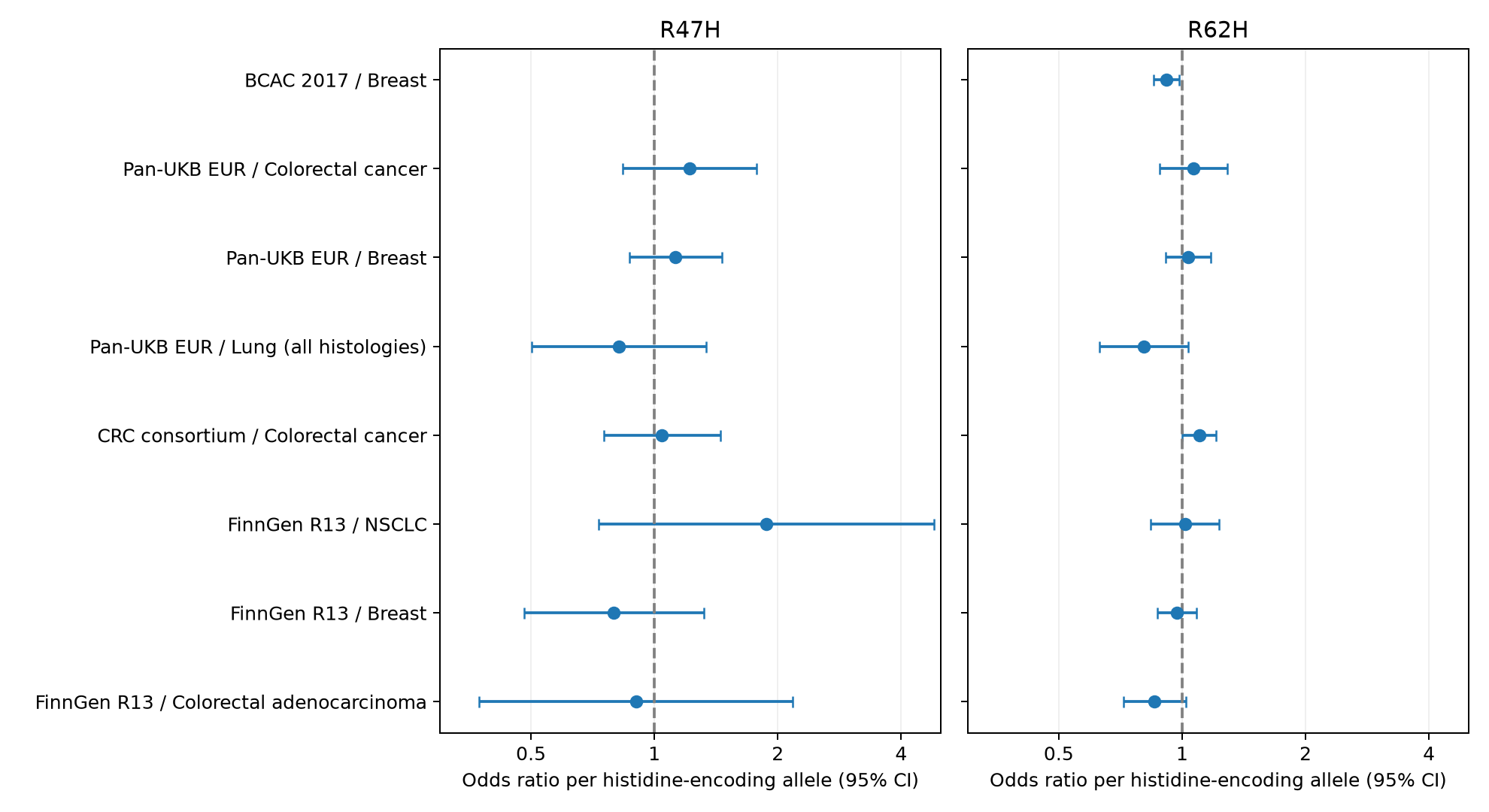
Figure 1. Source-specific odds ratios and 95% confidence intervals on a logarithmic scale. The vertical line marks no association. These individual estimates underlie the pools described in the text.
Alzheimer associations and precision for the rarer variant
FinnGen's R62H Alzheimer OR was 1.222 (1.073–1.392), among 16,652 cases and 483,534 controls. Pan-UKB gave 1.362 (0.832–2.229). A large published analysis combining Alzheimer studies reported OR 1.67 for R62H and 2.46 for R47H. Thus, FinnGen supports the expected direction for R62H but a smaller association than the published estimate. 7
R47H was especially sparse in Finland. Frequencies imply about 18 Alzheimer case alleles and about 5, 17 and 8 case alleles for colorectal, breast and NSCLC outcomes, respectively. These counts estimate the number of variant copies from reported frequencies; they are not observed counts of people carrying the variant. FinnGen's adjusted Alzheimer OR was 2.337 (1.188–4.595), whereas the frequency-derived unadjusted allelic OR was 1.304 (approximately 0.814–2.091). In Pan-UKB, about 16 Alzheimer case alleles gave an unadjusted OR of 3.570 (2.174–5.861), compared with the model OR of 16.827 (4.980–56.858). Adjustment for other measured characteristics and unstable models for rare variants can contribute to these discrepancies. The extreme Pan-UKB estimate is unsuitable as a benchmark for effect size, even though its quality-control field did not flag it as low confidence.
R47H's pooled biobank breast OR was 1.047 (six-test interval 0.767–1.429), and its pooled lung OR was 0.978 (0.545–1.755). The colorectal consortium interval was 0.673–1.619. These leave substantial effects open, so the R62H conclusion cannot be extended to R47H.
Exploratory endpoints and regional variants
An exploratory FinnGen all-cancer endpoint, with 128,001 cases, gave R62H OR 0.999 (95% CI 0.945–1.057). Melanoma, with 6,226 cases, gave 1.023 (0.839–1.248). These checks were chosen after examining the main results. They support an overall cancer association close to one, though combining cancer sites can conceal site-specific effects. They share cases with the main FinnGen outcomes.
Two nearby DNA variants had stronger FinnGen Alzheimer associations. The notation G>A denotes replacement of guanine by adenine in the DNA sequence. rs1242248932 G>A gave Alzheimer OR 2.036 (1.558–2.662; P=1.9×10⁻⁷), breast OR 1.125 (0.862–1.469), colorectal OR 0.863 (0.556–1.339), and NSCLC OR 1.401 (0.867–2.264). rs201258314 G>A gave Alzheimer OR 3.005 (1.780–5.072), breast OR 0.778 (0.453–1.337), colorectal OR 1.007 (0.406–2.496), and NSCLC OR 1.010 (0.360–2.833). Ensembl's Variant Effect Predictor, software that predicts how DNA changes affect genes, confirms that the latter encodes R62C, replacement of arginine with cysteine at position 62 in TREM2. These exploratory regional checks were selected by Alzheimer signal after the primary analysis; their effects on protein function and tendency to be inherited with the selected variants remain unresolved.
Interpretation
R62H, the better-measured variant with impaired binding, has breast-cancer odds close to one in two independent biobanks. Their interval adjusted for six tests places the plausible protective effect within roughly 11% lower odds, while the all-source sensitivity analysis permits roughly 12%. The exploratory all-cancer estimate also centers on one. The data constrain the proposed inherited protection against cancer most clearly for R62H and breast cancer; R47H and individual colorectal and lung effects remain weakly resolved.
Inherited variants with impaired binding need not mimic complete TREM2 deletion or antibody treatment, and their Alzheimer associations do not quantify TREM2 inhibition in tumor macrophages. These comparisons of cases and controls concern diagnosed cancer, so they leave the experimental rationale for treating established tumors intact. Dementia-associated changes in survival or diagnosis could affect the cancer associations. The breast-cancer interval is a statistical bound, not a clinical equivalence threshold. European ancestry, incomplete measurement of rare variants and possible shared participants in consortium pools further limit generalization.
Methods
Alleles and data sources
We identified each variant by chromosome, position and both DNA bases, rather than its identifier alone. Both identifiers also include a C>A change, from cytosine to adenine, encoding the amino acid leucine. The histidine-encoding alleles are C>T, from cytosine to thymine. GRCh38 and GRCh37 are versions of the reference human genome used to specify positions: R47H is rs75932628 at GRCh38 chromosome 6 position 41,161,514 (GRCh37 41,129,252), and R62H is rs143332484 at GRCh38 41,161,469 (GRCh37 41,129,207). All effects describe the odds associated with the T allele. The two variants were analyzed separately because the assays do not establish a shared quantitative reduction in receptor function.
We extracted public FinnGen release 13 summary statistics, the released association estimates rather than individual records, for Alzheimer disease (G6_ALZHEIMER), colorectal adenocarcinoma (C3_COLORECTAL_ADENO), breast cancer (C3_BREAST_WIDE) and NSCLC (C3_LUNG_NONSMALL_WIDE). Their case/control counts were 16,652/483,534, 8,624/372,159, 25,272/218,713 and 6,868/372,159, respectively. 3
Additional sources were the European colorectal consortium release GCST90255675, BCAC's 2017 overall breast-cancer release GCST004988, and European Pan-UKB results. The colorectal supplement listed 78,473 cases and 107,143 controls across 17 groups analyzed separately, including 3,161 adenoma cases. BCAC reported 122,977 cases and 105,974 controls overall. These totals are not verified variant-specific sample sizes. Pan-UKB groups diagnoses using numeric disease codes called phecodes. It contributed female breast cancer (phecode 174.1; 13,257/205,913), lung cancer (165.1; 3,337/416,654), Alzheimer disease (290.11; 839/410,833), and colorectal cancer (153; 5,693/386,740). 4, 5, 6
Exploratory FinnGen endpoints were all cancer (C3_CANCER_WIDE; 128,001/372,185) and melanoma (C3_MELANOMA_SKIN_WIDE; 6,226/372,159). These outcomes and the regional variants were examined after inspecting the primary results; their descriptive 95% intervals are unadjusted for testing multiple associations.
Quality and statistical analysis
FinnGen aggregate imputation INFO was 0.8974 for R47H and 0.9977 for R62H. These annotation data came from a different sample size than the association analysis, so their allele counts were not interpreted as disease-specific carrier counts. For every requested Pan-UKB variant row, the low-confidence flag was set to false, meaning the release did not mark that estimate as low confidence. The colorectal consortium used a threshold of 50 copies of the less common allele in five groups analyzed separately and a frequency threshold of 0.005 for that allele in the others. R47H's frequency is below the latter threshold, precluding assignment of the full consortium sample to that allele. Variant-specific contributions and imputation quality were unavailable. The released within-consortium heterogeneity statistic I², the estimated share of variation attributable to differences between studies rather than sampling, was zero for both alleles. The release retained results with I²<65%.
For BCAC, we checked that columns identified the same effect allele and combined estimate in 1,000 matched rows from the original release and its compact file in the Genome-Wide Association Studies (GWAS) Catalog, a public repository of genetic association results. We then retrieved the original target row with component estimates and INFO. R47H was absent from the retrieved BCAC region. A search of the relevant genomic region in an additional lung cancer consortium release did not yield either target allele. Missing variants were treated as unavailable.
We converted log odds coefficients to odds ratios by exponentiation and calculated 95% Wald intervals, a normal-approximation method, using 1.96 standard errors. Source P values were retained because rare-variant association tests can differ from coefficient-based Wald tests. To examine the effect of adjustment for multiple tests, we used a two-sided threshold of 0.05/6 and intervals extending 2.638 standard errors for two alleles across three cancer sites. These intervals do not provide simultaneous coverage across every source and positive control. BCAC component weights were inverse variances, and heterogeneity was assessed with Cochran's Q. Calculations used the Python programming language with the numerical and data-analysis libraries NumPy, pandas and SciPy.
We pooled estimates within each allele and cancer site using an inverse-variance fixed-effect model, which gives more precise estimates greater weight and assumes a common underlying effect. The principal breast pool combines FinnGen and Pan-UKB, separate national cohorts. BCAC plus Pan-UKB is an additional pool with no identified overlap; the 2017 BCAC report does not list UK Biobank. Pools combining BCAC with FinnGen, including the OncoArray sensitivity, assume no statistical correlation despite possible shared Finnish participants and are labeled accordingly. The colorectal consortium includes Finnish and UK Biobank contributions; its pool ignoring overlap is descriptive only. Lung pooling assumes a shared allele effect across NSCLC and lung cancer of all tissue types. Heterogeneity tests have limited power. The pooling strategy was added after inspecting source estimates.
To check the model estimates against allele frequencies, expected case and control allele counts were twice the corresponding sample sizes multiplied by allele frequencies. Unadjusted allelic odds ratios and approximate Wald intervals used these fractional counts; they are diagnostics, not replacements for adjusted association models. Cancer and Alzheimer coefficients were analyzed on their own scales; Alzheimer coefficients provide no quantitative scale for TREM2 inhibition in tumors.
References
-
Kober DL et al. Neurodegenerative disease mutations in TREM2 reveal a functional surface and distinct loss-of-function mechanisms. eLife (2016). doi:10.7554/eLife.20391.
-
Molgora M et al. TREM2 modulation remodels the tumor myeloid landscape, enhancing anti-PD-1 immunotherapy. Cell (2020). doi:10.1016/j.cell.2020.07.013.
-
Fernandez-Rozadilla C et al. Deciphering colorectal cancer genetics through multi-omic analysis of 100,204 cases and 154,587 controls of European and East Asian ancestries. Nature Genetics (2023). doi:10.1038/s41588-022-01222-9. European-ancestry summary release GCST90255675.
-
Michailidou K et al. Association analysis identifies 65 new breast cancer risk loci. Nature (2017). Full text. Summary release GCST004988.
-
Pan-UKB team. Pan-ancestry UK Biobank association results and documentation.
-
Sims R et al. Rare coding variants in PLCG2, ABI3 and TREM2 implicate microglial-mediated innate immunity in Alzheimer’s disease. Nature Genetics (2017). doi:10.1038/ng.3916.