Variants for a two-leaflet heart valve and for valve narrowing showed opposite links to bowel blood vessel disease in Finland and US veterans, but not in UK Biobank
Why it matters
A heart valve formed with two flaps instead of three often narrows later in life. In Finland and US veterans, variants linked to the two-flap valve tracked fewer diagnoses of poor blood supply to the bowel, while variants linked to an operation for valve narrowing tracked more. A broader British diagnosis did not show that split, so these results are no reason to think that having a two-flap valve protects the bowel.
A person born with two leaflets in the aortic valve instead of the usual three is prone to narrowing of that valve later in life. Do the genetic variants that predict this valve shape and those that predict severe narrowing also point to the same risk of poor blood supply to the bowel? One difficulty is that a diagnosis of intestinal vascular disease can cover both a shortage of blood (ischemia) and abnormal vessels that can bleed.
In Finland, variants more strongly associated with a two-leaflet (bicuspid) valve predicted lower odds of a bowel ischemia diagnosis. For a doubling in the genetically predicted odds of the valve diagnosis, the bowel odds ratio was 0.90. For variants linked to narrowing severe enough to require surgery (operated aortic stenosis), the corresponding odds ratio was 1.13. US veterans showed a similar split for intestinal vascular insufficiency (0.89 versus 1.19). In UK Biobank, a British population study, the two estimates were close to one another and to one, the value for no association (0.97 versus 0.98).
Valve anatomy and bowel disease
The aortic valve controls blood flow from the heart into the aorta. A genetic study combining 17 cohorts found 36 regions of the genome associated with a bicuspid valve. Some variants that predict a bicuspid valve also predict aortic stenosis. A score combining variants from the study also predicted disease outside the valve, including enlargement of the aorta in the chest (thoracic aortic aneurysm). Aortic stenosis has a familiar clinical link to the intestine: dilated intestinal vessels, called angiodysplasia, can bleed. Studies of patients with both conditions address bleeding, leaving open the question of ischemia.
A genetic scan of eight Finnish diagnoses covered 171 million variant–diagnosis records; six scans examined diagnoses in US veterans. In Finland, variants linked to peripheral artery disease (narrowed arteries supplying the limbs), atrial fibrillation (an irregular heart rhythm) and operated stenosis each tended to predict more intestinal vascular disease. Of 9.45 million variants in the bicuspid-valve scan, 8.45 million met the quality and frequency criteria, 1,323 met the statistical significance threshold, and 36 remained after selection of the strongest variant per region. These variants predicted more bicuspid-valve diagnoses and more operated stenosis in Finland, yet fewer bowel ischemia diagnoses.
Comparison of the two sets of variants
To distinguish the associations of valve shape and narrowing, we compared the 36 bicuspid-valve variants with 36 variants linked to operated calcific aortic stenosis in Finland, where calcium buildup narrows the valve. We excluded variants within one million DNA bases of a selected variant for the other diagnosis. That left 30 variants in each set. For each set we asked whether variants with a stronger link to the valve diagnosis also had a stronger link to the bowel diagnosis. The odds ratios in Figure 1 express that relationship per doubling of the genetic odds of the corresponding valve diagnosis. They compare associations across variants rather than outcomes between patients.
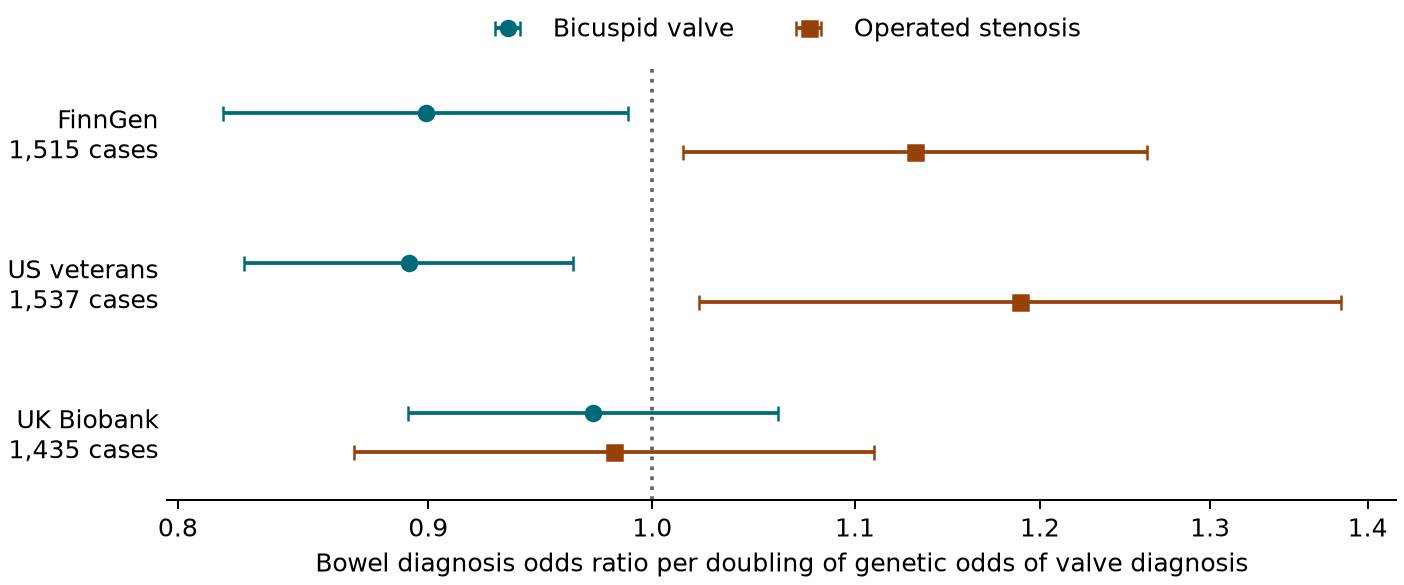
Figure 1. Bowel odds ratios for the two nonoverlapping sets of variants. Points show estimates; lines show nominal 95% confidence intervals. For the Finnish bowel ischemia diagnosis in the FinnGen study, 29 bicuspid-valve variants and 30 operated-stenosis variants matched. For intestinal vascular insufficiency, the corresponding counts were 29 and 26 in the US Million Veteran Program and 30 and 28 in UK Biobank.
Dividing the bowel odds ratio for the stenosis variants by that for the bicuspid-valve variants measures the difference between the sets. A value of one means equal estimates. The ratio was 1.26 (95% confidence interval 1.09–1.46) in Finland and 1.33 (1.12–1.58) in veterans. It stayed above one whichever chromosome we left out. The full set of bicuspid-valve variants showed little association with disease in other arteries in Finland: the odds ratios were 1.03 for coronary disease, which affects the arteries supplying the heart, and 1.02 for peripheral artery disease.
For the broad UK bowel diagnosis, the ratio was 1.01 (0.87–1.17). That interval allows a smaller difference between the sets but excludes both the Finnish and US point estimates. Using identical variants and weights across cohorts gave ratios of 1.26 in Finland, 1.35 in veterans and 1.02 in Britain. Neither missing variants nor differences in their weights explain the UK result.
Which bowel diagnoses counted
The UK and US studies used the label “vascular insufficiency of intestine” for different groups of diagnoses. The UK map of diagnosis codes includes angiodysplasia of the colon (code K55.2) in the broad category (441) but excludes it from the acute subcategory (441.1). The US code map assigns colonic angiodysplasia with or without bleeding to a separate category (556.11). For that category, the two sets of valve variants gave similar estimates in veterans (Table 1).
A genetic marker helped distinguish what the codes capture. We used the G allele (the version with a G base) at the variant site designated rs4871846 on chromosome 8 because in veterans each copy predicted lower odds of angiodysplasia (odds ratio 0.70, 0.62–0.80) but little difference in insufficiency (1.02, 0.94–1.10). In Britain, the same allele predicted fewer diagnoses under the broad code (0.89, 0.82–0.96); the acute estimate was less precise (0.96, 0.82–1.11). This pattern is consistent with the broad UK code capturing angiodysplasia.
Finland illustrates why including angiodysplasia need not erase the contrast. The Finnish circulatory disease definition includes acute, chronic and unspecified intestinal vascular disease (K55.0, K55.1 and K55.9). The digestive disease definition accepts all K55 codes and excludes different groups from the controls. The Finnish registry reports 864 cases with an angiodysplasia code under the broader definition, yet the ratio between the variant sets remained above one (Table 1).
Acute disease alone gave little support for an inverse bicuspid-valve association. The British acute estimate was close to one. In the Estonian Biobank study of intestinal vascular disorders, the estimate was above one for acute disease and below one for chronic disease, with few cases of either (Table 1). Including all bicuspid-valve regions, even those shared with stenosis, gave a chronic estimate of 0.83 (0.66–1.03). Whether the association differs between acute and chronic disease remains uncertain.
Table 1. Bowel odds ratios (nominal 95% confidence intervals) per doubling of the genetic odds of each valve diagnosis, using the nonoverlapping sets of variants. The last column divides the stenosis estimate by the bicuspid-valve estimate. The broad diagnoses and their subcategories share participants within each biobank.
| Bowel diagnosis | Cases | Bicuspid valve | Operated stenosis | Stenosis / bicuspid |
|---|---|---|---|---|
| Finland, all intestinal vascular disorders | 2,835 | 0.93 (0.88–0.99) | 1.10 (1.00–1.20) | 1.17 (1.05–1.31) |
| US veterans, intestinal angiodysplasia | 673 | 1.02 (0.91–1.15) | 0.94 (0.78–1.13) | 0.92 (0.74–1.15) |
| UK, acute insufficiency | 361 | 0.97 (0.84–1.14) | 1.09 (0.85–1.39) | 1.11 (0.84–1.48) |
| Estonia, all intestinal vascular disorders | 551 | 0.98 (0.87–1.12) | 1.10 (0.90–1.36) | 1.12 (0.88–1.43) |
| Estonia, acute | 174 | 1.17 (0.94–1.46) | 0.88 (0.63–1.25) | 0.76 (0.50–1.14) |
| Estonia, chronic | 129 | 0.74 (0.57–0.97) | 1.04 (0.69–1.56) | 1.39 (0.86–2.25) |
Severity of narrowing and speed of blood flow
The positive bowel association was clearest for variants linked to stenosis severe enough to require surgery. For 228 variants from a genetic study of clinically diagnosed aortic stenosis, the bowel odds ratios were 1.07 (0.99–1.15) in Finland, 1.07 (0.99–1.16) in veterans and 0.97 (0.90–1.05) in Britain. Estimates were also small and uncertain when we used only regions outside both the bicuspid-valve and operated-stenosis sets. A second genetic study of clinical stenosis yielded 15 lead variants and estimates closer to one in Finland and veterans. Several cohorts with bowel data contributed to the international stenosis studies, so these comparisons test other variants in the same bowel cohorts.
The two variant sets also differed in how often the allele associated with greater valve disease risk predicted faster blood flow. A population study using magnetic resonance imaging measured peak blood speed in the ascending aorta, just beyond the valve, excluding people with known bicuspid valves or prior valve surgery. Of the operated-stenosis risk alleles, 30 of 33 predicted faster flow, compared with 18 of 36 bicuspid-valve risk alleles. Conversely, variants selected for faster flow predicted operated stenosis, but their associations with bowel disease were imprecise in Finland and veterans.
The British result limits how far the Finnish and US associations generalize. Coding, control selection and sampling may contribute; the data cannot single out angiodysplasia as the explanation. Some bicuspid valves were identified at surgery, and variants may affect vessels independently of the valve. Aortic blood speed in a population sample does not measure the bowel’s blood supply during severe stenosis. The genetic associations therefore cannot tell a patient whether having a bicuspid valve protects against ischemia or how valve treatment would change that risk.
Methods and data sources
We used public summary statistics, which give associations for each variant, for people of European ancestry. The bicuspid-valve study included 9,631 cases; FinnGen release 13 included 13,490 cases of operated stenosis, all of which required an operation. Within each scan we selected single-base variants on chromosomes other than the sex chromosomes, with allele frequency 1–99% and a P value ≤ 5 × 10⁻⁸. Taking the lowest P value first, we excluded neighboring variants within one million bases. We removed regions shared between the valve sets before matching variants to bowel outcomes. For clinical stenosis we used the same significance and spacing rules and required data from at least 15 contributing studies in the larger scan and nine in the smaller. We applied the 1–99% frequency filter in the larger scan.
We matched valve and bowel associations by genome position and allele pair, expressing both estimates for the same allele. Finnish and veteran study searches that also required matching variant identifiers missed one Finnish bicuspid-valve variant found by position in the complete files. Its bowel association was near zero. In veterans we required an imputation quality score ≥0.8, a measure of how reliably genotypes could be inferred. For Pan-UK Biobank, the source of the British associations, we converted positions to the study’s genome coordinate system and excluded variants flagged as low confidence. The complete files matched all 36 bicuspid-valve variants, compared with 18 from an indexed search; both sets gave similar results. The release flagged both British bowel diagnoses because the share of variation explained by variants across the genome was imprecisely estimated. We analyzed the broad and acute outcomes separately. For blood speed, we used the scan of peak velocity alone, before the imaging study combined it with stenosis data. For the angiodysplasia marker rs4871846, we aligned estimates to the G allele on the GRCh38 reference genome and reported them per copy.
For each variant set we fitted a line through zero with the valve log odds per allele on the horizontal axis and the bowel log odds per allele on the vertical axis. We weighted each variant by the inverse variance of its bowel estimate, giving more weight to precise estimates, and treated the valve estimates as fixed. To allow for variation around the fitted line, we multiplied the slope variance by the residual heterogeneity statistic divided by its degrees of freedom when that ratio exceeded one. Two raised to the fitted slope gives the bowel odds ratio per doubling of valve odds.
To compare sets, we subtracted the bicuspid-valve slope from the stenosis slope and added their variances, assuming negligible covariance between estimates from separated regions. Even using the sum of the two standard errors, the Finnish and US contrasts remained positive. The comparison with fixed weights used variants present in all three cohorts (28 bicuspid-valve and 26 stenosis variants), weighted by genotype variance from the corresponding valve scan. FinnGen contributed both the operated-stenosis and Finnish bowel estimates. The Finnish and US confidence intervals describe precision for the particular comparison selected from the scans; they do not account for that selection. The UK outcomes provided a separate test of the contrast.