A membrane protein helps Pedobacter compete when leucine, isoleucine or valine supplies its nitrogen
Why it matters
A published screen showed that bacteria with a disrupted gene fell behind their neighbors when any of three related amino acids supplied all their nitrogen. We traced that pattern to many disruptions across the same gene, making it a useful starting point for understanding how this bacterium handles those nutrients. The results leave open whether the protein helps the cell take the amino acids in or cope with them once they are present.
Bacteria can use amino acids as a source of nitrogen. When a mutant grows poorly on an amino acid, several steps could be responsible: the cell has to take up the amino acid, remove its nitrogen and handle what remains. In the bacterium Pedobacter sp. GW460-11-11-14-LB5, mutants with a disrupted membrane-protein gene, CA265_RS17280, lost ground in competition when leucine, isoleucine or valine supplied all the nitrogen. Their fitness score measures how much their share of the mutant population changed during growth, on a base-two logarithmic scale. Median fitness was −4.35 across the six assays with these branched-chain amino acids (BCAAs), compared with −0.04 across the other 37 nitrogen-source assays. This contrast was sharper than for any of the other 4,422 genes measured. Mutants defective in successive steps of leucine breakdown, by comparison, lost fitness on leucine alone among the three.
The protein and the growth measurements
The protein catalog lists CA265_RS17280 as hypothetical, meaning that its function is unassigned. Its sequence and predicted structure place it in a family of membrane proteins called FUSC, in the group resembling the bacterial protein YccS. One member of the family, AaeB, forms part of a pump that exports aromatic carboxylic acids from Escherichia coli [5]. Price and colleagues found that disrupting other systems containing FUSC proteins affected growth on particular nutrients [1]. Neither observation identifies a substrate for the Pedobacter protein.
Price and colleagues grew mixtures of bacterial mutants, each marked with a DNA barcode that identifies where an inserted piece of DNA (a transposon) disrupted the genome. They measured fitness as the normalized change in each mutant’s abundance relative to the starting mixture, on a log₂ scale. A negative value means that a mutant became less common; it could still have grown. The public Fitness Browser [2] attributes 163 of the 177 experiments for this strain to Price and colleagues, including all the nitrogen-source assays. Its gene page for CA265_RS17280 flags a change in fitness on leucine, isoleucine, valine and phenylalanine in both starting mixtures [1,2]. We compared these effects across nitrogen sources, insertion sites and genes involved in using amino acids.
Results
Fitness across nitrogen sources
Leucine, isoleucine and valine have branched carbon chains. Across the six assays with these branched-chain amino acids, fitness estimates for CA265_RS17280 ranged from −4.53 to −4.22. Phenylalanine, an aromatic amino acid, produced a smaller defect (median −1.48). Of all 177 assays for the strain, only the six branched-chain assays and the two phenylalanine assays gave fitness estimates below −1 for this gene.
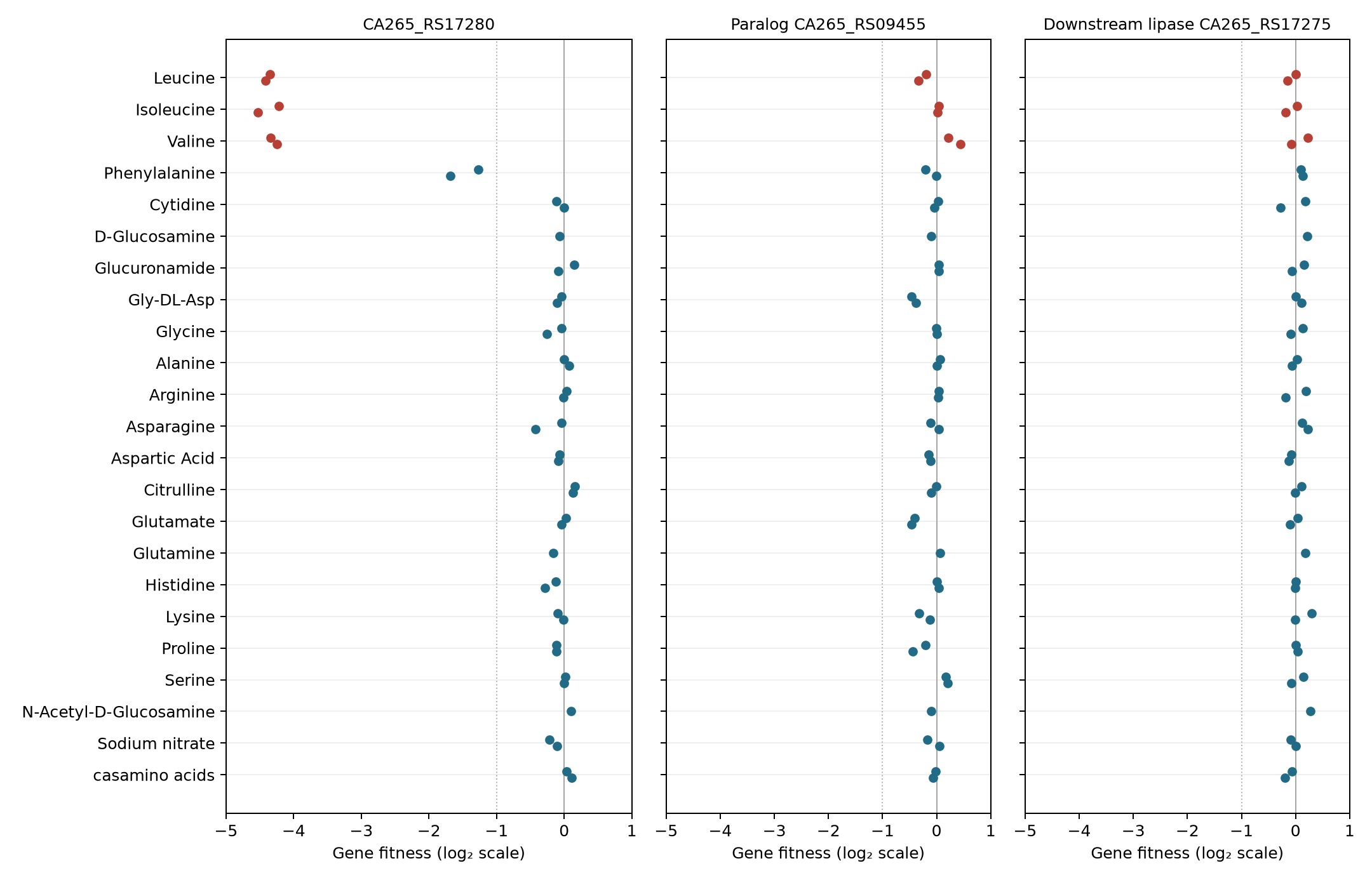
Figure 1. Each point shows the fitness estimate for mutants in one gene in one nitrogen-source assay. The 43 assays cover 23 substrate labels. Red points mark branched-chain amino acids. Slight vertical offsets separate repeated assays; the dotted line marks −1 for reference. All panels use the same scale. The paralog is a related gene in the same genome. The downstream lipase is a neighboring gene tested because an insertion can affect expression of the next gene.
To measure how specific each gene’s defect was, we subtracted its median fitness on the other nitrogen sources from its median on the three branched-chain amino acids. CA265_RS17280 had the most negative contrast of all 4,423 measured genes (−4.305). Removing the two phenylalanine assays from the comparison changed the contrast by 0.001 and left the rank unchanged. The gene also ranked first within each starting mixture separately (−4.30 and −4.34). All nitrogen assays began on 16 May 2017. The six branched-chain assays used 20 millimolar amino acid in a defined medium containing glucose; concentrations varied among the other nitrogen sources.
Insertion sites, neighboring genes and a related protein
Among usable mutants, 35 distinct insertion positions fell in the central 80% of CA265_RS17280. These formed 24 clusters when gaps greater than 10 bases separated clusters. In each branched-chain assay, 31–34 of the 35 positions had fitness below −1, and insertions in both orientations showed substantial defects. The median across positions ranged from −2.50 to −3.10 across assays. These simple medians and the Browser’s weighted gene estimates both show a pronounced disadvantage.
Insertions can suppress a neighboring gene farther along the same DNA strand. If suppressing that gene caused the defect, disrupting the neighbor directly should produce a similar loss. The next gene on the strand, CA265_RS17275, encodes a fat-splitting enzyme of the GDSL lipase family and lies 851 bases away. Its mutants had median fitness −0.039 on branched-chain amino acids. Mutants in the next gene, CA265_RS17270, which regulates transcription, were also spared. This makes suppression of a required downstream gene an unlikely explanation.
The short upstream gene CA265_RS17285 lies on the opposite strand. Its four central insertion positions showed a fitness gain on phenylalanine, the reverse of the defect in CA265_RS17280. Median fitness was +2.55 and +2.95 in the two starting mixtures, driven mainly by insertions in one orientation. Whether these insertions affect CA265_RS17280 expression is unknown.
The related gene CA265_RS09455 provides a comparison within the same genome. Its 65 central insertion positions showed no branched-chain amino acid requirement, yet mutants lost fitness under aluminum stress (median −3.62 in two assays). The same collection of mutants could therefore reveal a defect when the growth conditions changed.
Fitness during amino acid breakdown
The Browser flagged 26 genes for a condition-specific fitness change in at least one branched-chain assay. Only CA265_RS17280 appeared on the lists for all three amino acids; each of the other 25 appeared on just one. The leucine list included two enzymes that act on the carbon skeleton left after leucine loses its amino group: methylglutaconyl-CoA hydratase and hydroxymethylglutaryl-CoA lyase. CoA denotes coenzyme A, a carrier of carbon compounds during metabolism. Neither enzyme name contained the search terms used to identify candidate transport and metabolic genes by annotation.
Table 1. Median mutant fitness in two assays per nitrogen source. The catalog annotations give the proposed activities of the proteins compared with CA265_RS17280. Positive values mean the mutants gained ground in competition.
| Gene | Catalog annotation | Leucine | Isoleucine | Valine | Phenylalanine | Glycine | Nitrate |
|---|---|---|---|---|---|---|---|
| CA265_RS17280 | hypothetical protein | −4.38 | −4.37 | −4.29 | −1.48 | −0.14 | −0.16 |
| CA265_RS22650 | branched chain amino acid aminotransferase | −4.13 | −5.11 | −4.79 | −2.70 | −4.58 | −5.10 |
| CA265_RS15785 | branched-chain-amino-acid transaminase | +0.19 | −0.52 | +2.98 | +2.26 | +0.12 | −1.49 |
| CA265_RS03475 | glutamate dehydrogenase | −3.05 | −2.43 | −2.04 | +0.42 | +0.11 | −0.08 |
| CA265_RS13255 | leucine dehydrogenase | −0.25 | −0.19 | −0.73 | +0.44 | +0.52 | +0.13 |
| CA265_RS10640 | methylcrotonoyl-CoA carboxylase | −0.55 | +0.02 | +0.15 | −0.11 | +0.20 | +0.06 |
| CA265_RS09125 | methylglutaconyl-CoA hydratase | −0.89 | −0.10 | +0.01 | +0.11 | +0.57 | +0.25 |
| CA265_RS13115 | hydroxymethylglutaryl-CoA lyase | −1.36 | −0.08 | +0.19 | +0.09 | +0.38 | +0.29 |
| CA265_RS17575 | acyl-CoA dehydrogenase | +0.10 | +0.02 | +1.75 | +1.14 | +0.55 | +0.24 |
| CA265_RS17585 | acetyl-CoA acetyltransferase | +0.15 | −0.05 | +1.97 | +0.91 | +0.61 | +0.43 |
| CA265_RS17590 | 3-hydroxyacyl-CoA dehydrogenase | −0.00 | −0.05 | +2.17 | +0.94 | +0.49 | +0.20 |
| CA265_RS15000 | amino acid permease | −1.98 | −1.84 | +2.77 | +1.58 | +0.18 | −0.54 |
| CA265_RS18860 | alpha-ketoacid dehydrogenase subunit beta | unmeasured | unmeasured | unmeasured | unmeasured | unmeasured | unmeasured |
Disrupting three consecutive steps in leucine breakdown produced a defect specific to leucine among the branched-chain amino acids. In the two leucine assays, fitness was −0.54 and −0.55 for mutants in the first enzyme, methylcrotonoyl-CoA carboxylase; −0.70 and −1.09 for the hydratase; and −1.30 and −1.42 for the lyase. Mutants in all three genes had fitness near zero on isoleucine and valine. The leucine defects support a role for intracellular breakdown of its carbon skeleton beyond the ketoacid that remains when the amino group is removed.
On valine, disrupting three neighboring genes for enzymes that process carbon compounds bound to coenzyme A (CA265_RS17575, CA265_RS17585 and CA265_RS17590) conferred an advantage. Their median fitness values ranged from +1.75 to +2.17. Disrupting a possible amino acid transporter, the permease CA265_RS15000, also conferred an advantage on valine (+2.77), but reduced fitness on leucine, isoleucine and alanine (−1.98, −1.84 and −2.39, respectively). The permease is a candidate for a second transport route with a different set of substrates.
Genes involved in transferring or releasing nitrogen showed broader defects. Mutants in CA265_RS22650, which encodes an aminotransferase (an enzyme that transfers an amino group), lost fitness as strongly on glycine and nitrate as on branched-chain amino acids. Glutamate dehydrogenase (CA265_RS03475) ranked fourth by the branched-chain contrast (−2.45). Its mutants also lost fitness on alanine, aspartate, glutamate and proline (medians −2.97 to −1.99), whereas CA265_RS17280 mutants were largely spared on those substrates (−0.12 to +0.03). On phenylalanine the pattern reversed: glutamate dehydrogenase mutants retained fitness (+0.42), while CA265_RS17280 mutants lost it (−1.48). The broader dehydrogenase defect fits a shared route for nitrogen release: several amino acids transfer nitrogen to glutamate, from which the dehydrogenase releases it as ammonium.
Related proteins in other bacteria
For 14 related proteins in the Fitness Browser, none of the 47 fitness measurements with branched-chain amino acids as nitrogen sources fell below −1. All 14 proteins shared less than 30% amino acid sequence identity with CA265_RS17280. Eight more closely related Pedobacter proteins lacked fitness data on these nitrogen sources. Of the five for which neighboring genes could be identified, two retained the downstream lipase. A structure predicted by AlphaFold [3] for the matching protein sequence supports the assignment of CA265_RS17280 as a membrane protein.
Interpretation
The defect from disrupting CA265_RS17280 spans all three branched-chain amino acids, unlike the defects from disrupting leucine breakdown. Yet it is more specific than the defect in nitrogen release associated with glutamate dehydrogenase. The pattern fits a shared role in taking up or tolerating the amino acids better than a role in handling a breakdown product unique to one of them. The advantage of disrupting acyl-CoA metabolism on valine is consistent with a cost of valine breakdown, possibly from an intermediate. The fitness measurements identify neither that intermediate nor the rate at which cells process it.
Two other genes help explain why tolerating the supplied amino acids might matter. The next two most negative contrasts after CA265_RS17280 were for prephenate dehydrogenase (−3.19), an enzyme in tyrosine synthesis, and the (p)ppGpp synthetase/hydrolase (−2.49), an enzyme that makes and breaks down the nutrient-stress signals guanosine tetraphosphate and pentaphosphate. These defects are consistent with an imbalance among amino acids in the medium.
The assays show a competitive disadvantage across substrates and starting mixtures on a single date. None paired a branched-chain amino acid at 20 millimolar with ammonium to test whether the defect persisted with another nitrogen source available. In Pseudomonas putida, Schmidt and colleagues [4] helped distinguish uptake from handling breakdown products by comparing growth with branched-chain amino acids as carbon sources, with them as nitrogen sources, and with their ketoacids supplied directly. Only the nitrogen-source condition was measured here. Which substance the Pedobacter protein transports, and in which direction, remain open.
Methods
We used the public Fitness Browser database, protein catalog and indexed measurements of individual mutants for Pedobacter strain identifier Pedo557 [2]. We checked the source data on 13 November 2026 and recorded their web addresses and SHA-256 checksums (digital fingerprints of the files). We examined all 177 experiments and used the database’s nitrogen-source category to identify the 43 assays covering 23 substrate labels. We checked each assay’s substrate, medium, date and starting mixture and used the published gene-fitness estimates rather than recalculating them from sequencing counts.
The exploratory family comparison covered 202 measured proteins in four protein family groups labeled FUSC, ALMT, DUF1178 and DUF1643, with 23,783 fitness values and 13,508 condition summaries. Because the family comparison and the gene ranking used the same data, we report the rank descriptively without a confirmatory p-value. For each gene we subtracted its median fitness across the other 37 nitrogen assays from its median across the six branched-chain assays. We repeated the calculation after excluding phenylalanine and separately for each starting mixture. For individual substrates we report medians across assays.
We retrieved all indexed mutant-fitness measurements around CA265_RS17280 and its paralog. We used insertions the source marked as usable between 10% and 90% of each gene’s length. When several barcodes mapped to one position, we took their median fitness. We counted positions with fitness below −1 and summarized positions separately for each transposon orientation. The same genome annotation supplied gene order, strand and spacing.
To identify candidate genes by annotation, we searched terms for amino acid transport, aminotransferases, glutamate and leucine dehydrogenases, and ketoacid or acyl-CoA metabolism. We examined their complete nitrogen-source profiles, keeping missing measurements as missing. Independently, we retrieved every entry for the six branched-chain assays in the Browser’s SpecificPhenotype table, its list of condition-specific fitness changes. We counted distinct substrates per gene regardless of annotation or whether fitness rose or fell.
We compared protein sequences using the alignment program DIAMOND in ultra-sensitive mode, with no cap on the number of matches and an E-value (expected number of chance matches of that quality or better) of at most 10⁻⁵. For close relatives, we searched the UniProt protein catalog for Pedobacter entries annotated as YccS/FUSC. We required at least 40% identity across an alignment covering at least 80% of both proteins and a better match to CA265_RS17280 than to its paralog, as measured by the alignment bit score. This search covered proteins with the specified annotations. We located relatives in the European Nucleotide Archive by matching their translated sequences exactly, then identified annotated coding sequences within 5 kilobases. Before interpreting the AlphaFold structure, we checked its sequence against the protein in the fitness catalog.
References
- Price MN et al. (2018). Mutant phenotypes for thousands of bacterial genes of unknown function. Nature 557, 503–509. Article and supplementary information.
- Fitness Browser. Public fitness database, protein sequences, and Pedo557 strain-fitness measurements.
- AlphaFold Protein Structure Database. Prediction for A0A1X9Z8S1.
- Schmidt M et al. (2025). Engineering Pseudomonas putida for production of 3-hydroxyacids using hybrid type I polyketide synthases. Metabolic Engineering Communications 20, e00261. Full text.
- Van Dyk TK et al. (2004). Characterization of the Escherichia coli AaeAB efflux pump: a metabolic relief valve? Journal of Bacteriology 186, 7196–7204. Article.