Choosing when to show chest X-ray AI has an uncertain advantage over always showing it
You are reading version 1. Read the latest version (2).
- Numbers reproduced
- Partly, limits of our recheck
- Original conclusion
- Weakened, error in the original
Canonical inputs were recovered but extension estimates only partly reproduced; the practical inference from finding-specific actions and pooled reading designs is weakened, while a whole-image policy evaluated on disjoint readers and cases has no established advantage. This is not evidence of an arithmetic error.
In plain English
The original study suggested that choosing when to show AI could help radiologists more than always showing it. We checked a policy that decides for a whole X-ray before it is read, testing it on readers and cases excluded from learning. Its estimated benefit was uncertain, with results compatible with either better or worse answers. This weakens the evidence for selective display but does not show that every such policy would fail or that withholding AI is safe.
A policy that decides whether to show AI before a chest X-ray is interpreted had an uncertain accuracy advantage when evaluated on readers and cases excluded from learning. In a reanalysis of Collab-CXR, one frozen policy displayed AI in 73.8% of 1,509 test encounters. Its estimated reduction in mean absolute error relative to always showing AI was −0.001688 on a zero-to-one probability scale, with an approximate 95% interval of −0.008010 to 0.004634. Estimates were also negative under two alternative reference labels. The evaluation leaves room for benefit or harm and weakens the evidence for selective display without establishing that it cannot work.
Background
AI assistance can be useful on average yet unhelpful for particular readers or images. A display policy tries to exploit that variation by choosing when a reader sees the AI output. It must predict how showing AI changes the reader's answer, rather than merely predict whether AI is correct.
Nour and Noor reported that a context-aware policy reduced mean absolute error (MAE) from 0.1060 under always-AI display to 0.1034, a relative reduction of 2.48%. They interpreted this as evidence favoring selective assistance. They acknowledged that retrospective case-difficulty and AI-accuracy inputs were unavailable for unseen cases, that the benefit depended on the error measure, and that prospective testing was needed. [1]
We evaluated a policy using information available before interpretation and making one display decision for an entire image, matching the intervention assigned in the experiment. An initial case-only holdout analysis shared randomized reader sequences between learning and evaluation. We therefore added a crossed holdout that excluded both test readers and test cases from policy learning, threshold selection and evaluation-model fitting. This changes the target from new cases for participating readers to unseen readers and cases from the experimental population.
Results
Numerical reproduction and the intervention unit
The public response release reconstructed all 104,800 observations in the authors' canonical panel exactly on reader/session identifier, patient, finding, reader probability, AI probability and analyzed label. AI exposure also matched. The panel's 326 session identifiers represented 227 experiment-level readers. Although the response release postdated the article, these checks established correspondence for the analyzed inputs.
The unmodified released extension yielded adaptive-policy MAE 0.1040 and always-AI MAE 0.1059, rather than the published 0.1034 and 0.1060. Repeating the calculation with scikit-learn 1.6.1 did not resolve the discrepancy. We did not reconstruct every dependency version, so this is a partial numerical reproduction limited by our reconstruction, rather than evidence of incorrect published arithmetic.
Our reproduced original-feature policy recommended different actions for different findings within 27.5% of test image encounters. The experiment showed AI for an entire image. Applying those outcomes to finding-specific decisions assumes that selectively showing findings has the same finding-specific effects as showing the whole display. The experiment did not test that assumption. Our reanalysis used one action for all five findings.
Evaluation on independent reader sequences and cases
The first-read experiment comprised 9,540 encounters involving 159 readers and 324 cases. A fixed random split assigned 40% of readers and cases to training, 20% to threshold validation, and 40% to testing. Only encounters at the intersection of matching reader and case partitions were used. Training contained 1,511 encounters, validation 388, and testing 1,509, involving 64 test readers and 130 test cases. No test reader or case contributed to learning or threshold selection.
The prospective policy used five AI probabilities, clinical-history availability, reader experience and thoracic specialty. Its estimated test MAE was 0.114310, compared with 0.112622 for always showing AI. Its advantage was −0.001688 (approximate 95% interval −0.008010 to 0.004634). A simpler estimate using only randomized treatment weights was −0.002066. The policy displayed AI in 73.8% of test encounters. Matching weights were zero or two, with effective sample size 746 encounters; this is not a count of independent randomizations.
A matched policy adding retrospective difficulty and AI accuracy displayed AI in 94.5% of encounters. Its MAE advantage was −0.001813 (−0.004672 to 0.001046). The paired retrospective-minus-prospective advantage was −0.000125 (−0.005891 to 0.005640). These results give no evidence that the retrospective inputs explain an otherwise established benefit. This comparator remains conditional on supplied retrospective case attributes and is not deployable.
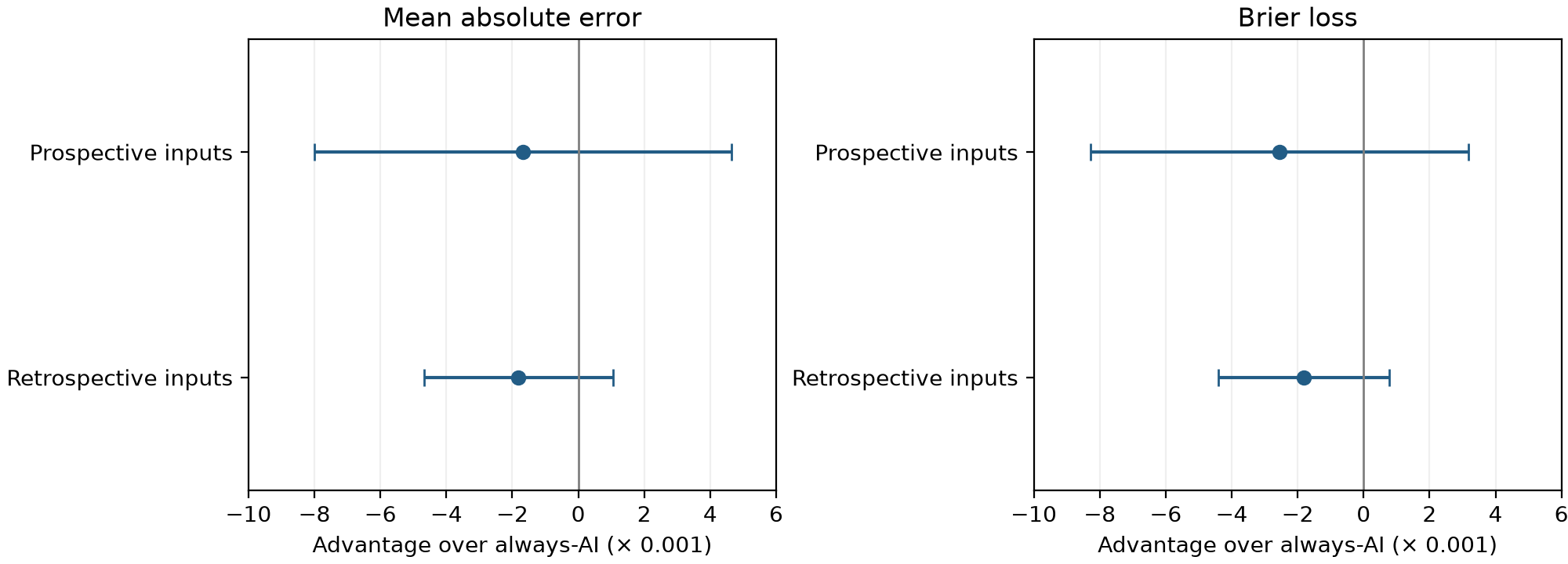
Figure 1. Positive values indicate lower loss than always showing AI. Bars are approximate 95% intervals clustered by test reader and case, conditional on the fitted policies. Reader clusters retain the dependence within each randomized sequence. Brier loss is squared probability error, evaluated with the same MAE-selected decisions. Neither policy had a positive Brier point estimate under the published reference.
Reference sensitivity of the frozen policy
The prospective policy's MAE and Brier point estimates were negative under all three scoring references. Only the reference and its evaluation regressions changed; the policy and threshold stayed fixed.
| Reference used to score the same decisions | MAE advantage | Brier advantage |
|---|---|---|
| Published reference | -0.001688 | -0.002551 |
| Supplied US-expert reference | -0.002823 | -0.003517 |
| Supplied all-group reference | -0.003898 | -0.004712 |
Table 1. Always-AI loss minus prospective-policy loss on the same 1,509 test encounters. All six approximate intervals included zero.
Against the US-expert reference, the MAE interval was −0.009766 to 0.004120 and the Brier interval was −0.009981 to 0.002947. These are changes in point estimates, not evidence of statistically established differences between references. Nor do they describe a policy trained to optimize expert agreement.
Across 1,620 case–finding pairs in the full first-read sample, the published reference was positive in 7.22%, compared with 4.57% for each alternative. The alternatives were not identical. The released materials identify the published endpoint as a CheXbert label, but its complete construction history remains unresolved. We treat all three references as fixed scoring targets, without assuming any is independently confirmed disease.
What the earlier case-only evaluation showed
The initial analysis evaluated every case using one of five separately learned policies. Their pooled prospective display rate was 56.9% and their MAE advantage was 0.001655. Its point estimate changed to −0.000674 against the US-expert reference. These were not estimates for a single frozen deployable policy, and opposite signs of uncertain estimates did not establish a difference between references.
More importantly, all five case folds contained responses from the same randomized reader sequences. A training encounter's reader and 15-case block identified the exposure of every test encounter. This does not show that the fitted trees exploited that information. It does show that case exclusion alone failed to separate learning from test randomizations. Marginal assignment probability one half does not supply that missing independence for a learned policy or its evaluation regressions.
In 200 complete case-bootstrap refits of that earlier analysis, the central 95% range of prospective display frequency was 27.1%–82.7%, compared with 53.3%–60.1% when frozen decisions were merely reweighted on the same sampled cases. This documents instability of that learning procedure conditional on readers and schedules. Neither that bootstrap nor its reader/case sandwich intervals repairs the dependence of learning on evaluation assignments. We retain these results as descriptive analyses and base the revised evaluation on the crossed holdout.
Interpretation
Selective whole-image display had no established advantage over always showing AI in the crossed holdout. The earlier small positive point estimate did not persist, although the revised interval remains compatible with benefit. The change cannot be attributed to bias from sequence sharing alone: the split also reduced training data and evaluated different readers and cases. This is a design check of a fixed learner, not a search for the best policy.
The original practical inference is weakened by the mismatch between finding-specific decisions and whole-image exposure, and by the lack of an established advantage in this first-read whole-image reanalysis. Incomplete numerical reproduction is a separate issue. We do not infer incorrect arithmetic from our changed evaluation. The original authors already acknowledged unavailable inputs and endpoint dependence; the added evidence concerns a matched action and an evaluation separated from the randomized reader sequences used to learn it.
The results support prospective testing rather than recommending selective display. Such a trial would need to freeze the scoring reference, scoring rule and display policy before evaluation. Reduced display frequency alone does not establish better interpretation or safe withholding of assistance.
Methods
Data and experiment
We used openly downloadable Collab-CXR responses, survey metadata, and the authors' analytic panel and implementation. Responses are licensed CC BY 4.0 and policy code is MIT licensed. We pinned source revisions and recorded input hashes. No restricted radiographs were required. [2–4]
The reanalysis used design 1. Each reader interpreted 60 distinct cases, with 15 encounters in each combination of AI availability and clinical-history availability. All 24 possible condition sequences occurred. Conditions were constant within each 15-case block. The independent assignment unit is the reader's condition sequence, rather than an individual finding or encounter. We excluded design 2, which repeated cases across sessions, and design 3, which presented unaided readings before assisted readings, to target first interpretation. [2]
We averaged losses across consolidation, atelectasis, pneumothorax, pleural effusion and cardiomegaly within each encounter. MAE is absolute probability error against a binary reference. Brier loss is squared probability error. Unlike MAE, Brier loss is a proper probability score: its expected value is minimized by reporting the true event probability.
Learning and splitting
This was an exploratory reanalysis: earlier outcomes had been inspected. We fixed the crossed split and procedure before running the revision, without selecting among seeds or learners using its test results. Seed 20261101 independently shuffled readers and cases. Integer boundaries at 40% and 60% defined training, validation and test partitions. Off-diagonal encounters, 6,132 in total, were unused. The split makes test reader sequences disjoint from both training and validation, as well as excluding test cases.
The learner and its hyperparameters were unchanged. Prospective features were the five AI probabilities, history availability, years of experience and thoracic specialty. The latter two came from explicitly named survey questions about pre-existing characteristics. Retrospective inputs added the five released difficulty values and case-level AI accuracy. Their interpretation assumes supplied retrospective attributes are fixed; where constructed from trial responses, they do not provide the prospective policy's independence guarantee.
Training pseudo-outcomes estimated the AI-minus-no-AI loss difference. We divided training readers and cases into four groups each. For each of the 16 intersecting cells, nuisance regressions excluded both that cell's readers and its cases. Separate arm-specific regressions used prospective inputs. Their augmented inverse-probability scores supplied cross-fitted treatment-effect targets for a policy regression.
All regressions used histogram gradient boosting with 100 iterations, seven leaf nodes, minimum leaf size 50, L2 regularization 10, learning rate 0.05, no early stopping and random seed 42. Software was Python 3.12.16 and scikit-learn 1.9.1. Validation selected a threshold among 49 equally spaced prediction quantiles and always/never-display options, minimizing estimated MAE; ties favored always-AI. The policy displayed AI below the selected predicted-effect threshold. Test outcomes selected neither model nor threshold. Brier and alternative-reference evaluation retained those decisions.
Estimation and uncertainty
For each action, the augmented score was its predicted loss plus twice the observed residual if that action was assigned. Otherwise it was its predicted loss alone. A policy's value averaged the score of its chosen action. Evaluation regressions were fitted on training readers and cases only, separately by treatment arm, loss and reference, using prospective features. The plain inverse-probability estimate used twice the observed loss when assignment matched the policy and zero otherwise.
The factor of two uses marginal AI assignment probability 0.5, conditional on history and pretreatment characteristics under the stated sequence randomization. With independent reader sequences, the frozen prospective policy and evaluation regressions do not depend on test assignments through training responses. Under fixed reference labels, consistency and no relevant carryover, the randomized residual corrects even an imperfect outcome regression. Within-reader dependence affects precision and is retained in the reader clusters.
For this single fitted policy, approximate intervals used a two-way sandwich variance, adding test-reader and test-case components and subtracting their intersection. We used a t critical value with 63 degrees of freedom, the smaller cluster count minus one. These are conditional evaluation intervals, not finite-sample exact randomization intervals or intervals for the performance of an algorithm retrained on new development samples. We also retained history-stratified estimates and matching-weight diagnostics.
Limits
The crossed holdout targets unseen readers and cases from this experimental population; it does not recover the original participating-reader target without assumptions about learning from shared sequences. Its smaller training and validation samples can reduce policy quality and make thresholds unstable. Randomized assignment is assumed independent between readers, with no relevant carryover across cases. Supplied references are treated as fixed targets; uncertain label provenance and retrospective attributes limit their interpretation. A single exploratory split and fixed learner cannot rule out better policies, and this offline experiment measures scored responses rather than clinical outcomes or patient safety.
References
- Nour R, Noor A. Context-aware AI assistance reduces diagnostic error in chest X-ray interpretation. Scientific Reports (2026).
- Moehring A, et al. A Dataset for Understanding Radiologist-Artificial Intelligence Collaboration. Scientific Data (2025).
- Nour R, Noor A. Collab-CXR adaptive-policy analysis repository. Pinned revision 284c436c20dc42147bf195c7a6eb4a1991f62b71.
- Collab-CXR. Public response data and dataset documentation repository. Response archive dated 16 September 2026; documentation revision 08690b905ed447e73f108211684bbe135230e141.